3 - Divination
Finding Things Out
The Word "witch" comes from the same Anglo-Saxon root as "wit" and "wise," and in its original form Wicce or Wicca meant "a knowledgeable person" or "wise man." The knowledge in question was arcane and generally forbidden by the religious or civil authorities.
Any form of consultation of a witch by a layman was and still is always begun by an occult diagnosis of the situation inquired about, prior to any action being taken. "Finding things out" is therefore of the same primary importance to the modern witch as to her Dark Age counterpart. Nowadays there are many such methods of magical diagnosis extant, ranging from elaborate ceremonial Tarot divinations to numerological analysis or simple teacup reading. But the true methods of divination as practised by the traditional witch still remain relatively unknown, and it is with these that I shall be concerning myself in these pages.
To the aware witch, time is not a continuous ribbon passing under the keys of some celestial typewriter, but rather a complex field extending into many different directions and dimensions. Given that view of time, that a man should possess a definite future as concrete as his past and present, albeit unseen for the most part, will not strike a witch in any way as odd or unrealistic. The whole process of divination of the future rests on this approach to an understanding of the true nature of time. Paradoxically, although the future is already "out there," the witch does not feel that her actions are already doomed to one simple course by rigid predestination. The nearest approach to an explanation would be to say that each one of us, at every moment of time, confronts a series of different choices in action. One of these ways we will take, for whatever reasons. That way as well as others is already "out there."
However, be that as it may, we still have a control over our choice of actions. We can make the destiny "out there" become a good one or a bad one, depending on our varied talents, opportunities, and, of course, choices. When a witch talented in the arts of prophecy or divination predicts a destiny for someone, she will, however, be basing it solely on a reading of the deep mind of her client. She will be reading the strongest marked "possible future" of her client at that present moment. This does not mean that there are no other possible futures, but that the one she perceives is the most likely one from the point of view of the moment of time she is prophesying in. If she is an expert diviner, she will be reading her client's deep mind at its most profound and basic level, which contains the firmest "guidelines" to its own future. But even these are still open to choices and different interpretations, depending on the will and inclination of the person concerned and whether he becomes sufficiently aware of where his nose is leading him—of his karma, if you will.
At this point it would be germane to mention the subject of curses and blessings inflicted by witches on people. In view of the preceding, you will see that when you as a witch inflict your will magically on someone, what in effect you are doing is throwing the weight of your witch power into the balance of a person's choice of future, and thus guiding his selection in favour of one direction as opposed to a set of others. This, of course, can be effected only through a contact with his deep mind, the place where the mysterious choices are made, hence the whole rigmarole of the magical operation.
But remember, and this is an important thing to bear in mind at all times, should your victim or client prove to be an extremely highly motivated person, with the guidelines to his actions strongly dictated from a great depth within his deep mind, or if he in fact is a powerful warlock, which is tantamount to the same thing, then the likelihood of your persuading his deep mind to accept anything other than its own selected destiny is going to be slim indeed. Not only is any spell you cast going to affect him in no wise, but the magical current you set in motion by your action will recoil on you as the sender and probably expend its energy on your own deep mind!
This is the eternal danger in malefic witchcraft, to be hoist on one's own petard; but we shall speak more of this later in Chapters 5 and 6 which deal solely with the problems of countermagic and magical attack.
However, to return to our topic of divination, we shall start with one of the first, simple rules of practical witchcraft:
Before embarking on any magical operation, perform a divination (a) to diagnose the true nature of the situation, and/or (b) to determine the likelihood of success of the particular magical operation you have decided to employ. There is no point, and indeed no future, in employing a blast of countermagic against some imaginary enemy when in fact a relatively simple amulet of beneficence may be all that is required. We must know what we are at—hence divination.
Now in magic and witchcraft, the operations of divination have always been conducted by means of contact with a power which is symbolized by the astrological symbol of Mercury. The Greeks called this power Hermes, the Egyptians Thoth, the Scandinavians Odin, the early Anglo-Saxons Woden. This power has generally been connected with the starry sky, the air, storm winds, and also the crossroads. Indeed in the voodoo pantheon the power of Mercury is often known at Maitre Carrefour or Master of the Gross-roads. He is the great mediator between the worlds and is also known as Psychopompos or Guide of Souls. The Saxons knew him by the name "Earendel, the Morning Star." The witch knows him by the name "Herne."
Before beginning any divination, it is always important for the witch to bring her deep mind into contact with Mercury; to tune into his waveband if you wish, whether the divination be performed by means of the relatively rudimentary entities governing the rune sticks, or by questioning a highly sophisticated entity such as Vassago in a show stone.
There are several methods of doing this, ranging from simply meditating upon one of the classical magical images of the winged Mercury to the full ceremonial rite of invocation. To my way of thinking, none of the methods are as aesthetically satisfying or successful as the use of the magical square of Mercury which, although Cabalistic in its origin, is truly witchy in the manner of its employment. Here it is:
| The Square Of Mercury | |||||||
| 8 | 58 | 59 | 5 | 4 | 62 | 63 | 1 |
| 49 | 15 | 14 | 52 | 53 | 11 | 10 | 56 |
| 41 | 23 | 22 | 44 | 48 | 19 | 18 | 45 |
| 32 | 34 | 38 | 29 | 25 | 35 | 39 | 28 |
| 40 | 26 | 27 | 37 | 36 | 30 | 31 | 33 |
| 17 | 47 | 46 | 20 | 21 | 43 | 42 | 24 |
| 9 | 55 | 54 | 12 | 13 | 51 | 50 | 16 |
| 64 | 2 | 3 | 61 | 60 | 6 | 7 | 57 |
As a matter of interest, one of the characteristics of magic squares, which is known to most mathematicians, is that the numbers in each line, vertical or horizontal, add up to the same total. In this case, 260. Now you may well ask what all this has to dp with Mercury? Well, you can think of magic squares as being signaling devices, types of psychic telephone numbers to the unseen. The way of using the Square of Mercury before any divination is this:
Take a blank sheet of white paper, and exorcise it with salt water and a Mercurial incense such as you will find listed under the heading "Herbs and Incenses." Having done this, draw a square with sixty-four compartments as shown above with your pen and ink of art. Now carefully and deliberately inscribe the numbers in the square as illustrated, in their correct numerical order, 1, 2, 3, 4, onwards, ending with 64. As you write each number, repeat a short invocation to Mercury of your own devising, such as "Mercury, be propitious to me," or "Herne, Lord of the Crossroads, Guide of the Dead," "Earende, the Morning Star" or even a string of his names from various pantheons like, "Mercury— Hermes—Odin—Thoth." Whichever you prefer.
The only important thing to remember is that the charm should summon up a mental image in your mind which in some way strikes your fancy and links the work in hand with an idea concerning Mercury, such as wisdom, speed, starlight, the air, a crossroads at night, or even one of the classical images of Mercury. It might be as well to consult a book of mythology at this point to acquaint yourself with some of Mercury's traditional forms and attributes.
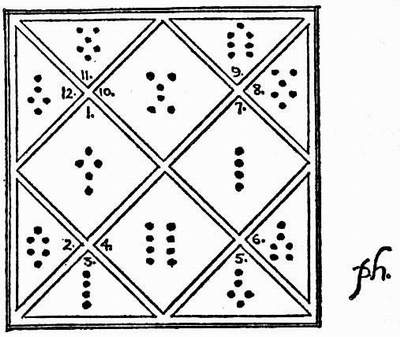
Sample of rune divination showing placement on a horoscope chart
When you reach the number 64, finish by "sealing" the talisman with the words "So mote it be," and drawing three crosses in the air with your right forefinger above the paper. (This is a very old method of sealing, or benediction, which was appropriated by the Christian church from their pagan forebears.) Now your square of Mercury will be charged and your deep mind fully attuned to the correct range of vibrations for the divination, which must be performed with the square kept either on your person or prominently displayed in your place of work.
Once you have made a square, whenever you wish to perform a divination, all that is necessary to do is to hold the square in your hands, and let your gaze fall upon the numbers one by one in their proper sequence, repeating your mantram at each number. No sealing is necessary at the end, however; you may begin the divination immediately. Keep your completed square in a new box or wrapped in a clean linen or silk cloth, as with your other magical artifacts; you will be constantly using it.
I shall now move on to a simple type of witch divination, which you as a beginner would be well advised to learn. The operation is known by the name of Casting the Runes.
Divination by rune sticks is one of the most ancient and celebrated witch methods of prognostication we have. The process dates back certainly to Druidic times and probably before. It is a very good example of a method of augury, that is, prediction or knowledge gained by signs and omens, as opposed to that of the inner vision as employed when scrying in a show stone or mirror.
Basically the rune sticks consist of four flat slats of fruit-wood—apple, pear, cherry, plum, hazel, rowan, or any other wood if you cannot obtain these. But they must be wood. They should be about five inches in length by about a quarter to a half inch in width. Finish off the rough edges and make the rods smooth and comfortable to the touch. Sprinkle them with salt and water and fumigate with a Mercurial incense within a properly cast circle. Now, using your brush and paint of art, make a large and obvious dot on one side of each of them, centrally located. When the paint has dried, turn the rods over and make two large dots on the other side of them, spaced so that the gaps between the dots themselves and the ends of the rod are all equal, in fact, so that the rods are marked into three equal segments by two dots.
These are your rune sticks. You should carry them about with you for a period of time before you use them to charge them with your magnetism, or witch power.
Now the method of their employment is this:
Provide yourself with some pieces of clean paper, your pen and ink of art, a good supply of Mercurial incense, your square of Mercury, a flat-surfaced table, your thurible and your cup of salt and water. Lock all the doors and means of access to your place of working, and if there is any chance of being overlooked through a window, make sure the drapes are drawn. Then purify the chamber with fire and water as you were taught in an earlier chapter, using your Mercurial incense.
Begin with the square of Mercury ritual to tune your deep mind to the correct level. At this point, write out your question on the paper provided with the pen of art. Then take the rune sticks in your right hand and cast them so they tumble away from you in parallel formation on the table. Say as you do so:
In thy name Herne
Lord of the Crossroads,
I take up the runes;
From a word to a word
let me be led to a word
from a deed to another deed.
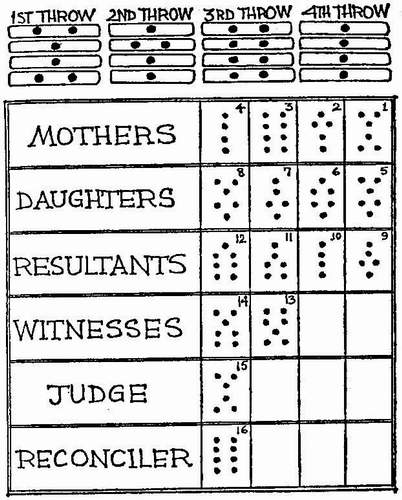
Throw the rods three more times in the same manner, repeating the spell, and note down all the figures formed by the rods on your paper underneath the question beginning at the right-hand comer and going left. Right to left, remember.
Now take the top dot or dots from the first (right) figure, note them down on the right-hand side underneath; then take the top dots or dot of the second figure to the left and note them down under your new set. The top dots or dot of the third figure to the left and those of the fourth complete the third and fourth line of your new figure. In effect, you will have skimmed off the top layer of dots of your four figures and made a new figure from them. Now do the same with your second, third, and bottom levels of dots belonging to your four primary figures (or mothers, as they are known). This will give you four new figures (known as daughters).
Now write out the eight figures again side by side, right to left beginning with the first mother and ending with the last daughter. We will now compose our last four figures, the Resultants. These are produced by adding the dots laterally of the first and second figures, the third to the fourth, the fifth to the sixth and so on across the eight.
Now the method of adding the dots is thus:
If the total number of dots is an odd number, you note down a single dot. On the other hand if the total number is an even one, we note down two dots. By this process the four resultants are manufactured, which along with the mothers and daughters, make twelve figures in all.
Now to the four resultants, you apply the same process again, laterally adding the dots of the ninth and tenth figures, then the eleventh and twelfth. This produces the two witnesses, figures 13 and 14, which are likewise added laterally to produce the judge, figure 15. Figure 15 is then added laterally to the first mother to produce the reconciler, figure 16.
This process appears vastly complicated on the surface, but in point of fact is extremely easy once you get the hang of the binary addition, which is, in fact, what the process is based on. After a minimal amount of practice you will be able to set up a chart in no time at all.
Now as to the interpretation of the figures:
Basically, the two witnesses symbolize either two main factors bearing upon the problem or a choice of two possible courses of action. The judge, being a synthesis of the whole, indicates the nature of the problem itself, and the reconciler indicates the nature of what will be the final long-term outcome. Now according to the way your question has been phrased, so will the answer be capable of interpretation. So it pays to be very specific about your question in the first place.
There are some modern witches who like to place the first twelve figures within the houses of a horoscope chart. For some people it can work quite well. I myself have never found it to be particularly satisfactory, however.
Anyway here is the method should you wish to try it:
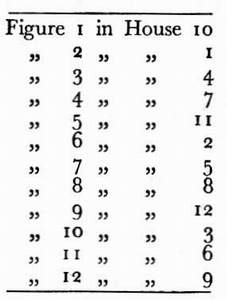
The interpretations are according to the astrological ruling of the house. For instance, house 1 refers to the querent, house 2 to money matters, house 3 to news and journeys, and so on.
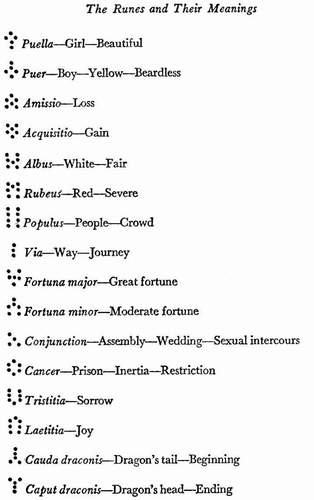
The following chart provides a simple and accessible interpretation of the runes and their meanings.
The actual symbols used in this divination system are also shared by that of the fifteenth-century wizard Cornelius Agrippa, geomancy, so-called. This involves the use of a tray of sand to construct the figures as opposed to a set of rods. The principle, however, remains the same, the idea of heaven leaving its impress upon the earth being implicit therein.
The Pendulum
Another device frequently resorted to by witches to "find things out" is the dowser, or water witch's pendulum. This device is exactly what it purports to be, namely, a weight attached to a piece of twine. The advantage of its use over that of other divination devices such as the rune sticks is the fact that it needs very little ritual preparation and its use is extremely simple. The disadvantage, however, lies in the fact that the answers it gives to questions are restricted to a solely "yes" and "no" basis. Often, however, this suffices, so for that reason I am including the pendulum here.
The traditional witch manner of making a pendulum is this:
Obtain a lodestone or, failing that, a small steel magnet and some strong twine about nine inches in length. Now, making sure the lodestone is free of dust adhering to it, or the steel magnet free from any grease, glue one end of the twine to it with a drop of strong plastic household adhesive which binds metal. When this is dry, sprinkle the pendulum with salt water, and cense it with an incense composed of wormwood herb (also called mugwort, artemesia, or southernwood) and a few grains of mastic.
Now in order to employ your pendulum, you must either hold the thread firmly between the finger and thumb of your right hand (your left if you are left-handed) and let it hang free, keeping your elbow out, away from your body or, alternatively, tie the free end of the twine onto the middle of a short stick or pencil, and holding one end of the stick lightly in each hand, rest your elbows on a table so that the pendulum dangles free between them. You may now either ask the pendulum questions with a "yes" or "no" answer or, alternatively, you may write the question down on a piece of paper and place it so that the pendulum can swing freely over it. If the pendulum swings to and fro, toward and away from you, the answer is "yes." If it swings sideways, however, the answer is "no."
Instead of the written question, you may also use a photograph of someone about whom you wish to find out something, asking the question in the same manner.
Some witches also use the pendulum to "dowse" by, that is to discover hidden water, oil, or buried minerals and lost articles. Here the pendulum should be held over a large-scale map of the suspected territory, and used to "explore" it until an affirmative answer is given. Then the pendulum is taken to the place indicated on the map, and using it, the witch then narrows her search down to the actual spot where the sought-after item or items are to be located. The latter process is, however, fairly advanced work. The beginner witch should only concern herself with obtaining 1 simple divinations by using it. Generally speaking, divinations will always go better if you use your square of Mercury first. The pendulum is no exception to the rule, although owing to the extreme simplicity of the divination, many witches feel they can do without any form of Mercurial orientation.
The Wand of Divination
The wand, or staff, is the magical instrument which is par excellence emblematic of the powers of divination or prophecy. The staff of the prophet, the divining rod of the water witch, or dowser (as opposed to the pendulum), and the wand of the necromancer are all variations on the same theme. In the witch processes that I enumerate here, a wand or wands in the plural all play a primary part. The rod is obviously a phallic emblem and has always been associated with divine wisdom whether it is presented in the Tibetan pantheon as a Dorji or thunderbolt sceptre or as the classical Mercury's winged rod, the Caduceus. All the legendary wizards from Biblical times on have carried rods wherein their powers were often vested. Jannes and Jambres of the Egyptians, Moses, Aaron and Elijah, Merlin, Virgilius, Roger Bacon: the list is extensive. Apart from its phallic connotations, the wand is also a pointer, or indicator, a flying arrow in the case of the Greek Abaris, again connected with occult methods of "finding things out."
Witches employ two different types of wands in their rituals: the riding staff—in the past often disguised as the legendary broomstick—used in fertility rites and the smaller Goetic rod, sometimes referred to as the verendum or baculum, which is used in the questioning of intelligences during divination. Often the riding staff will be carved with a phallic tip to it. The baculum usually is of a more Cabalistic composition, often engraved with Hebraic divine names.
However, as often as not, the two rods are combined as one by many witches, and the burning need to disguise the phallic tip as a besom has surely well passed now. The rod of divination can range from one to anything up to six feet in length; from the elbow to the tip of the longest finger of the hand is often considered the ideal length. It should be made from ebony or a fruitwood of some sort, preferably hazel or almond, straight and of one year's growth if possible, but this latter requirement is not absolutely necessary If you cut the branch yourself, try to do it on a Wednesday when the moon is waxing, at or around midnight, sunrise, midday, or sunset, for these are the times when the occult tides are at their most powerful. Use your Athame to sever the branch, mentally affirming your intention as you do so, that is, "to compose a wand of divination." If you are unable to sever the wood yourself but have to purchase it, never mind; the real value is imparted with the consecration which follows. This has to be performed on a Wednesday, again when the moon is waxing, at one of the four quarters of the day—midnight, sunrise, noon, or sunset.
First you must cast and purify your circle, kindling a suitable Mercurial incense in your thurible; perform the square of Mercury rite as an introduction. Then trim the wood of all twigs and excrescences with your Athame and peel the bark off, keeping your intention firmly in mind, repeating a jingle to concentrate your attention on the task in hand, such as, "Blessed be thou rod of power, rod of wisdom," and keeping in mind the Mercurial images of speed and air and flight as you did in your square of Mercury.
When you have made the wand as smooth as you can, you may shape the end in a phallic manner (which is traditional), or leave it plain and unadorned, with the sexual symbolism implicit rather than explicit; the choice is yours.
Then, with the point of your Athame, engrave the following runes upon the wand, working from right to left, and continuing to repeat your charm with each figure. When you have finished, ink or paint in the etched figures with your materials of art, always repeating the jingle either audibly or mentally. Should you wish to mix in any dried and powdered Mercurial herbs with the ink or paint before applying, this can be a very effective way of reinforcing the potency of the rod. Finally, fumigate the wand again in the incense smoke (do not asperge it; this would only demagnetize it and nullify all your previous effort!) and seal it with the triple cross and the injunction "So mote it be," as in the square of Mercury consecration. Either keep your completed wand in a new box of its own or wrap it in linen or silk. In all the following rituals of intelligence you will have cause to use it, whether they be those of seeing stone or mirror, necromancy, or triangle of manifestation. (See page 52 for the Wand Runes.)
The Magical Lamps
At this point, it would be a good time to mention some important artifacts, which you will need, often improvised the last minute, but in actuality as needful of proper preparation and consecration as your Athame or wand. The are the candlesticks or lamps of art. Quite apart from magical significance of light itself in your witchcraft, the is the very practical necessity of being able to read you workbook of art within the circle, should you need to use long, unlearnable conjurations riddled with complicated words of power. The candlesticks are simply made. If you aren't handy with woodcarving or don't have access to a potter's wheel, buy without bargaining (most important, this) as many candlesticks as you feel you may need in your rituals. Some witches like to place one at each cardinal point of the circle and one on the table of practice in the centre, making five in all. Or if the ritual be one involving a seeing stone or speculum, you will need two or three lights on the table, which in addition to the four cardinal points will make seven or eight in all. Usually, however, the cardinal point lights are used only at full ceremonial coven rituals and are generally common property of the group.
For the individual witch, two candlesticks are quite sufficient. Should you wish to make the candlesticks, as opposed to buying them, you must first exorcise your raw materials whether they be clay, wood, or metal by fire and water in a properly cast circle. As this work pertains to the nature of illumination and the operations of light, it is best performed on a Sunday, the day of the sun, preferably around noon, Having cast your circle at the requisite time and lit a solary incense, purify your materials or newly purchased candlesticks (which may be made of any material you choose). Then formulate in your imagination the brilliant, burning light of the noonday sun, and repeating a blessing with each rune such as "Blessed be thou, creature of light," paint the following characters with your materials of art, right to left as usual. When finished, seal them with the triple cross and "So mote it be," and store in your safe place till you need them.
Always use exorcised white candles in them during your rituals, unless otherwise directed. (See page 52 for Candlestick Runes.)
The Show Stone and the Magic Mirror
Consecrated globes of crystal or glass, otherwise known as scrying, seeing, or show stones, have been used from time immemorial by witches in the development of clear seeing and the questioning of spirit entities. In the past they were made of quartz or beryl but with the development of high-quality optical glass, natural crystal has passed out of use as being too expensive for the average witch. Or, if a show stone, be it glass or crystal, was too difficult or expensive to obtain, a witch would resort to a magical mirror, or speculum, which is economical to make and every bit as effective as the former.
Whether you, as a beginner witch, choose to use one or another of these items, what you will need is a black cloth or board to cover your table of practice, with a triangle of manifestation either painted on in white or stitched on in white tape. The triangle's sides should each measure about twelve inches. The triangle is a very old witch symbol, and represents the crystallization of form out of chaos. You will find it employed throughout witchcraft whenever some type of physical or magnetic manifestation is required.
Some Cabalistically inclined witches surround the triangle with a double circle, and between the two circles they inscribe the names and seals of the seven planetary angels and the demon kings of the four quarters of the earth, while others seek to enhance the potency of the figure by fortifying the sides of the triangle with the Hebraic divine names— Primeumaton, Anaphaxeton, Tetragrammaton—and placing the name of Michael, leader of the heavenly host, within; but none of these things is strictly necessary.
All you basically need is the triangle prepared with intention which is accomplished, as with your other magical tools, by exorcising and consecrating your materials with fire and water (using a Mercurial incense) in a properly cast circle on a Wednesday. Then, go to work using a charm to state your intention such as "Blessed be thou, focus of power," again, as with all your other artifacts. Finally, cense and seal with the triple cross.
At the same time that you make the triangle, you can also manufacture the pedestal for the show stone. This you may make simply from a square slab of exorcised wood, say six inches by one inch, depending on the size of your crystal. Make a slight rounded hollow in the centre to contain the show stone and prevent it from rolling off. It should be stained or painted black with an exorcised paint in which finely powdered wormwood herb is mixed. All the time you work on it, you should continue the use of the mantram that you evolved for the triangle. Many witches surround this pedestal with the names of the four Cabalistic archangels: Michael, Gabriel, Raphael, Uriel, or their symbolic representatives, the zodiacal signs of Leo, Scorpio, Aquarius, and Taurus. Again, however, this is not strictly necessary, merely a matter of personal preference.
Finally, wash the show stone itself in an infusion of wormwood, place it on its stand when dry, and cense and seal them both.
Should you, however, wish to make a speculum, or mirror, instead of buying a crystal, obtain a concave clock glass or chemical watch glass. Using the same formula that you composed your triangle by, exorcise and consecrate the clock glass. Then paint the convex side with two good coats of black enamel and wormwood. Hollow out a piece of wood in the manner suggested for a show-stone pedestal, stain or paint it black with wormwood paint, and glue in the black mirror, curved side inwards. Cense and seal.
This is your speculum, which may be used in exactly the same way as the crystal. Both the mirror and the show stone should be kept wrapped in a black cloth, preferably silk, when not in use.
The Pentacle of Protection
Now you have all the instruments except one that you will need for the greater forms of divination. That last implement is the pentacle, which it is advisable to wear during any ritual involving conjuration, bar none, whether it be a sending or a divination. Should the power raised by the formulae "short" and rebound upon you as the operator, or in any way go awry, the pentacle of protection will be your only means of "earthing" the force if it is one which has been raised via the deep mind of the operator himself and, as such, is not subject to the restricting power of the boundary circle, which limits the activities of any alien or invading entities. Cautious practitioners don the pentacle for all magical operations, even rudimentary ones of casting the runes or a simple love spell. For instructions regarding the making of your pentacle, see Chapter 5 which deals with the important matter of countermagic and protection.
The Conjuration of Vassago
Having now assembled the primary instruments of the greater divinations, you are ready to perform one such operation yourself. There are basically two varieties of these, one being the conjuration and communication with nonhuman entities, and the other dealing with the spirits or shades of the dead, necromancy so-called, or sometimes sciomancy. You will occasionally find that some witches tend to make the distinction between the two terms in that sciomancy, they claim, involving some relic of the defunct person summoned, an object link of some type, be it a lock of hair, bloodspot, or some personal belonging, attempts the evocation of the shade or ghost of the dead person, which is confined to visible appearance.
Necromancy, on the other hand, they argue, implies the reanimation of a recently defunct corpse, as in the legendary operation performed by Thessalian Erichtho at the request of Sextus, son of Pompey. This distinction, however, is merely scholarly, and the majority of witches use the term "necromancy" to refer to the operation which the pedants label sciomancy, namely, the evocation, of the shades, such as was attempted by Eliphas Levi in the nineteenth century. The corpse-reanimation method is very rarely, if ever, attempted these days, for obvious reasons.
Necromancy does not call for the use of your show stone, but rather a triangle of manifestation, so I shall leave that process till last, and deal with the conjuration of nonhuman entities first. The entity summoned for questioning par excellence is one that has been a favourite among witches from time immemorial, and is known by the name "Vassago." He is numbered among the seventy-two demonic intelligences in that medieval grimoire, the Lemegeton, or Lesser Key of Solomon; and Wierus, Cornelius Agrippa's pupil, also mentions him in his Pseudomonarchia Demonorum.
----
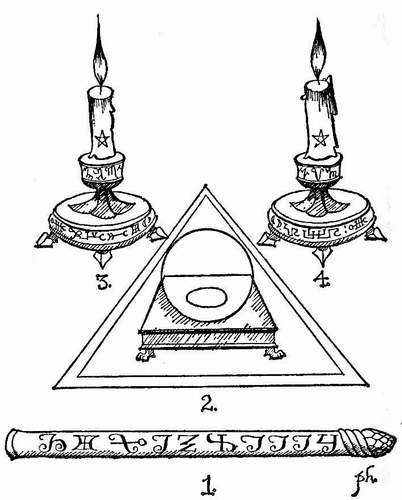
1. The wand
2. Seeing stone within the triangle
3. and 4. Lamps of art
----
... Vassago, a mighty prince, of the nature of Agares, who declareth things past, present and to come and discovereth that which hath been lost or hidden. He is good by nature, and governeth twenty-six legions of Spirits ...
But knowledge of his existence dates back long before this, even to before earliest Babylonian times. He was one of the Nephelim, and in Eastern fable, he is accounted one of the seventy-two Lords of the Djinn.
Your experiment should be performed during clear weather, when the moon is two, four, six, eight, ten, twelve, or fourteen days old, and thereby, of course, always on the increase. So great is the power of Vassago, however (he is a "prince" in the hierarchy), that he is not bound by any sidereal or solar rules of time, and therefore may be summoned at any hour of the day or night. He is to be called only in matters of extreme perplexity, when all lesser methods of divination have availed you naught. Although he is "good by nature," it is extremely important to remember that he is one of the seventy-two from of old, a being formed out of primordial fire eons before man evolved into his present shape, of an intelligence at this present time far superior to that of most men alive, and in the humiliating position of being susceptible to conjuration by apelike clay-formed Homo sapiens, by means of a faculty as yet mostly underdeveloped within said simian creatures. So approach his conjuration with extreme respect at all times; it is no idle operation.
Having selected your day of operation, you must choose a companion to act as a scribe or recorder of the visions. Lock yourselves in your secluded place of working, having gathered together your paraphernalia and such other close companions as are immediately concerned with the divination.
Your paraphernalia should consist of:
Your altar table with its triangle sign covering, pointing east; chairs in the west, facing east across the table, should you wish to remain seated during the scrying;
Your Athame, cord, thurible, cup, workbook, square of Mercury, and pen and ink of art, a supply of Mercurial incense, and a box of incense consonant with Vassago's nature (see end of this chapter, "Herbs and Incenses").
All or any of these things may be held by your assistants throughout the operation.
On the table itself should stand your show stone, or speculum, within the triangle, and to either side and about twelve inches behind it should stand two of your candlesticks containing exorcised white candles. The person who is to perform the ritual must hold the wand in his right hand; upon his breast (and indeed those of his assistants) should hang the pentacle of protection.
When all is safely in position, kindle your Mercury incense and candles, and trace around your floor a triangle with your Athame. Then proceed to cast your circle and exorcise it with fire and water as usual.
Having done this, you should next perform the square of Mercury ritual to attune yourself. Then replenish your thurible this time using "Vassago" incense.
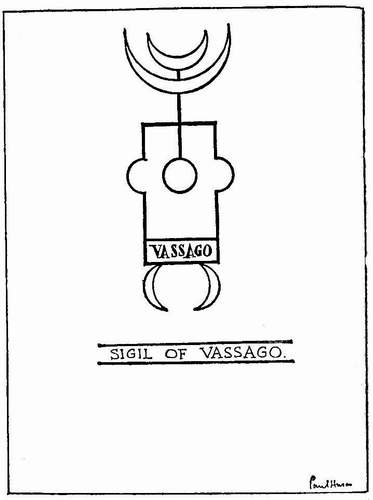
Now, take two of your clean sheets of paper, and on one draw the sigil of Vassago full size, as shown in the illustration, with your pen and ink of art. On the other also draw the sigil but this time small and in the top, right-hand corner. Next, on this last sheet, carefully write out the question you wish answered. On this piece you will record the nature of your visions.
Place this on one side for use later, and return to the first sheet now. Taking the full-sized sigil in your right hand, as perge and fumigate three times with Vassago incense, stating your magical intention each time:
"Creature of paper, I name thee Vassago. Thou art Vassago."
Transfer the paper to your left hand now, and taking your wand in your right, trace the sigil in the air above it three times, strongly visualizing a line of blue fire streaming from the tip of the wand and forming a great glowing sigil hanging in the air. Again repeat the binding spell three times:
"Creature of paper, I name thee Vassago. Thout art Vassago."
Then, again with the wand, draw three crosses in the air above the symbol, and seal with the words "So mote it be."
Now, moving in a clockwise direction, circumambulate the circle, carrying the sigil in your left hand, your wand in your right. Finish at the east of the circle, facing east. Hold the wand upright over the sigil and invoke Vassago with these words:
By Satandar and Asentacer
I conjure thee
O thou great and holy
Vassago! Vassago! Vassago!
Vouchsafe to descend from thy abode,
bringing thy influence and presence into this glass,
that we may behold thy glory and enjoy
thy society and aid!
Again circumambulate the circle clockwise at this point, returning to the east as before to continue:
By Satandar and Asentacer
I conjure thee
O thou great and holy
Vassago! Vassago! Vassago!
who knowest the secrets of Elanel
who ridest on the wings of the wind,
and art endowed with superlunary motion,
do thou descend and be present I pray thee ...
Circumambulate yet once more and finish the invocation:
By Satandar and Asentacer
I conjure thee thrice three times,
Vassago! Vassago! Vassago!
to descend and appear to us within this glass
speaking secrets of truth and understanding.
Then return to the west of your altar table, facing east, and place the sigil in the triangle under the speculum or show stone on its stand.
At this point you must seat yourself comfortably in front of the table, and holding your wand with both hands, gently and without strain fix your gaze on the surface of your speculum. At the same time with all the force of your imagination, visualize the same blue radiance playing around the speculum, and audibly repeat the question or nature of the divination addressed to Vassago, as previously set down on your paper. As you continue to gaze at the speculum, the surface will appear to fade away; in fact, your gaze will shift out of focus, and then spring back sharply in again.
This effect will continue for a while due to your eye being foxed by the shifting perspectives in the glass. You may also find you are experiencing a curious constrictive feeling around your forehead and between your eyes. At this point, should you have performed the divination aright, you will then begin to notice that the speculum surface has begun to haze over with a blue-grey mist. This is the sign that the vision is opening, and it is at this stage that Vassago will begin to take over and show certain things to you.
He may initiate the vision by revealing himself to you in human or therioform guise, or he may simply begin to show you the answer to your queries in uncomplicated symbolistic tableaux, rather like the diminutive images seen through the wrong end of a telescope or pair of binoculars. But one thing here is of paramount importance to beginner witches. Do not shift your attention from the speculum; try not to let your excitement at what is happening disrupt the delicate link between your everyday consciousness and deep mind. This is a very difficult instruction for the beginner, but it can effectively ruin the divination if not complied with.
Sometimes you will find that pictures are building up at the side of your immediate gaze. Here you must resist the temptation to move your line of vision to catch a glimpse of them, but rather allow them to build and unfold themselves before you. Sometimes the visions may seem to make no sense to you at the time. Be that as it may, you must describe them out loud, and have the companion who is active as your scribe note them down with the pen of art on the paper on which the question is written. The visions are very fleeting and will vanish like dreams from your remembrance should you not take care to record them at once.
When the stream of images seems to have finished, the glass will haze over for a last time and then return to its normal state. At that point, you must place more Vassago incense in the thurible and repeat the so-called licence to depart to Vassago, which breaks the spell and terminates the operation. This licence must never under any circumstances be omitted; to do so is to court magical disaster of the worst possible type, maybe even of the nature of that which befell the legendary Egyptian diviner Chiancungi in seventeenth-century England.
He and his sister Napula had, as the result of a bet, endeavoured to conjure the spirit Bokim to visible appearance, unsuccessfully it seems, for no manifestations were forthcoming. After frequently repeating the formulae, Chiancungi and his sister grew impatient and, omitting the licence to depart, quit the circle without more ado. At which point, according to witnesses, they were "instantly seized and crushed to death by that infernal spirit, who happened not to be sufficiently constrained till that moment, to manifest himself to human eyes."
Because there may be no visible manifestation of demonic activity does not mean necessarily that your spell has not worked. And even though Vassago be "good by nature," it pays not to take short cuts. To reiterate, in the summoning of intelligences, particularly those seventy-two formed of the primordial fire, maintain the strictest adherence to the principles of safe witchcraft.
The Licence to Depart
O great and holy Vassago,
we license thee depart into thy proper place
and be there peace between us evermore
by Satandar and Asentacer
So mote it be!
Keep a careful record of the visions obtained in this manner. Often the less obvious ones will either reveal much, hitherto unsuspected, when used as a basis for meditation, or as is sometimes the case, assume a new relevance with the advent of new information, previously unknown, on the subject inquired about.
On the other hand, do not despair if the operation is not an immediate apparent success. The door of vision is one which opens slowly but yields to persistence. Remember the advice of the Chaldean oracles: "Invoke often!" As long as the intent is a serious one, the ritual of Vassago is no exception to this rule.
When you have completed the licence to depart, broken the circle, and completed your vision record, you must burn the sigil of Vassago to ashes. In contrast to your square of Mercury, the sigil of Vassago may be used again. To repeat the operation, you will have to employ a fresh sigil every time.
Dreaming True
The subject of acquiring prophetic dreams, generally speaking, comes under this Mercurial heading. Processes concerned with acquisition of dreams concerning lovers, present or future, will, however, be kept for Chapter 4, Part 1, "The Loving Cup." But should you or a friend wish to acquire knowledge about a certain matter, and not wish to resort to the rune sticks or any form of conjuration ceremony, a very simple, and sometimes quite effective method of securing said information is by inducing a prophetic dream. Wait until the moon is waxing, approaching full. Then, prior to going to bed, take a warm bath in which has been mixed a few drops of the following mixture:
Oil of lavender
Oil of rosemary
Oil of peppermint
Oil of thyme
Powdered poppy seed
While you are taking the bath, fumigate your bedroom with an incense composed of:
Camphor
Powdered aloeswood
Jasmine
Pulverized cucumber seeds
Powdered white sandalwood
All of these are to be used in equal parts. This is a Lunar Incense, the moon being the ruler of sleep and dreams.
Before you lie down to sleep, write your question on a piece of plain white paper with your pen and ink of art, and place the paper and a small sachet of wormwood herb (Artemesia) under your pillow. If the spell works, you should have your answer to the question in the morning.
Necromancy
The summoning of the dead has always been considered by witches as among some of the most dangerous operations in the book, strangely enough, sometimes even more so than the summoning of demons. The truth of the matter is that it can be an extremely taxing operation to perform if the motivation is anything other than love, and if a physical manifestation is required, as is always the case when the shade is conjured to visible appearance.
Unless one who is suited to such energy transfers is present, that is, a materializing medium, the nervous and physical depletion visited upon the participants can prove truly onerous, and in some extremely rare cases, fatal. For this reason the ritual is often reserved for full-coven performance at Sabbat on those occasions when it is employed, in this way providing a good complement of participants to act as energy donors.
The best time for practising necromancy, however, is when the solar power is waning to its lowest ebb between the autumnal equinox and the winter solstice; this fact is made use of in the traditional witch festival, Halloween, wherein necromancy is employed. This is, of course, the Feast of the Dead, one of the four great Sabbats. (See Chapter 7, "The Coven and How to Form One," for more on this.)
However, complications aside, necromancy is one of the more spectacular of magical operations when successful, and if a legitimate motivation impels a witch to have recourse to it, and she maintains a serious, respectful, and considered attitude toward the operation, then chances of success are high.
There are two types of motive which make the operation of necromancy feasible and indeed permissible: intelligence and love. The first, that of intelligence, is resorted to when all else fails, when tea leaves or Tarot cards give unintelligible answers, when the rune sticks talk in riddles, when even Vassago falls silent, and when the one person who can give you the answer to your question is dead. This is the more complicated operation to perform. The second permissible motivation, that of desiring to meet a loved one again, gives recourse to an operation which is easier than the first mentioned and is of the type which is often incorporated into the grand Sabbat of Halloween, although, strictly speaking, most Sabbat rituals do employ some elements of the first variety.
Halloween, or the Feast of the Dead, is the time when the illustrious magical dead are drawn back into the company of the living by the ties of love and magic, to share in the joy of the Sabbat and bestow their blessing on the Witches' New Year, which begins November 1.
Most witches refer to the necromantic operation of love (as opposed to that of intelligence) by its traditional name,
"The Dumb Supper"; it can be used to evoke the shade of one's future spouse as well as that of a deceased loved one. I shall reserve instructions for its performance for Chapter 4, which deals solely with amatory matters, and return to that operation concerned with "finding things out." Therefore, to conclude this chapter, here are the details for the performance of:
Necromancy of Intelligence
This is, strictly speaking, a work of darkness, albeit intelligence, and as such should be timed to fall upon a night of the new moon or very shortly after. It requires thirteen days' preparation, however (which characteristic it shares with the necromancy of love), that preparation being a short nightly meditation around midnight on a photograph or portrait of the deceased whose shade you hope to summon. On the night of the fourteenth day, the new moon, cast and purify your circle just before midnight with a Mercurial incense, after making sure the room is secure from any intrusion. The paraphernalia you will need for the operation include: your Athame, cord, cup, and thurible, naturally, for erecting the circle; your wand, altar table with triangle cloth, lamps, and an equilateral triangle of white tape (large enough to stand in) on the floor outside the circle to the west. In this is placed a skull. Now this may be an actual skull if you have recourse to one, a replica of one made by you, or a drawing of one, never mind how crude, also composed by you.
In the small triangle on the altar should be placed a photograph of the deceased flanked by the lamps of art and an hourglass (an egg timer will do for this). You should have on hand a generous supply of Necromancy Incense (see end of this chapter under "Herbs and Incenses"), and also writing material to record the shade's answers.
Finally, on your breast must hang the important pentacle of protection (this applies to any companions as well).
At the first stroke of midnight, approach the west side of the altar table, facing east, and consecrate the photograph in the altar triangle with salt and water and incense. With the wand you must then trace an equal-armed cross surrounded by a circle in the air above the photograph, visualizing the symbol burning with a blue radiance as you did in Vassago ritual. As you perform each of the consecrations, say these words:
Colpriziana Offina Alta Nestera Fuaro Menut I name the [name of deceased] Thou art [name of deceased].
The circle cross you trace over the photograph is, like the triangle and pentacle, a witch symbol of great antiquity. Some witches, who are hermetically inclined, say that it is an abbreviated version of the alchemical rose cross, whereas others see it as being a type of the crux ansata, or Egyptian ankh, symbolizing divine life. In this particular instance, however, the symbol connotes a different history altogether, being derived from the same source as that old pirate device familiar to all readers of Treasure Island, the skull and crossbones. This emblem makes its appearance in more serious context in both Templar and Masonic symbolism, alongside that of the witch tradition. It is the sign of Osiris. Its proper import is that of death (sometimes accompanied by resurrection), and most necromantic processes make use of it. It is also used in laying curses on people, as you will find out in Chapter 6, which deals with magical warfare and such matters.
Having traced the symbol above the photograph, carrying the wand in your right hand, the photograph in your left, proceed clockwise, walking backwards, to the rim of the circle in the eastern quarter and, holding the wand upright over the photograph, pronounce the following conjuration to the east:
Spirit of [name] deceased,
thou mayest now approach the gates of the east
to answer truly my liege demands.
Berald, Beroald, Balbin!
Gab, Gabor, Agaba!
Arise, arise, I charge and command thee.
Repeat these words again to the south, then the west, and finally the north again, walking backwards around the inner perimeter of the circle, and changing each time the name of the gate corresponding to the quarter. Should you have any companions for this ritual, they too should accompany you around the circle to the four quarters, also walking backwards. Then, still proceeding backwards, you must return to the east of the altar table by yourself and, facing west across it, replace the photograph in the altar triangle. Pause for a minute or two at this point; all present should maintain a strict silence.
Then carefully place your necromantic incense within your thurible, and when it is fuming well, repeat the words of the grand citation, striking the photograph gently with the end of your wand at the completion of each line as you do so.
By the Mysteries of the deep [strike],
by the flames of Banal [strike],
by the power of the east [strike],
and by the silence of the night [strike],
by the holy rites of Hecate [strike],
I conjure and exorcise thee, spirit [name] [strike],
to present thyself here [strike]
and answer truly our demands [strike].
So mote it be! [strike].
(The "Hecate" invoked here is the classical Greek goddess of witchcraft. She is three-formed, having Persephone and Selene, goddesses of the dead and the moon respectively, as her other aspects.)
At this point replenish the thurible with more necromantic incense, extinguish all lights upon the altar table so that the room is plunged into darkness, and again moving backwards, carefully pass to the west rim of the circle, to kneel down, facing the triangle of manifestation upon the floor. Cross your arms slowly upon your breast—this is the witch gesture signifying the skull and crossbones symbol—and repeat the words of the charge inwardly as you do so: "Allay Fortission, Fortissio, Allynsen Roa!"
At this point close your eyes and again remain silent for a few minutes. Then, still with your eyes shut, greet the spirit quietly as though he were present before you. Here you may experience that most unpleasant crawling sensation, fear, but you must avoid panicking at all costs, keeping in mind that your questioning is legitimate and just. In fact, it is with this point of the ritual in mind that the whole issue of justification of the operation before the outset is concerned. You must be certain within your own mind that the operation is being conducted for legitimate purposes, all else having failed, in order to face this final moment of fear with equanimity.
Now, summoning all your courage, pronounce the deceased person's full names clearly and loudly three times, slowly extending your arms on either side of you in the form of a cross, and opening your eyes. If the operation has been successful, you will gradually perceive a dim form in the triangle before you, seemingly composed of the substance of incense smoke, sometimes illuminated from within by a very faint bluish phosphorescence. Whether the apparition is built up on a magnetic and physical or purely psychic basis or a mixture of both depends solely on whether you as a witch function best as a seer or a materializing medium, which are the two ends of the magical spectrum whereon witches function.
Depending on your various constitutions and the degree of your magical development, you and your companions may differ in what you see before you in the triangle. One may see a dim form, while another may see a clearly defined figure, and yet another see nothing at all but merely feel the presence of someone who wasn't there before. But whatever you do or do not see, you must present your question at this point, with the knowledge that if the information is not immediately forthcoming, it will be revealed later, usually by way of a chain of curious and inexplicable coincidences.
When the form fades, it will mean the power raised by the ritual has ebbed away, and the time will be at hand to conclude the operation. Return to the east facing west across the altar again, again walking backwards. Rekindle the lamps (and the thurible if necessary), place a final offering of necromantic incense upon the coals, and repeat the licence to depart, which runs thus:
Go, go, departed shade [name]
by Omgroma Epin Sayoc
Satony, Degony, Eparigon
Galiganon, Zogogen, Ferstigon.
We licence thee depart into thy proper place
and be there peace between us evermore.
So mote it be!
Then, finally, as with all your other Mercurial experiments, note down the results. In the final analysis, the best way to gain results is by a careful trial and error method, and this always depends on an accurate record being made. The results of your various researches should form a valuable part of your magical workbook.
Herbs and Incenses
For all divinations, great or small, whether the operation be one of mere sortilege such as casting the runes or a grand operation of necromancy, two easily accessible Mercurial divination incense ingredients are extremely useful to have on hand at all times: namely, gum mastic and cinnamon (the latter preferably in oil or essence form).
The first may be obtained at any good art materials suppliers as it is used in picture varnish, while the second can be obtained easily enough from any pharmacy. These two ingredients may be fumed on top of charcoal by themselves as divination incense or mixed with the following traditional recipes to form a more powerful blend.
| 1. Wormwood (Artemesia) Flax Cardamons Anise Camphor Chicory |
2. Orris root Fennel Pomegranate skin Red sandalwood Poppy seed |
| 3. Valerian root Saffron Wormwood St.-John's-wort (Hypericum) |
4. Linseed Psellium |
| 5. Violet roots Parsley |
6. Anise Poppy seeds Camphor |
|
7. Cloves (powdered) |
|
Any or all of these may be mixed to advantage with Solomon's-seal and/or holy thistle herb to enhance the effect. Experiment to see which type suits you best.
Dittany of Crete is mixed with any incense where a materialization is required in the operation. Most if not all of the herbs aforementioned may be obtained from any shop which handles the sale of botanicals. Substances like the gums and essences, such as camphor and cinnamon, can be obtained at the pharmacy.
Vassago Conjuration Incense
This is a Jupiter-type incense, for though he is Mercurial in function, Vassago is primarily Jupiter-oriented in nature. His incense should be composed of:
6 parts frankincense
6 parts balm of Gilead
6 parts grain of Paradise
1/2 part saffron
Touch of ambergris (an artificial tincture is quite sufficient)
If you cannot obtain these ingredients, a good substitute can be compounded of frankincense, saffron, and Cedarwood oil.
Necromancy Incense
3 parts wormwood herb (finely reduced)
2 parts good-quality, resinous church incense
2 parts gum mastic
3 parts dittany of Crete (finely reduced)
1/2 part pure olive oil
1/2 part wine
1/2 part honey
A few drops of the operator's blood
Blend the ingredients together and let stand overnight. The resultant incense should be of a fairly solid, crumbly consistency, but if it turns out too liquid, add extra dittany and wormwood until the right, dryish texture is reached.

