2 - Preliminary Preparations
Your Witch Name
Assuming you have embarked on your career as a practitioner of the Black Arts, you will have to take a new, magical name to supplement your old, mundane one. Some unkind critics have called this the nom du Diable. It is nothing of the sort; at least, not in the sense they mean it. It is, in fact, an important part of your newly burgeoning witch personality, and henceforth you will be known chiefly by it to your fellow practitioners.
Many witches or warlocks choose to take a name which is intimately connected with magic and the supernatural, the favourites being the names of other, legendary practitioners of the Black Arts.
For instance, if you are male, you may choose the name of a legendary sorcerer such as Zyto, Balaam, Elymas, or Cyprian; or, alternatively, maybe Merlin, Althotas, Vergilius, or Vandermast.
A witch might well choose Morgana, Armida, Vivienne, or Melusina; Brisen, Nimue, Hellawes, or Fredegonda, Nocticula, Bensozia, Sidonia, or even Urganda!
Or you might choose a name of more classical inspiration like Apollonius, Medea, or Circe; or ancient Egyptian like Nectanebo or Arnuphis, or maybe something really complicated like Diancecht, Osmandine, or Ansuperomin!
The choice is yours. You must find one that appeals to you, that calls forth your feeling for the unseen world, gives you a thrill, and frankly makes you feel considerably powerful and no less sinister! Should you not wish to use a name from legend, you may try toying with those of the gods and demigods of mythology. Greek, Roman, Norse, Celtic— whichever you wish. A very good lead in these matters can be provided by finding out your astrological birth sign and planet and looking up the legends that surround them. For instance, if you are an artist or craftsman born under the sign of Taurus, you may well decide on the name of Daedalus, being that of the wizard-craftsman of King Minos, leader of the Cretan Bull Cult, thus linking with Taurus the Bull. Or, alternatively, if you are a female witch born under Taurus, ruled by Venus, you may decide that the name "Ariadne," daughter of King Minos and Theseus' bride, would be suitable, especially as she is indeed a form of Aradia, one of the chief spirit powers of the witch world.
A third method which can yield results is the numerological one. Add up all the digits which compose the name you are best known by, using this scheme to allocate the letters to numbers:
| 1 | 2 | 3 | 4 | 5 | 6 | 7 | 8 | 9 |
| A | B | C | D | E | F | G | H | I |
| J | K | L | M | N | O | P | Q | R |
| S | T | U | V | W | X | Y | Z |
Keep adding the resultant numbers together till they form a single digit, thus:
| J | O | H | N |
+ |
S | M | I | T | H | ||||
| 1 + | 6 + | 8 + | 5 | 1 + | 4 + | 9 + | 2 + | 8 | |||||
| = 20 | = 24 | = 44 | = 4 + 4 | = 8 | |||||||||
Now numerologically speaking the digits have the following traditional planetary attribution:
1. The Sun
2. The Moon
3. Mars
4. Mercury
5. Jupiter
6. Venus
7. Saturn
8. Uranus
9. Neptune
In John Smith's case, his name planet will be Uranus. His next step would be to consult a book of classical myth and legend, on the subject matter surrounding Uranus. There will be ample material to select a name from, especially if the book is one of comparative mythology, showing the interrelations of legends among different cultures.
Should none of these methods yield results or appeal to you, then you should just go ahead and evolve a name that "feels right," cooking it up for yourself out of the blue, using your intuition to guide you. This in fact is ultimately the only criterion; the preceding methods are merely indicators and helps.
So mull over a selection of names in your mind. Ponder them in reverie if you can and let your deep mind send up some hints if possible. This really is the best way, as in the final analysis the deep mind is what we are really concerned with here. The witch name is basically designed to be an indication of the true nature of you as you really are deep down! There exists a coven of witches in England today whose female members only use witch names of a floral derivation, Rosemary, Japonica, Aubretia, Flora, and so on!
Some witches like to take worthy mottoes in Latin like Sapiens dominabitur astris or Omnia vincam, maybe a bit ecclesiastical in tone, but quite legitimate, though to my mind again less effective than the considerably more evocative names of legend.
Just choose one that satisfies you. It may take a bit of time; but it is worth considering well since once you inscribe it on your magical instruments, you are stuck with it.
Having settled on your witch name, you must keep it very, very secret, as it will eventually become one of the keys to your deep mind. You will be using it whenever you wish to "switch on" to perform a spell; this will be partly accomplished by pronouncing the name silently to yourself whenever you begin your use of the pyramid powers.
You should only divulge it to others who are close witch friends, preferably when you are closely bound together with them in the form of a group, or coven.
And as already mentioned, you will also write it on all your magical witch tools, using special witch runes to do so. Which brings me to my next topic.
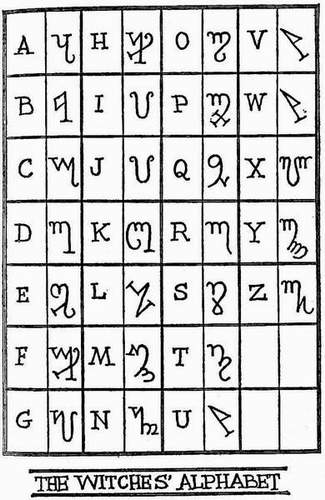
The Witch Runes
These are, in fact, the letters of your witches' alphabet. Whenever you write your name on one of your magic instruments, you will use them. They are quite easy to learn, and with a little practice, you will soon be able to write them speedily. They are variously called by practitioners the Runes of Honorious or Theban Script, although this latter name does not necessarily imply a Greek or Egyptian derivation Some witches believe that they are relics of Atlantean days while others think that they have a connection with the Cabalistic "Enochian Script" of the Elizabeth astrologer and magician Dr. John Dee. Whatever the case they are very ancient and have been used from time immemorial by witches as their magical alphabet in which spells and inscriptions were written.
Not only will you use these runes to write your witch name on your magical tools, but also to write it on your witch jewels.
Signs of Identification
All witches and warlocks usually possess items that are often known by occult ritualists as jewels; in a witch's case these are items worn like jewelry signifying Witchdom to those that have eyes to see, often bearing in runes the witch's name, the symbol adopted by her coven (should she belong to one), and her rank in it if it possesses a hierarchy of any sort. They usually serve three purposes—that of providing a means of recognition between members of different covens; a talismanic "link" with the collective mind of their own group by means of which they "plug in" to the elemental powers drawn down at the Sabbats; and third, sometimes as a means of "Fascination," that is to provide a reflective surface of the same sort often made use of by hypnotists when they wish to throw their subjects into a trance. The ring and pendant which often contain gemstones, are generally the only jewels which are put to the latter use, however. One jewel which definitely does not fit into this latter category, however, being hidden mostly and only revealed at Sabbat meetings, is the garter. This and the girdle cord I shall consider last.
The Witch Jewels
The Necklace, the Bracelet, the Ring and Pendant, the Girdle Cord and Garter
The necklace: The necklace is worn by women coven members often at Sabbats and Esbats only. It is in all probability of similar derivation to that of the girdle or garter Some witches say that it has a connection with "Brisingamen," the elven necklace possessed by Freya, the Norse love goddess.
Others say that through its occasional use of acorns as beads, it derives from the worship of Diana of Ephesus, whose devotees saw the head of their goddess bound with a coif of hair in the shape of the acorn itself. The number of beads for the necklace often consists of multiples of nine or thirteen. Acorns aside, however, the beads may be made of any material you please—metal, stone or wood—the only qualification being that they be fairly large and chunky. Amber is a favourite, as also are turquoise and jet, Many witches like to string their own, after exorcising the beads with fire and water initially and charging them in their own witch name, like any other magical tool, when they finish. (For instructions on general exorcisms by fire and water as well as magical "charging," see further on in this chapter.)
The bracelet: This is usually made of copper or silver an is worn by witches of either sex, again as a form of identity sign. However, unlike the necklace, it is engraved with the witch name of the bearer, the coven symbol (which is often an animal such as an owl, cat, or serpent), and his rank in it. There are usually only two "degrees" of rank, that of the triangle and the more advanced one of the pentacle. If male, the leader of the coven is sometimes known as the magister or master, the female as the high priestess. These are generally honorary ranks and titles, however, and simply indicate seniority of membership for the most part. Very occasionally are they indications of power. (See Chapter 7, "The Coven and How to Form One," for more on this.) Sometimes coven members will wear the bracelet to signify the triangle, and the garter, the pentacle grade.
Should you not belong to a properly formed coven, your name in witch runes will be all you need to have, plus any other amuletic symbols of good luck you may choose, such as your zodiac birth sign and planet.
Similar to the bracelet are the ring and the pendant. These are usually the only witch jewels bar the necklace that actually possess gems or stones set into them. These are the primary "fascination'' jewels, and the more intricate and unusual the jewel, the better it serves its purpose. As to its composition and monetary value, it is completely a matter of individual taste and economy. The best magical witch stones are traditionally the sapphire and the opal. However, most precious and semi-precious stones do just as well, especially those which traditionally are held efficacious against the evil eye and fascination! These, in fact, are excellent accumulators of witch power, and as such, if you have ever worn one as a good-luck charm, has provided you, albeit unwittingly maybe, with an equal and opposite means of fascinating others or casting your own evil eye! In effect, you will be fighting fire with fire!
Here is a list, in alphabetical order, of some of those stones you may care to use as the bezel of your ring or pendant:
|
Fascination Gems |
||
| Amber | Diamond | Onyx |
| Beryl | Emerald | Peridot |
| Bloodstone | Jade | Sardonyx |
| Carbuncle | Jasper | Staurotides (Cross-stone) |
| Carnelian | Jet | Ruby |
| Cat's-eye | Lapis Lazuli | Turquoise |
| Coral | Moonstone | Zircon |
You may have your witch name engraved upon the ring or pendant—either on the reverse surface or around the stone itself. Sometimes the zodiac birth signs are also engraved, occasionally even a Cabalistic word of power such as Ararita, Tetragrammaton, Mehafelon, Ananizapta, or Shemhamphorash.
Incidentally, a very good idea which some witches resort to is to use a poison ring as their jewel. The inner cavity of the ring itself is very well suited for concealing either written charms to be carried about the person or philter powders to be slipped warily into some unsuspecting person's drink! The metal of which the ring or pendant is made can be any you wish—the following are used by witches to magically stimulate the following traits in their witch character:
Gold - energy and general success
Silver - intuitiveness and magical ability
Copper - success in love
Brass or fixed mercury - mental agility
Tin - expansiveness and generosity
Iron - courage and aggressive instincts
Lead - stability
Sometimes an amalgam is made of some or all of them, depending on the orientation required. The resulting alloy is then known as magical electrum. But this is specialist stuff. Gold, silver, or copper is the usual choice.
Like the other jewels, the ring or pendant will always be exorcised and consecrated with fire and water in the waxing moon, and named with the possessor's name.
Finally, we come to a consideration of the concealed signs, the witch's girdle cord and garter. The girdle cord, often red in colour, is used for several practical purposes, the least of which is to hold in your tabard, or ritual witch's robe. It is made of a specified length with certain knots tied in it, and is also used to measure the diameter of your magic circle when you cast one. Some practitioners also use it as a type of ritual rosary when they are performing a spell with a lot of repetitions in it, telling the knots in it like beads; I shall describe its manufacture later in the chapter under the heading of "Your Witches' Working Tools."
The garter is perhaps the most unusual piece of insignia carried by witches and, as such, is concealed and worn openly only at coven meetings. The other jewels can pass as regular items in the eyes of the uninitiated, and as such can usually be worn openly.
There are many styles of witch garters in existence. The traditional colour is bright red, though black, blue, and green ones are to be seen. Often a female practitioner will have her garter made of velvet and backed with silk, the male variants being snakeskin, crocodile, or soft leather of some sort backed with blue silk. The garters are fastened by means of gold or silver gilt buckles. Sometimes tiny gold or silver bells are also sewn on, reminiscent of those worn by English Morris dancers.
On the outer surface of the garter are embroidered the witch name, coven symbol, and coven rank, if any. Sometimes the same signs that are inscribed upon the Athame are also added.
Garters are always worn above the left knee, and let me reiterate, only on coven occasions or during the casting of spells.
The garter concludes the list of witch jewels. Most of them are optional, except for the necklace in the case of women. Why this latter exception should be made, I do not know. However, it is traditional coven practice, and as such should be complied with by any female witch, if she really wishes to obey the letter of the law.
Manner of Dress
This is a matter over which there is much controversy in the witch world. Many practitioners claim that the best way to work magic is the traditional way: nude.
Others, equally tradition-minded, claim that this is not necessarily the case, and that ritual robes, or tabards, should be worn. The rationale behind nudity, apart from the sheer fun of it, is that clothing inhibits the emanation of your witch power. As an explanation or justification of the belief, I have never felt it held much water. Witch power is not easily impeded by mere clothing. It passes through walls and traverses wide distances easily enough, so why should a few flimsy garments prove such a barrier to it?
No, the chief reason for the nudity is a psychological one, the state of release from tension, mundane cares, and sexual inhibition is the aim being striven for here.
So if you feel that wearing no clothes may put you in the frame of mind where your magic will work all the better, then that is what you must indeed do. Careful though! Remember prying mother-in-law. Lock the door!
However, for those who live in chilly climates or who aren't enchanted by the idea of naked frolics, the tabard is the alternative. This at its simplest is a long piece of fairly heavy black material, folded double, with a hole for the head cut at the top, poncho-wise; the sides are sewn up to within about nine inches of the top, leaving holes for the arms to pass through. The completed garment hangs to the ankles. It is belted with the girdle cord.
Many practitioners, however, prefer more complicated or flattering garments, in varying colours such as blue, violet, red, green, or white, often with the addition of a hood, or cowl, to be drawn over the head for greater impersonality during a ritual. Special sandals may be worn or the feet left bare, again as you will. However, let me advise you here should you form a coven, a certain uniformity of dress is desirable—often zealous witches will possess two robes for that very reason; a uniform one for Sabbats and Esbats, and a more individualistic one for private use.
Again your witch name and appropriate signs may be embroidered on the hem or breast of the garment if you desire, but this really isn't necessary. Indeed the tabard itself is not entirely necessary. It is merely a psychological prop to put you in the right frame of mind for magic, and all the rituals and processes can be as easily performed wearing your ordinary, everyday clothes—just as long as they don't work to your disadvantage by bringing you back down to earth again with a bump, that is.
Your Witches' Working Tools
In order to perform any act of successful ritual witchcraft, you must have your set of basic traditional working tools. Without them, all the most powerful born-witch or warlock is powerless when working at a distance from his victim. They are the tools of your trade, as much as an easel and brushes are of the artist.
The magical act is a cumulative one. You start from scratch with newly purchased substances, ritually purify or demagnetize them with salt water, and incense, and then recharge them with your concentrated witch power. From these charged substances, you then fashion your implements, and with these implements, you cast your first spells.
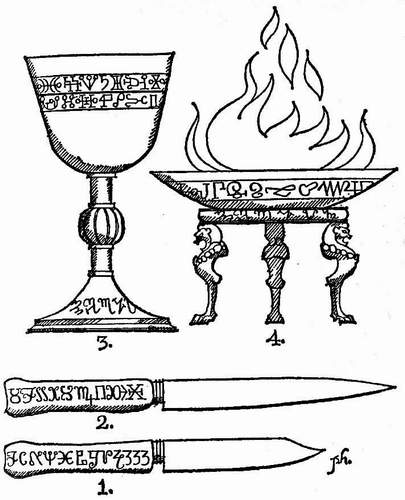
The basic witch tools themselves are five in number; the full complement eight. There are many lesser ones which merit the designation more of common household implements that you keep specially for your witchcraft. For instance, needles for sewing, scissors for cutting, a white-hiked knife and so on. I shall list the important ones at the end of this chapter along with other useful things you will need in your witches' cupboard.
1. White kilted knife
2. Athame
3. Chalice
4. Thurible
These are your basic working tools, however:
With these simple though basic tools you will be able to manufacture all the other magical artifacts that are mentioned in the following pages; the wand, the speculum, the candlesticks, the pentacle, the mandragore, and the alraun, and all the talismans, philters, incenses, images, and amulets that will be your general stock in trade. The ways and means to manufacture such things will be discussed under the specific headings throughout the book as we come to them.
To make your working tools, the first thing you must do is to learn how to purify and consecrate all your raw materials (or exorcise them, as we call it) by means of salt, water, and incense.
Theoretically, the salt, water, and incense stand for the four elements of the Wise—earth, water, and fire, together with air—symbolically constituting the basis for the material universe, in the language of alchemy and witchcraft. By exorcising anything you are in effect symbolically using these four basic constituents to "wash" the article of all extraneous vibrations, prior to recharging it with your own will and concentrated witch power. Before, in fact, transforming it into a servant to accomplish a given magical task. Throughout the following pages I will refer to this process of purification as either exorcism or "passing something through fire and water."
Formula of Exorcism by Salt, Water, and Incense
Basically, any form of words can be used to exorcise something, ranging from a long ecclesiastical-sounding Latin invocation to a simple jingle. Witches generally prefer the latter. Here are two charms that can be used for exorcism, and which partake of the nature of jingles:
Taking a small handful of new salt and casting it into a bowl of fresh water, breathe these words onto the water's surface, mentally visualizing—and this is the important thing —with all the faith, will, and imagination you can muster, a dim bluish light beginning to hover over it as you do.
Water and earth
Where you are cast
No spell nor adverse purpose last
Not in complete accord with me.
As my word, so mote it be!
This is now your charged salt and water of exorcism which you will use to make your working tools.
Similarly, casting a few grains of good-quality church incense onto a glowing charcoal block contained in an ashtray, chant as you hold your hand outstretched over it:
Creature of fire
this charge I lay,
no phantom in thy presence stay.
Here my will addressed to thee;
and as my word, so mote it be!
Again, strongly visualize the coals radiating that strange blue light as you speak. With this charged fire, you will complete the exorcism of your raw materials.
Now the first working tools you should make are the cup and thurible. In fact, as soon as you have made these you will be using them to contain the water and fire respectively, rather than relying on the services of any handy bowl and ashtray.
The Witches' Cup
The witches' cup is a variant of the cauldron of Ceridwen. This, in turn, was a Celtic development of early Prytanic myth which later became the central theme of all the legends concerning the Holy Grail, that mysterious relic which is woven inextricably into the Arthurian romances.
The cauldron, bowl, or cup symbolizes the receptive passivity of the great womb of nature, out of which all things are born and to which all return. It is seen as female in nature and is analogous with night, darkness, space, and, of course, the all-encompassing sea. Water is the traditional element of the Wise related to it.
The cup or chalice is used to contain the salt water of exorcism or, alternatively, the wine of libation. This is the sacramental wine which is consumed in some ceremonies, and also used to consecrate things at times. The cup is also used to compose philters in.
During persecution times the use of the chalice or cup was generally discontinued, owing to the fact that should a witch or warlock be found in possession of one, it usually led to an immediate bout of prolonged torture, the reason being, of course, that church authorities inevitably suspected the cup to have been used for heretical and blasphemous perversions of the Mass. In their eyes they were undoubtedly justified, as there is indeed a ceremonial feast at the Sabbat, wherein witches consume cakes and wine in much the same manner as the early church did in its Agape, or love feast. It is a rite common to many cults.
In order to make your own cup, you must first buy, without bargaining over the price (this will apply to anything you use in your spells), a goblet anywhere from three to five inches in diameter. It can be made out of anything you please that isn't porous and will hold a liquid. Some old witch cups are made of animal horn, and others of silver or silver-gilt like the conventional church chalice, or even of tinned copper. If you decide on a brass or copper one, be sure you glaze it well on the inside, since both of these metals can become very poisonous when a reactive liquid like wine is brought into contact with them. Glass and ceramic are also acceptable, but, as I say, a metal or horn one is traditional.
The process of consecration is simple. During the period of the month when the moon is waxing toward full, take some salt water in a bowl and steep in it the following powdered herbs: vervain (verbena), mint, basil, rosemary, Hyssop, lavender, sage, valerian, fennel. Sprinkle some incense on a charcoal block and charge both fire and water with the words I have already given you, mentally putting all your effort of will, faith, and imagination into seeing the elements as glowing with vibrant, purifying light. Having done this, sprinkle the cup with the water, then pass it through the incense smoke, chanting words to this effect, and visualizing the blue purifying light flickering around it as you do.
By water and fire I conjure thee
That there remain
within thy frame
no adverse thought nor enmity.
Hear my will! Attend to me!
As my word, so mote it be!
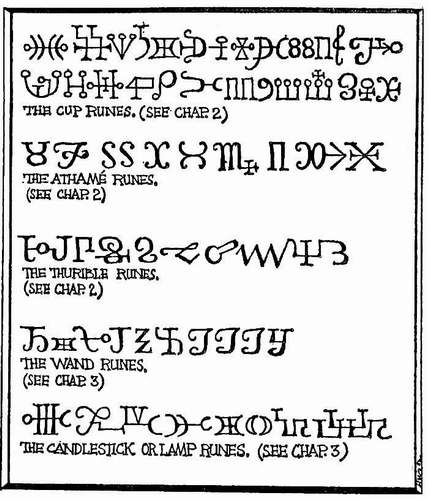
Having done this, paint the following runes around the cup with a new brush and paint. Black or white enamel or stove-black is best for this. For this ritual you may also mix into it a pinch of your powdered herbs, vervain, et al.
As you paint each rune, chant these words, visualizing the signs glowing with magical light as you do: "Blessed be thou cup of water!"
Having done this, paint the runes that spell your witch name around the base of the cup, pronouncing each letter out loud as you do so.
When you finish, chant the words "So mote it be!" and put your completed cup safely away for future use.
The Thurible
Again, a simple process. Buy a new metal chafing dish or incense burner, preferably with small legs or a stand to raise its base off the tabletop to prevent scorching.
Fill it with about an inch of sand. This will provide good insulation from the heat of the burning charcoal. Now, again when the moon is waxing (this will always be the case, unless otherwise stated), exorcise the thurible with charged fire and water in the same way that you did your cup. Then paint the proper symbols around it, chanting the following words with each symbol and again charging them with light. You may mix a little dragon's blood resin with your paint if you like, for added potency. "Blessed be thou creature of fire!"
Paint your witch name around the base, repeating the letters and charging them as you do so, and again terminate the spell with the words "So mote it be!" This is your complete thurible. With it and your cup you will henceforth perform all your water and fire exorcisms.
Now that we are equipped with our main tools of consecration, we shall deal with one of the most important of all the other witch tools:
The Athame
The Athame, or witches' black-hiked knife, is the instrument we use to draw magical circles and other diagrams, in the midst of which many of our spells are cast. Some witches, following the Cabalistic tradition of the old magical grimoire, the Key of Solomon, also employ a white-hilted knife, in addition, using the former to cast the circle, and the latter for anything that needs to be ritually dug, engraved, cut, or pierced. Most present-day witches, however, refer the white-hilted knife to the ranks of the lesser instruments, and rely entirely upon the Athame in their operations.
Buy a steel knife with a black handle; the blade should be about five or six inches long. When the moon is waning, make an infusion in distilled water of any of the Martial herbs listed at the end of Chapter 6. Into this, mix a few drops of blood, either your own, traditionally that of a black cat, but that of a fresh beefsteak, chicken, or lamb chop from your nearest supermarket will do. Your own is best, however.
Exorcise the knife with water from your cup and incense mixed with some of the aforesaid herbs burned in your thurible; then proceed to heat the blade of the knife on the thurible coals until it gets as hot as possible. You will have to stoke up a good heat to do this. When the blade is good and hot, plunge it into your waiting brew, chanting these words, and visualizing the knife glowing with power after each immersion:
Blade of steel I conjure thee
to ban such things as named by me.
As my word, so mote it be!
This process of tempering, or forging as it is called, should be repeated three times.
Having accomplished this, you must now magnetize the blade by stroking it repeatedly with a lodestone or bar magnet. Hold the Athame in your left hand, the magnet by one end in your right, and beginning at the handle end of the blade, draw the tip of the magnet down the whole length to the very point. Keep this up for a good five minutes, always stroking in the same direction, chanting these words at each stroke:
Blade of steel, I conjure thee
attract all things as named by me!
As my word, so mote it be!
Finally, paint the proper runes upon the handle in white paint with which you may again mix any of the powdered herbs you used in your previous infusion. Chant the following words to charge each rune: "Blessed be thou knife of art!"
Then paint your witch name on the reverse side of the handle, again spelling the letters out loud to charge them, finishing with the usual words "So mote it be!"
Finally, you must bury the Athame for three days and three nights in the earth, point down. Your backyard will amply suffice.
At the end of this time, you may dig up your Athame, and, wrapping it in an exorcised piece of cloth, tuck it safely away, ready for future magical use.
The third of your working tools is:
The Cord
otherwise known as the girdle, cingulum, or cable tow. The latter name derives from its use in various initiation rituals, some of which will be explained in Chapter 7. The cord is used basically to measure the radius of your circles, for binding things—and even, on occasions, for binding oneself! (For this, see under the heading "Ligature" in Chapter 6.) To make the cord, you should ideally spin your own flax or gather your own river rushes. Never mind, though; do as most urban witches do and buy a ball of red ribbon. From this you should measure off three six-foot lengths. When the moon is waxing, exorcise these with water and fire, and knotting the three ends together, start braiding them, chanting the following jingle, binding in the magical light with each twist:
Made to measure,
wrought to bind,
blessed be
thou cord entwined.
When you finish, make a large firm knot with the free ribbon ends to prevent them from unravelling, and repeat your sealing words, "So mote it be!"
Finally, tie another large knot three feet six inches from the first knot, a further one at four feet, another at four feet six inches, another at five feet, and yet another at five feet six inches. These will be the measurements of the triple radii when you use the cord as a compass cord for your magic circle. Using it to measure by, you can make two different triple circles; a larger one for coven working and a smaller one for solo spells or small groups.
The Workbook
Your final major working tool!
In this, you must write all your magical recipes, spells, and rituals before you use them, using a good clear hand which will be legible by candlelight.
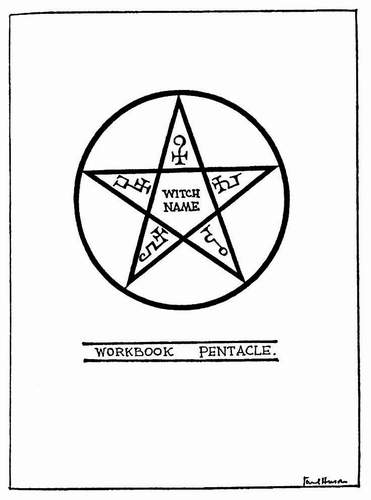
Our old friend the tradition-minded witch will insist on making her workbook out of parchment, sewing it herself and sticking a cover on it.
However, if this seems overcomplicated to you, buy a thick book of good-quality drawing paper, about the size of a large exercise book. Then, when the moon is waxing, cover the back and binding of this book with a material of you own choice. Many practitioners favour velvet or moire silk. Others prefer a leather or skin, often reptile. The choice of colour ranges from black or white to red and green, even an occasional silver or gold!
You should then exorcise the book with water and fir Then, with a pen and ink specially bought for this purpose, draw in this pentacle and its runes on the front side of the first page and the reverse of the last. As you draw in each rune, chant the following words:
Book of words,
book of deeds,
blessed be
thou book of art!
The "art" referred to is magical art, needless to say.
Finally, write your own witch name in the centre of the pentacles, charging each letter as you do so in the usual way, and sealing again with the words "So mote it be !"
This book, along with your Athame, will be your most treasured magical possession and should only be shown other witches and coven members.
How to Make Your Magic Circle
This is your first spell of practical witchcraft! To cast it you will be using all your working tools.
To those familiar with Cabalistic sorcery, the magic circle is generally viewed as a means of defence against hostile spirit entities; to the witch, however, though it may serve this purpose in some of her spells, it has a far more important function usually. This is, in fact, to serve as a lens to focus the witch power she raises in her rituals. It is a sort of magical boiler tank in which the steam is compressed in order to channel it into some useful activity such as driving a piston rod. In this way the witches' circle can be compare very closely with the ground mandala, or dkyilhkhor, used in Indian and Tibetan magic. It has very ancient, pre-Celtic origins.
In Cabalistic magic the circle will usually consist of basically a double or triple concentric circle. In between the lines will be written Hebrew names, divine and angelic, which pertain to the nature of the operation. In the centre may often be traced geometrical figures, such as a square or a pentagram whose sides or number of points again correspond numerologically with the type of spell being cast.
To the practising witch, however, this is all mostly totally irrelevant and unnecessary. Quite apart from the theoretical over-complication, the practical details are much too demanding. Unless one is wealthy enough to possess a house or apartment with sufficient rooms to dedicate one entirely to magical practice, the full-painted floor circle with all its geometrical ramifications is generally quite out of the question.
No, as a witch, your basic requirement for many spells will simply be a triple circle drawn out on the floor or carpet in temporary masking tape if you want. This is advisable for group or coven workings, but when you are operating solo, you can dispense with even that, using an imaginary boundary line, but making quite sure you stick within it. Because of this it is wise to make the circle rims coincide with marks on the carpet or pieces of furniture, so you can maintain a correct visualization. Anyway, here is your method of casting your circle.
Clear a space on your den or living room floor sufficient to draw a nine-foot-diameter circle (eleven-foot for coven working). Now, pin one end of your cord down to the floor in roughly the centre of the room with a heavy object—a chair or table leg maybe—or have someone hold it down if you are working in company. Now, stretching the cord out tightly, take your Athame, and wrapping the cord around its handle at the first knot, the one four feet six inches from the pinned end, trace a nine-foot-diameter circle lightly on the floor with the knife point, keeping the cord taut and using the chair as a pivot.
You must do this in a clockwise direction (known as deosil to witches) always turning to the right. You must also begin your tracing operation standing in the east and end up back in the east. For this, you will need the aid of a small pocket direction-finding compass. As you trace the circle, use your witchly imagination to visualize that blue witch fire blasting down your Athame blade, like an oxyacetylene blowtorch, leaving a line of flickering violet-coloured flames in its wake. Listen to them hiss and crackle; you are surrounding yourself with a circle of magical light!
If you want to memorize the right colour of the fire, try igniting a few drops of methylated spirits or brandy in a saucer (careful though!) and observing the resultant flame.
Having drawn your first circle, you must now repeat the operation, shortening your cord by moving your Athame six inches down it to the second knot, the four-foot one, giving you a circle with an eight-foot diameter. Repeat the operation a third and final time, using the next knot down, the three-feet-six-inch one, which will give you your inner circle of seven-foot diameter.
This is your magic circle. You must now proceed to exorcise the ground inside it by sprinkling and censing to the four quarters—east, south, west and north—always travelling deosil, and using your fire and water exorcism.
Having got this far, you are now standing in a ritually purified witches' circle, and the lens for your witch power is in position. You can now proceed with the spell itself, such as one of the many outlined in the following pages.
Before finishing this chapter, however, I shall list a few of the ingredients and bits and pieces you will find useful in practising your craft; buy them new, without haggling over the price, of course; keep them apart from your everyday things; and before you use any of them in a spell, simply exorcise them with fire and water.
A Witch's Initial Supplies
1. Charcoal blocks for the thurible. Preferably self-igniting, but the regular kind will do, sprinkle with a few drops of alcohol or cheap cologne to ignite. You can obtain them from most religious supply stores. A lot of shops specializing in the sale of exotic foreign imports also stock them. Be sure to get them unperfumed, though.
2. A supply of plain, undecorated white candles about six to nine inches long. Beeswax is excellent, but ordinary tallow or stearin will do well. Candles of other colours such as black or red will be mentioned in the spells, where they are called for.
3. Salt. Ground rock salt is best, but ordinary table salt will do for exorcisms.
4. Water. Tap water will do for exorcisms, but distilled water such as used for steam irons will be needed for your philters and elixirs.
5. White masking tape. Most art suppliers stock this. It is very useful for the temporary marking out of circles or triangles, particularly where group work is concerned.
6. Good-quality plain white drawing paper for your talismans. Ideally, sheepskin parchment, but this is very expensive and the paper will do just as well.
7. An elementary schoolboy's geometry set including compasses, protractor, ruler, and set square. This is to draw your talismans and sigils (magical symbols) with.
8. A small sewing kit containing scissors, needles, and thread.
9. A dip pen; your "pen of art" (not a ballpoint) for drawing talismans and writing in your workbook.
10. A good-quality (squirrel or sable) paintbrush for painting runes on your magical tools.
11. Thick black waterproof ink to use with your dip pen; your "ink of art." To this, you may add a perfume or herb at the time you cast your spell, consonant with its nature, such as powdered basil for love, cinnamon for intelligence, etc.
Tradition-minded witches make their own ink with one of the following two recipes, usually the latter:
Either
Powdered gall-nuts
Roman vitriol or green copperas
Alum or gum Arabic
or
Gum Arabic
Powdered burned peach kernels
Soot or lampblack (hold the back of a spoon over a candle)
Distilled water
12. A selection of household glues.
13. Paint, both black and white; your "paint of art." Most witches find a stove enamel is best because it takes on ceramic and glass as well as metal. You will be using it to inscribe the runes on your working tools.
14. A small square table to practise on, of cardtable size. This throughout the text will be known as the "table of practice" or "altar."
15. A good assortment of jars and bottles. Little medicine bottles are extremely handy for containing philters and powders. The herb jars sold in various sizes at shops dealing in fancy kitchenware are, of course, ideal.
16. Finally, a generous supply of adhesive labels for easy identification of your preparations. Many a hex powder looks all too similar to a love sachet mixture! Enough said.
17. Finally a sharp, white-hilted knife for preparatory cutting or "bigraving" (engraving).
These are you basics. You can build up your stock as you go along. Many of the spells in the following pages call for special herbs or spices, and you can buy them for the one instance, and then store the remainder for future use. Try to keep all your magical things together, preferably locked away in a safe place—perhaps a cupboard or closet reserved for the purpose, best of all a room dedicated to your craft.

