4 - Spells For Lovers
This chapter I have divided into two sections, the first to satisfy the traditional witch who has yearnings towards romantic love and would practise solely on that level; the second half I have entitled simply "Sex Magic," which should speak for itself and is aimed at the more modern-minded witch.
Part I. The Loving Cup
As the title of this section indicates, one of the main witch implements you will be employing in the traditional, romantic approach will be the chalice, so far only used in consecrations. The Athame is never used in this branch of witchcraft, being an instrument of defence or aggression. Many of the lesser love spells make use of philters and potions for the raising and transmission of magical power; it is the chalice that contains them at their compounding which provides the focus for the invoked force.
Should you or a friend wish to cast a love spell to gain the attentions of another person, it will be well to remember the general witch principle of the transmission of power, which brings me to another big rule of practical witchcraft. A magical operation will always enjoy a greater chance of success if you "complete the circuit." Extremely powerful witches can indeed work without the aid of object links or power objects with the person or entity they are attempting to influence; they simply locate him or her with their fully activated deep minds and work their will directly. Those of lesser ability, and that of course includes all beginners, must make use of an object link so-called, such as was employed in the ritual of necromancy in the form of a photograph. That is, an object intimately linked, or belonging to, the person on whom the effect is being worked.
The alternative to this is the employment of what is often referred to as a power object, that is, some object manufactured by the witch as charged with her own will and magnetism, which is physically conveyed into the presence of the designated victim; in fact a form of talisman, whether for good or ill as the case may be, which acts as a kind of battery or condenser of magical power.
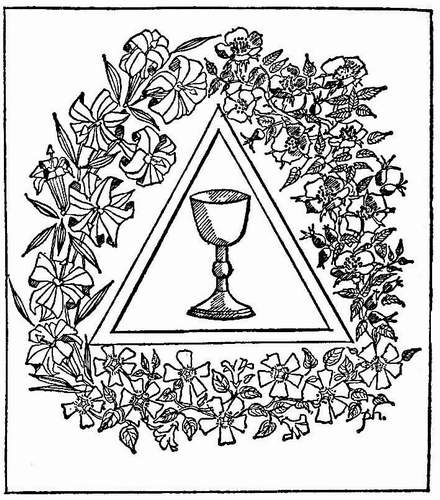
The loving cup
Most philters partake of this second definition.
The Puppet Spell given later in the chapter provides at excellent example of total completion of the circuit, using both object link and power object.
The chalice is dedicated to certain of the subtler powers of the unseen, which are considered feminine in relation to the more violent nature of those invoked in works of, say, wrath and chastisement; the chalice powers are invoked by means of a symbolism somewhat similar to that of the classical divinities of love, such as Venus and Amor. Indeed the chalice is obviously sexual in its implication of receptive passivity, as opposed to the more thrusting aggressiveness of wand and the Athame.
It would be truer to say that the witch symbolism of the chalice was rather more akin to that surrounding the elven-folk, the fays, and enchantresses of medieval legend, Vivian, Brisen, Nimue, Lady of the Lake, Morgan le Fay, and of course Melusine. The May queens and corn maidens of European folklore are all partakers of the same symbolism along with Greek Persephone and Euridice, retracing their steps to the underworld during the cold winter months when the sun has grown dark and the days short; the Lord of the Dead holds rule over the land for the first three months of the witches' year beginning on the first day of November, the Feast of All Hallows.
The Lady of Delight is known by many names among witches, some of them classical in inspiration like Diana or Hecate, or Celtic like Rhiannon; she is also known as Habondia, Hulda, and Herodias, and sometimes by other versions of the last name, Aradia, Ariadne, or Arianne. She is Mistress of the Moon as well as the realm of Venus.
In all your operations of romantic love it is her presence you must invoke, by any of the aforesaid names you may find significant—again a little mythological research will help you here. You should strive to contact the goddess before your spells of romantic love, by visualizing her clad in silvery garments, mantled in darkness wherein the stars dimly gleam, and with long streaming hair. She is crowned with a wreath of flowers and corn, while above her brow shines the lunar disk on either side of which rise two rearing serpents. On her right hand perches her symbolic bird, the white dove.
All flowers and blossoms, particularly those with a perfume, are sacred to the Lady, and before beginning the more complex operations of love it is as well to strew your altar with them. Apart from the associative symbolism of flowers, they also give off a subtle magnetism which is peculiarly in accord with works of this nature. No magical circle is necessary for these operations either, for the force invoked is benevolent rather than a hostile one, and as such need neither the sharp magical focusing nor the quality of incisive delineation provided by the Athame's traced boundary line No demonic entities or unfriendly departed shades are summoned in this type of witchcraft. All that is required is the purification of the place of working, and the spell itself.
Now all of these processes in this chapter are best per formed on a Friday around eight in the morning, three in the afternoon or ten at night, when the moon is waxing. Some truly astrologically minded witches claim that the moon should be passing through the first ten degrees of Taurus or Virgo and well aspected to Venus and Saturn as well, This, however, is not strictly necessary, although fully in accord with principles of medieval witchcraft. The observance of the correct moon's phase, suitable day of the week, and time of day, along with a firmly resolved intention, is all that is really necessary.
Among the first love spells you should acquaint yourself with as a beginner should be those classed under the heading "Philters."
This is the way they should be compounded:
Having observed the correct time of day, as indicated above, you must seal your place of working from all intrusion. In its usual, central position should stand your alt table, topped with its triangle cover; one angle pointing east as always. In the centre of the triangle should stand your cup, flanked with your lamps. The thurible should also be present on the altar, together with a box of suitable incense (the composition of which will be given at the end of this chapter). Finally the materials for your philter, a pestle and mortar such as is sold by any good kitchenware shop, and, of course, your workbook in which the spell has been previously written out.
Finally, surround the altar triangle with a circle of fresh flowers, preferably sweet smelling. These may be any that please you; freesias, narcissus or lilac, jasmine or carnations, anything you like, depending on your location and the time of year. The choice is yours. To a lot of witches, the rose seems a very good choice, as this blossom has always been considered most germane to matters of love, and a symbolic attribute of the Lady. Cabalistic legend has it that Balkis, Queen of Sheba, was a witch, and that the wisdom she came to question Solomon, King of Israel, about was magical in content.
... I am the rose of Sharon, and the lily of the valleys,
as the lily among thorns,
so is my love among the daughters...
The rose has been preserved as the Lady's emblem in the annals of courtly love and among the symbols of alchemy. The lily, however, passed directly into Christian Catholicism and became an attribute of the Madonna, which is only right and proper, as the Virgin Mary is but a Christian echo of an aspect of the Lady herself. However, due to this association, it is more to be considered a symbol of cool chastity rather than love or passion.
Having seen to your initial preparations, illumine the lamps and kindle the appropriate incense, chanting as you do such words of consecration as:
"In thy name, Habondia, and that of thy Ministers of Love, do I proceed in this work of Love."
Summon up the Lady's image in your mind's eye, also recalling such memories of past love as will serve to "turn you on" to the right wave length. What sort of memories can do this must be left to the reader's own discretion. You know your own past best. Having thus dedicated your operation and brought your deep mind to attention, you may now proceed with the composition of the philter.
The first, and simplest, love charm you should learn is one used for centuries by witches.
The Coriander Spell
Pour a small quantity of pure distilled water into the chalice, and count seven coriander seeds into your mortar. Pound these well and strongly summoning an image in your mind's eye of the person or persons that the spell is designed to affect, call their names aloud three times, and chant these words,
Warm seed, warm heart,
let them never be apart.
Then cast the powder into the chalice, imagining as you do so the full force of your desire entering it also. See it as a flame descending on the surface of the liquid. Complete the spell with the words "So mote it be!" and draw the seal of the triple cross in the air above the cup with your right fore-finger. Leave the herb to steep for about twelve hours; then strain the philter through fine muslin or cheesecloth and introduce it secretly into the food or drink of the person or persons the spell is desired to affect.
This spell is a good example of the use of a power object, as in fact are all the following philters. Now which of the philters will be most successful for you to use is going to be a matter that you should experiment with on your own account. Some witches swear by the Coriander Spell, other have more success with the following:
The Periwinkle Spell
Having observed the correct time of the month and day and prepared your place of working in exactly the same manner as for the preceding Coriander Spell, assembled your ingredients, kindled the thurible, and invoked Habondia:
Take dried leaves of periwinkle (Virica major or minor), Mercury herb, Cinquefoil, vervain, and rose petals, place them in your mortar and grind them to a fine powder. Repeat as you do so, over and over, a jingle to declare your intent such as, "By this act I draw [name] and [name] into a bond of love and desire." Then taking two very small pinches of the resultant powder, mix them with the water in the chalice, again charging it with the full force of your crystallized libido, and again sealing with the triple cross and the words "So mote it be." Leave the philter to steep for twelve hours, strain through fine muslin or cheesecloth, and introduce it secretly into the food or drink of those named in the charm.
Generally speaking, I think you may find this the more successful spell of the two, owing to the potency of the ingredients, which the coriander, although mildly effective by itself, cannot hope to compete with.
Finally, there is the True Love Philter. This has been with us a long, long time, and is no less effective than the former potion, when properly used, but is rather less employed owing to the scarcity of one of its ingredients, namely mistletoe berries, rare at most times save Christmas. You will generally find magical practitioners avidly buying up mistletoe when it appears in the shops around December, and not putting most of it to decorative uses, either.
The procedure adopted for composing this philter does not vary from that of the Periwinkle Spell, save in its ingredients, which are:
Dried seeds or flowers of elecampane
Dried vervain leaves
Dried mistletoe berries
Pound and mix with the water in the chalice exactly the same way as you did in the Periwinkle Spell.
The process of actually introducing a few drops of the philter into the food or drink of your victims is an art in itself. If you are a witch given to cookery, the process can be made relatively simple. Should you be on sufficiently good terms with your intended victims, and of course a sufficiently well-accepted cuisiniere, the gift of a few home-baked cookies or even a chocolate souffle may not be considered unduly strange.
Of course, the ideal method of introduction is by simply dining or taking refreshment with your intended subjects, and dexterously laying your spell during the evening when you are not observed. Of course, you must be extremely circumspect about your actions lest you get known for this kind of activity; you may then begin to find you are mysteriously losing friends, despite the fact that they may be finding themselves beginning to take an equally mysterious delight in each other's company.
Should neither you nor the person who requests your services as a witch be a dab hand at cookery nor feel yourselves sufficiently nimble to sprinkle a few drops of your philter into your subject's food or drink, then never mind; there is another possible way of accomplishing your ends. Buy a pack of cigarettes of the brand you know your victim to smoke, and with a small eye-dropper, introduce a few drops of the philter onto the tobacco of each cigarette. All that remains is that you or an accomplice offer your victim a friendly cigarette: Your aim is thus very neatly accomplished.
There are any number of other ways of solving this simple problem, and I shall leave it to your resourcefulness and imagination to devise them for yourself.
Witches, of course, have been famous for supplying love potions and philters throughout the ages. Notable cases like La Voisin in Louis XIV's time spring to mind. A lot of them, including La Voisin, often employed revolting ingredients in their mixtures, like powdered toads or the desiccated dust of moles, usually whipped together with a good helping of some highly poisonous aphrodisiac like cantharides, the notorious Spanish fly. This was, and still is, a sure telltale giveaway for the inefficient witch. The bludgeoning effect of drugs is the last resort of the ineffectual spellbinder. Witchcraft is effected by magical art, not chemical means. Always remember that in your workings.
Most of the simple though traditional love spells that clutter up the workbooks of older witches tend to be rural charms mostly unsuitable for the modern urban witch who lives in an apartment in New York City, or a semidetached in Croydon, England. Some of them, however, preserve the real flavour of old-time witchery, and as such deserve mention in passing.
One making use of the second law of direct transmission is the
Willow Tree Spell
On a Friday morn (8 a.m.) when the moon is waxing, dig the earth out of the footprint of the one you would have as a lover and dig it into the soil surrounding the roots of a willow tree, chanting the following charm as you do:
Many earths on Earth there be
whom I love mine own shall be.
Grow, grow willow tree
sorrow none unto me.
He the axe, I the helve,
he the cock, I the hen:
As my will, so mote it be!
Another charming one of similar ilk is
The Apple Spell
Apples being a fruit sacred to Habondia, it is entirely appropriate that they should figure as much in love magic as they do. Here is the original spell translated from the workbook of a German witch in rhyming couplets:
On Friday early as may be,
take the fairest apple from the tree,
then in thy blood on paper white
thine own name and true love's write.
That apple thou shalt in two cut
and for its cure that paper put,
with two sharp pins of myrtle wood
join the halves till it seem good.
In the oven let it dry:
And wrapped in leaves of myrtle lie,
under the pillow of thy dear,
yet let it be unknown to her.
And if it a secret be
she soon will show her love for thee.
Myrtle, like the apple, is also sacred to Habondia; also the spell is true to all the usual witch principles in its insistence on the fact that it must remain a secret, and the two apple halves with the paper sandwiched between remain undiscovered by the victim.
Another simple piece of old-time sorcery you might care to try is the
Tormentil Spell
This can be performed as it stands of with full ceremonial chalice preparation as used for your other philters, among which it may be grouped. I place it here rather than with the others on account of the rarity of the herb itself, which though once commonly stocked by herbalists for its astringent properties, is now something of a rarity and, as such, only deserves mention among our quainter reminders of bygone days.
Pound or grind to powder the root of Potentilla tormentilla, repeating the name of the person you desire over and over as you do.
Then take a pinch of powder, and with it, either compose a philter in distilled water, or drop it into the person's food, uttering these words as you do.
Tormentil, Tormentil,
make [name] subject to my will.
Be he bound, or be he free,
as my will, so mote it be!
Personally, I have never tried this spell, not ever having had the luck to obtain any tormentil. There may still be some around in out-of-the-way herbalists. If you ever get the chance, buy some and try it. It used to be a sorcery much attested to a century ago.
The Sator Spell
Here is an experiment of love which makes use of a simple written talisman to be carried by the person who wishes to be the object of desire. It is a spell which does not make use of the law of transmission, however, but rather acts as a "booster" on the deep mind of the supplicant.
For a change, this process borrows from Christian symbolism rather than the other way round. However, you do not have to be of Christian persuasion to make use of it. It has been in existence long enough—nineteen centuries in fact— to gather round it a potency as a love spell quite independent of its early ecclesiastical origin. The good use it has been put to down the years by practitioners of the craft is ample evidence of that.
The name of this particular piece of Magic is the Sator Spell. The words of the charm itself probably derive from the words Pater noser and "A. O." standing for Alpha and Omega, the first and last letters of the Greek alphabet. Pater noster is the Latin for "our Father," the first words of the so-called Lord's Prayer. "Alpha and Omega" is one of the many titles bestowed upon Jesus by the early Christians, meaning the "first and the last," a reference to his attributed divinity. These words were sometimes formed into an equal-armed cross, which symbol though pagan in origin, as has been already mentioned, became a suitable stock on which to graft the newly arrived cult symbol, the Latin or cross of crucifixion. This emblem was then used as a code sign among early converts.
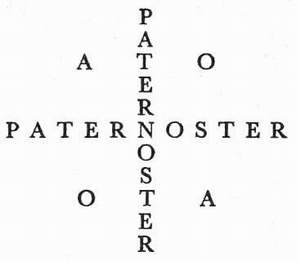
However, prior to the formation of the Holy Roman Empire, the early Christians themselves were subject to great persecution, and someone hit on an ingenious method of continuing the use of the Pater noster code sign and still utilizing all the letters comprising the cross, but cunningly forming them into an acrostic which was at the same time a palindrome. That is, a square of words which reads the same across as it does down, and also can be read backwards to the same effect.
| S | A | T | O | R |
| A | R | E | P | O |
| T | E | N | E | T |
| O | P | E | R | A |
| R | O | T | A | S |
So successful and satisfying was this formula, that it was joyfully seized upon by the practitioners of the Black Arts, and turned to excellent account, particularly as a love spell, which it is now generally known as and much
renowned for.
The method used in preparing this spell is as follows.
Select a Friday with the moon waxing and choose your time, either 8 A.M., 3 P.M., or 10 P.M. Then, your altar dressed in the usual manner for amatory workings, purify the chamber with fire and water, with the regular Habondia invocation and attendant images. Then take a sheet of clean, white paper such as you used for your square of Mercury, and after exorcising it with water and fire, divide it up into twenty-five equal squares, five down and five across with your pen and ink of art. Then chanting a suitable jingle phrasing your intention with each letter that you inscribe, such as, "[name of person whom spell is cast for] greatly desired and strong in love!"
Write the letters of the acrostic into the square in the following order, beginning with number 1 and ending with 25, as usual injecting into it all the force of desire and yearning you can muster.
| S | A | T | O | R | 9 | 1 | 4 | 13 | 19 | |
| A | R | E | P | O | 3 | 12 | 24 | 15 | 21 | |
| T | E | N | E | T | 23 | 18 | 20/7 | 5 | 10 | |
| O | P | E | R | A | 8 | 2 | 11 | 25 | 16 | |
| R | O | T | A | S | 6 | 26 | 17 | 14 | 22 |
Begin at number 1, A, and end with number 26, O. The centre square, N, should be written in seventh, and written over again twentieth. When you have finished, seal the charm with the triple cross and "So mote it be!"; wrap it in a piece of clean cloth or place it in a box, and bury it in the earth for a day and a night, if possible at a crossroads or a place where two paths meet. A crossroads or churchyard is the traditional place, but a flowerbed or ordinary patch of ground where two paths cross will do. When the twenty-four hours has elapsed, remove the talisman from the soil, and give it into the keeping of the person it is to benefit.
During the time they wish to receive its aid, they should carry it on their person and sleep with it under their pillow. The spell will not last forever, though. It is only good for about twenty-eight days, and then a new talisman has to be constructed.
A very simple though sometimes extremely successful magic for the witch with a green thumb is
The Hyacinth Spell
Actually, this may be performed with any type of bulb from a tulip to an onion! Habondia being the patroness of all flowers, however, a sweet-smelling variety stands more chance of success, I always feel.
Plant the bulb in a new pot, naming it as your loved one as you do Every morning and evening when you water it, chant these words intently over it.
As this root grows
and this blossom blows,
may her heart be turned to me.
As my will, so mote it be!
A Planetary Spell
Finally, in this section of romantic love, here is a traditional Cabalistic spell, which operates by invoking the aid of Sariim, princes or intelligences attributed to the heavenly bodies, in this case Mercury, the moon, and Earth itself who rule over and direct the demonic cohorts. The Cabalistic titles conferred upon these powers are, of course, a thin disguise for those original watchers, or witch-entities, with which you are beginning to become acquainted. Two of these you have already been introduced to, namely, Herne, the Wise One, and Habondia, the Lady of Delight, subject of the present chapter. The third you have yet to meet—the Earth Power, which we will deal with in the following chapter, which is devoted to the construction of the pentacle and mandragore, among other things, and deals with the problems of protection, counter-magic, and general well-being.
Because of the fact that this spell calls upon the powers of genuine witch entities, albeit under a Cabalistic guise, and contains some rather pleasing imagery, it is made use of frequently by poetically inclined witch novices. In my opinion it is somewhat verbose, as most Cabalistic workings tend to be, but here it is.
You will need a clean sheet of talisman paper, your pen and ink of art, one of your lamps of art, your cup of water, salt and rosemary, and your thurible containing a suitable amatory incense.
Select a clear night when the moon is waxing and shining brightly in the sky. Having made sure you are alone or that your only other companions are witches like yourself, place the paper in your altar triangle, and draw the following diagram on the paper with your pen and ink of art. Pass it through water and fire, naming it with the name of the person you wish to influence. On the reverse side of the talisman, write "Melchidael Baresches."
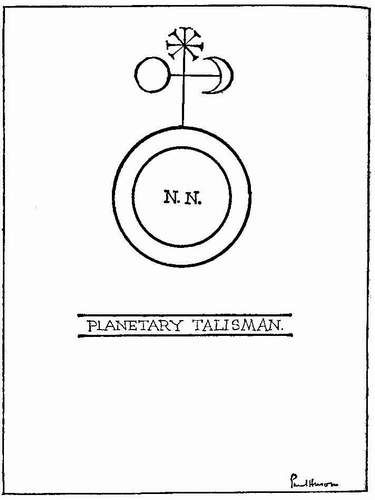
Now if you have a garden or very secluded backyard, you can perform the whole ceremony out of doors. If not, perform the ritual up to the point indicated above indoors, and complete the following outside.
Search out the moon in the sky, and then observe which is the brightest star close to it. Having done this, place your parchment on the ground, bare earth or grass as opposed to concrete or asphalt, if possible. Then cover the parchment with your right foot and bend your left knee to the earth. Then take your workbook containing the spell in your left hand (it's better to learn it by heart if you can), your lighted lamp of art in your right and, seeking out the moon and star with your gaze, pronounce the following incantation three times:
I salute and conjure you,
O beautiful Moon, O beautiful Star,
O bright Light which I hold in my hand!
By the air which I breathe, by the breath which is within me, by the earth which I touch, I conjure you. And by the names of the spirits who are princes residing in you; by the ineffable name On, which hath created All; By thee, O resplendent Angel Gabriel, together with the princes of Mercury and Earth, Michael and Melchidael!
I conjure you again by all the divine names of God, that you send down to obsess, torment, and harass the body, spirit, soul, and five senses of the nature of [name of victim] that they come to [name of supplicant] at [such and such a time] and do accomplish his [her] will, having no friendship for anyone in the world especially for [name of supplicant]. So long as he [she] shall be indifferent to [supplicant] so shall he [she] be obsessed, so suffer, so be tormented. Go then promptly; go Gabriel, Michael, Melchidael, Baresches, Zazel, Tiriel, Malcha, and all those who are with you. I conjure you by the great living God to accomplish my will, and I [Witch's name] do promise to satisfy you duly!
Having repeated this thrice, cast amatory incense upon your thurible coals and, rising from your kneeling position, stand the lamp of art upon the paper, and leave it to burn down and extinguish itself.
On the morrow, give the talisman to the person who requested it, and have him place it in his left shoe or otherwise carry it about his person until such a time as the spell takes effect and the victim seeks him out.
As for the Cabalistic names for Mercury, the moon, and the Earth, Michael, Gabriel, and Melchidael are traditionally the angels assigned to these spheres. Tiriel and Malcha are the intelligences assigned to Mercury and the moon respectively, while Baresches is in all probability the past part of Malcha's complete Hebrew name which has become detached and turned into an entity in its own right. "Malcha Be Tarshishim va A'ad Be Ruach Shechalim." The name Zazel is that of the spirit of the planet Saturn, here doubling for the Earth. In astral or sidereal magic which deals with a heptadic or sevenfold planetary scheme, the Earth powers are generally classified and invoked under the aegis of Saturn.
The worst thing about this charm is its verbosity, which far from stirring your deep mind into activity, may in fact only succeed in lulling it back to sleep. The redeeming qualities of the process, however, lie in its firm basis in witch principles, with its invocations of the powers of the earth, moon, and star Earendel, with the moon representing the Lady as initiator of Desire. Incidentally, I omitted to mention but by now it should go without saying, when you utter the invocation to the star mentally summon up your Mercury symbolism from Chapter 3, and when you invoke the moon, concentrate on Habondia and her attendant images. For the Earth, which I will deal with in the next chapter, summon up in your mind's eye an image of all growing things; of plants and mosses and great ancient forests, of the smell of peat and loam; the darkness of cellars and caves, the silence of gardens at night at the abandoned overgrown churchyard. Think of all horned and hoofed animals, also.
Above all, be aware of the earth beneath you.
The Love Dream
A traditional variant of the Dreaming True Spell is that of the St. Magdalene's Eve Spell, which date, incidentally, is held by witches to be sacred to Habondia, no less.
In order to perform this operation, which traditionally should be done only on St. Magdalene's Eve, July 22, and the aim of which is to procure a dream of a loved one, rather than one of knowledge, prepare a bath in the same manner as in the Dreaming True Spell mentioned in the last chapter, but under your pillow tuck a sachet of St-John's-wort (hypericum) and a piece of paper on which has been inscribed the name of your beloved.
Prior to turning your light out, drink a potion composed of half a cup of distilled water, three drops of white wine, three drops of gin, three drops of vinegar that has been stirred with a sprig of rosemary. This should be mixed in your witch's chalice.
Then dream on!
Amatory Necromancy, The Dumb Supper
Finally, to conclude this section on romantic love, I shall deal with the second type of operation which comes under the definition of necromancy, and as such was mentioned previously in the chapter on divination. The operation of amatory necromancy is known among witches as the Dumb Supper. It can, however, be utilized for two purposes; the first being the evocation of the shade of a dead loved one, the second the calling forth of what is known as an eidolon or wraith, the spectral apparition of a future loved one or spouse.
Whether the operation is of the necromantic or eidolon variety does not change the central ritual, the Dumb Supper proper. The only difference lies in the thirteen days preparation for the necromantic variant, similar to that of the necromancy of intelligence.
In common with all the other amatory operations aforementioned, no boundary circle will be needed for this rite; even if the work is one of necromancy, the constraining ties by which the shade is summoned are those of love and affection and one will not be dealing with a potentially hostile entity.
Should you, in fact, be calling the shade of a dead loved one, you should time the operation to coincide with some date which was in some way auspicious to him—the day of death, birthday, wedding anniversary, or whatever. Some time which you feel that the soul of the deceased, in whatever state of consciousness it may have passed into, may still dimly be aware of; a time when the ties of Earth may yet exert some slight influence on it, however weak.
Prior to summoning, you should arrange a commemorative shrine facing east on the west side of the room in which you plan to do your magical working. This should be composed of a photograph or portrait of the deceased, veiled with a dark cloth and flanked with flowers which should be changed from time to time, and any object links or personal mementos of the deceased that you might have.
Exactly at midnight on every one of the thirteen preparatory nights, seal yourself in your place of working, light one of your lamps of art in the east of the room, unveil the portrait, kindle a small amount of amatory necromancy incense in your thurible, and seat yourself facing the picture with the light streaming from behind you. Inwardly, call the person by such names as you knew him by, while keeping your eyes fixed on the picture. Try to recall the incidents you can wherein you shared moments of affection or love with the deceased. Continue your meditation for anything from ten minutes to one hour before extinguishing the lamp, redraping the portrait, and so concluding.
During the thirteen days of preparation you must also try to seclude yourself from company as much as possible, even from that of other witches, reserving most of your affections for the memory of the dead person. This can be very difficult, but it should be persevered in. It is, in effect, the sounding of a preliminary, gentle call into the unseen to the shade of the departed one, which builds each evening at your meditation, culminating finally in the actual evocation ceremony.
When the night of evocation arrives, having eaten no supper nor partaken of any refreshment since sunset, just before the hour of midnight strikes, arrange your place of working in the following manner:
Cover your altar table with a new, white, exorcised cloth, and place a chair at the west side of it facing east, and one opposite, facing west. On the table, place a bouquet of sweet-smelling flowers. Then light two of your lamps before the portrait, and kindle your thurible, burning amatory necromancy incense.
Consecrate your place of working now, walking backwards beginning at the east, passing to the south, the west, and finally the north, asperging and censing as you go, and calling upon Habondia to aid you in this work. Every action in the ceremony must be performed silently and backwards for only thus do we begin to walk in the paths of the dead.
Having got this far, you must now lay two place settings at the table, yours in the east, the deceased's in the west, using your ordinary household dish service and cutlery which should have been passed previously through fire and water. The settings should be sufficient to provide for the normal amount of courses you would serve at a regular dinner for two if you were serving it, preferably of the type of food you know was favoured by the deceased. It should also include a glass for wine, beer, or whatever beverage the deceased enjoyed drinking with meals. You must now proceed to serve the food, again walking backwards to and from the kitchen, and always as silently as you can. When you serve the food, you must serve only very small portions, a quarter of the amount you would regularly eat, as it is a symbolic gesture only: The dead are very light eaters!
You should allow sufficient time for the first half of the operation in order to reach this point just as midnight arrives. As the hour strikes, approach the portrait, backwards as always, slowly unveil it, and mentally repeat the necromantic grand citation to yourself as you do so:
By the mysteries of the deep, by the flames of banal, by the power of the east, by the silence of the night, And by the holy rites of Hecate, I call thee by the ties of love, Spirit of [name of deceased] to break thy eternal fast with me. So mote it be!
Then, after replenishing the incense, move backwards clockwise round the table to your seat and begin to eat your portion of your supper. As you do this, avoid looking directly at the seat opposite you. This is most important. If you break this rule, you can effectively nullify the spell. The temptation is enormous but must be resisted strongly.
When you have finished your repast, leave the dishes as they are, and walking backwards, replenish the incense and extinguish the lamps at the portrait, still avoiding staring directly at the chair in the west. Then return to your own. Close your eyes, call the deceased's name three times, and then mentally repeat the words of the great necromantic charge: "Allay Fortission Fortissio Allynsen Roa!"
With your eyes still shut, mentally welcome the loved one. Traditionally, this is the place where the shade will manifest. You should slowly open your eyes and see what you can see. Again, as in the necromancy of intelligence, this will depend on the stage of your development. Communication with the shade theoretically can be carried out mentally; most witches find that this takes the form of a peculiar wordless communion, a sort of spiritual osmosis or blending together of ideas, your own, and that of the deceased. Even if your inner eyes are not sensitive enough to perceive any form, or the current raised by the operation is not sufficiently strong to bring about a materialization, it can nevertheless be a very unnerving experience to find yourself confronted by someone loved, but long dead, and in such intimate contact again that your very minds meld together. Allow yourself to enjoy this silent communion without reservation. The time will pass all too quickly. When you have fully enjoyed, or been duly horrified by, whichever the case may be, the manifestation or, alternatively, when the experience begins to dwindle like a dream as the hour of midnight passes and the magical current slackens, repeat the licence to depart silently to the shade:
Go, go, departed shade [name of deceased]
by Omgroma Epin Sayoc,
Satony, Degony, Eparigon,
Galiganon, Zogogen, Ferstigon,
we licence thee depart into the proper place
and be there love between us evermore.
So mote it be!
Cast a few more grains of incense on the coals as you silently bid adieu.
Finally, before you finish for the night, complete your magical record, as always.
Now, as I mentioned before, some witches claim this very same ritual can be used to evoke an eidolon of one's future loved one. This is a form of summoning of the living. The only difference between this and the necromantic version just described is that the summoning of the eidolon omits the thirteen days preliminary preparation. It is, morever, a tricky operation for beginners to perform and also a somewhat untrustworthy one, as there is obviously no object link possible, save for the operator's tenuous emotional link with the future.
This may strike some as the last word in absurdity, but if you pause to reconsider the parapsychic phenomenon of precognition as we did in Chapter 3, you will realize that for a witch who deals wholly with the world of the paranormal, the laws of time as well as space as we know them in our everyday lives do not necessarily apply.
The time to employ this ritual of evocation of a future loved one is traditionally midsummer's eve, the night of June 20, just before the summer solstice.
On that note, I shall end this first section of spells for lovers. The following pages will deal with spells designed for the more impetuous practitioners.
Part II. Sex Magic
In the contemporary world of instant sex without romantic preamble, the modern witch may not have the patience required for the more dated "Loving-Cup" approach. In other words, she will be seeking for some magic which, if Habondia's charms prove too lightweight, would allow her to be swept off her feet literally and metaphorically.
The key to success in this area of magic lies in our old friend, the witches' pyramid. Our chief weapon is none other than the potent will itself. Of course, we are dealing here with the art of bewitchment proper, sometimes known as the evil eye. But let us call it by its real name as used by practitioners themselves:
The Art of Fascination
In order to understand this mysterious process, by which you will be effecting your more lustful ambitions, we should first glance briefly at the theory which underlies the practice.
The art of fascination, in itself an integral part of all witchcraft, can take many forms, ranging from the simple matter of "binding" someone (enforcing one's will), to the more exotic and difficult practices such as the "binding" of animals (snake charming), and control of physical phenomena like the gathering or splitting up of clouds (weather working) and controlled poltergeist phenomena (smashing windows, levitating ashtrays, etc.).
The human body radiates energy, which forms an egg-shaped cocoon about it which modern occultists call the aura. Exactly what the nature of this energy is and where it comes from we don't know; the prevalent theory among witches is that it is produced via the nervous system. It is known variously by the names od, odyle, magnetism, telergy, or simply witch power.
Red-haired people are said to possess this energy in free-floating form available for projection more than any others, hence the awe and fear that the red-headed witch has been held in from the time of ancient Egypt down to the present day. Set, the sorcerous brother of Osiris, was reputed to have had red hair; back in the old country in the eleventh century William Rufus (son of William the Conqueror) was publicly much feared on account of his connections with witchcraft, red hair, and the evil eye! Today the red-headed witch has become something of a cliche, but the origin of the belief is rooted in centuries of witch knowledge. If you have red hair, you are lucky indeed!
This energy, or witch power, is in fact what you have been using all along to empower your rituals. It can, however, be used without the assistance of a spell, if you learn how to project it correctly. This projection is known as fascination. Generally speaking, the power can be projected by strong mental action alone. However, most practitioners find it much easier to do when accompanied by a gesture of some sort.
Strangely enough, witch power seems to be more strongly emitted from some areas of the body than others. These are: the eyes, the mouth, the hands, and the genital organs. Because of this fact, the gesture has a more important function than merely a psychological prop for the practitioner. In fact, when you wish to exercise your witch powers directly, especially in sexual matters, there are three things you should endeavour to do:
1. Fix your victim intently with your eyes.
2. Get into manual contact with him.
3. Contrive to breath on him somehow.
No doubt these things will all be second nature to the seasoned seducer, but magically speaking they do enable your power to make contact with your victim more easily.
Here is a brief quotation from a witch's old workbook on the subject, which though archaically phrased gives a very good description of the basic eye practice:
For when your [the witch's and her victim's] eyes be reciprocally bent one upon the other and are joined beams to beams, and lights to lights, then the spirit of one is joined to the spirit of the other and strong ligations made - And most violent love is only stirred up with a sudden looking on, as it were, with a Darting Look, or piercing into the very inmost of the heart! ...
While trying to fulfil conditions 1, 2 and 3 you will stir your deep mind, summoning all the pyramid powers into activity, letting your imagination run on a lustful rampage, bending your basilisk gaze upon your victim with all the intensity of a burning will held steady by the hand of faith, the while maintaining that enigmatic secretive smile which is the trademark of your craft.
An old dodge used by witches for pumping up the power to its required intensity is the use of rhythmic breathing. Here we make use of two principles: The oxygenation of the blood to bring increased energy, but more importantly, the mental tying of the in-and-out breathing with the pulse of the bloodstream and acceleration of it accordingly. This has the effect of quickening the metabolism, and generally enhancing the output of nervous energy available for conversion into witch power.
The ideal way to employ your powers of fascination are, of course, if you can get your prospective victim onto home territory; the witches' lair! Invite your victim round for drinks and dinner, hopefully with the moon waxing on a Friday, though this isn't generally necessary. Friday, apart from magical consideration, is a good night, as your victim in all probability won't be pressured to rush off after dinner on the pretext of work the following day!
Put him at his ease, serving cocktails before dinner if you like but keeping everything casual and intimate; use candlelight if possible. Wear a dab of your Cernunnos perfume. (See end of chapter.)
Prepare the dinner yourself. This will provide you with an ideal opportunity to employ your philters. But don't overdo them. You don't want the food or wine to acquire a strange taste.
The meal itself might well consist of a juicy meat dish, as rarely done as you can manage it, well-garnished with sage, thyme, or coriander philter powder, and maybe served with a crisp side salad containing such amatory vegetables as endive, parsley, raw carrots, and apples; chilled tomatoes stuffed with basil can also be a good thing to serve.
Of course, oysters and champagne are excellent in these matters, but you should first take the trouble to find out whether your victim appreciates them. Some unfortunate souls find them nauseating even to contemplate, and this is hardly the frame of mind to cast your future lover into at the beginning of the evening! It might be well to find out exactly what your victim's tastes in food actually are before you even embark upon the meal, and vary your menu accordingly. One of the surest ways to a person's heart is through the stomach.
Apropos of this, at the end of this chapter you will find a full list of amatory herbs and plants which you may be able to weave into your cooking.
For dessert you can deliver your whammy. Cardamom apple pie! Both cardamoms and apples are extremely magically potent in matters of love, and can be readily combined in this very acceptable and homey recipe.
After dinner, philters can again be ever so subtly introduced into liqueurs. These should be drunk in a room which you have previously fumigated with a suitable love incense; the lights should be low, and music may be playing very softly in the background.
You should contrive to place your victim so that he is seated with his back to the west. You should be in the east, the place of power. You may now begin your process of fascination, secure in the knowledge that he is all but yours for the taking.
At this point, you must introduce your eye technique. How to catch your victim's gaze with your own is a matter of individual preference. Some witches still use the old dust-in-the-eye dodge. Others just fix their gaze rudely on the point between the eyes of their victim without more ado. In my opinion this is die best way - the frontal attack!
Should he - I say he; it will be she if you happen to be a warlock - should he, in fact, sternly resist all your attempts to catch his eye, then you can only conclude that maybe he has guessed what is afoot; you should then immediately pass to phase two of the operation, manual technique. This is effected by the introduction of an exterior object of some delicateness or precision, which will be placed in his hands for closer scrutiny. Your witch jewel loaded with your magnetism is ideal for this. Now while he is examining this, you must take the opportunity to settle close enough to him to initiate and maintain some form of manual contact with his body, beaming all the concentrated force of your witch power into him through the link, whether it be shoulder, waist, knee, or even more intimate parts.
Should he by some devious process manage to elude your grasp, move directly to phase three, breath technique. In order to do this, you must arrange yourself in such a way that you can actually breathe on him, preferably near his face and ideally into his mouth, again powerfully emitting the full radiance of your witch power through your open lips. At this point, you will probably have gained full ocular contact at last, so you may also use this additional channel for your powers of sorcery.
Having got thus far I would say you are off and away. All that remains is that you turn the conversation instantly to matters of sex.
However, if all else fails, I can only suggest you resort to the use of one of the following spells.
Not everyone is always immediately successful at fascination, inasmuch as the powers of the pyramid need practice and application before they can be switched on and off at will. But keep working at it! As I say, all things yield to perseverance, matters of love no less than anything else.
Should you gain no appreciable result the first time around, one of the following spells will aid you in your entrapments. The last two are very potent and can be of considerable help to the lustful though maybe as yet unfascinating practitioner.
The rituals themselves in this area of magic are ruled by a very different power to Habondia. In fact, we are dealing with her consort, the Horned One, in medieval times claimed by the church to be none other than Satan himself. The attribution is merely scholarly, however, as the Horned One existed long before Christianity came into existence, with its concept of the devil. Whereas Habondia's symbol is the dove, Old Horny's is the goat. To students of symbolism, this attribute should speak for itself. The goat is the age-old representative of lust and debauchery, and Cernunnos himself, for such is his witch name, is frequently represented as possessing the cloven hooves, horns, and erect phallus of his attribute.
His symbolism has much in common with that of the Greek god Pan with his attendant satyrs and silenoi and the prehistoric phallic giants carved into the turf in various places around England such as the Cerne Giant and the Long Man of Wilmington. He is the god of the dead, winter, and chaos, and it is from this aspect that he derives his title, the Lord of Misrule. Herein he is characterized as the King of Debauchery and Licentious Frolic. The mid-winter festival of Saturnalia is dedicated to him, and witches celebrate this about the same time that Christians celebrate Christmas.
Whenever you wish to perform a spell whose object is to boggle someone's mind with lust, you should invoke holy Cernunnos with all the powers of the witches' pyramid. Instead of Habondia's flowers, however, upon which Old Horny tramples joyously, you should surround your altar triangle with pinecones, evergreens, and the horns, teeth or hooves of animals which are all especially held sacred to the god.
We are not dealing with the gentle mystery and twilit glamour of Habondia's womanly enchantments, but rather the darkness of the Wildwood, the trampling and snorting of the god of beasts, and those rude and basic facts of life, the rearing phallus and the hungry vulva.
To begin this section on lust, here is a small traditional spell, more suitable for performance by the male warlock, to stir up the baser passions in a lady. It is not much in use nowadays for obvious reasons, but it is quaintly illustrative of the use of the principle of direct transmission. Though there is no ritual to speak of here, nor any invocation to the Horned One, he and his ministers are definitely present in the warlock's mind when he makes use of this charm.
The ingredients for this sorcery are simply a bitch in heat and another male dog, plus a small, attractive looking glass such as the warlock knows will prove acceptable to the object of his lust. Now the trick of this spell lies in arranging that the two dogs couple on a Thursday around the hour of 8 A.M., 3 P.M., or 10 P.M.; having arranged for this accordingly, you must then contrive to catch the reflection of the copulating dogs in your looking glass, uttering this spell forcefully as you do so, and bending your basilisk gaze on the scene before you:
I the dog and she the bitch,
I the helve and she the axe,
I the cock, and she the hen.
As my will, so mote it be!
Having done this, hopefully without exciting too much attention from your neighbours, either present the loaded looking glass to your future ladylove as a gift, or in some way induce her to gaze into it. One look and she will be lost to you. Be prepared to have the clothes torn from your back.
The rituals of this section are also best performed on a Thursday, a day held sacred by witches to the more aggressive approach to love, again at 8 A.M., 3 P M., or 10 P.M. Unlike any other spell you have performed before, however, you will be employing a grand triangle of manifestation, and the instruments of power will be your Athame and chalice; the altar should be decked with animal horns, evergreens, and so on.
Now the first spell that utilizes the awesome power of Cernunnos is a process which exists in at least fifty variants in the witch world; it is known by the rather inoffensive name of the Love Knot, a tame title for such a dramatic piece of sorcery. Its object is to render the performer the object of overwhelming lust for another stated person. It can have a backwards and destructive method of employment which we will return to in a later chapter under the heading of "Ligature"; but for now I shall dwell on its positive aspect.
Whereas simple love philters will generally only conjure sweet yearnings of tender passion (unless of course heavily dosed with aphrodisiac drugs), the Love Knot is highly potent traditionally, when it comes to unashamedly stirring up lust, and is often used as a last resort along with the Puppet Spell.
Like many other really powerful spells, it introduces the element of time into its working; water cannot break rocks swiftly, unless used in great quantities, but a steady drip-drip can do wonders with erosion. Often the deep mind is far more receptive to the drip-drip variety of persuasion than it is to the blockbursting approach of instant all-out magical attack.
The Love Knot Spell
All you have to do to accomplish this piece of witchery is to possess yourself of a few hairs from the head of the person you seek to influence. A hairbrush and comb is the most likely place to look for these. People are apt to get suspicious, rightly so as it happens, if you smilingly produce a pair of scissors and blithely purloin a lock of their hair.
Prepare your place of working as already indicated with pine-cones, ivy, evergreens, and horns. In your thurible, burn one of the Cernunnos incenses suggested at the end of this half of the chapter; in the chalice pour a few drops of red wine. On the floor, with the point of your Athame, trace around the edges of a large equilateral triangle, big enough to contain yourself and the altar and allow you plenty of room for movement. This should be marked out with white tape beforehand.
Begin the spell by chanting the following ancient invocation to the Horned One, starting in the east and repeating it to each quarter, travelling clockwise.
As you do so, cense and anoint each side of the altar table with a dab of wine from the chalice. This in effect is consecrating the triangle to the service of Cernunnos.
At the same time, try to visualize yourself as standing in a small clearing within a vast, dark forest. The tops of the tree close far above you over your head, and through the green twilight you can hear in the distance the trampling and occasional cry of a wild beast as it crashes through the undergrowth. It seems to be approaching the clearing in the trees where you stand, drawing ever nearer each time you face another quarter to repeat your invocation. Now you can even smell the rank goaty smell of the beast! It is Cernunnos himself, the Horned One in his dark semianimal form with rearing antlers and erect phallus, eyes burning like coals in the forest gloom. Finish your call to the north, and see him vividly in your mind's eye standing in the east outside the perimeter of your charmed triangle. You may visualize him as the classical god Pan, the Sabbatic goat or even as that figure of Elizabethan romance, Robin Good-fellow, or Puck. These are all but faces worn by Cernunnos, god of the witches!
Invocation to the Horned One
Eko; Eko Azarak! Eko; Eko Zomelak!
Eko; Eko Cernunnos! Eko; Eko; Arada!
Bagabi lacha bachabe;
Lamac cahi achababa,
Karellyos!
Lamac Lamac Bachalyas;
Cabahagy Sabalyas,
Baryolas!
Lagoz atha Cabyolas;
Samahac atha femyolas,
Harrahya!
Return to the east, and facing west across the altar, gather up the three pieces of twine and consecrate them with incense and wine in the name of the Horned One. Then knot the ends of the twine and braid them together, binding the hair into the plait as you do. Summon up the image of your victim in your mind's eye as you do this, repeating this quaint jingle over and over:
Lord Cernunnos I ask of thee,
let [name] no pleasure, sleep, nor solace see,
till heart and loins be turned to me!
When the cord is woven, tie the free twine ends together forcefully with the words:
As my will, so mote it be!
No triple cross of sealing is necessary here since the tying action is forceful enough on its own. Fasten the finished cord around the upper part of your thigh if you are a woman or around the genital organs themselves if you are a man, tight enough not to slip, but not so tight as to restrict the circulation of the blood. This would only be self-defeating. Wear this cord, or cingulum as we call it, for twenty-eight days, removing it only for showers or bathing.
Should no appreciable result have occurred by this time, you up the ante, so to speak, and set the seal on the magic by performing this final part of the spell:
Prepare your place of working with a large floor triangle again and with the usual arrangements of lamps, incense, and pinecones on the altar, making quite sure that the thurible contains a good quantity of glowing charcoals. The chalice should be back again in the triangle, this time containing a few drops of olive oil, red wine, honey, and your own blood or urine.
Then invoke Cernunnos at all four quarters as previously. Remove the cord and tie nine knots along it, beginning with one at either end and working in pairs towards the centre, where you should place the final one. As you do this, repeat your charm with each knot:
Lord Cernunnos I ask of thee,
let [name] no pleasure, sleep, nor solace see,
till heart and loins be turned to me!
Finish on the last knot with "As my will, so mote it be!"
Having done this, dip the cord briefly in the chalice so that it picks up a few drops of the liquid, then cast it, together with a few grains of your incense, onto the thurible coals, repeating these words with all the intense conviction, not to say lust, you can manage:
Ure Spiritus Igne
Renes nostros et cor nostrum
Fiat, Fiat, Fiat!
The second half of the process reinforces the subtle effect of the first on the victim's deep mind, and gives it a sharp reminder of what all the nudging has been about.
Incidentally, some malicious witches who take a delight, indeed pride themselves on such matters, perform the Love Knot in reverse on pairs of lovers or married couples. This operation is known in the craft by the interesting French name Denoument des noeuds, or "loosing the marriage knots." It has been practised through the centuries, and sixteenth-century theologians such as Del Rio, De Lancre, and Bodin spoke frequently of it in their writings. It was one of the prevalent witch practices which fanned the flames of hysteria in the public mind almost more than anything else leading to popular endorsement of the great witch persecutions of the sixteenth and seventeenth centuries.
The Puppet Spell
The other lust spell you should definitely be acquainted with for last resorts is the famous puppet spell, sometimes referred to by snobbish practitioners as I'Envoutement d'Amour. This is the one I mentioned earlier in the chapter as being an excellent example of the use of both object link and power object. Here it is.
Select a Thursday when the moon is waxing at 8 A M., 3 P.M., or 10 P.M., and after securing your usual privacy, deck your altar table with horns and evergreens as in the previous experiment, the chalice of wine outside the altar triangle, the lamps of art, and your thurible containing a suitable Cernunnos incense. Within the triangle should be placed freshly exorcised modelling clay or beeswax either of which are easy enough to obtain. Also a few hairs from the head of the person you are going to bewitch, or some of his nail clippings. Hair is usually easier to obtain. Failing both these things, an item of the victim's clothing will do - a tie, sock, or handkerchief - anything so long as it has been worn by the victim.
To complete your preparations, as in the previous spell, draw a large equilateral triangle on the floor around yourself and the altar with the point of your Athame, big enough to walk around in, and in such a manner that the sides parallel the one on your altar covering. Again, you may mark this great triangle out with white masking-tape beforehand if you wish.
When you have drawn the triangle, place the Athame back on the altar in the small triangle alongside the modelling materials and hair.
These preparations should be sufficient to have alerted your deep mind, so you can now begin the spell, chanting the invocation to Cenunnos at each side of the altar and again anointing it with a dab of wine from your chalice.
Now when the cold shivers on your spine inform you that the Horned One is indeed present, take the clay or wax and mould it into a doll whose features resemble your victim's as closely as you can manage. A bought doll is a very poor substitute, although some witches do use them - half the magic is contained in the modelling process. I have known other witches who go to the opposite extreme and not only take the pains to get the features right, but even go so far as to build the doll up from a tiny skeleton made of pipe cleaners, which is then "fleshed out" with modelling clay. But don't worry, just do your best. It really doesn't matter how crude the puppet is, just so long as it is the best you can manage. The one important thing to remember is that you must clearly delineate the sex of the mannikin. That is, you must exaggerate the sexual organs of the doll in such a way as to be quite apparent that they are in a state of extreme sexual excitement.
When you have finished your modelling process, carefully press the hairs into the puppet's head, or if you have nail clippings, stick them gently into the extremities of the arms and legs. Should you have a piece of clothing, wait till after the next operation before wrapping it around the doll's body like a makeshift coat. Then take your Athame and, with the tip, scratch the words (victim's name), son or daughter of X and Y (victim's mother's name and father's name). Then turn the image over and scratch on the back of it:
"N" (victim's name) lusting for "M" (supplicant's name). At this point, if you are using a piece of clothing instead of hair or clippings, tie it around the puppet. Now consecrate the puppet with oil and wine, chanting these words as you do each time and strongly projecting the mental image of the victim onto the figurine as you do so.
In the name of Cernunnos, the Horned One,
Creature of earth [or wax],
I name thee [N], son [daughter] of[X] and [Y].
Thou art [N], son of [X] and [Y].
Then seal it with the triple cross and the words "So mote it be!"
Having done this, lay the completed puppet in the altar triangle face up with its head pointing to the east. Take the Athame in your right hand (left if you are left-handed) and raise it high above the image, pointing at the place where its heart would be; now, visualizing Cernunnos himself standing behind you guiding your hand, strongly project the mental image of your intended victim onto the puppet, trying to see it as him. When your mind is set unwaveringly on this idea, chant the spell thus, whipping your emotions into a final torrent of fire as you do :
It is not my hand which does this deed
but that of Cernunnos, the Horned One.
As blade pierces heart,
so shall the loins of [N] burn with lust
for [M] [supplicant's own name].
With that plunge the Athame forcefully into the puppet's heart uttering the usual sealing words "As my will, so mote it be !" Withdrawing your knife, wrap the hapless puppet in a purified linen cloth.
This fulfils the first condition of the law of transmission, that is, work accomplished by means of an object link. In order to enforce the spell by satisfying the second condition of the law, once you have wrapped the puppet in the clean, exorcised cloth, you should then at some point conceal it somewhere in the victim's vicinity, burying it under the eaves of his house or hiding it in his home where he won't find it. Failing that, bury it under a spot over which he is sure to pass. But be careful to hide it in a place where he won't get his hands on it, for two very cogent reasons. The first is simply that you should avoid letting your victim get the wrong end of the stick about what kind of magical blast is being aimed at him. If he happens to harbour a secret and maybe unconscious fear of the occult and discovers your puppet labeled with his name and gashed through the heart, the spell could very well misfire and, far from summoning desire, more likely engender a hearty loathing in him for you, your client, and the entire unholy business. Amatory magic is a very touchy business, in many ways much more so than works of wrath and chastisement, hexing, and the like.
The second, less obvious but far more important reason for concealment is one which may not occur to you as a beginner witch but would leap to the mind of an old pro immediately: Should your victim himself turn out to be a dabbler in the Black Arts, or indeed intimate with one such as yourself who is, it would be a comparatively easy operation for him to divine the direction from which the magical onslaught emanates, and by means of the very same puppet, being impregnated with your magnetism, bring about your magical downfall in any number of ingenious ways. Therefore, let me again reemphasize a certain degree of caution, at the risk of sounding repetitious and unnecessarily wary.
Herbs and Incense of Love
To conclude this chapter on amatory matters, here are a few simple recipes for the various incenses mentioned in the preceding pages, plus a list of amatory magical ingredients you may wish to experiment with on your own.
Love Incense
First, an incense to be used with all general works of love such as the composition of philters, the Planetary Spell, etcetera.
Traditionally, witches used to make this of musk, lignum aloes, red coral powder, tincture of ambergris, and rose petals, mingled with a few drops of pigeon's blood and the desiccated brain of a sparrow! However, modern witches generally omit the last two ingredients and substitute an old culinary standby, the white of an egg, strangely enough. This, apart from its magical effectiveness, also can be used as a binding agent for the powders, should you wish to compose ready-made incense cones or pastilles as opposed to loose granules.
All or any of the flowery perfumes are appropriate to these operations, so if you should wish to substitute for the ambergris, which even in its synthetic form can be quite expensive, you may safely employ oils of myrtle, jasmine, rosemary, violet, verbena, or sandalwood - frankly whichever you happen to find the most seductive. You may even mingle in a perfume you intimately connect with one of your climactic experiences of the past to great advantage. Coral powder, traditionally has a magical affinity with operations of love, but again, due to its comparative rarity, many modern witches also omit this. The ground rose petals and the powdered lignum aloes provide a very good solid base to mingle the flower oils or essences with. Musk and civet essences may also be mingled to great advantage with your incense, but these, like ambergris, tend to be on the expensive side. Many modern haute couture parfumiers utilize these three essences or their synthetic substitutes as bases for their most closely guarded recipes.
Amatory Necromancy Incense
1 part vervain herb (verbena) (finely reduced)
1 part wormwood herb (finely reduced)
1 part powdered sandalwood, lignum aloes, or rose petals
1 part dittany of Crete (finely reduced)
1 part gum Benjamin (benzoin)
Moisten with a few drops of:
Pure olive oil
Red wine
Honey
The operator's blood
A dash of essential flower oil of your choice (a favourite of the deceased, if possible).
Blend all these ingredients together on a Friday when the moon is waxing, leaving them to steep overnight. Add extra herbs to make up a dry consistency if necessary.
Extra Philter Herbs
Along with the plants already mentioned, here is a short list of herbs readily available on the market, which traditionally are held to be highly potent in magical love philters and, as such, are employed by most modern witches, with varying degrees of success. As a novice witch, you will find it well worth your while to purchase some of these, including the herbs already mentioned, to experiment carefully with along the lines we have laid out in the preceding chapter.
Useful Philter Components
Fennel
Sea holly root, or Eryngo (Eryngium maritimum)
Cardamom
Dill or anet
Ginger
Cumin
Marjoram
Cowslip flowers (Primula veris)
Endive (when used as a sachet, potency lasts seven days)
Linden or lime tree flowers
Mullein
Grain of Paradise, also known as Egyptian Paradise seed
Motherwort (Leonurus cardiaca]
Ginseng root (much favoured by our Eastern copractitioners)
Violet petals
Sweet sedge (sweet flag, Acorus calamus)
Verbena
Thyme
Anise
Basil
Rose petals (can be used in form of rose hip syrup)
Apple (either blossom or fruit itself)
Lovage (Levisticum officinale, "loving herbs" of old lore)
Rosemary
Honey
Juniper berries
Valerian
After being consecrated, the herbs can also be made up into love sachets given to the person who longs to be desired. They should be carried about on the person and tucked under the pillow at night. Make the sachets themselves of thin white cloth tied up with red ribbon, yarn, or thread; this is the traditional witch method. (For more detailed information on sachet powders, see the next chapter.)
Finally, here are some twenty extra useful love herbs for use in sachets only which you may care to experiment with. In all cases the herbs singly or mingled together should be consecrated in the name of either Habondia or Cernunnos, with the intention of the charm firmly uttered over them while they are being tied up with the ribbon.
Some of these ingredients should be kept extremely well-guarded and labelled, however, and never under any circumstances be administered orally as a philter; they can be highly poisonous and the effects extremely nasty. I have listed them accordingly.
Useful Sachet Powder Ingredients
Lavender
Vervain
Orris root ("love" or iris root)
Balm (Melissa officinalis)
Rue (use for a clear head in love matters!)
Hawthorn blossoms
Periwinkle blossoms (Virica major and minor)
Yarrow (potency lasts seven years - good for marriages)
Dragon's blood reed (more traditional to the United States, brings back straying lovers)
Mandrake root (Bryonia dioica. Don't eat this. Highly suitable for Cernunnos magic)
Olive leaves (calming of strife)
Cowslip flowers
Satyrion root (Any type of orchid. Not advisable to eat. Highly suitable for Cernunnos magic)
Myrtle leaves or blossoms
Balm of Gilead buds
Meadowsweet (Filipendula ulmarid)
Jasmine blossoms
Violet petals
Bergamot
Lignum aloes
Sandalwood
Marigold
Southernwood (Artemesia abrotanum, or "lad's love")
Most of these herbs can be bought from any shop which specializes in herbal medicines or botanicals. Make sure the herbs are unadulterated though; many shops try to get away with tricks like substituting bay for myrtle and so on. Incidentally, a very good amatory herbal bath sachet to be used before any adventure in love, whether it be an act of witchcraft or a night on the tiles is simply prepared as follows:
Mix together these dried herbs on a Friday when the moon is waxing:
7 parts lavender
6 parts rosemary
5 parts rose petals
3 parts lovage
2 parts verbena leaves
1 pinch orris root
1 pinch thyme
1 pinch mint
1 pinch sage
1 pinch marjoram
Tie up in a piece of thin muslin or cheesecloth, and steep in your bathwater. This may sound like a fascinating bouquet garni but I can assure you many witches find it highly potent for chases d'amour!
Rosemary by itself can be steeped in pure water, and the infusion obtained used as an amatory wash for the hands, or for sprinkling to the four quarters of the room prior to any invocation of romantic love and Habondia. It tends to be quite unsuitable for Cernunnos, however.
Cernunnos Incense
For use in any invocation of Cernunnos, or spell designed to arouse lust.
A few drops patchouli essence or patchouli leaves finely powdered
1 part good-quality fine-grain church incense
1 part bay leaves finely reduced
1 part Cyprus wood or pine needles finely reduced
1 part wormwood herb
1 part vervain herb
Moisten with a few drops of:
Oil of cloves
Gum turpentine (pine oil)
Olive oil
Honey
The operator's blood
Red wine
Finally, a drop of civet or musk essence if you can get hold of them. If not, never mind.
As with all your other incenses, let this mixture steep overnight, adding more solid ingredients if necessary to bring it to the requisite dry consistency. It should be prepared on a Thursday at the usual time, with the moon waxing. It is very strong, and you should use it sparingly.
Cernunnos Perfume
To be worn during any operation or adventure involving lust and seduction. There are several varieties of this perfume extant, the commonest one consisting of this formula :
5 parts musk - (synthetic essence will do)
5 parts civet
-
"
1 part ambergris
-
"
1 part patchouli or cassia - "
The first three of these ingredients are very expensive, however, so here is a very good alternative recipe, which can also be highly potent used sparingly:
1/3 patchouli oil
1/3 Cedarwood oil
1/3 pine oil (good-quality gum turpentine)
1 drop vanilla
1 drop jasmine oil or ilang-ilang
1 drop oil of cloves
1 drop essence of rose
1 drop geranium oil
This perfume should be mixed with pure alcohol should you wish to compose a toilet water or cologne as opposed to a heavy perfume. Should this recipe be too difficult for you to make, patchouli oil by itself will do.
A few drops of Cernunnos can be mixed with your Sabbat oil to add extra impact. The actual composition of that oil I shall reserve for Chapter 7.
As in the composition of the Love Incense, so also here; should you wish to experiment with new essences and perfumes, go ahead. However, for matters of lust, as opposed to romantic love, I would advise you to stick to the more bitter and piney perfumes. Leave the flowery essences to Habondia and her works of romance.

