6 - Rome attacks the 'Witches'
Long after the envoys of now ecclesiastical Rome had contrived to extirpate British Christianity - that early and still-pure Faith which had been carried to Britain by Joseph of Arimathea (and by, some say, even the Mother of Christ and her faithful companion, St John) - Roman Christianity grudgingly allowed a claim by the British bishops that this introduction of Christianity by a Disciple of the Lord gave the bishops precedence over those of any other branch of the Church.
A sentimental tolerance for this claim had softened Roman opinion towards primitive British Christianity, but when Rome reappeared on British shores in AD 597, no such sentimental tolerance had developed, and it was with the firm intention of 'converting' British Christianity to the Roman obedience by any means, not excluding force, that Augustine and his companions landed in Kent.
As it happened, the 'conversion' did not exclude force. Moving very much as the pagan Romans of Suetonius had moved against the Druids - and in almost the same part of Britain - the agents of the Roman Church moved against the great Abbey of Bangor, centre of Christianity, killed six hundred of its monks, and destroyed a library rivalling in size and importance those of Pergamum or Alexandria. Small excuses are needed to effect large charges: like the wolf in the fable, Augustine used any - and the smallest - excuse to do what he had intended to do from setting out on his 'civilising' mission. With him, Augustine brought Pope Gregory's orders to the British bishops that they should put themselves under the direction of Augustine. But, as the British bishops had never accepted the claim of the Bishop of Rome to speak for, and make the rules for, all Christians, they refused to accept the orders.
A second meeting provided Augustine with his needed excuse to go against these semi-heretics; when the British bishops entered the meeting-hall, Augustine did not rise, and, offended by this discourtesy, the bishops promptly walked out. It was now Augustine's turn to be offended - at the bishops' temerity in taking offence! - and ten years later, Aethelfrith, King of Northumbria, a 'distinguished convert' to the Roman faith, moved against Bangor. Small differences between the British and Roman practices offered, after the massacre, no difficulties in 'ironing out'. The adoption of the Roman method of calculating the date of Easter; the adoption of the Roman form of tonsure for priests and monks, the substitution of certain British ritual forms by the Roman equivalents - all these were accepted by British Christians who had not failed to profit by the lesson in 'frightfulness' provided at Bangor.
Now remained the Old Religion.
We are so used today to living as the subjects or citizens of multi-million-population countries that it is not easy to visualise a world in which 'independent sovereign states' were to be counted in their hundreds.
It was easy not so very long ago - say until about 1806, when Napoleon the Great began the first important unifying of Europe since Charlemagne had tried to recreate the Roman Empire a thousand years earlier. When Napoleon set about the unification of Germany there were no fewer than six hundred states in Germany alone; some big - as Prussia, Bavaria and Hanover; some small, and many even smaller; principalities, duchies, margravates, landgravates, counties, baronies, prince-bishoprics, as Cologne, Osnaburg and Wurtzburg. It is hard today not to think of all this fractionating of the German lands as something impossible to reconcile with that entity (split for the present) that we have learned, for more than a century, to think of as 'Germany'.
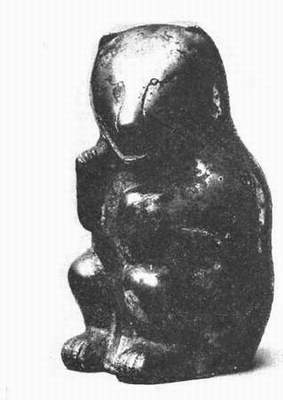
la The Bear Goddess - Chinese Artemis. The earliest religious object yet discovered is the figure of a bear; and the cult of the Bear Goddess - Artemis -was as widespread in Roman London as it was in Ancient Greece. In pre-Christian times, trade and cultural contact between Greece and China was close. Did the Greeks export the worship of the Sacred Bear to China? This gilded bronze bear is the surviving foot from a ritual vessel of the Han dynasty, c. 100 BC-AD 100. (Photograph: British Museum)
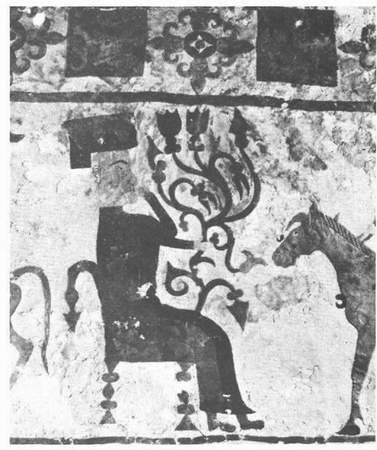
lb Great Mother of the Steppes. The Divine Mother in her 'benign' aspect, holding the symbolical Tree of Life, as she appears on a hanging of applique felt, found in the Eastern Altai in 1949. The felt hanging (or carpet) was part of the great archaeological treasure found by the Russian scientist, S.I. Rudenko, in Mound V at Pazirik. It is now in the Hermitage Museum in Leningrad. (Photograph: Novosti I Press Agency (A.P.N.)
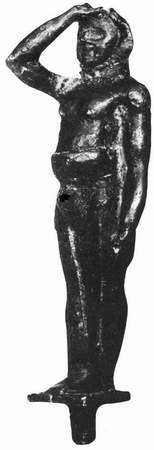
2a A worshipper from Crete. With Mohenjo-daro's three-faced god, this worshipper from ancient Crete, c 1600 BC, shares that ithyphallic condition which enables us to know that this is an object from one of the many Mediterranean fertility cults, all variants of the Old Religion (Photograph -British Museum)
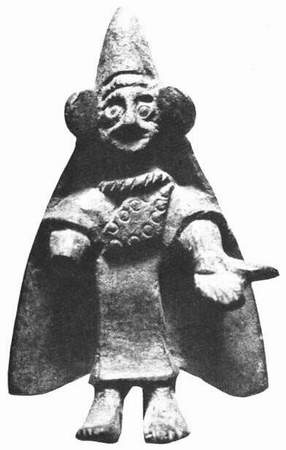
2b An Iberian shaman From the very centre of the Western Fertility Cult comes this figure of an Iberian priest, whose high-crowned hat was adopted by many a later priesthood, and whose 'blinkered' undercap was inherited by the later Iberian culture, as exemplified in the magnificent head of 'the Lady of Elche'. Note the ritual breast-plate marked with seven sun symbols. (Photograph: British Museum)
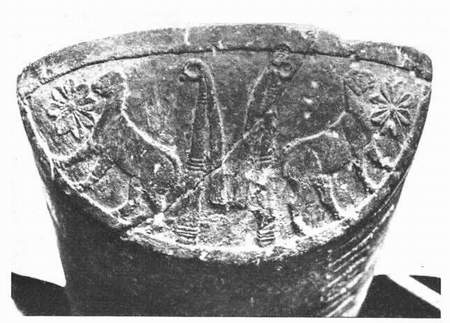
3a The formality of ritual. Even though this limestone drinking trough dates from c. 2900 BC, Sumerian religion had already reached that stage of sophistication when such 'basic' symbols as the Horns of Fertility had been completely stylised, as in this ritual object from the temple of the Goddess Innana, at Uruk (modern Warka), Southern Iraq. (Photograph. British Museum)
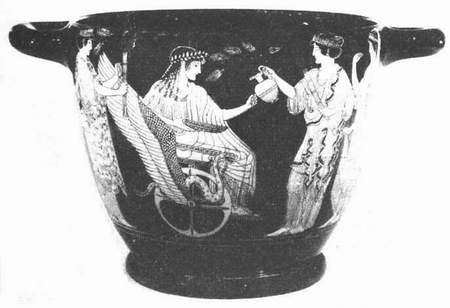
3b The Eleusinian Goddesses Two potent figures from the most ancient beliefs of the Fertility Cult Demeter and Persephone wait on Triptolemus, founder of the Eleusinian festivals and mysteries in honour of Ceres (the Corn Goddess). A 'red-figure' skyphos from Attica, c. 490-480 BC. (Photograph - British Museum)
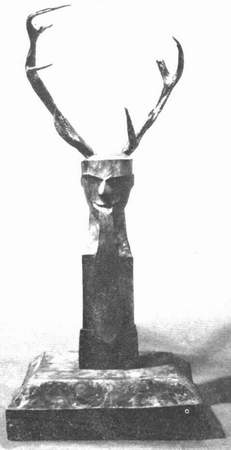
4 The Horned God of Ch'ang-sha. The universality of the Horned God. This carved wooden head, fitted with real deer antlers, comes from Ch'ang-sha in the Province of Honan, south-west China, and is dated to fourth-third centuries BC. (Page 86) (Photograph : British Museum)
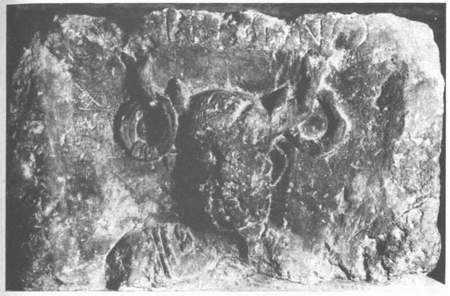
5a Cernunnos of the Parisii. The great Horned God of the Gauls, as carved on this altar, marked with his name, found under the existing altar of Notre Dame at the end of the eighteenth century. The rings on his horns show that the modern game of quoits had a religious origin. The altar is now in the Musee de Cluny, Paris. (Photograph: Service de Documentation Photographique, through Contrad Research Library)
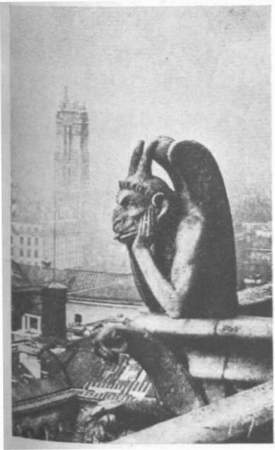
5b The Watcher over Paris. In 1797, under the high altar of Notre Dame, Paris, there was discovered the altar of the God to whom the original building on the same site had been dedicated: Cernunnos, the Horned God of the Gaulish Celts. Notre Dame has been officially 'de-paganized' since the fourth century, but high on the western facade of the Gothic cathedral the God of the older religion still keeps watch over Paris. The English and Americans call this figure - wrongly - 'the Gargoyle': the French - quite as wrongly - le Chimere or le Strige (Chimaera, vampire, ghost). All these names are wrong: here is Cernunnos still above, as he was once present below. (From the Author's collection)
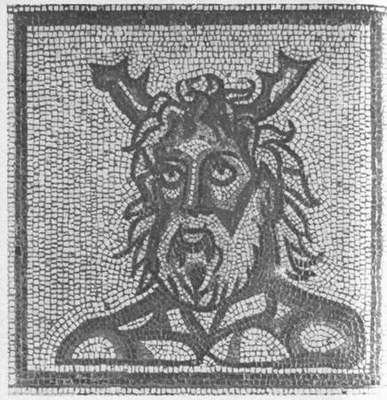
6 Cernunnos in Britain. Romano-British mosaic, now in the Verulamium Museum, St Albans, where Cernunnos is erroneously identified as Neptune, on 'The Sea God Mosaic'. In fact, this is one of the clearest representations of the Horned God to survive from Roman Britain. (Photograph: The Verulamium Museum; Author's collection)
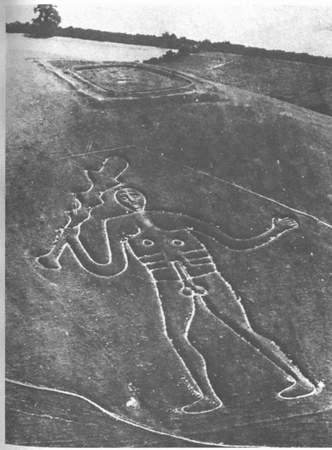
7 The Cerne Abbas Giant, Dorset. Britain's-perhaps the world's -most famous surviving fertility god: the Cerne Giant, whose location, Cerne, is simply the God, Cern (unnos). Lethbridge incorrectly calls the Cerne Giant 'Helith, Helios or Hercules', but the name, Cerne, makes it clear whom this huge figure, cut in the chalk, is intended to represent. In the centuries, Cerne of Cerne has lost his horns, but not - even through the era of Victorian public prudery - the unambiguous statement of his function as the Lord of the World's Fertility. (Photograph: National Monuments Record)
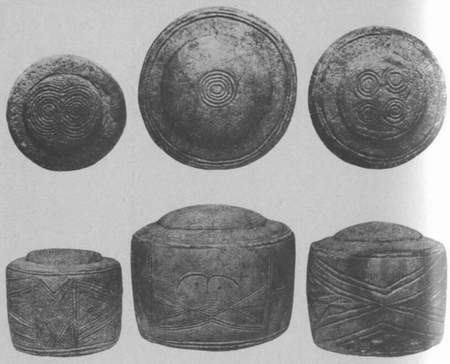
8 The Folkton drums. Roughly contemporary with the Cretan worshipper (plate 2a), these primitive 'cult objects', carved from chalk, were found with a burial of the 'Beaker' period on Folkton Wold, Yorkshire. The anthropo morphic element has been stylised almost out of recognition, yet the obvious sacred nature of the 'drums' proves the existence of an organised Fertility Cult in the Britain of pre-Stonehenge date, about 1600 BC. (Photograph British Museum)
The problem of 'bringing back Britain' into the Roman way of life was rendered most difficult for Augustine and his fellow-missionaries by the fact that in no acceptable sense of the phrase, was Britain, after the withdrawal of Roman rule, a 'nation'. Even when the Romans had ruled, the island had not been homogeneous, so far as its population was concerned; now, with the Angle, Saxon, Jute and Frisian immigrants added to the Roman-ruled stock, the population contained even more ethnic elements than any that Rome had known.
I have said that, when Rome withdrew her Eagles (and her civil servants), the Celtic peoples reverted to their own tribal organisation, which had been suppressed by Rome. But this did not mean that they were unable to agree to present a common defence against a common enemy; and modern research has greatly modified the tale of the Anglo-Saxon invasions, as told in school-books even today.
It now seems certain that the German land-seekers from Holstein and Jutland made, first, for the western coast of France, being put off by the still formidable defences of the Litum Saxonicum per Britanniam ('The Saxon Shore in Britain' - to distinguish the 'anti-Saxon defences' the other side of the English Channel; Litum Saxonicum per Galliam, with a defensive system based on Gessoriacum - Boulogne). The Saxons, under their King Eadwacer, sailed around the peninsula of Brittany, and moved up the Loire as far as Angers, occupying the town and preparing to take root there. In 463,
Childeric, King of the Franks-still a 'rex', or sub-king acknowledging the sovereignty of Rome - kicked the Germans out. Then, and only then, did they try — with better luck this time -for a foothold in Britain.
In or about the year AD 500, a great battle was fought between the 'British' and the German immigrants at an as-yet-unidentified place named 'Mount Badon' (Mons Badonicus). The result was not only a halting of the Anglo-Saxon advance westwards, but what seems to have been a final halt to immigration altogether. A well-substantiated contemporary account of the battle and its results says that the Saxons, unable to find further Lebensraum, returned to the Continent, finally settling down in what is now Saxony.
One of the strongest supports for this theory that the British 'contained' the Saxon advance at Mount Badon is to be found in a religious context, and has been pointed out by F.M. Stenton, in his Anglo-Saxon England. (1)
----
[1] Oxford: Clarendon Press, 1943.
----
Tracing the former existence of immigrant 'holy places', by the Teutonic names ealh, 'temple', hearh, 'hill sanctuary', leak, 'grove', and weoh, 'idol, shrine', Stenton points to one curious and highly significant fact:
The distribution of these heathen names is curiously irregular. More than nine-tenths of them fall within an area which could be indicated on a map by lines drawn from Ipswich to Stafford, and thence due south to the Channel. No heathen names have so far been found in Northumbria; they are very rare between the Humber and the Welland; and there is no. certain example in East Anglia ... What the surviving names establish beyond all doubt is the strength of heathenism in the centre and south-east of England.
Many passages in the history of the Conversion become clearer in their light. The difficulty with which the East Saxons were brought to accept Christianity is made more intelligible by the numerous heathen sites in their kingdom. The heathen sanctuaries of Wessex provide an admirable illustration of Bede's statement that Birinus, meaning to preach in the remoter parts of England, remained in the south to combat the strong paganism of the Gewisse. (2) On the wider question of the conditions which governed the work of the Roman mission to England, the evidence of these names is of peculiar significance. It shows that, throughout the country in which Augustine and his companions laboured, heathenism was still a living religion when it met the Christian challenge. (My italics - M.H.)
What we must now ask is the question: to what extent may the 'heathenism' of the Anglo-Saxon invaders be equated with the existing Old Religion, as practised by those British who were not members of the British Christian Church (3) or of one of those other religions introduced during the days of Roman rule?
To answer this question, we shall need to examine not only the religious beliefs of the Teutonic immigrants, but also what we know or many confidently deduce of the several beliefs of the British.
----
[2] Original names of the West Saxons. Obsolete by Bede's time, the name was revived, as sentimental archaism, by the later English kings in their charters. Cf. the spelling in the modern tide, Master of the Queen's Mustek.
[3] Christianity was brought to Britain direct from Jerusalem perhaps ten years or so before the Claudian invasion.
----
First, let us see what the Teutons believed.
It was precisely because English heathenism was still so powerful a social force that the Christianised historians and commentators devoted so little space to it in their writings. To discuss it was not only bad cess in itself, it was also to advertise a 'false' religion, as well as the more important fact that the Church had failed, so far, to 'extirpate' it.
However, the admirable and mainly honest Bede had permitted his patriotic sentiments to triumph over his religious prejudices, and, in writing his De Temporum Ratione ('Casting up the accounts of the years') has told us some important things about his 'heathen' ancestors and their beliefs.
We may also deduce what the heathens did by the things forbidden to the Faithful, especially those prohibitions which are to be found specified in the Poenitentiale of Theodore, Archbishop of Canterbury (d. 19th September, 690).
That the Anglo-Saxons of pre-Christian days had a year of twelve, rather than thirteen (lunar) months, indicates that at some time during their residence in their Continental home they had fallen under the influence of a culture using a twelve-month calendar. If the influence, direct or indirect, was Roman, then the adoption by the Teutons of the twelve-month calendar could have come only after the Julian reform of 46 BC, when the old Roman year was adjusted to the month-lengths that we still use today.
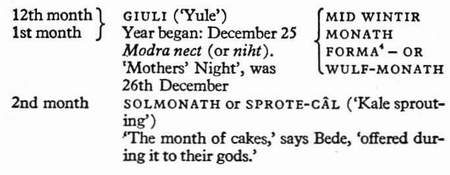
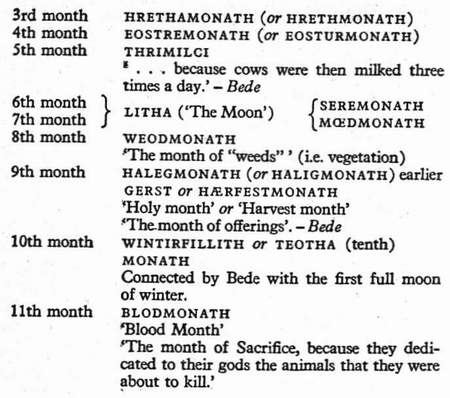
The names and 'character' of the Old English months were as follows:
----
[4] Forma - 'first, foremost, earliest'.
----
Now, it is clear that, in abandoning the old 13-month year which would inevitably be the choice of a Fertility-oriented people, the ancient Teutons retained much of the flavour of the old in their new calendar.
It is not only plainly the calendar of a Fertility religion; it is even more 'Fertility' than historians of the quality of F.M. Stenton seem to have realised.
Stenton, for instance, whilst rejecting the theory that Bede invented the names of the goddesses, Hretha and Eostre, so as to be able to account for the names of the months, admits that 'neither name can be explained, and neither appears in any other mythological system'.
I am not so sure that Hretha cannot be explained. It bears so striking a resemblance to a common Anglo-Saxon word, hrither, 'an ox', that it is surely permissible to advance the theory that Hretha is (not so much 'cow', as) 'female ox', 'she-bull' - that is, a female deity having the character, if not the characteristics, of the bull. Or, perhaps, more accurately: the Consort of the Divine Bull.
As for the other goddess, Eostre, which has given modern English its 'Easter', there is no reason why this should not be a loan from Greek or Latin, borrowed by the Teutons whilst still in their Continental home.
Greek - oistros; Latin oestrus; means some species of stinging insect, probably the well-known 'Spanish fly'; a meaning all the more probable in that a derived meaning in Greek and Latin is 'fury, inspiration' - and hence the sting of Springtime sexuality, the prick of concupiscence, the juror femineus, the 'oestrum'.
Thus the sequence, to Fertility-conditioned minds, would be: March - dedicated to the Bull-Goddess (the personification of the dual creative principle of Nature); April - dedicated to the personification of the Oestrum, the procreative impulse attacking all animals in the spring. 'But other [Old English] divinities,' says Stenton, 'which have never been called in question bear equally obscure names - there is at least no obvious explanation of Erce, the Old English name of Mother Earth ....'
In my opinion, there is an obvious explanation of the name, Erce, as that of 'Mother Earth', but we shall have to turn to a language other than Greek or Latin to find the explanation. It seems to be that Old English Erce (pronounced airchay) is nothing more or less than Basque (that is, Western European Neolithic) erche (pronounce it air shay), 'bowels, belly, intestine, womb'. What, in the simple imagery of a primitive people, could be more fitting than to think of, and call, Mother Earth 'the great womb'? That fruitful womb from which all blessings flow ....
These images are eternal; they have survived the dreadful sophistication of modern man, as I thought the other day when
I turned on the wireless and heard a fruity tenor sing:
... a tree, whose hungry mouth is pressed
against the Earth's sweet -flowing breast ...
If such images force themselves into the mind of even a modern song-writer, how should we wonder that we find them - I had almost said, 'without looking' - in the nomenclature of ancient peoples. Erce in Old English; Erche in that far more ancient Western Neolithic: 'the Great, the Ever-Fruitful Womb of Mother Earth'.
These are not the only points at which the religion of the Old English seems to be connected with the Fertility Cult.
The month of May, for instance, is called Thrimilci because, as Bede says, cows were then milked three times a day -no people not in the closest touch with Nature could think of naming a month after an abnormal yield of milk.
But the fact that September is, as well as being Gerst (barley) monath or Hoerfest (harvest) monath, 'The Holy month', and, as Bede notes, 'The Month of Offerings', means that a pre-Christian 'harvest festival' was an essential part of the Old English year.
The worship - or, at least, the sensitive awareness - of the Moon is more than merely hinted: June and July were dedicated to, and named after, Litha, 'The Moon'; October was Wintirfillith, a name connected by Bede with the first full moon of winter: three months dedicated to the Moon; three months connected with animals; three months connected with sacrifice or offerings. Surely these can be the sentiments of none other than a Fertility religion?
The eleventh month - November - is Blodmonath, 'Blood month'; 'the month of sacrifice, because they dedicated to their gods the animals that they were about to kill.' But O.E. blod, 'blood', had already acquired extended meanings which took the significance of the word far beyond the juice of butcher's meat. Our word, bless, comes to us through O.E. bletsian, itself derived from an earlier bleodswean, 'to sanctify by the (ritual) shedding of blood'. And it was this extended meaning which became dominant, words developing from the sacramental meaning which had no close association with the bleed which had generated them; words which developed into our modern 'bless', 'blessed', 'blessing3, 'blessedness', and the many semantic variations on all these words.
Stenton remarks that Bede's explanation of Blodmonath 'gives what is by far the earliest reference to the practice of killing off superfluous stock for winter food, and the name shews that the custom, with a naive economy, was made a sacrificial occasion.'
I cannot see that the necessity to kill off cattle should make the acts of praise to the Giver of All Good any less sincere. Our ancestors thanked Him for the opportunity that He had given them (through sending them winter, if you please) to eat well
- to eat better than usual. To thank God for a happy accident is not to be naive or hypocritical; rather is it to be piously realistic.
Even Pope Gregory advised Augustine to permit converts from heathenism 'to kill and eat at the Christmas festival (the Old English New Year's Day} a great number of oxen to the glory of God, as they have formerly done to the Devil'.
One of the novelties in time-reckoning introduced when Julius Caesar reformed the Roman calendar in 46 BC was the division of the year - any ordinary, not a 'Leap', year - into four groups
- 'Quarters' - of thirteen 'weeks' (septem dierum spatia) of seven days each. This new division complemented, not supplanted, the ancient Roman division of the month into three periods, begun with the Kalends (first of each month), and continuing through the Nones (fifth or seventh) and ending with the Ides (thirteenth or fifteenth); and though a Semitic origin has been claimed, not unreasonably, for the origin of the seven-day week, it was the astrologer and not the Semite who introduced it into the Roman calendar.
That the week had been adopted by the Teutons before their migration to Britain - their uneasy foothold in France was too brief that they might have acquired a Roman-type calendar there - proves that the race had been in contact, proximate or remote, with either Rome or the source from which Caesar's astrologer-advisers adopted their seven-day week. That the Old English Teothamonath ('tenth month') was always regarded as synonymous with Roman October (originally meaning 'eighth month'), makes it clear that the Teuton-Roman cultural contact was made after the Julian reform of the Roman calendar had, by inserting two 'new' months between June (sixth month) and September ('seventh month'), altered September, October, November and December, from original 'seventh', 'eighth', 'ninth', and 'tenth' months, respectively, to ninth, tenth, eleventh and twelfth in the year's calendar.
And that the inspiration of the Teutonic seven-day period came rather through Roman than through any other cultural influence is strongly suggested by the fact that the allocation of the seven days of the 'rule' of Old English gods follows Roman precedent. As:
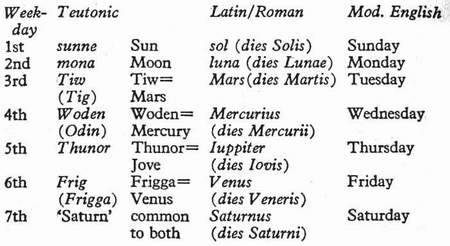
At first it might well appear that there had been a transposition of the 'divine patrons' of the 4th and 5th days, since the identification of Woden with Mercury, and Thunor with Jove, is not immediately convincing. One would rather have expected the equation Woden-the-All-Father = Jove-Father-of-the-Gods, and Mercury, to some extent, shares qualities with Thunor. But a close examination of these gods, in all their aspects, will convince us that contemporary religious opinion was not at fault in identifying Woden (Odin) with Mercury, and Thunor with Jupiter. But I shall return to these identifications presently. For the moment, let us note what we may gather from the choice of gods to protect the days of the week.
What is significant is the fact that the choice enables us to know which of their gods the Teuton Old English considered to be of the first rank.
In the week-day names, there are four native Great Gods, Tiw, Woden, Thunor and Frig (Frigga); the two Heavenly Lights - 'the Sun to rule the day, the Moon to rule the night' [5] - personified in a subtly different way from other races', other religions', personification, in that, with the Old English, mona, the Moon, was like the Sun, sunne, of the masculine gender.
----
[5] I paraphrase Genesis, 1:16]
----
Different from the practice amongst the majority of the Ancient World's religions, the deified Moon was, for the Teuton Old English, not a goddess but a god. There was also Satur(n), who may be an import from Roman belief - Roman Saturnus was originally a blight-god, and thus a proper member of any Fertility Cult's pantheon - but may be descended from a primitive Indo-European source common to both Proto-Teutonic and Proto-Italic. The fact that the sixth day is named after Saturn amongst the Celts also (modern Breton, Sadorn, 'Saturday') would seem to argue an Indo-European source common to both Celtic and Teutonic; for even though Celtics and Teutons were in close contact at the beginning of the present era, the Celts are hardly likely to have adopted a Teutonic nomenclature. The conclusion is irresistible that both Teutons and Celts took the name, Saturn, from a common source - and this common source is unlikely to have been other than Roman.
Are the Old English gods and goddesses Fertility deities?
Let us take the 'week-day' divinities in order.
First: Tiw. If, in using his name to replace that of Mars in the Roman week-day name-list, the Old English equated Tiw's characteristics with those of Mars, then, as in the case of Mars, Tiw must originally have been a pastoral deity. Stenton calls Tiw 'the pre-eminent war-god of the Germanic peoples', and so, indeed, he was; but Mars became a war-god only through his having (as the Guardian of crops and flocks) to defend the pastoral and agricultural activities of his devotees. The ancient Carmen Arvale, that hymn to Mars recorded in AD 218 as part of the ritual of the Arval Brethren, has been interpreted by Norden - it had become unintelligible to even the Arvals by the third century - to shew that it was a ritual to protect the boundaries, invoking, first the Lares, as the agri custodes, 'Guardians of the Tilled Plot', then Mars, 'who is not only the wild war-god, but also the protector of the farmers' crops, house and buildings, ... summoned to take his stand on the "threshold" and protect the land from harm.'
Finally, the hymn calls on the Semones (a name connected with the root SA, which gives, besides Latin semen, English seed). 'The Semones are a group of gods of whom little is known, but Norden suggests that they are divine potencies, executive agents, as it were, for the supreme gods: "The Semones, manifestations of powers which preserve the people, will co-operate".' (6)
If Mars, then, was amongst the Romans a god whose pastoral origins had not been forgotten, the same must be true of the war-god, Tiw.
At first glance, the identification of Woden (Odin) with Mercury is not, as they say, 'all that obvious' - though we must never forget that the identification was obvious to the Old English of two thousand years ago.
On what was this identification based?
Mercury (Hermes among the Greeks), though best known in later times as the Messenger of the Gods, diaktoros, has his true nature shewn clearly enough in ancient Pelasgic sculptures, in which he is presented as a bearded middle-aged man, without hands or feet, but with a large and fully erect membrum virile, this last being the unmistakable badge of the Fertility God. (7)
Patron he may be of 'all secret dealings, cunning and stratagem', but he is also the god of good luck, especially, as Hesiod points out, with regard to increase of cattle, so that, to the Ancient World, Hermes/Mercury, though god of merchants, thieves and handcraftsmen, was pre-eminently a god of increase: ho nomios theos, 'The Pastoral or Shepherd God.'
This was the god whom the Old English equated with their own Woden, the All-Father? At first glance, as I said, the equation seems unwarranted (why, for instance, did the Teuton English not rather equate Woden the All-Father with Iuppiter Optimus Maximus, 'Jove, Best and Greatest'?); yet there must have been excellent reasons for the equation Woden = Mercury. What were these reasons?
Both gods, though potent in themselves, belonged to that class of supernatural being acting through magical instruments. The 'insignia' presented to Hermes/Mercury by Jove included not only the winged cap - petasus - and the magic wings for Mercury's sandals - talaria — but also the short curved sword, herpe.
----
[6] The Latin Language, op. cit.
[7] Compare, e.g., the figure on the chalk-downs at Cerne Abbas, Dorset.
----
Now this last word is obviously allied with an ancient IE. word for 'reap' (Latin, serpo, 'I reap'; Welsh, harff, 'sickle'; Russian, serp, 'sickle') that it is evident that, before it became a magic sword, herpe was simply a sickle - the proper and necessary symbol of an agricultural Fertility god.
Woden, too, like Mercury, is a god who is as well, or even better, known for his potent accessories as for those qualities inherent in his character. Let us list the magical accessories of the two equated gods:
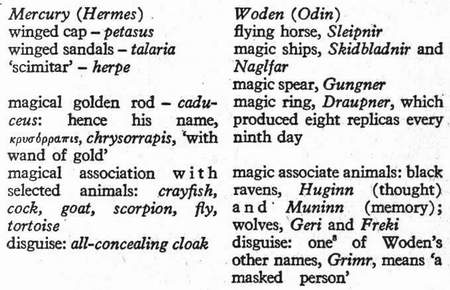
The points of resemblance between the two gods are as numerous as they are striking. Both were renowned for wisdom; Mercury's being a gift of the Greater Gods (especially Zeus/Jupiter), Woden's having been purchased - he gave an eye for a draught from the Well of Mimir, which gave All-Wisdom.
----
[8] Stenton says that, 'so far as is known, he was the only god to whom the English peoples applied an alias', (i.e. Grimr.) This is not quite correct: in the complicated mythology of the Teutons, the high-priest of Odin (Woden) became the God Himself, and the priest's name was Sigge, son of Fridulph.
----
His likeness to Mercury impressed the ancients, and, since Mercury was a Fertility god, Woden was likewise. The fact that each temple of Woden was in the charge of twelve priests - diar or drottnar - which, with the ever-present God, made up a coven of thirteen (as in the origin of Christianity) (9) is the strongest indication that we have here, in the worship of Woden, an aspect of the universal Fertility Cult. Woden's wife was Frigga (Frig, Freya).
There are other indications of Woden's right to be classed among the Fertility gods. His one eye, with which he could scan the whole world within the compass of a single brief glance, equates him partially with the one-eyed Cyclopes, 'sons of Earth and Heaven', and thus originally the personification of the beneficial inter-action between Sun and Rain; the Sky and Mother Earth; to produce the wealth of growing things. Woden certainly seems what the ancients held him to be: a Fertility God - and be it noted further that he sat on his throne in Asgard with his two ravens perched always on the chair's back; ravens whose perpetual presence links him very closely with the ritual of the Basque country. (10)
If Thunor is Jove - and the Old English evidently thought so - then Thunor is as much a Fertility god as was, originally, Jove, whose name simply means 'Sky-Father', and whose 'All-Power' was primitively specialised to ensure fertility in man and beast and plant.
There remains but Woden's wife, Frig (Frigga), and no one doubts that she was a Fertility goddess.
And the rather shadowy 'Satur(n)' of 'Saturday' brings us back to one of the titles of Mars in his less warlike aspect: Mars Sator, 'Mars the Sower'; from the root of sator, 'Satur(n)' being obviously derived.
So that the four principal gods - as well as Satur(n) - that the Old English worshipped were all unequivocally Fertility gods - deities fitting to enter into the pantheon of any Fertility cult. What, then, of the Druids?
The 'historical truth' commonly accepted is that C. Suetonius Paulinus took his legionary troops north-west to the 'sacred groves' of the Druids on the isle of Mona (Anglesey), and there destroyed not merely the groves and the Druids, but Druidism itself.
----
[9] The memory of the primitive Christian 'coven' of Christ and His Twelve survives curiously in the tradition by which the prelates of the Roman Church - now numbering many hundreds - are known collectively as 'the Twelve', the Pope addressing 'the Twelve' in his identity of 'Master'.
[10] Morrigu, also the Irish goddess of war, in her aspect of a hooded crow.
----
Now a little thought, some time over these past nineteen centuries, should have persuaded the historians - who have been repeating this myth ever since Tacitus committed it to his Annals - to reject the story as too unlikely for credence. With all the organisation and modern mechanical and electronic equipment available to the secret police of totalitarian regimes, tyranny has not succeeded, as we know, in suppressing either contradictory opinions or religious belief. How could the burning of a sacred grove and the massacring of even hundreds of Druids have destroyed Druidism?
Again: the Romans ruled Roman-occupied Britain for four centuries, a span of time equivalent to that which separates us from the middle of Elizabeth I's reign.
The British, according to the legend, had all become 'Romanised'. Yet, the historical truth is, that, as soon as Roman rule was lifted, the Celts resumed their old tribal social organisation, neglected Latin (which survived only in the walled cities of London, York, Exeter, and some others) save as a 'prestige' affectation amongst some of the Welsh kings, and began again to produce domestic utensils, weapons, decorative objects and articles of personal adornment in that Scythian-inspired style which is seen to be as 'typical' of native Celtic art in the fourth, fifth and succeeding centuries as it had been in the days immediately preceding and following the Roman invasion of AD 43.
In the decoration of villas, temples and other buildings, in the period during which the Celtic Britons are so obviously moving back into control of national affairs, there is sometimes a merging of two art-styles, as in the temple of the (Celtic) god, Nodens, at Lydney on the Severn, where a rather debased 'classicism' keeps company with decorative themes of purely Celtic inspiration.
Again: for all the survival of Latin in English place-names, in those cases of survival where the fusion of two names (in two languages) denotes peaceful occupation by the invader or immigrant, the double name - as the very common Woodcote (wood, Anglo-Saxon; coed, 'wood', in British Celtic - now Welsh) - marks the co-operation of Briton and Saxon, and never - or hardly ever - that of Saxon and what the Saxons themselves called Boc-loeden; the Latin-speaking part of the British population.
Again to point out the possibility that the 'savage' nature of the Anglo-Saxon invasion may well have been over-written by monkish or other religious-subsidised historians, the correspondence of Pope Gregory and Augustine makes it clear that, certainly in the kingdom of Kent, there were many Christian churches of the Roman period, neglected, but unharmed by the new rulers - churches which, with only a little restorative work, could again be made usable. The attested presence of these Christian churches with the notable absence of Roman Christianity amongst the Celtic British demonstrates how ineffectually these subsidised churches tried to wean the Celts away from an older religion which, if we may believe Roman and later historians, was 'extirpated' at Mona in AD 60.
It is significant, in an examination of the relations between the newcoming Saxons and the indigenous Celts, that it is not only in ordinary place-names that there is evidence of friendly (or perhaps not actively hostile) contact. To such explanatory, 'macarontic', names as Woodcote, we must significantly add such as Weedon Beck and Weeden Bois, in Northamptonshire, as well as Weeden, near Aylesbury, where Weeden is the divine name, Woden (unaltered to this day in Woden Law - 'Woden's Grove') joined to the Celtic, dun, 'hill'. [11]
If the incoming Saxons could equate Woden with the corresponding Senior God of the Druidic Celtic religion, and if both Celtic and Saxon religions were basically Fertility Cults, then the surviving, pre-Celtic practitioners of the most ancient Fertility Cult of all (what we shall call the Religion of the Witches) might have had no difficulty in meeting the Saxon invaders on non-hostile terms. The conclusions to which all this evidence seems to force us is that what Stenton calls 'the case for the vitality of Old English heathenism' rests on attested and proven facts.
----
[11] As all Celtic cities and towns, including London, were built on hills, the Celtic word, dun, came to acquire the extended meanings of 'settlement, tribal centre, township', and so came to provide the ending for many well-known Celtic town-names: often, on the Continent, with a Latin beginning, as Augustodunum, mod. Autun.
----
That the Saxons seem to have been tolerant towards other religions is supported by the fact that abandoned Christian churches of Roman date were available to the Augustinian mission of AD 597, and the only explanation that I can offer for the manner in which the newcoming Roman Christians used the (often still heathen) Anglo-Saxons to attack the non-Roman Christians is that the necessity for doing so was presented to the Anglo-Saxon kings in a thoroughly convincing but not altogether honest fashion.
There is no question that the British Christians, firmly based at such places as Bangor in the west, and at Iona and Lindisfarne, in the north, had made no attempt to convert the heathen Anglo-Saxon; and left to his own religious devices, the heathen may have felt neglected, and even snubbed, by the indigenous Christians' ignoring of him as a possible recruit It was this apparently studied neglect of the Anglo-Saxon immigrants by the heads of the British Christian Church which may - more than the arguments of King Aethelred's Christian wife, the Frankish princess Berctha - have inclined the King of Kent to accept membership of the Roman Church, and forcibly to induct ten thousand of his pagan subjects into 'the Faith'.
Concessions had to be made, of course, even to a King with a Christian wife. In a famous and often-quoted letter to Augustine, Pope Gregory directs the missionary to 'accommodate the ceremonies of the Christian worship as much as possible to those of the heathen, that the people may not be much startled at the change'; and in particular the Pope advised Augustine to permit converts to kill and eat at the Christmas festival (which was, as we have seen, the New Year's Day -December 25 - of the heathen) a great number of oxen to the glory of God, as they had formerly done to the Devil - a passage already noted on page 135.
The retreat from compromise was to come much later -towards the end of the next century, when a formal adherence to Roman Christianity had been made by perhaps as many as half the total of the immigrant kings.
As Stenton says, 'that Gregory's attention was first called to Britain by a simple desire for the conversion of its heathen inhabitants may not be doubted. But Gregory was in the succession of ancient Roman statesmen, and could not have been indifferent to the political advantages which would follow from the reunion of a lost province of the empire to the church of its capital.'
By 'official' Roman thinking, Britain, as a province of the Empire, was not even lost - merely strayed; temporarily alienated; but still, and always, an inalienable Province of the Empire. As such it is classified in the writings of Jordanes, the Gothic historian of the sixth century.
My own view ranges further; I have long held that the Roman Church - its Head adopting the imperial, civil and religious insignia of the vanished secular empire - set out consciously and purposively to replace the Roman Empire of the West in regaining its lost provinces.
The Church, in its own organisation, had already adopted, in taking it over, the well-tried organisation of the State Religion: as has been well said, where there had been a flamen, the Church appointed a bishop; where an arch-flamen, an archbishop. In the scarlet slippers of a Roman senator, and perpetuating, in his own high office, the title of Pontifex Maximus - the tide first borne by 'the King of the Sacred Rites', and afterwards by the Emperors - the Bishop of Rome seemed to unite in his person the highest dignity of ancient religion and modern dominant political theory.
Backed by such material ambitions, the fearless and ruthless missionaries worked towards one end: to secure conformity. If they managed to secure that, they were not much concerned with sincere belief. Lip-service is all that a tyranny requires; for lip-service will include all the 'outward signs of inward grace': attendance at official ceremonies, regular and generous contributions of Church or Party funds; abstention from 'disloyal' (open) comment. The realists who govern any big and powerful society know that they can expect no more than overt conformity; and that, once that is obtained, they need no more. The members of that society may disbelieve as much as they like; so long as they turn up for meetings and put money in when the box passes, then the society will be safe from 'saboteurs'.
In starting a new religion, one certainly needs faith. To keep that religion going, one does not need faith, one needs organising ability. This the heirs of Imperial Rome, the ambitious planners 'in the succession of ancient Roman statesmen', had in a measure which, for those disorganised days, was unique.
Once a sufficient number of English kings and sub-kings had been either 'converted' or made into allies of Christian Rome, the Church began to shew itself a little less tolerant of the Old Religion than its initial 'hands off' policy might have led the Old Believers to think. Nevertheless, the Church still proceeded at a prudent pace; 'Softly, softly catchee monkey' was still the watchword from Rome, and the Archbishop of Canterbury, Theodore, and his Dean, Hadrian, began to denounce Old Religion paganism definitely, though never intolerantly - by the standards of the day.
Theodore was a Middle Eastern, from the Cilician capital, Tarsus, birthplace of St Paul. Hadrian was a Negro - a novelty even for the seventh century: the first, but possibly not the last, man of his colour to become Dean of Canterbury.
On such provocative subjects as divorce, Theodore is more tolerant than even the English law-courts of today; on the matter of the Old Religion, he is, as I have said, definite without being unduly intolerant. It is obvious that, in forbidding the rites of 'paganism', he is also aware how subtly the Old Beliefs have entered into the fabric of the people's thinking and way of life.
First of all he attacks the habit - to be attacked again and again over the centuries - of 'guising'. The selection of this particular 'pagan' custom was probably inspired by the fact that the 'Other Name' for Woden was Grimr (surviving in Grimes dic, 'Grimsdyke'), meaning literally 'a masked person', for Woden, like some divine Haroun-al-Raschid, wandered all over the world disguised.
The Liber Poenitentialis of Theodore refers thus to the banned custom of 'guising' - a custom so old that in the Palaeolithic cave drawings of Ariege, there is the representation of a shaman dancing in the 'guise' of a wild beast.
In Latin which has already fallen from its strict classical standards, the Penitential Books warns:
Si quis in kalandas [should be kalendas] ianuarii in cervulo aut in virula (12) vadit, id est, in ferarum habitu se commutat, et vestiuntur pellibus pecudam, et assumunt capita bestiarum; qui vero taliter in ferinas speeds (should be speciebus) se transformant, III annos poeniteant; quia hoc daemoniacum est.
----
[12] Sc. vetula.
----
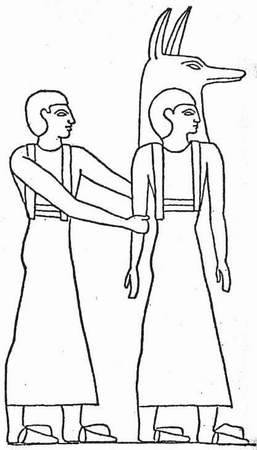
Egyptian masked priest: There is a direct religio-cultural link between the 'Hallowe'en masks' of modern America and the animal masks shewn here. This temple painting from Denderah, Egypt, shews the masked priest being led by his companion to a religious ceremony. Later the masks were so made that the wearer's vision was not obscured. This dates from the XXVI Dynasty.
Whosoever, at the beginning of January, ventures forth disguised as a young stag (fawn) or a cow-calf, (13) that is to say, to change himself into the likeness of wild beasts by dressing himself in animal-skins and masking himself with their heads: to any such as truly, in this wise, so disguise themselves, let there be a three-year penance, for such things are devilish.
----
[13] 'In cervulo aut vetula' is translated by Margaret Murray (The Witch-Cult in Western Europe) 'as a stag or a bull'. The diminutive forms are very clear: cevulus is not 'stag', but 'fawn', and vetula is certainly not 'bull', but 'calf' - and female at that. Dr G.B. Gardner's rendering of Theodore's slipshod Latin is such a botch as to be less exact than the original.
----
This, of course, was a mild punishment, compared with the punishments which, nearly a thousand years later, were awaiting unbelievers.
Theodore also forbids eating and drinking in a heathen temple, a prohibition which seems to imply that the heathen had meeting places more permanent than is implied in such names as Woden Law, 'Woden's Grove'.
But perhaps the heathen were using abandoned temples of Roman origin; which would have irritated Theodore, who would have seen in them buildings easily adaptable to the True Faith.
For the next four centuries, earnest enjoinders to 'support' Christianity and eschew heathenism issued from kings and ecclesiastics. The unenthusiastic, apologetic tone of even those prohibitions issuing from ecclesiastics is not easy to explain, unless we assume that Christianity in England was still only the faith of a minority, though perhaps, those issuing the prohibitions did so under orders. Since the tone of these constant reminders to uphold Christianity and forswear heathenism reminds us of the regular 'affirmations of solidarity' with Soviet Russia made by that Empire's colonial dependencies, we may not be far wrong in thinking that kings and prelates were speaking with the voice of, and on the orders of, Rome.
This, for instance, sounds half-hearted and distinctly lacking in spontaneity; a mere duplication of a propagandist hand-out:
Let every Christian man do as is needful to him; let him strictly observe his Christian duties. ... Let us venerate right Christianity, and totally despise every heathenism.
The unhappy likeness to the 'Socialist solidarity' resolutions will not pass unnoticed. This quotation is from the Laws of King Aethelred (978-1016).
Unlike the Penitential of Theodore, later exhortations to right conduct rarely threaten penalties, which looks as though heathenism must have made rapid advances at the expense of Roman Catholicism. The Laws of Wihtraed, King of Kent (690), impose fines on 'those who offer to devils', but Kent, first of the Anglo-Saxon kingdoms to be Christianised, was always under direct and exceptional Roman influence; the Confessionale and Poenitentiale of Ecgberht, first archbishop of York, are far more moderate. Published between 734 and 766, they merely forbid offering to 'devils', auguries, vows taken at wells, (sacred) stones or trees and the gathering of herbs with any incantations save Christian ones.
There is a certain tightening up of laws against 'witchcraft', especially after the beginning of the tenth century, when 'paganism' had been reinforced by new waves of heathens, mostly Norse and Danes. Conversion had soon gathered these invaders into an uneasy partnership with the now settled English; but that the Danish invasions had 'given a shot in the arm' to the Old Religion is evident from the warnings which were officially issued against commerce with heathenism.
Fines are threatened, but the system of fining is often hard to understand, as when, by the laws of Athelstan (924-930), a person ('witch' is not mentioned) kills another by sorcery and cannot deny the crime, the killer must die. But if he deny the guilt - even though the threefold ordeal shall prove him guilty - he is punished with only 120 days imprisonment.
But mostly what the kings and prelates publish are nothing more than pious exhortations to defend Christianity and abhor heathenism. As the Ecclesiastical Canons of King Edgar (959) urge: 'We enjoin that every priest zealously promote Christianity, and totally extinguish every heathenism; and forbid well-worshippings, necromancies and divinations; enchantments and man-worshippings, and all the other vain practices which are carried out with various spells, and with frith-splots,(14) and with elder-trees and trees of other kinds; and with stones, and with many other delusions, with which men do much of what they should not. And we enjoin that every Christian man zealously accustom his children to Christianity and teach them the Paternoster and the Creed. And we enjoin, that on feast-days, they abstain from heathen songs and devil's games.'
This is very mild indeed, and is preached from no position of strength. The fact is that the religious situation, as the first millennium drew to an end in only-just-politically-united England, was sadly confused; and even the most zealous guardians of Christianity hardly knew how to distinguish between friend and foe.
----
[14] I cannot accept Dr Murray's translation of frith-splot as from 'frith = brushwood, splot = plot of ground; sometimes used for "splotch, splash".' 'Splot' is a plot of ground; but 'frith' is peace' - and 'frithsplot' is 'holy ground' or ground where men may meet in peace.
----
The Danes, for instance, have always been represented as providing as it were a 'boost' for Paganism; but numismatics -as its evidence so often does - flatly contradicts the legend of the 'anti-Christ Dane'.
The Viking coinages of England, Ireland and Man are liberally endowed with what appears to be Christian sentiment, and it is hard to maintain that this was 'propaganda' to popularise the Viking invaders with the now fully-Christianised inhabitants of England if, at the same time, the theory of the 'ruthless, pagan' Viking is maintained. Obviously only one of these theories may be correct.
The coinages of Danish East Anglia (circa 885-915) include silver pennies produced as 'memorials' to St Martin of Lincoln and St Edmund, that King of East Anglia who had been defeated and killed at Hoxne, in 869, by the very invaders who now issued a penny to commemorate 'the Saint's death!' (But see page 150). Both pennies are 'piously' marked with a Cross.
And though the coins of Danish Northumbria (circa 898-915) are not, in their designs or legends, ostensibly 'Christian' (though they do all bear the Cross), one penny carries the name of Plegmund, Archbishop of Canterbury (890-914) coupled with that of the King; and a Danish copy of an English penny reproduces the original Plegmund design intact.
In the Viking coinage of York, the 'Christian' sentiment is even more apparent - and more puzzling. Not only do the silver pennies and halfpennies bear the Cross - an elaborate 'patriarchal' design joins the now usual long and short crosses and the cross-crosslet - but at least two quotations from the Liturgy, in Latin, appear on the coinage: MIRABILIA FECIT ('He hath worked wonders') and DOMINVS DEVS REX ('The Lord, God and King'). The Viking coinage of York and the English coins of the Hiberno-Norse Vikings (circa 919-954) both include a 'St Peter of York' issue, with a cross pattee, and the legend SCI PETRI MO (contracted Sancti Petri Moneta, -'money of St Peter'), with the addition, on the Hiberno-Norse coins, of EBORACEI ('struck at York'). (15)
----
[15] The spelling, on the York coins, of the Latin name for the city, Eboracum or Eburacum in classical Latin, varies greatly, varying from Eboraceum to Earices, most forms being in the locative-ablative case. The distortion of original Eboraco has produced one interesting (unintentional?) form, Ebraice, 'Jewish'.
----
Some of this coinage was struck in France, which may account in part - but only in part - for the fact that all legends are in Latin: King Siefred is SIEFREDES REX; Earl Sihtric is SITRIC COMES. Within the Hiberno-Norse Viking coinage, two issues are of particular interest: those of Anlaf-Sihtricsson. In the issue of his first reign, 941-944, Anlaf calls himself, on his coins ANLAF CVNVNC ('King Anlaf'), but on the coins of his second reign, 948-952, he has changed his style, not only to ONLAF REX, but also to ANLAF REX TO [TIVS] B [RITANNIAE] - the first time that the Roman name for 'England' has been brought back on an English coin.
And all this 'Christianity' is accompanied with emblems of undoubted 'Pagan' provenience and significance: the Hammer, the Sword, the Raven, the Bow-and-Arrow. A possible hint of some religious 'deal' is perhaps suggested by the double symbol on a penny of uncertain origin, but possibly of Sihtric: a sword and key. As this coin is associated with the York issues, and thus (again possibly) with the 'St Peter' issues, the sword may represent the (pagan) Viking; the key, 'St Peter' - though the sword is also Peter's emblem.
That this possible religious deal was, in fact, made, seems to be proven by the fact that King Guthred, who reigned at York between the reigns of Haldene and Siefred, provided a resting-place, at Chester-le-Street (whose name means 'Roman fort on the stone-paved road'), for the relics of St Cuthbert, Bishop of Lindisfarne, who died three hundred and more years before.
However, though Cuthbert, originally a pillar of Celtic, as opposed to Roman, Christianity, submitted to Rome, and counselled his followers to accept the metropolitan authority of the Archbishop of Canterbury, he may have been revered, by the Pagans, as an opponent and victim of Roman tyranny.
As Stenton says:
... it is significant that between 670 and 690 Archbishop Theodore found it necessary to appoint penances for those who sacrificed to devils, foretold the future with their aid, ate food that had been offered in sacrifice, or burned grain after a man was dead for the well-being of the living and of the house.
It is still more significant that he was asked for his ruling whether altars might be hallowed or masses said in churches where heathen were buried, (16) for the fact that such a question could be put indicates the survival of heathenism among the higher orders of society. It is also clear that this survival was not merely the result of conservatism in remote parts. In Kent itself, a generation after King Eorcenberht had ordered his people to destroy their idols, the laws of Wihtraed contain provision against offerings to devils. There is no doubt that Christianity was the dominant religion throughout England in 664.
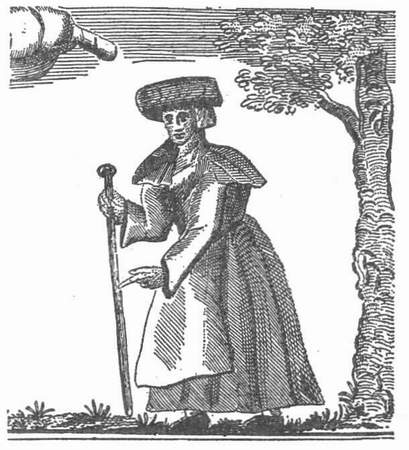
The Witch of Edmonton: Though this engraving of Elizabeth Sawyer (note again the 'Witch' forename) comes from Caulfield's Wonderful Museum of Remarkable Portraits, published in 1794, Elizabeth, the Witch of Edmonton, was hanged as a witch over 170 years before. Note the hat, with its origins in a remote Mediterranean past - another striking example of survival.
----
[16] This looks as though churches had been appropriated by the 'pagans' for regular use.
----
But it is equally certain that the older beliefs of the English people, though driven underground, (17) were still alive.
Taking leave to doubt the assertion that Christianity was the dominant religion throughout England, either in 664 or at any other time, I cannot but agree with all that Stenton says in the passage just quoted; adding my own opinion that what applied to English religion in 664 applied with even more force in 984.
As the year 1000 drew near, the superstitious everywhere looked for anything from the appearance of Christ-in-His-Majesty to Ragnarok, when gods as well as men would perish, and only Vidar and Vali would survive the world-cataclysm, to rebuild the universe on an eternal basis.
----
[17] My italics - M.H.
----

