5 - The Emergence Of The Enemy
Christianity, in common with a multitude of new religions, or old religions with new faces, emerged in the ferment of emotional excitement which had involved all the world's peoples in the years immediately preceding the Christian Era. That there was an unusual celestial phenomenon to catch men's attention and to inspire them with disturbing thoughts is not denied; many maintain that the Star which brought the Wise Men to Jerusalem was a nova - it is accurately dated in Chinese records; and, if this sudden brightness in the sky was indeed a nova, then its magnitude must have been of a literally shocking kind.
But, whatever the cause, men were gravely disturbed in the first years of the Roman Empire, and a rumour was current in many strata of society and through many different religious bodies that some sort of Saviour of Mankind might be confidently expected (or, for the wicked, as confidently feared). It was this rumour which explains the quick success, not only of Christianity within the first century of its foundation, but of many other creeds - most gone, save from histories. Of these other creeds, those of Mithras and of the Gnostics, Manichaeans and Zoroastrians were the most important; of them, only the Zoroastrians survive to this day.
It has often been commented upon - and never explained -that the witches, especially of the time of the witch-trials, gave the text of spells and invocations which seemed to be addressed, either wholly or in important part, to the God both of the Old Testament and the New.
To the Spirit
'... now, therefore, in the Name and by the power and dignity of the Omnipotent and Immortal Lord, God of Hosts, Jehovah, Tetragrammaton, (1) I do...'
Other spells and invocations - and by far the more common - invoke, sometimes the Gods both of the Old and New dispensations, sometimes the Christian God only. The Virgin Mary and the lesser Saints are often associated with the Christian Redeemer in the ritual, as are the Eucharist (often using the actual consecrated bread) and other Sacraments of the Christian Church.
Peter Haining expresses a widespread point of view when he writes (in his The Warlock's Book):
Scholars have noted how persistently the name of God - the Christian God - is employed in witchcraft and Black Magic rituals. They are agreed that, because He was believed to be the most powerful of all deities, any command given in His name could not be ignored by inferior spirits. Those who dabbled with the powers of darkness also considered His name to be a protection against danger from any entities that might be evoked. It could further be argued that the Black Magician not wholly dedicated to evil was also trying to build up store in both, heaven and hell!
This is all true enough, so far as it goes. The trouble is that this passage, like most of the others written from the same point of view, does not go far enough. I propose now to take the commentary a great deal farther and make a suggestion that neither witch nor witch-hunter has yet, to my knowledge, put forward.
Yet this suggestion explains so much otherwise inexplicable that I cannot understand how at least one person of the past failed to put it forward. The silence of the witches on the subject may be explained by an honourable desire to preserve secrets, yet I cannot accept that this is the true reason for the unbroken silence, over the centuries, on the subject that I am about to discuss.
----
[1] Tetragrammaton is Greek for 'four letter (word)'. When writing the name of God in Hebrew, only the consonants were written, never the vowel-points, the true pronunciation of the Sacred Name being a verbally transmitted secret of the Hebrew priests. Consequently, the four Hebrew consonants of the Name -yod, he, vau, he - 'J.H.V.H.' -were known as 'The Four Letters', Tetragrammaton. To add the last to 'Jehovah' - the Name vocalised by guesswork - is simply to be tautological.
----
The simplest and most satisfying reason for the witches' constant mention of Jesus Christ is that, as soon as Christ's teaching - and, even more, the reported details of His life - were made available beyond the narrow confines of an Israel-based and relatively small sect, the members of the ancient Fertility Cult in its purest form instantly believed that they had recognised in Jesus Christ a perfect theophany of their own eternal God.
This theory is put forward in no disrespectful sense - far from it. If the reader will forget his perhaps strongly held religious prejudices, and try to consider the persona of Jesus Christ from the point of view of a devout member of the Fertility Cult in, say, the first century after the Crucifixion, that reader will surely see why it would seem to such a member of the Cult that Christ, in His words and life, expressed the very highest principles of the Cult.
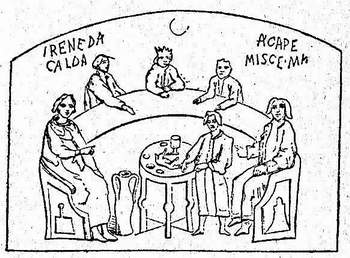
The Agape, feast of brotherly love: The agape or 'love-feast' of primitive and still unsophisticated Christianity, as depicted in a catacomb fresco of the second century. The ceremony, it should be noted, is a sellisternium, not a lectisternium; that is, the guests are seated in chairs, not reclining on lecti. As the sellisternia amongst the 'pagan' Romans were strictly private banquets for women, the early Christians' agapai were obviously 'woman-orientated'. The Latin inscriptions read (left of picture): IRENE DA CALDA (correctly, Irene da calda(m)) -'Peace: give me hot (water)'; and (right of picture) AGAPE MISCE ME - 'Love: mix me (wine and water)'. The Romans never drank wine unmixed with water.
For consider. Christ, after His childhood, had been apprenticed to an honest trade. He was not directly associated, in His work, with the land; but He was a village carpenter, working with the timber that He himself had taken from the living tree. He was not a man of the city. But as soon as He embarked on His mission of teaching, He forgot even His carpentry and joinery, and, as His parables shew, conceived His ideas strictly in terms of agricultural and pastoral - true Old Fertility -images.
He was, the Fertility Cult members marvelled, not only a fellow-member, but one whose every action affirmed his affinity with their primitive but rational beliefs. In His actions -especially those of a magical ('miraculous') nature - He shewed himself to be a charitable and powerful Spirit of Plenty. For those who followed Him and heard His words, He had freely-offered gifts: He made wine out of water; He caused the sea to 'be fruitful and multiply', so that the nets of His disciples broke under the strain of a record - and unprecedentedly bounteous - sea-harvest. He made a few fishes and a few loaves so to reproduce themselves as to be able to feed an immense multitude come to hear Him preach, with a wealth of homely countrymen's tropes and analogies, the simple and soul-supporting facts of life.
When the four Gospels - redactions of the mysterious and now lost 'Q' (2) - were available to circles outside those purely Christian, members of the Fertility Cult were even more strongly convinced that, in Jesus Christ, they had to acknowledge one of their Masters.
Not only was His death foreshadowed, announced, and willingly (though not painlessly or uncomplainingly) accepted; the pattern of that Sacrifice belonged, in all its details, to the most ancient sacrificial patterns of the Cult.
----
[2] 'Q' is the hypothetical master-Gospel - hypothetical since its existence has so far been only deduced; no copy or part of a copy having yet been found. It is the master-Gospel from which, it is supposed, the four canonical Gospels have been derived.
----
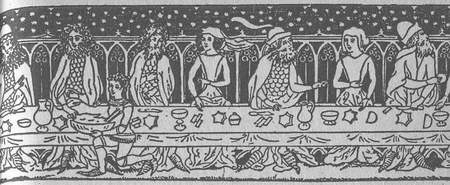
Mediaeval agape: By the thirteenth century the strongly Fertility-flavoured early Christian agape has reverted, with the rule of non-Christian English kings, to a completely and openly 'pagan' affair. This illustration of a 'mixed' banquet from an early thirteenth-century MS shews the unmistakably Fertility character of both celebration and participants. The star-shaped 'trencher' of bread and the vine-crowned feasters should be noted. Note also the ritual cap of the diner on the extreme left of the picture: compare the dentate pattern on his cap with that on the cap of the Great Mother from the Pazirik mound. (See Plate 1)
Then again, the obvious astrological bias in editing the New Testament - a bias most obvious in the Gospel of Matthew -would have had a strong and esoteric appeal for all Cult members, with whom astrology was an essential constituent of their faith. Whatever later ages may have decided to think of the story of the Annunciation, the early compilers and editors of the New Testament were in no doubt of the astrological significance of the Nativity episode.
In ancient Jewish astrological lore, Gabriel (who, in the Gospel, announces the forthcoming birth of Christ to the Virgin Mary) is the angel who governs the Moon; and Virgo, the Virgin, represents the Moon-Goddess in the original six-sign zodiac of the ancient Babylonians.
It is clear, therefore, that the astrological bias in the editing of the New Testament would definitely equate the Virgin Mary with the Moon (Goddess) since it is Gabriel, the Angel of the Moon, who is the spirit chosen to announce the tidings to Mary. The tidings themselves are significantly worded, though it is only in Luke that the angel speaks to Mary; Matthew makes Gabriel speak to Joseph, rather than Mary; and Luke and John omit the episode altogether.
What the angel Gabriel said was this: 'Hail, thou that art highly favoured, the Lord is with thee; blessed art thou among women ... Fear not, Mary, for thou hast found favour with God. And behold, thou shalt conceive in thy womb, and bring forth a son, and shalt call his name JESUS.'
And when Mary asked how this could be, 'seeing I know not a man'?, Gabriel explained: 'The Holy Ghost shall come upon thee, and the power of the Highest shall overshadow thee: therefore also that holy thing which shall be born of thee shall be called the Son of God.'
To the members of the Fertility Cult, this promise, with its fundamental linking of natural reproduction with the holiness of 'the thing which shall be born' of Mary, was fully in the tradition of their religious sentiments and beliefs. They had no difficulty in accepting Christ as a manifestation of their God, and they began to worship Him, the more fervently as they perceived - what only the most naive of then and now could deny - that political ambition and the greed for power and wealth had almost entirely 'de-Christianised' the Christianity of Christ. Wherever the Gospel story came, Christ represented to the supporters of the undefiled Fertility Cult the bitter and outspoken opponent of that corruption which was overtaking the Cult itself in the great cities growing up within the Roman Empire.
Christ, with such Fertility themes as the Parable of the Sower, of the Vineyard, the Prodigal Son, the Good Shepherd; with His openly expressed contempt and hatred for the city men, the parasites who battened on the good earth and on the men who helped to make it fruitful; Christ Who whipped the money-changers from the Temple, and Who said how nearly impossible it was for a rich man to enter the kingdom of heaven - to return, in other words, to the simple faith of Fertility; this was the Christ Who became and remained one of the great Gods of the Witches.
There is a curious name which occurs in the evidence given at the witch-trials of, especially, the late sixteenth century: Christsonday. (3) At Aberdeen, 1596-7, Andro Man 'confessis that Crystsunday cum to hym in liknes of ane fair angell, and clad in quhyt claythis'. 'Siclyk, thow affermis that the Quene of Elphen hes a grip of all the craft, bot Christsonday is the gudeman, and hes all power under God ...':'... all thay quha convenis with thame kissis Christsonday and the Quene of Elphenis airss.'
----
[3] The variant spellings of this name - Christsonday, Christsunday and Chrystsunday - are due simply to the fact that late sixteenth century clerks of record permitted themselves considerable licence in rendering all words, especially proper nouns, even within a single paragraph.
----
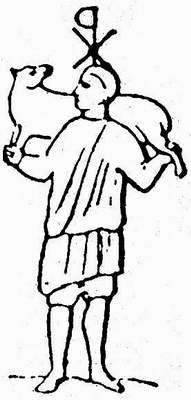
The Good Shepherd: The Good Shepherd must have been that aspect of Christ of most appeal to members of the Old Religion. This simple representation comes from a fresco on a ceiling in the so-called 'Crypt of St. Caecilia' in the catacombs of Rome. It dates from either the second or third century AD. Note reversed 'Chi-Rho'!
Whence came this curious word? Margaret Murray, with, however, no strong conviction apparent in her suggestion, asks if the strange word may not have been an ignorant 'interpretation' of the Latin phrase, Christus filius Dei: 'Christ ,Son of-God'. Dr Murray ingeniously - but I think wrongly - proposes that this phrase was mis-read as 'Christ's Son, "Dei"', 'Dei' ('Day') now being read as the name of 'Christ's son'. We shall pass over the difficulty of reconciling such a person, real or imaginary, as 'Christ's Son' with such a theophany as that reported by Andro Man, who saw 'Christsonday... in likeness of a staig', or with a ceremony in which the faithful 'kissis Christsonday ... airss', and ask ourselves if we may not find a more acceptable etymology for this exceedingly curious name, 'Christsunday'.
Now, in the trial of Andro Man, to whose evidence we owe most of what we know about Christsunday, the libel - as Scots law calls the written evidence against the accused - mentions that 'Thou confesses that the devil thy master, whom thou terms Christsunday, and supposes to be an angel and God's godson - albeit he has a thraw by God (4) - is raised by speaking of the word Benedicite.' (5)
Now, noting that Benedicite (Latin for 'Give your blessing to me/him/us/them') has developed from an original Basque phenxatze" 'to think, to ponder' ('Consider well, brethren and sisters ...'), we see that a Basque origin for the '-Sunday' of 'Christsunday' is easily suggested.
Actually, the Basque ending is not 'sunday' but '-unday' -the Basque ande'e (andere) 'miss, lady, mistress". And 'Christsonday' or 'Christsunday', then, is, in fact, 'Christ's ande'e' -not Christ's Mother or Christ's wife, but Christ's female aspect, as, in Trinitarian doctrine, the Father, Son and Holy Ghost are all aspects of the same Triune divinity.
The interpretation of this mysterious word, Christsunday, has achieved something of the first importance: the proof that the Heavenly Androgyne - the hermaphrodite Artemis (Diana), the hermaphrodite Freya (Frigga) and, indeed, Hermaphroditus himself (fusion of himself and the nymph, Salmacis) - had not been banished from the Old Religion, as it had been banished from official Christianity. Andro Man's evidence with regard to 'Christsonday's' 'family' relationship to God is instructive - 'God's godson', which phrase seems to be both tautology and a play on words.
But if there was an aspect of Christ which was hermaphrodite, in the opinion of the Old Religion, the Greek version of John xiii. 23, with its disturbing implications for modern orthodox Christians, would have been perfectly comprehensible to the Old Religionists. They would also have understood what Christ must have meant when (and it has shocked many since) Christ rebuked His Mother for seeking to divert Him from his task by some trivial domestic question: 'Woman, what have I to do with thee?'
----
[4] 'Has a thraw by God' = 'Has quarrelled with God'.
[5] The spelling of this passage has been modernised.
[6] Itself derived, of course, from Latin pensare, 'to ponder'.
----
But the Old Religionists would see clearly that Christ had not said that to His Mother - he would hardly have addressed her as 'Woman' - but before His Mother; so that she, as well as the twelve disciples (making a coven of thirteen, with Christ as their Grandmaster and Incarnate God) could hear and comprehend. 'Woman, what have I to do with thee? - the female principle - seeing that, in Me, are fused indissolubly the two Great Principles of Life. I am both Male and Female; the Heavenly Androgyne; the Self-fertilising, Self-generating source of material and spiritual existence.'
When, perverted by the assured promise of wealth and power, organised Christianity abandoned the simple Fertility-based and Fertility-reverencing Faith of its Founder, the Old Religion did not abandon either its respect for, or its belief in, Christ. The Old Religion, as far as Christ was concerned - and as far also as the Christianity of Christ was concerned - remained obstinately and perhaps even bitterly (not so much reactionary as) fundamentalist. It could not - and did not, ever - follow already corrupt official Christianity, when its skilled and conscienceless managers stepped into the positions, and inherited the wealth accumulated over a thousand years of official Paganism (not the correct word, but usage has made it so).
Totalitarian in outlook, the Rome-based Christian Church would not - and, indeed, could not - tolerate any religious rivalry; the weakness of all totalitarian disciplines and social-economies is that they cannot survive in the presence of a liberal opposition, with the result that the opposition may survive, develop and work only 'underground'.
There was to come a time when all the highly-organised forces of the Church's totalitarian ruthlessness were to be directed towards the 'extirpation' (the Totalitarians' favourite word) (7) of the Old Religion, and - helped by the fact that the growth of cities and of the merchant-class had divorced many from the land (and thus from the Fertility Faith) - the Totalitarians' success was almost as total as they would have wished.
----
[7] Because this Latin word means 'to pluck out by the root', it expresses the totalitarians' 'total' ambition perfectly. That is why it is one of their favourite words.
----
To affirm that 'tyranny never succeeds' is to ignore one of the most obvious truths of history. It not only often succeeds; tyranny is one of the most consistently successful forces in human affairs.
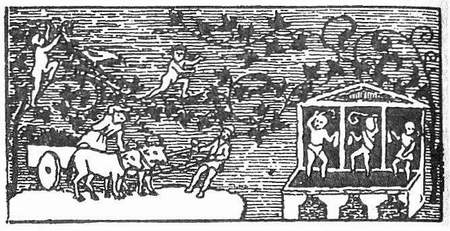
The True Vine: The theme of 'The True Vine' persisted even into a time when Christianity had abandoned its primitive ideals. By the beginning of the fourth century, when this mosaic was executed for the church of St Constantine, Rome, this truly Fertility theme of the grape-gathering and the vintage must have been regarded as something of an archaism by a Church about to be promoted to monopolistic power by Constantine the Great.
But before we return to the impending struggle between the Old Religion and a Christian Church suddenly liberated from 'inferior citizen' status and endowed with the greater part of the Roman Empire's wealth, let us look at the beginnings of a religious development which was to provide the Church with a most powerful antagonist more than a thousand years later, and to create a Cult which, unlike that of the Old Religion, would not be extirpated - even though gravely weakened - by the Roman Church's 'Hounds of God'.
This was Diabolism, a product of, and a development out of, the Fertility Cult; a natural evolutionary form of belief, to which the adjective 'inevitable' may be given, providing that the special 'socio-economic-philosophical circumstances were present to give Diabolism its origin in the already well-established and essentially non-Diabolic Fertility Faith.
One of the incidents in the story of Christ which must have made a strong appeal to the Old Religionists, and helped to convince them of Christ's adherence to, and (reincarnated) leadership of, their Cult, was the post-Crucifixion journey out of the world - synopsized into a few words in the Creed: 'He suffered under Pontius Pilate, was crucified, died and was buried. He descended into Hell, and rose again the third day.' This, to the members of the Fertility Cult, was the exact expression of one of their fundamental beliefs - and if we may accept the assurances of the late Dr Gardner, it is what those of the Old Religion still believe today.
It is no argument against the truth of any belief that 'people used to believe this five thousand years ago'. Nor need a devout Christian hesitate to recite the Creed, even knowing that, long, long ago, Ishtar, they believed, went down into the Land of No Return; as others had done before Her, and others were to do after she had visited the place of shadows and had come back.
When she descended into Hell - to use the English of the Authorised Version - life went, as it were, into stasis:
Since the Lady Ishtar descended into the Land of No Return,
The bull does not spring upon the cow,
The ass does not bow over the jennet,
No more man bows over woman,
The man sleeps in his chamber,
The woman sleeps alone.
Ishtar seeking Tammuz, Isis seeking Osiris, Ceres seeking her daughter Proserpine, carried off to the Lower World by Pluto - these are all the poetic, romantic expressions of what seemed a fact to early peoples: that the crops spring up from the earth in the beginning of the year, and 'return to the earth' in the year's end. The variant on this ancient theme is to be found in the legend of Ceres and Proserpine, where the sought one returns only for half a year. This version of the legend must have originated in a region where the year is pretty evenly divided between fallow and fertile.
The honest realisation, by all ancient peoples, that He Who governs the pattern of this world must have the dual function of the Life-Giver and the Life-taker presented the God with two complementary aspects, which made Him at once the Lord of the living and the Lord of the dead.
In his life-giving aspect, He was the fertiliser of women and all female things, the bestower of reproductive power on men and all male things. In His life-giving aspect, he made the plants and trees yield of their fruit; the seas shoal with fish. To men looking for His bounty, the God in this aspect must have seemed 'good'. In that other aspect, when He chilled and killed the earth, so that few things - and none of them edible -grew; when the bull no longer sprang upon the cow, the ass no longer covered the jennet; when the trees were stripped of their leaves, and the game hid within its winter holes; the God must have seemed 'bad'.
It was easier then - as it has been too often found easier since - not to try to reconcile the 'good' and 'bad' aspects of one Deity, at once all-provident and all-demanding; but to assume a dual Divine Management of the universe; to assume that what is good for Man comes from the loving-kindness of a 'good' God; what is bad from the malign impulses of a 'bad'. Manichaeism - to give a fairly modern name to wrong-thinking perhaps as old as thinking Man - is an error into which all mankind must have a tendency to slip. And beyond Manichaeism - the belief in a Dual Direction of destiny - lies the far more dangerous error that the dominant partner in this Good-Evil partnership is ... Evil.
Again we have an error into which it is no difficult matter to find oneself slipping. We remember the 'bad' things which have happened to us, simply because we do not notice the 'good'. We take 'good' so much for granted that it is rarely that anything but the 'bad' captures our self-pitying attention. And so we may, if we are not careful of our souls' health, tend to believe the world managed by evil influences, when (despite the Hounds of God, the foul lawyers who ministered to the greed of Henry VIII, the Godless Williams - alias Cromwell - and his life-hating Roundheads, Lenin and his malignant apes, Hitler and his fellow-diabolists) the world is still more good than evil.
Rome, in its origins, was a community of staunchly independent farmers, who, on the approach of an enemy, would willingly lay down their hoe and sickle, and take up sword and spear.
From these simple, humble beginnings, the Romans built up the world's first great empire; a federal state which lasted, as a political entity, from 753 BC to AD 1461 - a span of over two thousand years, with a powerful 'influential' extension beyond mere political power whose authority is still vigorously active even yet.
Rome never forgot its peasant and yeoman origins; and the terms which entered the Latin tongue during those simple formative years became an inalienable part of the language. Today, when the British has followed the Roman into the limbo of vanished empires, many of the terms that we employ to describe legal and commercial probity come, not merely from the Latin tongue, but from the far-off thinking of the Latin and Roman farmer.
We 'stipulate' a condition, because, in the Forum, Roman farmers broke a straw, stipula, as a sign of faith in the unwritten contract. We talk of 'promulgating' this Act, that reform; forgetting, most of us, that to pro-mulgate is to squeeze milk, mulgum, from the udder of the cow. We have all heard that pecunia, 'wealth', came originally from pecus, 'cattle', as English 'fee' came from Anglo-Saxon feoh, 'money, property', from an earlier meaning, 'cattle'. Pax, whence English 'peace', comes from a root which originally meant 'to mark out a boundary' - and thus to ensure peace amongst quarrelling neighbours. And so on.
The religious ideas of this rustic period were equally obstinate in survival, and 'pure' Roman religion, up to the end of official 'Paganism', and, indeed, far beyond it in time, was a religion of the Fertility Cult group.
Two causes came to modify Roman 'pagan' faith, and to ensure the introduction and growth of that heretical, darker face of Fertility. The first was the gradual domination of Roman and Italian sentiment by the million-and-a-half immigrants - mostly slaves who had been captured in war; and mostly Orientals - who were imported into the capital of the world over a period of little more than a century.
Influential even when still enslaved; trusted by the ruling class, up to the Emperors, because the slaves were trusted by no one else; the slave or ex-slave population of Italy, especially of Rome, had it, as they say, 'both ways'.
Numerically superior to the native Romans in numbers, they yet enjoyed the advantages of that organisational, self-serving capacity that 'depressed minorities' will always exhibit The slaves were neither a minority nor a 'depressed minority', but they behaved as though they were - and profited as though they were. Once freed, they were, in many cases, hardly less wealthy or influential than they had been as slaves; the freedman, C. Caelius Isidorus (his cognomen means 'Gift of Isis', so that he may have been an Egyptian) bequeathed 4,116 slaves to his heirs - perhaps a fifth of what the Emperor possessed.
With all these exotic elements, who exhibited the same capacity for chasing the fast aureus or turning a dishonest sestertium as do their spiritual heirs, the 'oppressed minorities' and 'displaced persons' of today, the fancy religions entered, with all the 'fringe benefits' that such religions offered and offer: the fortune telling, the spell casting, the ritual cursing of enemies -
adiuro te demon quicunque es et demando tibi ex anc ora ex anc die ex oc momenta ut equos prasini et albi crudes occidas, et agitatore Clarum et Felice et Primulum et Romanum occidas collida neque spiritum illis lerinquas.
'I adjure thee, Demon, whosoever though mayst be, and I demand of thee that from this hour, this day, this moment, thou afflict and kill the horses of the Green and White team, and kill and batter the drivers Clarus and Felix and Primulus and Romanus, and leave no breath of life in them.' (Graffito from a wall in Pompeii.)
Titus Egnatius Tyranus defictus est. Publius Cicereius Felix defictus est. 'Titus Egnatius Tyranus is hereby solemnly cursed. Likewise Publius Cicereius Felix.' (On a roughly-cut piece of lead, from Roman London.)
The Pompeian graffito, with its faulty spelling - ignoring of initial h in such words as hora and hoc; mismanagement and confusion of declensional cases; ignorant metathesis - lerinquas for relinquas — suggest an imperfect acquaintance with Latin, and thus a non-Italian origin. One imagines some exotic soothsaying demon-handler, a sort of Pompeian predecessor of the lady fortune-teller, of any seaside resort - but (in the Pompeian milieu) much more imaginative and a great deal more dangerous.
And, along with the soothsaying and spell-casting and misfortune-averting, go those other standbys of the occult con-man: the love-philtres, the abortifacients, the poisons for a business rival, a wearisome wife, a too-long-living wealthy father.
We have the description of such a practitioner of magic in Apuleius's The Golden Ass: perhaps the first clear description of what happened when Dualism began to corrupt the Old Religion - or, at least, many members of it - by exalting the Death aspect of the Godhead at the expense of the Life aspect. God controls both Life and Death - God, under whatever name we know Him. But to see Him only as the Master of Death, the Guardian of the Portals of Non-being ... that is to court evil, and to become, eventually, as evil as the error which can seduce Man away from Him who is not only the Most High and Living God but also - and importantly, vitally also — the God of the Living, of Life.
Why this concentration upon the Death aspect of God is wrong - is (in every sense of the word) evil - is because no one who loved and respected Life could see God save as the master of creation, and the guardian of Life's continuity. The worshippers of God in - if one like to think of it so - His 'killing aspect' are wrong, and evilly wrong, because they are Anti-Life. In many of its actions, the Roman Church has been wrong; it was never more right than when it condemned Manichaeism as a - literally - diabolical heresy.
The justification for thus condemning Manichaeism (or Dualism by any other name) is supplied by the inherent instability of the average human mind when faced with two equal and opposite choices. If the two Aspects of the Godhead be separated into the White and the Black, into the Giving and the Taking, into what is (but ought never to be) called 'Good' and 'Evil', then few minds indeed will retain their balance as they walk the tightrope between the two choices over the howling pit of Chaos and Old Night. Just as the Coriolis Effect swings us towards the Equator, no matter how hard we strive to walk in a straight line, so, in human experience, there seems to be a Coriolis Effect of the less material world, to swing us towards the, darker of the two Aspects. That is why the two Aspects making up the totality of Omnipotence should not, for the sake of Man's sanity, ever be divided.
In the cities of the Roman Empire, the dangerous division was already an accomplished fact.
From the beginning of his urban civilisation, Man saw matters clearly enough to realise that, in organising his society into a socio-economic unit based on a city, he had already become, or was inevitably condemning himself to become, Man of a fundamentally different type from that Man who still roamed the steppes, hunted in the woods, tilled the open land (open because laboriously cleared by the tiller), and netted food from the sea.
The semantic content of those many words relating to the concept of the City will sufficiently indicate that mankind has never been in any doubt of the price extorted from Man for the doubtful privilege of living in a city-based society. Such words as economy, in both its senses: (managing an - oikos, 'house, abode, dwelling') should be compared with such words as civic, political, politics, politician; the first from the Latin, the rest from the Greek, word for 'city'. Men who gathered for the first time in cities, for both protection and the advantages of centralised administration, must have had depressing forebodings of the price which was to be asked; not otherwise could such words as political, politics and politician have so quickly acquired, and so very long retained, their pejorative meanings.
The one important difference between the City Man and the Country Man - one, because it is the master-difference from which all later differences, important or not, have developed -is that the City Man soon becomes separated from the sources of his food; and so, within a very short time, separates himself, mentally no less than physically, from the earth which feeds him. The Country Man may never, because of his daily association with the soil, forget the intimate, the truly vital, connection between the Good Earth and the maintenance of life on this planet.
In an article that I wrote on the Roman Army, as it was at the time when the Western Empire had collapsed and the Eastern Empire was preparing to take over the responsibility for maintaining, from Constantinople, the threatened Romanitas of the tottering but salvageable Empire, I used a somewhat rare word. To try to capture some of the now half-Oriental baroque of the Byzantine manner, I employed evaginate, based on a Latin verb, evagino, to be found in the legal code drawn up by the Eastern Emperor, Justinian (builder of the cathedral of St Sophia in Constantinople). A friend - younger than I - asked me to explain to him the meaning of 'evaginate'.
'To draw a sword from its scabbard; to unsheath it: E, "from"; vagina, "sheath, scabbard" - any sort of sheath, by the way. Anything which wraps around or encloses. Our specialised meaning hadn't then attached to the word, any more than it has in French, where gaine, directly derived from the Latin vagina, means a sheath, scabbard, case, even an elastic corset. Originally, the word means "something empty". "Empty" is vacuus, vacua, in Latin. Vagina also means the sheath of an ear of corn; you know, the hull, the husk ....'
But my friend didn't know. He'd seen grain growing in a beer ad; had seen the wind flattening the ears of corn as he'd driven down a motorway, for one unimportant geographical point to another. He had never plucked an ear of corn, 'Don't remember ever actually seeing the stuff ... close up, I mean ....'
The meat and fish for his family now came from the deepfreeze; his children had never eaten a kipper so as to have to deal with head and fins and skin and spine; kippers today, he condescendingly informed me, were sold, filleted, in a transparent bag, sealed. 'All you've got to do is to put them - still in the bag, sealed - into boiling hot water. No smell. Just the job for flats. Houses, if it comes to that. No mess. No bones. Nothing to stink up the dustbin. No waste. Eat up every scrap you pay for. Marvellous ....'
I asked him more. No, his wife wouldn't think of gutting a fish ('Nasty, messy job ...'). Doubt if she'd know how. And, anyway, why bother? People did it for you, these days ....
The divorce between this amiable young man and the material sources of his physical, mental and spiritual energy was complete; he had come a long way from the city-mind of Sumeria, from whose cities one might at least see the crops greening the rich alluvial plain of Sumer. Nor, I think, did the Egyptians ever forget - no matter what the size of their great cities - the direct connection between their food and the life-giving Nile.
But, today, the city has forgotten whence conies the food that it eats in ever greater quantities; and already, by 57 BC, when Pompey, taking over the annona (public food distribution system), reckoned that he had to find for no fewer than 486,000 people, Rome, though surrounded by the rural territory helping to supply the city (ager Romanus) must already have blurred its consciousness of where the food originated. By the very beginning of the Christian era, when the figures for corn imports from Egypt and Africa, as supplied by Aurelius Victor and Josephus, indicate a Roman population of not fewer than 1,000,000, the mental link between the Roman and his food-sources must have been very tenuous indeed.
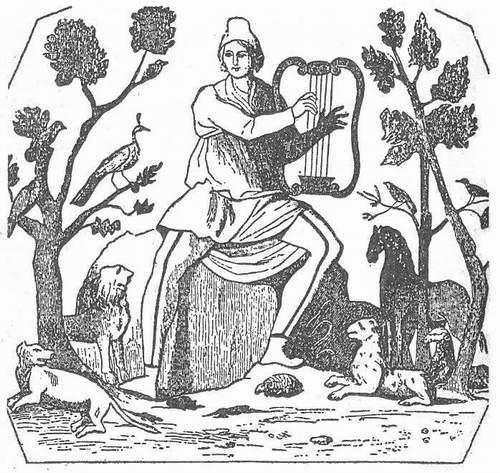
Christian Orphism: This wall-painting from a 2nd c. Roman catacomb clearly demonstrates, not merely the 'oecumenical' and 'eclectic character of early Christianity, but its established character as yet another 'panzootic' faith which would have made a strong appeal to the as-yet-uncorrupted Old Religion. Orpheus, as a 'charmer of animals, was a true Fertility figure, though rather a 'hero' than a god.
No Fertility Religion may flourish in a city, which soon forgets the mechanism of growth and reproduction; the perpetual cycle of sowing and harvest; of spring to new life and fading to inevitable death. City-dwellers know what causes their own children to be born; they forget the physiological affinities between themselves and the beasts whose meat they devour. Where Fertility rites continued to be practised in the bursting-at-the-seams cities of the post-Republican Roman world, they were self-conscious archaisms; or curiously perverted forms of the true Old Religion.
And, with the tens of thousands pouring into Rome - to the 'traditional' Syrians, Israelites, Greeks, Chaldaeans, Baby Ionians, Pergamites, Bithynians, Egyptians, and so on, were now added Orientals from even farther East: from Arabia, India, 'Malaysia' and hither China, as Augustus, by sea and land, opened up the trade-routes of the Far East - came the fancy faiths, the novelty-religions, with their sharp con-men-missionaries and lonely-women-pleasing priests.
In my book, The London That Was Rome, (8) I traced no fewer than nineteen gods and goddesses - in addition to the ten or so already identified by traditional archaeology - having temples in London; some of the divinities, such as Artemis and Mars, had several temples, though, in the case of Mars, each temple was built, it seems, to honour a different 'aspect' of the god.
That makes a total of some thirty divinities - of whom we know — worshipped in Londinium; if we add to these the others whose cults have been identified in places elsewhere in Britain, we arrive at a total of not far off fifty, many of them local divinities or gods imported by troops coming from abroad without touching at London. To such troops belonged the Baghdadis, Damascenes, Palmyrenes and other Middle Easterns who were mostly recruited in Syria and other Levantine lands, and sent to Newcastle-on-Tyne, from which the recruits for the British Legion, based on the Tigris and Euphrates, left for their Middle Eastern headquarters. (9)
----
[8] London: George Allen & Unwin, 1971.
[9] Two Middle Eastern units based on northern Britain were a battalion of Syrian archers, the Cohors I Hamiorum Sagittariorum and an irregular infantry unit, the Numerus Barcariorum Tigrisiensium, recruited from the Tigris area, and stationed at South Shields.
----
Roman military activity was always accompanied by an allied commercial activity - 'Trade follows the Flag!' On the great wall that Hadrian built from the east to the west of Britain, a Palmyrene merchant named Barates had his store; he had acquired a licence to supply the legionary troops - not the first, and by no means the last Semitic trader to hunt up business so far afield.
Palmyra, an oasis on the camel-track between Syria and Palestine, had grown from lowly beginnings associated with the domestication of the camel as a beast of burden in the twelfth century BC, to a position of such commerce-based wealth and power that for a short time, Palmyra was able to challenge the might of Rome herself. However, in AD 272, Palmyra surrendered to the legions, and, after a revolt, was destroyed. Rebuilt, it regained little of its former glory.
Barates came from Palmyra at a time when it was still one of the great commercial centres of the Middle East; and, having made his money supplying the officers and 'squaddies' of the legionary troops with those 'extras' not included in the ration, Barates married. His wife was his freed slave-girl, Regina ('My Queen'), and, by one of those freaks of survival, the tombstone that Barates erected to his mourned Regina was found in South Shields (probably the least Roman place that I have ever shudderingly seen!), and may now be examined in the Free Library of that unlovely town. Written in both the beautiful Palmyrene (Semitic) and the Latin monumental script, and cut by a master-mason, the Latin part of the bilingual inscription reads:
D[is] M[anibusl/Regina liberta et conjuge [for coniux] Barates Palmyrenus (10) natione Cattvallauna an[nis] XXX To the Gods of the Underworld [This stone commemorates] Regina, freed slave and wife of Barates, (11) the Palmyrene. [She was] of the tribe of the Catuvellauni. [She lived] 30 years.
----
[10] Should be 'Barates Palmyreni' - but the whole inscription is in the doggiest of dog-Latin. As the present physical type of Tyneside shews, the Celts were drained off and replaced by Middle Easterns. Most were only imperfectly acquainted with Latin, as the botched Latin of the Barates inscription shews.
[11] If thirty-year-old Regina left sons to her loving (and, being Syrian, philoprogenitive) Barates, it may be from them that the common North Country name of Barren (Barratt) has descended to our own times.
----
Regina, then, was British, member of the Catuvellauni, a Celtic tribe whose capital was either London or St Albans, and whose king, Cassivellaunus, was second only to Boadicea in his opposition to the Claudian legions of AD 43. So that, under the Roman occupation, the British were being enslaved in their own country - a fact to be noted when accounting for the speed with which the Celts reverted to their ancient tribal organisation on the departure of the Eagles.
Now, if Barates came from Palmyra, which god or gods did he bring with him to the windy bleakness of the Wall? If he came from the matriarchally Semitic land behind the Fertile Crescent, he probably brought a goddess or goddesses with him: Ashtoreth, the Semitic Venus, perhaps - whose name so closely resembles that of the goddess Adraste, whom, in the momentary pause before battle, Boadicea invoked after having let the magical hare scamper Legionwards. Or Barates may have brought with him - a single object of devotion, or a companion for other divinities of his worship - one of those darker aspects of the Life Principle: perhaps even the Great Mother herself.
I mention the odyssey of the Semitic merchant Barates here, to shew, through one unimportant man's wanderings - two thousand miles by Mediterranean merchant-ship or in a two-wheeled carpentum or four-wheeled carrus along the Roman roads - gods could pass as freely from the eastern boundaries of the Empire to the western. And what Barates was doing, tens of thousands of others, soldiers and merchants, officials and state-surveyors (no missionaries, mark you; that was left to a later day) were doing.
In its origins, Christianity, still profoundly influenced by, and selflessly modelling its sentiments and conduct upon, the noble example of its Founder, remained for decades a religion as 'secret', as 'closed', as Mithraism and other contemporary faiths were to remain until their extinction. Not until after the Church had organised itself internally 'on a military foundation', with a special language based on the terms in use amongst the Roman soldiery (thus anticipating the practice of the Salvation Army eighteen centuries later), did it cautiously open its doors to the 'pagan' (the Roman squaddy's slang term for 'civvy'), and admit him to its secrets.
In considering the strange history of the Roman Church it should always be borne in mind that, notwithstanding its later oecumenical character, it began as a 'foreign' religion, whose membership, even in Rome - particularly in Rome -was almost completely composed of 'foreign' elements. It was what we should call today 'a religion of the Left'; a proletarian faith preached to the down-trodden, the enslaved, the tyrannised. Affirming the evil, not only of riches but, worse, of rich men; submitting with hardly-concealed reluctance and open ill-grace to Governmental rule; promising a Kingdom not of this world; it is not difficult to see why the early Christians should have seemed to the Romans of the Empire ill-conditioned anarchists who were better out of the way.
In those days of oppression; for, though the Christians openly proclaimed sentiments invited oppression, there is no doubt of the historical reality of the persecutions; they were not so far from the simple faith of the Old Religion. They can hardly, in those formative times, have queried too closely the teachings of the Master; so that, when the time came for them to edit the sacred writings according to their new thinking, they could hardly excise sentiments sanctified by centuries of reverence. The bucolic images, so reminiscent of the Old Religion - 'I am the Good Shepherd', 'I am the True Vine' - had to remain; though, paradoxically, the brain-washers and publicity-managers of the new Church raised the status of the simple Shepherd God of Palestine to a triple-crowned Emperor of the Universe. In this, they were but causing Christ's image to reflect the strange changes which were overtaking more earthly emperors.
Under the influence of the now completely Orientalised Greeks who, their country and its colonies deprived of their independence by Rome, took a fearful revenge by plundering every social class of that conquering Empire upon which the vampire Greek had come to batten, the ancient Roman virtues of gravitas, pietas, honestas, vanished.
Greek influence and supple persuasiveness it was which caused the Emperors to dress and comport themselves as the divinities that their coins and monumental inscriptions said that they were. Gradually - and at no very slow rate - the Emperor, by dress and ritual and carefully-arranged theatrical showmanship (all managed by Greeks - often slaves), affected to represent, in his Divine Person, that Over-God - Zeus or Iuppiter - who, ruling all lesser gods and goddesses, began to bring the foreshadowings of a true monotheism to Roman state religion, a development which was to prove greatly to the advantage of the Church of Rome when the time for its historic take-over of Roman state religion came due.
The presence of Christians in Rome in the years immediately following the Crucifixion is easily explained by the presence of a colony of Jews, settled there by the interest of Julius Caesar who, like many other educated Romans of a philosophical turn of mind, was interested in the Jewish religion. Indistinguishable, to Roman eyes, from the Rome-settled Jews, the Christian Jews newly arrived from Palestine from the earliest days of their 'separation', took every step - not short of physical violence - to make it plain that they were always to be distinguished from the Unbelieving Jew.
The Roman authorities, seeing the newer Jewish immigrants as 'trouble-makers', might have expelled them, but for one of those world-shaping accidents which, more than all human planning or even (one might affirm) Divine intervention, bend the pattern of mankind's destiny. Already the Roman Jews had felt the weight of imperial disapproval; in AD 19, when Christ, if the stories be true, was out of his time as a carpenter's apprentice, and was serving as ship's carpenter on a merchant-vessel belonging to his uncle, Joseph of Arimathaea, trading to Britain; in AD 19, then, the emperor Tiberius angrily shipped 4,000 of the Roman Jews to the mines of Sardinia. And when, in AD 70, Rome moved against the Jews of Palestine, and destroyed the Temple of Jerusalem, it was the orthodox Jews and not the Christian Jews who were the principal objects of Roman official disapproval.
Though not a proselytizing religion, Christianity attracted its disciples, nonetheless; it was certainly established in Rome as early as the reign of Claudius, AD 41-54, and had recruited so many adherents that, by AD 64, Nero was able plausibly to blame on them the conflagration that, some say, the emperor himself began.
The strength of early Christianity was in its 'popular' appeal but this popular appeal made it, even in its earliest days, powerful friends. Though the historians Tacitus and Suetoniu appear to know of Christianity only by report, St Paul' Epistles, greeting those Christians who are 'of the household of Caesar', prove directly, in Carcopino's words, 'that the apostle had recruited some of his followers from among the retainer of the emperor, among those slaves and freedmen who, under specious appearance of humility, included the most powerful servants of the empire'. (12)
The Church which developed out of this popular radical religion never forsook its original 'proletarian' image, even in the days of its greatest wealth and authority. In the beginning though, the 'proletarian' attitude was a necessity of member-ship; certainly a necessity of promotion within the tight-knit organisation. We have seen the same ludicrous business in our own time; as they did in the days of the French Revolution. In Rome, the obvious wealth and power of this 'underground' movement attracted educated, ambitious men who, prepared like Henry IV to compromise with their habits for an ad-vantage, began to join the movement.
The New Men moved delicately. They not only accepted the existing Sacred Writings with all their uncouth solecisms, their faulty (and often meaningless) translations from the imperfectly understood Greek; these ambitious newcomers abandoned their 'Oxford accents', and bent their tongues to the crude vocables and the loose grammar of the sermo plebeius, the common people's way of speaking. At least, they used a 'was you?; me and Gaius had a shufti at them lions larss Toosdy; my old woman - cor! she's a crafty cow! - topanta mea — mehercle! - prime cata'st!' type of speech when attending the love-feast of the faithful - the agape - but not when gently trying to convert their still well-spoken and unconverted friends. The Russian aristocrats who, joining the revolutionaries, tore off their epaulettes and wore workers' cloth caps could hardly have disgusted honest men more than these 'gor blimey' renegades from paganism sickened those to whom pride was more valuable than money or power.
----
[12] Jerome Carcopino: Daily Life in Ancient Rome (translated by E. O.) Lorimer) Harmondsworth: Penguin Books, (paperback), 1956.
----
This sketch of the Roman Church's beginnings is essential if we are to understand how and why it became, in later centuries, the bitter and unrelenting foe of the Old Religion.
The Church's teaching was successful because it was so marvellously adaptable. Though it was anti-sex - and so anti-Life - from the beginning, it attracted the women of the later Empire because its still-remembered Jewish origins inclined it, despite its bias against sex, to elevate the status of woman: the respected, powerful and always obeyed 'Momma' of any normal Jewish household. Anciently when Rome and Italy (except Etruria) were populated by non-Oriental peoples, Woman had enjoyed an elevated position, especially when she was Wife and Mother of a Roman household. Her position protected as much by unshakable popular opinion as by inflexible laws, the Roman matron occupied a rank in the social hierarchy superior to that that Woman has enjoyed in any other society - even Jewish.
But the population of Italy; even more that of Rome; had been diluted by the importation of Oriental blood; so that Rome was no longer 'Western' in any but a strictly geographical sense. And the Orientals who now ran the Empire were not of those peoples amongst whom Woman enjoyed - or, to this day, enjoys - any elevated social rank. She was a chattel; a domestic slave; an amusement; a breeding mare. The Church offered a change; a reversal of the woman-degrading trend; a restoration of Woman's old privileges and old rank; her esteemed place in society would be hers once again. Women have always been the strongest and most faithful supporters of the Church of Rome; it was to consolidate their membership that a female counterpart of Christ - the Theotokos -was reintroduced into the religion.
During the third and fourth centuries, Rome had to fight for her very life; enemies gathered on every frontier; and in this confused atmosphere - with Rome holding the borders, but only just - the one well-organised and not at all confused body offered its help to the State. The Emperor Constantine accepted; and Christianity became, officially, the religion of the Empire. The former 'pagan' religion was - also officially - not suppressed, any more than Jewish shops were suppressed 'officially' in the early days of Nazi power.
The Nazi authorities knew that they might safely leave the 'disciplining' of the Jews to the unofficial zealots roaming the streets looking for Jews to molest, Jewish shops to loot and smash, and Jewish synagogues to burn. It is astonishing to observe with what courage the adherents of the proscribed faith bore up against the first taste that the world was to have of Christian persecution. It was not, indeed, until the very end of the fifth century; a hundred and fifty years later; that a 'converted' barbarian Emperor officially proscribed Paganism, and ordered that what remained of its property should be handed over to the Christian Church - which, anyhow, had already adopted the organisation and many of the forms of the State religion that it had supplanted ('Taken over complete' is probably the most correct way of expressing it).
The Church waited only until after Constantine's death to produce one of the most shameless forgeries in the history of false pretences: the famous Donation of Constantine. This document purported to be the instrument by which the Emperor Constantine surrendered the imperial insignia and his sovereignty over the Western Empire to the Pope of Rome. Appeal to this impudent forgery to support every claim to supreme kingly authority in the West was made by Pope after Pope for centuries until, indeed, with the smashing of Rome's total power by the Reformation, the Donation of Constantine might be denounced for the swindle that men had long known it to be.
Some distant municipia and coloniae, profiting by the Empire's inattention during a time when every resource was needed to protect the heart-lands of the Imperium, disregarded the official recognition of Christianity as the State religion. The traces of Christianity in Britain are very few, and that London was still 'pagan' at the beginning of the seventh century (so that the Londoners angrily kicked out Mellitus, the 'Bishop of London' whom King Sebehrt would have placed over them) we have on the authority of the Venerable Bede.
The Church's great opportunity - an opportunity seized without hesitation and with both hands - came with the official extinction of the Roman Empire in the West (the original Roman Empire's original home) by the barbarian, Odoacer, chief of the Heruli, who, in extinguishing the Western Empire, proclaimed himself King of Italy.
What was left of Rome was ruled from Byzantium, the Eastern Empire, as yet too unprepared and weak to challenge the Germanic and Scythian tribes now pouring into and across Europe. In this governmental vacuum, all that remained of Old Rome - the Rome of Romulus and Remus - was the 'true' Roman Emperor, the Pope, claiming a shadowy sovereignty by virtue of the forged document falsely signed with the name of a long-dead Emperor.
The barbarian kings, after a little 'token' sacking, settled down to become 'Romans', and in this pious wish they had every help from the Church. The wonderful buildings of Theodoric in Ravenna shews how closely a barbarian king could identify himself with the culture of the politically extinguished but still culturally living Empire. Theodoric, King of the Ostrogoths, revolted against his overlord, the chief of the Heruli, and, overthrowing Odoacer, proclaimed himself King of Italy in the Herulian's place. Theodoric made his capital at Ravenna, and left the Pope to rule Rome.
The plan to restore the vanished glories - with the wealth and the power - of the Empire; but, this time, by a religious, rather than a military campaign of recovery; can have been no inspiration of the moment. The plan may have been many reigns in maturing; but the plan itself was inherent in the fundamental transformation which had changed the Roman Church from a foreign, immigrant, Leftish, evangelical 'Pentecostal' faith, with a carefully cultivated 'proletarian' image, to an efficiently organised, wealthy, powerful and insatiably ambitious force, whose organisation is so clearly modelled on that of the pagan state-religion that we can think of the Roman Church, in the years immediately preceding Constantine's 'conversion', (13) as a 'shadow' ecclesiastical government, readying itself to take over control on the expected dismissal or abdication of 'the old firm'.
----
[13] For all his support of the Church, he was never baptised.
----
The dates not only indicate this; they seem to me to prove it.
Constantine the Great, British-born son of a British mother, and ruler of Britain and Gaul," decided to make a bid for the Empire itself. The boldness of his ambition may be measured by the fact that, under the reorganisation of the Empire by Diocletian, with its division into Eastern and Western sub-empires, four emperors - and not merely one - were henceforth to be entrusted with the management of those imperial Roman dominions which stretched from Portugal on the west to Mesopotamia on the east; from Scotland in the far north to - as we have recently discovered - Southern Arabia and East Africa on the south. Constantine had to rid himself, then, of four obstacles between himself and the Purple. By October 28, AD 312, he had succeeded. He fought and defeated the last enemy, Maxentius, at the Milvian Bridge, about three miles out of Rome. On the following day, the Senate 'unanimously' voted him senior Augustus of the Empire.
In making his bid for the throne, Constantine had had the help of Licinius Caius Flavius (so nicknamed because he was yellow-haired) Valerianus, a poor Dalmatian peasant of brilliant military genius, who had joined the Roman army as a simple miles, and had been appointed, by the emperor Maximinianus, an old platoon-mate, to be governor of Pannonia and Rhaetia (modern Switzerland, Austria and the western Balkan states). By the time that Constantine - on his way to the supreme dignity - had blackmailed himself into a sub-emperor's purple, Licinius was already one of the Tetrarchy. Constantine courted his help; gave him his sister Constantia as wife. Licinius it was who first began to defeat Maximinus, and got rid of him for Constantine, who, as soon as he had defeated Maxentius, turned on Licinius, using as excuse the fact that Licinius had persecuted the Christians, on whose help Constantine had openly proclaimed his intention henceforward to rely. (It seems no Christian historians' fable that Constantine did cause the mystical Christian Chi-Rho monogram to be painted on his soldiers' shields.)
----
[14] One often hears it said that 'the old Province of Gaul is the modern France'. It is not so. The Province of 'the Gauls' (Galliae) had its southern boundaries along the Loire, becoming its western boundaries along the Rhone until Lyons, and then turning north-east again to include the part extending to the present Switzerland.
----
Licinius, offering battle to Constantine, was twice defeated; he fled to Nicomedia, from which he was forced to return. His wife, Constantia, pleaded with her brother to spare Licinius. Constantine did - until AD 324, when he ordered that Licinius, then in exile at Thessalonica, should be strangled. To make sure that no revengeful heir might grow up to trouble Constantine's ambitions or menace his health, the Emperor ordered that Licinius's son - Constantine's sister's son, as well - should be put to death also. 'A great and good ,man, Constantine', as the Church's panegyrists described him; and exactly the same words were used by Sir Winston Churchill, in his history of World War II, to describe the late Josef Stalin. It depends, of course, on how one regards all these things.
Now for the significance of the dates.
Exhibiting all the known Christian emblems, amulets and other religio-magical talismans, Constantine advanced to victory at the Milvian Bridge. On the following day he was voted to the supreme position in the Empire; and, as a token of his gratitude to the Christian God for having helped him to victory, Constantine made over to the Bishop of Rome the Lateranus enormous palace - this, exactly a year later, in the winter of 313-314.
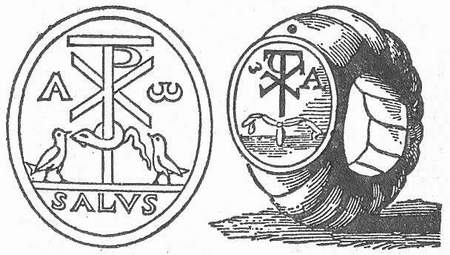
More eclectic Christianity: A seal and seal-ring dating from possibly as early as the first century. Note how 'Christian' symbolism is mixed with that of other faiths. Not only is the distinctively 'Christian' Chi-Rho monogram united, in both cases, with the sacred (and non-Christian) Tau, there are also the most ancient Babylonian Sky-Serpent and the pair of good-luck birds. And whilst the Latin word salus simply means 'health, wealth, prosperity', etc., it should not be forgotten that Salus was the Roman Goddess of Health, with an important temple in Rome itself.
Whatever other opinions regarding Constantine's future attitude towards the Church, its directors were confident that they could contrive to preserve and encourage Constantine's friendship towards Christianity, and to profit to the full from that sympathy.
By the beginning of the third century, the Church had undergone fundamental change - a fact of which I was reminded when, some years ago, I was passing by Buckingham Palace, and a large limousine entered the courtyard, its occupant being saluted by guards and policemen on duty. It was the 'General' of the Salvation Army, arrived to receive his order of chivalry from the late King. The Church had shed its Leftish, radical, communistic, deliberately uncouth social attitudes, and though it was still saddled with sacred writings edited under the old, 'proletarian' dispensation, there was little which might be done about that now. But, in every other respect, the Church had given itself a new image - polished, urbane, worldly; above all, educated in the traditional Roman manner. Little Pagan boys learnt their Latin through a study of the Pagan classics - indeed, there were classics of no other kind; and whereas the Church, in its 'strict' period, would rather have left its Faithful illiterate than learn from such 'devil's works', the advantages of compromise had been seen; and whilst the Church proclaimed that it never did, nor ever would, compromise on religious matters, it compromised on those involving a common culture.
By the middle of the third century, some noble families had become openly Christian; there was even a Christian minority in the Senate, led by the noble Anicii. But the support of the Church, 'traditionally educated' though it now could claim to be, still came from the women, aristocratic or otherwise In the noble family of Ceionii Albani, the women were all Christian, the men, Pagan to a man.
Those dates ...
In 313, the year following Constantine's victory over Maxentius, the Lateran Palace was made over by the new emperor to the Bishop of Rome.
In 314, the Bishop of Rome, satisfied now that, sooner or later, the Church's 'manifest destiny' would call it to share, or even to usurp, the supreme power in the Empire, hastily convened the Council of Ancyra - perhaps the most important single event in the history of the Old Religion.
On the agenda of this Council, which was summoned to warn the assembled bishops of the imminent 'promotion' of Christianity, and to make plans for the assumption of power, was the subject of the Church's future relations with State Paganism, and all the other religions which were outside The One True Faith. In particular, the assembly concentrated its attention on the Old Religion - for reasons which have been only superficially (and never constructively) examined. Here I may put forward my view that it was because aristocratic, rich women - the Church's most notable converts to date -were already forming a 'reform group' within their own intrinsically separate (but which might easily become separatist) section of True Belief.
The monastic ideal was in fact invading Roman high society - and what a society it was! Its salient features are familiar from the writings of Ammianus and other contemporaries: the wealth and luxury of the aristocratic elite, the passion for the circus and the arena, the ostentatious progresses with attendant hordes of slaves and eunuchs, the extravagant banquets, the ornate hairstyles and jewellery flaunted by the women. Amid all this worldly racket there were not a few who resolved on a renunciation of property and pleasures. This was not merely a withdrawal from all the temptations and vices of a decadent society; it was also a protest at the official Christianity which ... had made the capture of the secular world its main objective. (15, 16)
At the time that the Council of Ancyra met, this emotional revolt of the rich women Christians against the Church's 'backsliding' had done no more than to send them off in search of a 'more primitive', 'purer', far more demanding Christianity -that Christianity that these wealthy female zealots imagined that the Church, seduced by wealth and the promise of power, had abandoned.
----
[15] My italics - M.H.
[16] This passage is quoted from Professor Joseph Vogt's admirable The Decline of Rome; London: Weidenfeld & Nicolson, (English translation), 1967.
----
So far, this search for a 'reformed Christianity' had taken the women no further than a convent, as Marcella, niece of the Praetorian Prefect, Lampadius, was to enter, in 365 - though it must be admitted that this convent was established in her elegant and luxurious mansion on the Aventine Hill. But others, attracted by the news of eastern monks' ascetic life, did actually make pilgrimages to these holy men - amongst the pilgrims, Melania, widowed twenty-four-year-old daughter and granddaughter of consuls. She reached Jerusalem, founded several convents, and put herself under the spiritual guidance of a learned monk, Rufinus, whose self-appointed task it was to translate Greek theological works into the Latin that the Church, identifying itself with Empire's most extreme nationalism, had now adopted as its official language.
But for how long, the assembly asked itself, were disappointed, scandalised women to be content with moving backwards within the Church? Might not a time be coming -and perhaps soon - when the revolt of the rich, earnest women would take them outside the Church, into the orbit of another faith living obviously nearer to its original simple ideals?
The practical measure to be taken now was to block up as many exit-holes as possible; to destroy as many alternative religions as possible. It is at this point that the Old Religion - never, of course, popular with Christians; but so far tolerated by them - becomes Designated Enemy. A 'rule for the Bishop' (Canon Episcopi) was drawn up, to deal with heresy and paganism and unbelief - all very different things - and though this Canon's authenticity was to be impugned, centuries later, by (of all bodies!) the Church, I see no reason to doubt that it was a production of the Council of Ancyra of 314, and represented, if not the unanimous view, then at least the majority view. It certainly represented the official view.
As this Canon Episcopi was an opinion of a Church Council to whose authority appeal was to be made until the end of the fifteenth century, that opinion, so far as it concerns the Old Religion, ought to be quoted here.
Bishops and their assistants must labour with all their energy to uproot (exstirpare) thoroughly from their parishes and sees the pernicious art of sorcery and malefice invented by the Devil; and if they find a man or woman follower of this wickedness, to eject them, foully disgraced, from their parishes. For the Apostle says, 'A man which is an heretic, after the first and second admonition, him avoid.' Those are held captive by the Devil who, leaving their Creator, seek the Devil's aid. And so Holy Church must be cleansed of this pest.
That constitutes the first 'official' warning. Old Religion beware!
It is also not to be omitted that some wicked women (17) perverted by the Devil, seduced by illusions and phantasms of demons, believe and profess themselves, in the hours of night, to ride upon certain beasts with Diana, the goddess of pagans, and with an innumerable company of women, and in the silence of the dead of night, to traverse great spaces of earth, and to obey her commands as of their mistress, and to be summoned to her service on certain nights.
But I wish it were they alone who perished in their faithlessness, and did not draw so many with them into the destruction to which infidelity leads. For an innumerable multitude, (18) deceived by this false opinion, believe this to be true, and, so believing, wander from the True Faith, and are involved in the error of the pagans, in thinking that there is anything of divinity or power save the One God.
Wherefore the priests throughout their Churches should preach with all insistence to the people, that they may know this pagan doctrine to be in every way false, and that such phantasms are imposed on the minds of infidels, and not by the divine, but by a malignant spirit.
Thus Satan himself, who transfigures himself into an angel of light, when he has captured the mind of some miserable woman, and has subjugated her to himself by infidelity and lack of faith, immediately transforms himself into forms and likenesses of different personages; and deluding the mind that he holds captive, and exhibiting things joyful or mournful, and persons known or unknown, leads that captive mind through devious ways, and though it is merely the mind which receives these impressions, the Infidels believe that they have these experiences in the body and not simply in the mind.
----
[17] My italics - M.H.
[18] My italics. This, at a time when, according to the less critical histories, 'Paganism had almost ceased to exist'!
----
Who is there who is not led out of himself [Greek: 'ecstasy' means 'to fly out' - i.e. of the body] (19) in dreams and nocturnal visions, and sees much when sleeping that he had never seen waking? Who is so stupid and foolish as to accept that all these things which are happening only in the mind happen in bodily experience - as when the Prophet Ezekiel saw visitations of the Lord in spirit, and not in actual fact, and the Apostle John saw and heard the mysteries of the Apocalypse in the spirit and not in the body, as he himself says: 'I was in the spirit.'
And Paul does not dare to say that he was rapt in the body ....
But Paul does not say that he was not. St John positively affirms that he was 'in the spirit' but St Paul, when describing how he was caught up into the third heaven, to hear 'unutterable words', is not at all positive in this matter: 'Whether in the body or out of the body, I cannot tell.' This is an instructive episode in ecclesiastical history: a false statement made to an assembly of experts - not one of whom protested that Paul did dare to say that, at any rate, he may have been rapt in the body.
It is therefore to be publicly proclaimed to all that whoever believes such things, or similar to these, loses the Faith; and he who has not the right faith in God is not of God, but of him in whom the faithless one believes, that is, of the Devil. For of Our Lord it is written, 'All things were made by Him.' (20) Whoever, therefore, believes that anything can be made, or that any creature can be changed for better of for worse, or be transformed into another aspect or identity, except by the Creator Himself, Who made everything, and by Whom everything is made, is beyond doubt an infidel.
----
[19] As has been pointed out before, by many others, the difference between right-acting and wrong-acting depends on the doer. St Paul (2 Corinthians, 12:2-4) was a notable ecstatic.
[20] Another curious - intentional? - mistake. It was of God, not of 'our Lord' that this was written. (John 1:3.).
----
Apart from the warning to the Old Religion that this explicit and lengthy condemnation of 'infidelity' expressly gives, this extract from the decisions of the Council of Ancyra is important in that it defines the experiences of the faithful at Old Religion assemblies as so much diabolical illusion - though, curiously, it does not appear to dismiss the traversing of 'great spaces of the earth', in 'the silence of the dead of night' as illusory.
What the Council appears to have thought is that the members of the Old Religion were what used to be called 'englamoured' - caused to experience happenings which had reality only in their imaginations. The phenomenon of 'ecstasy' was one well known, by personal knowledge or hearsay, to every member of the Council; amongst the Greeks, the Ecstatici were diviners who used to put themselves into a trance-state (by drugs?), and, recovering from the trance, describe what they had seen 'when out of the body'. The Hellenistic Jew, Paul, not only knew of this practice, but, evidently, employed it himself.
It is noteworthy that the Council's concern seems predominantly with women, and, just as women were the main support of the early Church, so it is obvious that they were - or the members of the Council believed them to be - the main support of the Old Religion. The gatherings of Old Religionists are stated to have been mainly if not exclusively of women, though whether the phrase 'innumerable multitudes' reflects the facts or is merely a propagandist 'loading' to justify the contemplated persecution of the Old Religion, it is impossible to say. At any rate, the Old Religion was still, in 314, sufficiently vigorous to warrant the Church's attempt to put it down.
Ten years later, another Council was convened - the famous Council of Nice (Nicaea, in Asia Minor). Presided over by Constantine the Great, the Council's ostensible reason was the suppression of the Arian heresy; its real reason: to take advantage of the 'favourable climate' created by Constantine's sympathetic and protective attitude towards the Roman Church. The Roman Church did not then protest against, nor has since condemned, Constantine's treachery or murderous impulse. So far as the Church was concerned, this was accounted a virtuous and pious act - Licinius had been an active persecutor of Christians. He 'deserved' to die. Morality does not demand that a True Believer keep his word, however 'solemn', to a heretic, pagan or infidel - as John Huss was to discover in 1415.
The Council of Nice, called ostensibly to combat the Arian heresy, was, in reality, a meeting summoned to decide on internal discipline and external relations with non-Christian elements. It was clear now, that Constantine intended to make over the State religion to the Bishop of Rome - and the Church was determined to overhaul and up-date its 'immutable' rules in good time for the take-over.
Nothing was said about that other - and more important -heresy: the Old Religion. The question had been dealt with thoroughly by the Council of Ancyra, ten years before; and, as the leaders of the Roman Church realised, they would have had their hands full overcoming the opposition of Paganism at Senate level. There was all the time in the world to attend to the 'extirpation' of the Old Religion later ....
By the end of the sixth century, the New Europe had achieved a relative stability, after the rape of all the Western Empire's outer provinces by 'barbarian' invaders. The incalculably powerful prestige that Roman culture - and, indeed, Roman institutions generally - enjoyed among the barbarians exercised a moral force which weakened the barbarian's enmity and soon converted them to defenders, rather than destroyers, of the everywhere apparent achievements of Roman architects and engineers, Roman sculptors and painters; above all, of Roman administrators and Roman lawgivers.
The Franks who had burst into 'the Gauls' had - after the first few token barbarisms, not only respected the cities of Roman Gaul; they had respected, protected and preserved Roman municipal administration. They had even retained the Latin tongue, which is why the French speak French today, and not some German dialect.
In the 'Seven Provinces' - modern Southern France - the Roman culture changed even less. The Visigoths went straight through to the Basque country - that the Romans called 'The Seven Peoples' - and, hardly halting, went on to Spain proper, there to found the powerful Visigothic kingdom of the North, which survived until Tariq overran it in the eighth century.
The Germanisation of the Empire did not come about for two reasons: the German kings achieved their successes with the minimum number of troops, thrusting forward in the irresistible force of the Blitzkrieg, so that they could not take over anything save the actual sovereignty of the lands that they had invaded. And, either as a result of this paucity of numbers or because it suited the invaders to disturb as little as possible existing social order, the wealthy and powerful senatorial families, with their vast estates, and their armies of both slaves and private soldiers, were left in undisputed possession of all the things which had given them power. And, in addition, the Church - its prelates, priests, buildings, and estates - remained relatively untouched, especially in the Gauls and in the Seven Provinces. Attila the Hun had ravaged Europe in 447, but his nightmare invasion was brief, and his success due to causes which prevented his being opposed by any united force.
The Merovingian king, Clovis (Ludwig, Louis), after having fought and defeated the Roman general Syagrius in 485, had himself baptised in 496, and when, eleven years later, Clevis's fellow-Teuton, Alaric, invaded what was now 'France', Clovis, with an army of Romanised Celts and Franks, defeated the invader at Vorcille, near Poitiers. Except that, as from 510, Gaul was ruled from Paris and not from Rome, Gaul was as Roman under the Merovingians as it had been under the Caesars.
The sentimental attachment of the new German kings for Roman institutions is strikingly demonstrated by the fact that Clovis asked for and received from the Emperor of the East an honorary consulship, with the meaningless title of 'Augus-tulus', the robes of state and other insignia of royalty.
Sigismund, heir to the Burgundian throne, deserted Arianism for Catholicism; and, because, with the collapse of Roman rule in the West, a career under the Empire was no longer possible to ambitious young men, they sought careers in that 'non-Imperial Rome' which had survived the fall of the Empire. Thus the Germanic take-over of the West had strengthened, not weakened, the Church; and though the Visigoths and Ostrogoths were Arian, even this heresy gave way to Catholicism under the compulsion of political advantage.
Europe was safe from Roman Catholicism for another thousand years, since the now Catholic kingdoms of north-east Spain - the old Roman territory of 'The Seven Peoples' - soon recovered from the shock of the Arab conquest, and rallied to overcome and expel the Saracen. It took the new Spaniards seven centuries before the last Arab kingdom fell, but, by opposing a Christian force to the Arab invaders, the Visigothic-Catalan-Basque-Celtic fighters of Navarre and Aragon and Old Castile interposed a defensive barrier between Moorish Spain and still Roman Gaul.
With all of continental Western Europe - save for the future Arab conquests (but those were nearly three hundred years in the future) - safe in its hands, the Roman Church prepared to extirpate what it considered to be its two most dangerous enemies: the non-Roman Christians and the adherents of the Old Religion. Historical accident had caused both to flourish in a Britain rapidly de-Romanising itself.

