7 - The Language Of The Witches
In the preceding pages, I have several times mentioned that such-and-such a word, found in the Old Fertility vocabulary, is Basque or Basque-derived. Now that our history of Witchcraft has brought us within sight of Witchcraft's extinction as an organised religious system, the time has come to ask whence the Western Fertility religion was derived, and how it became disseminated throughout Europe. In identifying the traditional language of the Cult, preserved, astonishingly free from serious corruption, in the inherited rituals, we shall, I maintain, be able to answer those questions.
Many years ago, examining the racial origins of the English people, Bradley sought the evidence of a pre-Celtic tongue in the names of rivers, mountains and other permanent features of the landscape - it being widely recognised that such names survive many changes of overlordship. Bradley thought that he had proved the currency, in pre-Celtic times, of a language allied to the Arabic; and before we dismiss this supposed discovery as so much 'vapid balderdash', (1) we must pause to consider the significance of the numerous Arabic town and village-names that Isaac Taylor noted in Switzerland, and my own theory that the alternative name of an ancient German tribe (their 'real' name, Teuta, modern German, deutsch, simply means 'The People') - Alemanni (or Alamanni), as recorded by Tacitus - is the Arabic al yaman, 'on the left hand side', i.e. 'the South' (because, if one faces the East, the South is on the left - compare the name of 'the Yemen', from the same Arabic phrase).
----
[1] The contemptuous term with which C.L. Ewen (Some Witchcraft Criticisms, 1938) dismisses the theories of the late Dr Margaret Murray, an opinion which is quoted, with obvious approval, by H.R. Trevor-Roper in his The Witch-Craze of the 16th and 17th Centuries. Trevor-Roper describes Ewen as 'a real scholar'.
----
Well; the explanation of Arabic names in Europe - not unconnected with the fact, that the greatest number of Arab coins have been found in Sweden — is something to which another investigator must give his time and patience. Here it is only necessary to say that Bradley was what the children call 'very warm' - for it was a language from North Africa, as Morris-Jones later surmised and proved, which was spoken here before the Celts came. By one of those happy accidents, it has survived, even as a spoken language (as Ancient Egyptian survives in the Coptic dialect), and it was my identifying this millennia-old tongue as the language of the Witches which enabled me to do the following most important things:
1. Translate many of the ritual texts, now supposed by the sceptics to be mere gibberish, and by the faithful to be so corrupt as to defy analysis and interpretation.
2. Restore, through those translations of the texts, enough of the ancient ritual, so as to clarify the philosophy inspiring the ritual.
3. Determine, through the restored ritual, much more closely the type of religion with which I was dealing.
4. Date, to within fairly close limits, the introduction of language-and-religion into Western Europe.
5. Demonstrate, by the continuous appearance of new names in the record, but still in the old, yet surviving language, that the closest contact had been maintained between the Centre of the Cult and its outlying 'parishes' - a contact not less close (and often, one feels, closer) than that subsisting between the Pope and, say, a rural dean.
6. Give proof that local changes in ritual practice, e.g. Italian Witchcraft's subordinating the Male to the Female Divinity, were not 'heretical' breakaways, and that the tight-knit organisation - Continent-wide - survived until it could no longer survive against the totalitarian fury of monastic (2) monomania.
----
[2] The crusade against Witchcraft was conceived and carried through, as we shall see, not by the established clergy of the Roman Church (very many of whom were rightly suspected of being more 'pagan than Christian) but principally by one self-dedicated order of monks and priests, the Dominicans. The Jesuits, to their credit, were almost always opposed to the witch-hunts, and two famous Jesuits had the courage openly to denounce the persecution of the witches.
----
How greatly - and how quickly - does a language change? There may be no dogmatic answers to this question; for any language may, given the right conditions, be almost completely protected from change. Of all the languages descended from the parent-language, Indo-European ('Ayran'), Lithuanian reveals itself as the most sturdily conservative of all. Its forms are often of such incredible antiquity that comparable archaisms are to be found only in Sanskrit, which ceased to be a spoken language (if it ever was a spoken language, that many now doubt) more than three thousand years ago. To illustrate my point by the example of a single word of Indo-European origin, surviving in six languages - I select the word for 'snake'.
Sanskrit - circa 1000 BC - ahis
Greek - circa 800 BC - (ophis)
Latin - circa 300 BC - anguis
Old High German - circa AD 800 - unc
English - modern - snake
Lithuanian - modern - angis
Some three thousand years of world-change separate modern Lithuanian angis from Sanskrit ahis, yet how eroded has become the Old High German of a thousand years ago - unc -whilst only a philologist could recognise in English snake the Indo-European word from which both ahis and angis developed.
Yet Lithuania is not cut off from the world; she has had, for centuries, great cities, thriving ports: no one may explain this curious conservatism which has guarded her ancient language from serious deformation through the pressures of perhaps more than five thousand years.
Greek is another ancient tongue which has changed far less than one might have thought, though the conscious conservatism of the Byzantine emperors inhibited change for more than a thousand years. Still, even though there is a 'popular Greek', modern literary Greek, with its carefully preserved spelling, could easily be understood by Socrates or Plato.
What made for the relative preservation of the Witches' language was the traditionalism that one always finds, amongst all people and at all times, in the highly conservative mentalities of Religion and Law. In these two disciplines, archaic forms not only survive, but are carefully guarded against neglect, erosion and decay. The archaic forms of English and Scottish law are outdone in a sentimental attachment to antiquity for its own sake in the United States of America, where legal practices which have been swept away by successive reforms in England still make up much of corpus of United States federal and state law.
I expected, all the same, to find that the original language of the Witches had undergone some change, especially as the area in which the language was still spoken had been constricting seriously for the past three thousand years; a fact which meant that, though the 'outlying parishes' in communion with the Centre maintained, throughout this long period, close, even intimate contact, the language had ceased to be a spoken one away from the Centre, with the result that it would tend ever more to become deformed as it ceased to be understood. (Listen to the average Roman Catholic priest's pronunciation of the last words of the Ave Maria: '... Blessed art Thou amongst women, and Blessed is the fruit of Thy'm Jesus,' where 'Thy'm' stands for a correct, 'Thy womb'. With no written text for reference, to cover the original and halt corruption of the text, the ritual speakers of the Witches' language, I feared, would have had a full opportunity to play -I nearly said, 'merry Hell' - with the original tongue.)
Decipherment, as I have learnt by experience, is a matter of almost anything but 'inspired guessing', which never yet got the would-be decipherer anywhere. It was 'inspired guessing' which led Captain Conder, R.E., to 'guess' that the Hittite hieroglyphics were in the Turkish language - even though, when the Hittite inscriptions were written, the Turks had not even begun to move from their original home in Eastern Mongolia - so that Conder's 'inspired guessing' put back the decipherment of Hittite nearly forty years.
I tried to approach the decipherment of the Witch rituals with no preconceived ideas that might tempt me into guessing or prevent my seeing what it would not suit me to see. I was even prepared to test the texts to see whether or not they were (as so many people said they were) pure gibberish.
But if the 'gibberish' of the phrase hocus-pocus derives from a meaningful hoc est Corpus (meum) ('his is [My] Body'), I was prepared to believe (especially after some of my more difficult and rewarding decipherments) that something which made sense lay behind the apparent gibberish of the Witch rituals.
Of course, at a first glance, it was easy to see what adulteration had overtaken the language, even though one did not yet understand it. Here were misspelt and mis-understood Latin, Greek and Hebrew - 'Athatos', for Greek Athanatos,(3) 'immortal'; 'Ciclap' for 'Cyclops'; 'Tetragammaton' in the same text as the correct 'Tetragrammaton'; Latin Semones, 'fertility spirits', rendered Semonei; (4) etc., and to crown the absurdities of the ignorant repetition of rituals no longer understood, the old V form of ampersand has been misread as a mysterious divine or semi-divine being, 'Z', who is included amongst those spirits conjured to provide the gift of invisibility.
For my first experiment in deciphering the Witch texts, I chose a fairly well-known chant from the Initiation Ritual. The chant is given both in Peter Railing's The Warlock's Book (W.H. Allen, London, 1971) and Raymond Lament Brown's A Book of Witchcraft (David & Charles, Newton Abbot, 1971). I shall give the Haining version here, partly because it is all in the ancient tongue, whereas the Lament Brown version is partly in English, and also because the text of the latter version looks to me as though it has had the misfortune to be edited by someone ignorant of the ancient tongue. As it stands, the Lament Brown version is not so much gibberish as rubbish - a fact that my attempted translation of the text as given in Haining will, I trust, make evident.
----
[3] Yet original N is preserved in the English name of the flower 'tansy'.
[4] Misspelt or not, the mention of the Semones is interesting - as shewing the tenacity of ideas in religion. The Semones were fertility spirits (from the ancient root, sa, 'to sow') and were invoked in the famous hymn of the Arval Brothers, already so corrupt as to be unintelligible by the beginning of the Roman Empire.
----
Here is the Priestess's chant, as she opens the ceremony of Initiation:
Eko: Eko: Azarak; Eko: Zomelak (5)
Bagohi Lacha bachabe
Lamac cahi achababe
Karellyos
Lamac lamac Bachalyas
Cabahagy sabalyos
Baryolos
Lagos atha cabyolas
Samahac atha famolas
Hurrahya.
With this text plainly written out, and lying before me on the desk, I studied it carefully, letting ideas flow into and out of my head. One or two words caught my attention. In particular, Lamac lamac ... sabalyos ... Samahac... seemed to echo the words of Christ on the Cross: 'Eloi, Eloi, lama sabachthani?', 'My God, my God, why hast Thou forsaken me?" But a mere consonance of sound in even one or two words is not sufficient to justify the assumption that one has broken the cipher. All languages exhibit chance coincidences of sound; but not, save in rare cases, of meaning: hay, in Turkish, means 'living, lively, alive'; in Spanish, hay means 'there is' - French 'il y a'; in English, hay means 'dried grass, used for cattle feed'. The three words, all spelt the same and pronounced not very differently, have totally different origins and totally different meanings. I decided that I was not justified in thinking that the language of the Witches might be Aramaic.
One of the first rules of cryptanalysis (an American word but a good one) is to study the undeciphered text, and, usually by counting, but in any other way which seems to get the imaginative puzzle-solving faculties working, to endeavour to detect a pattern. Now, in studying the 'Eko: Azarak, Eko: Zomelak (or Zamilak ...)' text, I was struck by the relative frequency of the suffixed particle (an enclitic? a suffixed article, as in Roumanian and Danish?) ac/ak — Azarak, Zomelak, Lamac and Samahac, Four words, with six occurrences all told (Lamac occurs three times).
----
[5] Zamilak in Lament Brown.
[6] Mark. xvi. 34. The words are often spelt differently.
----
Now there is a language in which the -ac termination is frequent, and I knew of only one such language: Basque.
In Basque, -ac (-ak) is the suffixed definite article, either singular (nominative case, active, of the so-called 'definite' declension) or plural (nominative case, simple, again of the so-called 'definite' declension). Were these words ending in -ok (-ac) nouns with the suffixed definite article, 'the'? I decided to check on these possible nouns first, and when I turned up the word nearest in sound to azarak I must admit that I felt something of a shock.
For azaro, in Basque, is 'November', and it is on the Eve of November ('All Hallows') that the Witches hold one of the two greatest festivals of their year. This certainly looked promising, especially since the nominative definite of azaro is azaroac - not very far from azarak, bearing in mind that Basque words differ greatly in pronunciation even from province to province of the Basque country; and here we were dealing with a word which might have been imported into the Fertility ritual of Witch Britain many, many centuries ago. The wonder would be, not that it had changed a little from the original Basque, but that it had retained, over the ages, so near a resemblance.
Now, if one be a witch, what does one - what did one - do in November? Hold the rituals and have a feast. Yes, here was a possible clue to the meaning of 'Eko'. For, in order to feast, one has to kill; and before the discovery that hay and root-crops can feed animals through the winter, November was the time for the feast which followed the (compulsory) killing of all but the basic stock.'
The cultivation of meadows, with their provision of hay, and, even more, the sowing of root-crops - turnips, swedes, mangolds, etc. - did away with the necessity of feasting, though not the voluntary participation in what had come to be, for witches and others alike, one of the most pleasant social affairs of any year. So what did 'Eko' mean? - though I more than half suspected what the dictionary was about to turn up.
----
[7] Hence, as we saw on page 134, the Anglo-Saxon name of 'Blodmonath'.
----
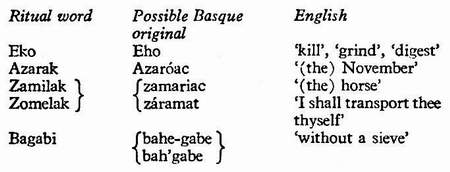
Yes. Eho (pronounce the 'h' as a chi [x] in Greek or the 'ch' in the Scots word, loch) means 'to kill, to digest, to grind'. Controlling my desire to shout 'Eureka!', I still felt that all looked most promising. As Professor Blegen wrote to Michael Ventris, decipherer of the 'Linear B' Mycenean script, 'All this seems too good to be true Is coincidence excluded?', I should have to take good care that, in my attempted decipherment of the Language of the Witches, I must exclude coincidence. And if eho meant 'kill' (or 'digest' or 'grind') and azar(o)ac meant '(the) November', what did Zomelak (Zamilak) mean?
Remembering that, in strangers' pronunciation of Basque, as of other languages, the sounds of I and r seem to be interchangeable, there were two promising words in the dictionary, both from the same root: zamariac, 'the horse', and zaramat, 'I shall transport thee thyself.
Deciding to make, for the present, no attempt to link the supposed Basque words, as I discovered them, in the intricate syntax of the language, I wrote down the words of the ritual chant, and tried to suggest a Basque original for each word. Here is what the list looked like after I had finished what, I knew, must be only the initial stage of a decipherment:
Now this, I thought, is strange! In many a witch-trial, the ability of the witches to transport themselves in a sieve is mentioned. But, in any case, the words of the First Witch in Macbeth echoed in my memory:
A sailor's wife had chestnuts in her lap,
And munch'd and munch'd and munch'd: 'Give me,' quoth I:
'Aroint thee, witch!' the rump-fed ronyon cries.
Her husband's to Aleppo gone, master o' the Tiger:
But in a sieve I'll thither sail,
And, like a rat without a tail,
I'll do, I'll do, and I'll do ...
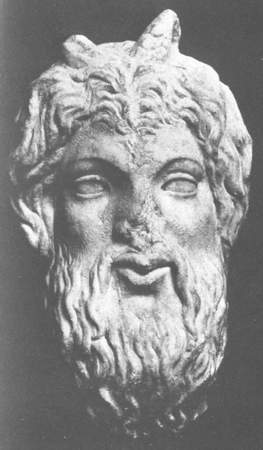
9 Pan - God of the 'Everywhere'. Pan, the 'Universal', was the semi-human personification of the Goat, in its aspect of a Fertility symbol. The Goat rivalled the Bull in the Old Religion as the archetype of Fertility, and, as Pan, the Goat (who later became the Devil of Christian mythology) was one of the most powerful gods of the early pantheon. (Photograph British Museum)
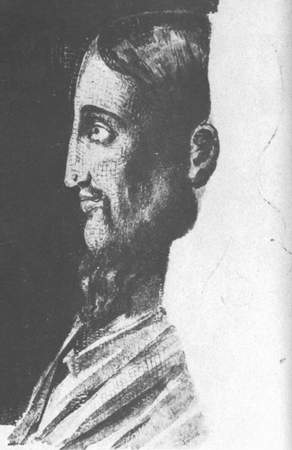
10 The 'Christ of the Old Religion'. Unfinished sketch for a mosaic found on a wall of a Roman catacomb of the second century. Painted perhaps within a century of the Crucifixion, the portrait is instinct with those gentle, generous characteristics that the Old Religion would have sought and recognised in their Incarnate God. (Page 92) (Photograph Count Romeo Gallenga, Rome, through Contrad Research Library)
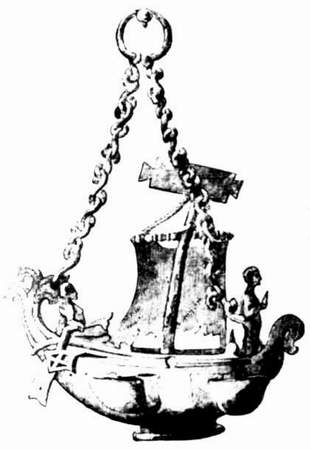
11a Analogical symbolism. The symbolism of any 'enclosed' order or society tends to become ever more catachrestic - and so less instantly comprehensible to the outsider. The Fish, an ancient fertility symbol, acquired a special ritual significance in primitive Christianity, perhaps because the name of the Mother, Maria, means 'the Seas' in Latin. And because the Fish, and so its home, the Sea, were sacred, so also was the symbol of Man's dominance on the Sea: the Boat - a potent religio-sexual symbol to this day. Illustrated is a finely modelled bronze funerary lamp, found in a Christian catacomb of the second century. (Contrad Research Library)
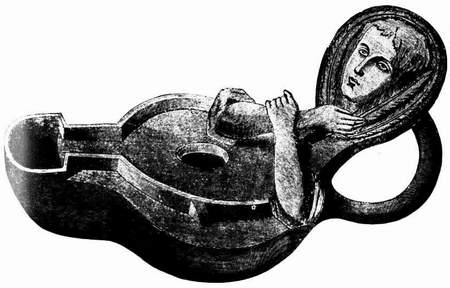
11b Funerary survivals. The Fertility element in early Christianity. This funerary lamp, dating from the second century and found in the catacombs at Rome, combines the symbolism of Life and Death: the latter in the palm-wreathed 'living' face of the deceased; the former in the pattern of the lamp, which consciously symbolises both male and female organs of generation. (From the Author's collection)
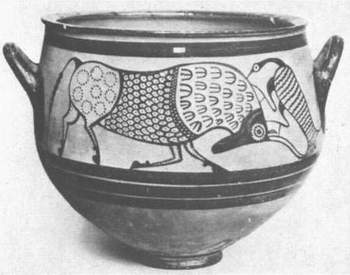
12a The 'Bull theme' spans the centuries. The pottery bowl, made under Mycenaean inspiration at Enkomi, Cyprus, at some time between 1300 and 1200 BC, shews the ancient symbols of the Bull, archetype of Divine Fertility, and the Bird, archetype of Divine Omniscience. The Bull was the 'cult object' par excellence throughout 'Mycenaea', where elaborate rituals cent: around his sacrificial death. (Photograph : British Museum)
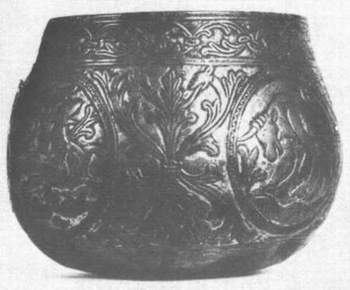
12b The 'cult object' dominates men's minds still, though it is over 2,0 years later, and 2,000 miles away. See how the 'Bull theme' persists on this silver-gilt cup, the famous 'Halton Moor Cup', found with a coin hoard in Lincolnshire, and dating from AD 1027. (Photograph: British Museum)
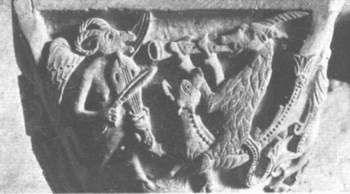
13a 'No Christianity here!' The not-so-cryptic announcement, in an officially Christian place of worship, that 'Believers in the Old Faith are still welcome here!'. Commonly described in Church and Government publications as 'animals playing musical instruments', this carving, from a Norman capital in St Gabriel's Chapel, in the crypt of Canterbury Cathedral, shews the two Horned Gods - Ram and Goat - and the Fish-Serpent; all three, either separately or together, symbolising the principal of Universal Fertility. It was for no Christian worship that these three ancient symbols were so carefully - and joyously - carved for the instruction and reassurance of the Faithful. As I have explained elsewhere, the 'saint's' name, Gabriel, indicates a former temple (in Roman times) of the Cabiri, Samothracian demon gods. (Photograph: National Monuments Record)
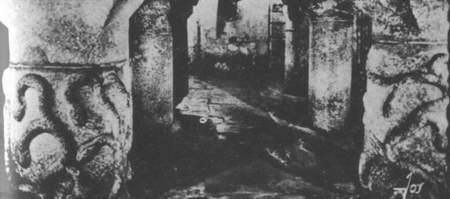
13b The 'Serpents' of Lanmeur. These 'serpents' - as they are locally called -guard the tomb of St Melar in the church named after him at Lanmeur, Finisterre, Brittany. The crypt was traditionally built in AD 779 to house the body of the dead saint, who lies buried in an unmarked grave between the two 'serpent' pillars: a prophet of the New Faith guarded to eternity by the ever-potent symbols of the Old. The 'serpents' are, in fact, one of the two most ancient symbols of the Sun - the footed cross (swastika, fylfot) or the 'three-foot' (triskeles), still used as a national symbol by the Manx and the Sicilians. By making the members of the triskeles resemble serpents - themselves, because of their likeness to the male organ of generation, a potent Fertility symbol - the designers of the Old Religion, obviously very active at Lanmeur in 779, ensured the utmost 'mana' for their symbols. (From the Author's collection)
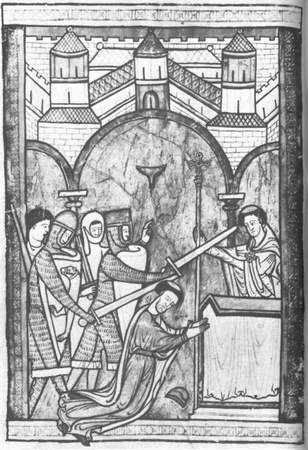
14 The ritual killing of Thomas Becket At the altar of Canterbury Cathedral, Christmastide, 1170/1, as surrogate Victim for King Henry II, the Incarnate God of the Old Religion Note that Becket's cap is of the Mithraic 'Phrygian' type, and that the knight actually delivering the fatal stroke is Sir Reginald FitzUrse ('Son of the Bear') whose name shews him to be a priest or at least a worshipper of Artemis, the Bear-Goddess (Photograph British Museum)
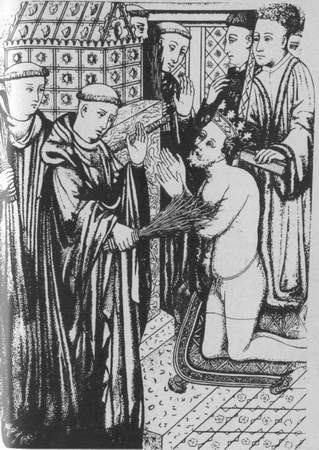
15 Absolution for the 'Incarnate God' The ritual 'penance' undergone by King Henry II after the equally ritual 'murder' of Thomas Becket The King, tripped to his underclothes, but wearing the royal crown (with the Fertility symbol of the living plant), prepares to be 'punished' for Becket's voluntary death as the Divine Victim Note that the instrument of punishment is a birch of broom (Latin, planta genista), from which the Plantagenets took their name. (Contrad Research Library)
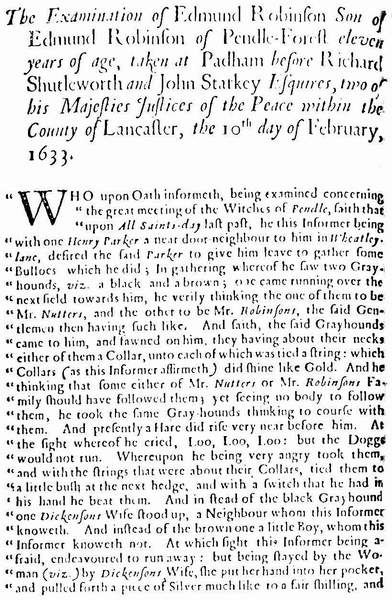
16 'A little child shall lead them.' England knew no such savagery as was practised for centuries on the continent. However, here is the evidence of an eleven-year-old boy, taken in 1633, which on 'Dickenson's Wife' was both charged and condemned. (Contrad Research library)
So ... perhaps ... Zomelak bagabi is really zaramat bah'gabe, 'I shall transport thee thyself, without a sieve.' Again, as Blegen said, 'All this seems too good to be true. Is coincidence excluded?' Is it? I decided to go on.
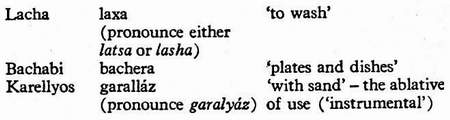
Let us pause here a moment. We have, in these last three words, a group which 'makes sense'. 'Wash the plates and dishes with sand' - still a favourite cleaning material in many parts of the world. Let us now recapitulate. Without claiming that we have already solved the puzzle, let us see what we think that we have found:
'Kill (the victim) in November (at the great winter feast), (to which) I shall transport thee thyself, without a sieve. (And afterwards) let us clean the plates and dishes with sand.
The next word, as we say when doing the crossword in the home-going train, certainly seems to fit. It is:
Lamac - lanac - '(the) work'
There are many precedents for the m/n, n/m alternation; a famous example being in the witch-rituals themselves, where the name of the ritual sword, athame, is obviously the Greek [Insert pic p161a] athanatos, 'undying, immortal, eternal' - the Greek word which has given us our English word, tansy, a plant to which magical life-prolonging qualities were once ascribed.
Bachalyas - Bacheraz - 'with plates and dishes' - once again the instrumental case, or 'ablative of use' (suffix -az)
The alternation 1/r, r/1 is as old as the parent language, and is a speech phenomenon of world-wide distribution. (For example, Old French lossignol, 'nightingale', becomes Modern French rossignol. And so on.) The pronunciation of intervocalic r in all the Basque dialects is so faint that many people cannot detect the sound, and this fact is so much recognised by the Basques themselves that the Basque word for 'white cheese' may be spelt either cembera or senbea (note again, by the way, the alteration, m/n).
Cabahagy - khoporagei - 'destined for the drinking cup'
The particle, -gei, suffixed, means 'destined for'. Aphezgei, 'destined for the priesthood', means a seminarist or novice. That there is a possible - even a likely - connection between 'plates and dishes' and 'the drinking cup', one might well believe. But the exact syntactical link between this word and the preceding I cannot, for the present, determine. But that the connection is capable of being established, I have little doubt.
Sabalyos - sabelaz - 'with the stomach, entrails, belly, etc.'. Another instrumental case, or ablative of use.
Baryolos - balijoaz - 'if they went' or 'if they were to go" or 'if they had gone'. (3rd person plural, subjunctive preterite imperfect of the verb joan, 'to go'.)
Note again what seems now the regular 1/r, r/1 alternation.
Lagoz - lakhaz - '(with) a full measure, full quantity'. Lakha means now a measure of 2 1/2 litres, but originally had rather the sense of 'a jugful', and thus of any full measure.
atha - (probably) eta - 'and'
Cabyolas - khoporaz - 'in the goblet or drinking vessel'.
Samahac - semiac - 'the sons'. The cases may be nominative, either singular or plural or accusative plural. But the -ac termination is also the sign of the vocative plural, which would translate as 'O Sons!'
Seme, Basque for 'son', is obviously a word borrowed from the Latin, though it is curious that, in abandoning their traditional word for 'son' (for they must have had one), the Basques anciently selected, not the 'ordinary' word in Latin, filius (French, fils; Spanish, hijo; Italian, figlio; Portuguese, filho; Roumanian, fiu), but the word, semen, 'seed', used for 'offspring, progeny', etc. only in its most affectedly poetic sense, i as used by, e.g., Ovid.
The abandonment of a traditional native word for a foreign phrase, even where the abandoned word is, One would say, indispensable, is paralled in other tongues. For , example, in Greek, where the old word for 'king', anax, was abandoned in favour of the word of unknown origin, basileus, 'king'. However, the adoption of semen for 'son' could even be pre-Roman, but in any case is certainly an importation into the Basque language of no modern happening.
atha - eta - 'and'
famolas - familiaz - '(who are) with the Family'
This may well be from the most ancient Latin word for 'family', familia, and not from the more recent French famille, since French words ending in -aille, when imported into Basque, take the termination -alla. Examples: French battaille, bouteille, caille; Basque batalla, boutilla, calla.
Hurrahya - (ritual cry) - Bodin, writing in 1604 and 1616, reports that the invitation to the witch-dance began with the words, 'Har, Har..." in Guernsey, the version was 'Har, Har, Hou, Hou, danse ici, etc.', 'Hou', according to Margaret Murray, became the name of a local deity whose name forms part of that of several small islands in the region: Lihou, Jet-hou, Brecqhou, etc. 'Haro' is also called upon by any Channel Islander who asks for justice. This ancient custom is called 'Crying Haro!' 'Hurrahya', here seems to be same as 'Har-hou'.
Now, allowing for the fact that Basque whose existence we have, I claim, plainly established beneath the not-so-corrupt 'English' text, is most ungrammatical to any modern Basque, let us see, all the same, what we have deciphered. The declensional endings have become deformed or lost over the centuries, but the words, though not linked together in the precisely orderly Basque syntax (a very complicated system), are, though worn down to simple radicals, still comprehensible. And their totality does, as I have already claimed, 'make sense'. But which sense?
Ignoring the missing or incorrectly used Unking case-endings and conjunctive and other particles, let us try to make a continuous and intelligible 'narrative' out of the chant as given in Mr Haining's book.
It now runs - the English version - like this:
Kill (or the Feast) in November; kill! I shall transport thee there myself, and without the aid of a sieve, to scour the plates and dishes with sand: work (which must be done) with those plates and dishes. (We shall meet our friends) ready for the drinking-cup if they shall go (to the Feast), their bellies full with quaffing from the drinking-cup. O Sons (of the Master) with your Families (shout His praises with the cry)'. 'HURRAHYA'!
Languages, transposed from one geographical context to another, often change far more than the original of the 'Eko: Eko: Azarak ...' chant has changed in its present environment. Who would find it reasonable that Latin libella, our 'level' (same word), would have become niveau in modem French? Or that the original of the nursery-rhyme which begins Hickory-dickory dock ... is a Breton rhyme which begins Digoret dor, digoret d'eoc'h ... ('Open the door; open it to yourself ...' i.e. 'let yourself in!'), or that Eeny-meeny-miney-mo is a counting rhyme, of which, so corrupt has the original become, only two words remain intelligible: eeny ('one') and a word for 'four' which is the first part of the phrase, catch a nigger ..., where catch a is almost certainly Irish Gaelic ceathair, 'four', now pronounced [k'ahir']? And other words have become even more perverted on unthinking lips as they pass, parrot-fashion, from generation to generation.
It says much for the tenacity, not only of the faith but of the purpose of the Old Religion that its members should have retained, without the corrective aid of the written record (which began to be made only at the end of the fifteenth century - and then by the Religion's enemies), the ancient rituals so well.
In deciphering the 'Eko: Eko: Azarak ...' text, I was struck by a haunting sense of familiarity, and not until I had completed the draft translation of the sub-Basque did I track down what was nagging at the fringes of memory. The 'trigger' was the double reference in 'Eko: Eko' to 'plates and dishes'. Ritual meals, from the Roman lectisternia (for male gods) and sellisternia (8) (for female gods) to the agape, the 'love feast' of the early Christians, were a standard rite of all religions in past times; but there was something nearer to fret my sub-conscious, something not quite connected with religion, as we think of religious things. And then ... I remembered. The 'meaningless' rhyme to which the children of the farm-hands would skip in the dusty, narrow road by Sparrows' Farm:
Cups and saucers,
Plates and dishes -
Here comes Sally
With calico breeches!
Good lord! I hadn't thought of the children and their absurd jingle for more than forty years. But now, as it came back to me, I began to examine it - for the first time in my life - in the light of what I had discovered already, not only about 'Eko: Eko', but about so many other sounds within the context of the Old Religion.
----
[8] Because the men ate whilst lying on sofas, lecti, but the women ate sitting upright on sellae, chairs or benches.
----
The macarontic - the rhyme in two (or even more) languages - was a well-known literary device of the early and late Middle Ages (there has been at least one popular macarontic song recently: English and French - Darling, je vous aime beaucoup - ); and now it occurred to me to wonder if the 'intelligible' part of the children's jingle ('Cups and saucers, / Plates and dishes') had not been originally part of a macarontic, prefacing, as the correct English translation of the Basque original, two lines left in the Basque; the last two lines which, in the mouths of generations of children, had degenerated into the nonsense about Sally and her underwear. I wrote down the principal words:
SALLY
CALICO
BREECHES
- and considered what I had written from the point of view of the 'hidden Basque'. Was there a clue here?
Well, the (English) word, calico, was promising. Co, a suffix is a particle of very frequent employment in Basque; it not only does duty for our own preposition-conjunctions, of and for, but expresses shades of meaning that the word of and for are Unable to express. I wondered of which Basque word the twentieth century children's 'calico' was the far distant echo?
Well, after I had finished with Basque dictionary and grammar, the results, coincidental or not, were certainly startling:
English - Basque - Meaning
Sally - salhi - 'skimmer, strainer, sieve, etc.'
calico - callaco - 'for the curds'
breeches - beituzu - 'thou hast (it)': 2nd person singular, 'respectful form', present indicative, 'incidental form', of verb, ukhen, 'to have'. As Basque has no special construction for interrogative sentences, beituzu here should probably be considered interrogative - 'hast thou (it)?'
- or, in connected form:
Cups and saucers, plates and dishes [are all ready] - hast thou the skimmer for the curds?
Once again, we are in the presence of food - or, rather, a simple, innocent, ritual feast. The dish itself is significant: curds ... one of the main constituents of the diet of the hardy Scythian nomad, whose descendants still thrive on the koumiss and yoghurt made from the curdled milk of their equally hardy little mares. And it was in the Chinese province of Ch'ang-sha, on the eastern borders of the Scythian territory, that the antler-crowned head of the Horned God was made in the fourth or third century BC. (9)
Indeed, as one turns the pages of book after book on that obviously never-failing source of interest, the Witch-cult, one is struck by the predominantly Basque character of names at every level, from that of the strange legless dog, Jarmara (Basque, chamara, 'the blouse, the shirt', because Jarmara's hair hung down to cover his paws), to the daughter of Queen Diana, Aradia (Basque, Araldia, 'the reproduction of one's kind, fertility, fruitfulness' - what better name could there be for Queen Diana's daughter?). One of the most curious 'leakages' of the ritual tongue into the currency of common speech (compare such Masonic idioms as 'on the level', 'on the square',
etc.) is represented by the obsolescent exclamation 'By Jingo!' I was, I confess, somewhat astonished to see that its Basque, though not its Old Religion, origin was recognised in the last
century by the Rev. E. Cobham Brewer, whose invaluable Dictionary of Phrase & Fable (12th Edition) has this: 'By Jingo, or By the Living Jingo. Basque "Jainco", the Supreme Being.' (It is also spelt, Jinco.)
I was inclined to see, in the modern word, jinx, an adaption of an older word also based on Jainco or Jinco. But, on reflection, I prefer to derive this word from Basque jeix, 'to milk'. To be under a jinx is to be 'milked' of one's good fortune, reasonable expectations, etc.
----
[9] See illustration, Plate 6
----
The Romans expressed a similar semantic concept in their word, mulcta, 'fine, penalty, emercement', from the same root which gave them the old word, mulgeo, 'I milk'. (10)
Often, the traces of Basque (as a ritual tongue) are so unrecognised as such that puns dependent upon a knowledge of Basque go completely 'over the heads' of those who ought to have taken the verbal point. For instance, Christian Green, one of the Somerset witches tried in 1644, confessed that 'The Devil doth usually suck her left Brest about Five of the Clock in the morning in the likeness of an Hedghog ...' 'Hedgehog', in Norman French (another respected tongue, since its importers were Old Religionists to a man) is herisson (from which the earlier examples of the common English and Irish name, Harrison, derives).
Somewhere in the course of the phonetic development of Basque and Norman-French in England, the two languages became somewhat confused in pious but muddled heads, and Norman-French herisson got itself mixed up with Basque harritze, (11) 'to petrify with astonishment'. One may see how the confusion arose; but the mix-up conferred unexpected (from the hedgehog's point of view!) blessings on this harmless but unfortunately edible creature, and from being a gypsy's plat du jour, Mr Hedgehog became a witch's familiar.
Pierre de l'Ancre, than whom the Old Religion never had a more dedicated, more ruthless or more subtle enemy, was under no illusions as to the centre from which the strength to maintain the Faith, despite the most savage persecution, supported witches throughout Western Europe. A lawyer who, like so many of his time-serving kind, had joined the religious orders in their persecution of witches, De 1'Ancre moved down to the Pyrenean country of the Basques, so as to be as near the 'storm-centre' as possible.
To write his two books, Tableau de l'Incon-stance des mauvais Anges (Paris, 1613) - 'How Evil Spirits Betray Mankind' - and L'lncredulite et Mescreance du Sortilege (Paris, 1622) - 'Of the Folly and Wickedness of Casting Lots' (i.e. for 'magical' purposes) - De l'Ancre not only tried (and, inevitably, condemned) as many witches as he could, but also interviewed them - perhaps 'grilled' would be the better word here - and carefully, in his pettifogging lawyer's way, kept a detailed record of all the evidence.
----
[10] This opinion is expressed in conscious defiance of the etymologists, who deny the connection between mulgeo and mulcta.
[11] Even more so in respect of the genitive case, harritzen.
----
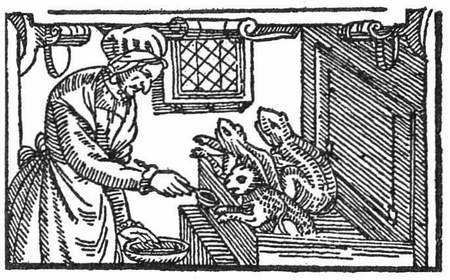
Toads as familiars: The toad, ugly and venomous, but wearing a precious jewel in his head, was, by popular report, greatly favoured as a familiar of witches. In 1579, at Windsor, Mother Button kept 'a Spirite or Feende: in the likeness of a Toade'; in 1582, at St Osyth, Margerie Sammon had two devilish 'toades', named Tom and Robbyn. The name of the Essex woman who owned a toad-familiar called Lunch, in 1588 (the year of the Spanish Armada), is not given. Here is a witch of 1630 feeding her toad-imps.
Whilst wishing that such a man had not lived, we may still be grateful, in a resigned sort of way, for the full record that he left of the conditions under which the Old Religion was struggling to maintain itself in the Basque country at the turn of the sixteenth and seventeenth centuries.
By his own standards, De 1'Ancre shewed considerable courage in writing down what the witches 'confessed', in their own words, for it was a widely-held belief of the time that the incautious repetition of witches' 'spells' could bring about the direst results. However, in the interests of the honest record, De 1'Ancre undertook to - literally - defy the Devil by writing everything down.
Thus, we have some of the very words that the Basque witches used, though there is a grim humour in the fact that all the 'diabolical spells' and 'fearful blasphemy' that De l'Ancre's shorthand-writer was taking down were phrases of the most innocent kind. It is certain that the witches, faced with torture or not, were careful not to betray their real secrets to this murderous and murdering attorney.
If the Basque that De l'Ancre records seems to be often incorrectly written, one must remember that apart from a few words and phrases, our knowledge of Basque dates only from 1545, and that even today there are wide variations in spelling, not simply because the Basque dialects, like those of Brittany, differ greatly among themselves, but also because, for all the efforts at standardisation and the establishment of a standard orthography regardless of regional differences (as was done for Breton in 1941), Basques continue to pronounce and write their words with a remarkable independence.
Some of the phrases and sentences in Basque recorded by De 1'Ancre are the following:
1. Stated to have been said by the witches of the Basses-Pyrenees in 1609, after having anointed themselves, but before starting off for the Sabbat (on broomsticks, says De 1'Ancre): 'Emen hetan; emen hetan!' - that De 1'Ancre translates as 'Ici et la; ici et la!' Translation is correct - 'Here [and] there!' - but the modern spelling is more usually 'Hemen han!"
2. 'At the elevation of the Host, the congregation cried [in 1609], "Aquerra goity, Aquerra beyty, Aquerra goity, Aquerra beyty," which means Cabron arriba. Cabron abaro.' (The last word, abaro, should have been spelt abajo - 'below, beneath, underneath', as the sense of the translation makes clear.)
This is correct, though archaically spelt, Basque; in modern orthography, the salutation would read: Akhera goiti, akhera beiti, 'The He-goat on high, the He-goat below!'
3. 'At the elevation of the chalice at a Christian service, they said, "Corbeau noir, corbeau noir."' Certainly, to French ears, what the congregation said may well have sounded like corbeau noir, 'black raven', but what was probably said was not in French but in Basque - cordoan ori, 'grasp (thou) the cord'. A cord, string, lace, was, as we shall see, a ritual object amongst the witches. If my interpretation is correct, here is Basque misheard by a Frenchman as French. (Not the only instance of mishearing. Margaret Murray has suggested that the cry of "A Boy" is possibly the Christian recorder's method of expressing the Bacchic shout "Evoe":' - 'a joyous shout in the festival of Bacchus.')
4. 'There were two forms of words to be used when making the sign of the Cross; the first was "In nomine Petrica, Agora, Agora Valentia, Iouanda, goure gaitz goustia", translated [i.e. by De 1'Ancre] "Au nom de Patrique, Petrique d'Arragon, a cette heure Valence, tout nostre mal est passe".' Patriarkha is 'patriarch' in Basque, but I think that we have here a misheard and misinterpreted Basque bethiereco, 'eternal, everlasting, immortal'.
Agora, with the sense of 'now, at this moment', could be an old spelling of modern Basque oral, 'now, at this moment', but it looks more like the Latin phrase, hac hard, 'at this hour'. Of course, there is no reason why a Latin phrase should - not have been adopted by the Basques; most European languages have such phrases. Cf. modem French recta: 'punctually, promptly' - payer recta, 'to pay on the nail'. The words reported as names are obscure. 'Ar(r)agon' may be Basque aragien, possessive genitive plural, definite declension, of the word aragi, 'flesh, meat, victuals'. The rest of the invocation is fairly pure (and correctly reported) Basque: 'Iouanda goure gaitz goustia.' De l'Ancre's clerk's reported 'Iouanda' is (modern) joan da, 'he, she, it goes'. Goure is 'our'; gaitz, 'misfortune, trouble, evil'; goustia (modern gucia), 'all'. 'All our trouble passes at this moment' - a remark that even the most devout Christian might make when signing himself with the Cross.
5. The second (invocation at the sign of the Cross} roused De 1'Ancre's horror as peculiarly blasphemous: 'In nomine patrica, (12) Aragueaco Petrica, Gastellaco Ianicot, Equidae ipordian pot.' (Translated by De l'Ancre as:) 'au nom de Patrique, petrique d'Arragon. Iannicot (sic) de Castille faictes moy vn baiser av derriere.' Ianicot' (French spelling, with silent final t) is Jainco, Jinco, 'God'.
----
[12] Basque patrica and petrica can have no connection with either Peter (Petrus) or pater, 'father'. The former - Peter - is Phetiri, the latter, aita. That 'petrica and patrica' are plays upon the Latin word pater, 'Father', in the phrase, In nomine Patris, etc., is evident, but in what the double meaning consists I am as yet unable to say.
----
The reporter has made a fearful botch of egidu (egizu), with a spelling, 'Equidae', which suggests a Latin name for a Celtic tribe of horse-totemists (perhaps that's what he thought he had to write down). Egidu means 'do thou this!' Pot is 'kiss', (13) in modern as well as old Basque.
The corruption discernible here, so far as the Basque is concerned, is, I believe, unintentional. People write down, not only what they truly think that they hear, but, subconsciously, what they wish to hear: the well-known 'Freudian slip'. It is obvious that the clerk who, knowing no Basque, wrote 'Equidae' for 'egidu', must have heard that, in former times, the Celts had inhabited this part of France, and his spelling reflected the fact of his reflections.
But it must be noted that people credit power to the imperfectly understood; that gibberish commands respect and trust simply because it is gibberish - that is, words which, to the speaker, and listener, are unintelligible.
When Martin Tulouff was charged in Guernsey in 1563 with having bewitched his neighbours' cattle, he 'explained' how he had caused the beasts to yield blood instead of milk by pronouncing the powerful spell, the meaning of whose words was evidently unknown to Tulouff. Yet all that the dog-Latin 'spell', 'Butyrum de armento!', signified was simply 'Butter of cattle!' (14) - but perhaps these were only the first three words of a long Latin curse?
----
[13] The resemblance to Old Irish poc. 'kiss', may be noted. Poc is supposedly derived from Latin pax (i.e. the kiss of peace) - but is it?
[14] Properly, armentum (old form, armenta) means, not 'cattle', but specifically 'cattle for ploughing; any beast of burden', including horses. But, by 1563, the word, even in the mouths of persons better educated than was Martin Tulouff, was used to describe cattle generally.
----
One of the gravest charges against the 'heretical' Cathari and Albigenses of the thirteenth century, and a prime reason for the ferocity with which the Dominicans urged totalitarian war on them was that they preached the Gospel and conducted their services in the language of the people. The Roman Church has recently conformed to a custom that, in England at least, dates from as far back as Wycliffe's reformation of the fourteenth century.
No doubt he and similar earlier reformers had heard of the demon Tutivillus, mentioned in Piers Plowman, the Towneley Mysteries and other medieval writings, who collects all the words skipped over or mutilated by priests in the conduct of their sacred offices. These scraps Tutivillus takes with him to Hell.
A similar reformation was carried through in the services of the Old Religion, though, just as the Jesuits at Farm-street and Spanish-place offer Latin to the more conservative Roman Catholic worshipper, so the Old Religion retained its ancient ritual language, Basque. But for everyday affairs the European witch used the vernacular, preserving, all the same, the meaning and intention of her invocations and conjurations with remarkable fidelity.
Thus Issobell Gowdie, on trial as a witch at Auldearne in 1662, gave the words of the charm that she used for her habitual shape-changing:
'I sail goe intill ane haire,
With sorrow, and sych, (15) and meikle caire;
And I sail goe in the Divellis nam,
Ay quill [that] I com horn againe.'
She always managed to come home again, for the 'return charm' was equally efficacious:
'Haire, haire, God send thee caire.
I am in an haire's liknes just now,
Bot I sal be in a womanis liknes ewin now.'
Almost exactly 1,600 years before Issobell Gowdie stood before her interrogators and gave her 'purely voluntary' evidence, (16) another strong-minded woman - a Celt also - faced and astonished her persecutors.
----
[15] Sych = 'sigh, sighing".
[16] According to Margaret Murray, The Witch-Cult in Western Europe; Oxford: The Clarendon Press, reprint (paperback), 1963.
----
After having beaten off the Roman soldiery, causing them to retreat to the south-west, Boadicea (Boudicca) marched on London, putting the inhabitants to the sword - Tacitus says 70,000 perished in the three cities that she sacked - and burning the City; traces of that almost total combustion confirming at least that part of the story. But at last, under the decisive leadership of Suetonius, the Romans recovered from the shock of defeat - especially of defeat at the hands of a woman - and in the last great battle fought outside King's Cross, a few hundred yards from where I am writing this book, Boadicea was overcome.
And what joins Boadicea, over the span of more than a millennium-and-a-half, with her fellow Celt, Issobell Gowdie?
This.
As the Romans, armoured in leather and bronze and iron; the helmets of their officers sinisterly gay with feathers and fur and horsehair; and every constituent part of that ruthless military machine in its appointed place - from the third-rate spearmen to take the shock of the first enemy assault to the war-elephants at the rear; as this glittering parade awaited the howling charge of the British war-chariots, leading the battle-mad onrush of the naked Celtic warriors; there was a pause ... and a silence the deeper for all the calm of that sunlit morning in the summer of AD 61.
The Queen, in her scythed covinnus, led the van; behind her, her naked soldiers - for the Celts always shed their clothes to face their enemies - awaited the signal to charge. The Romans, too, waited, for even if the common soldier was ignorant of the Celts' military efficiency, the older officers recalled the number of important contributions that the Celts had made even to the Roman mastery of the warrior's art.
Though they bore Latin-sounding names, the cateia, a sort of boomerang; gaesum, javelin; lancea, thong-thrown spear; parma, the Celtic light shield; sparus, the spear, and essedum and covinnus, the war-chariots, had all been copied by the Romans from the Celts, and their names, for all the Latin look, were still originally Celtic. The Romans watched the Queen, who had smashed the crack Legion IX Hispana, with respectful interest, not at all unmixed with apprehension. Uneasy in the emotional silence, the armoured elephants, with spiked balls chained to their trunks, moved restlessly beneath the turbaned mahouts.
What was she up to? every Roman asked himself, as the Queen — not herself naked, as Tacitus tells us - stepped from the war-chariot on to the tender Middlesex grass.
They saw that she had gathered up her tartan plaid, and was holding something concealed within. What was it? What could it be?
The Queen, raising her voice in a prayer to Adraste, let her plaid cloak loosen, and then all saw what she had been carrying within its folds. A hare ....
And no ordinary hare, as Issobell Gowdie was to point out, sixteen centuries later. A magical hare, trained to see the outcome of event, and to read the riddle of the future.
The Queen let the animal go, and, after a pause, he scampered across the 'empty space between', straight through the Roman lines. What his swift passage seemed to tell the Queen and her Druids, no one now can say. But whatever the omens, they were not, that day, of victory ....
In view of the long prevalence of the hare in the magical 'working' of the Old Religion, I was a little astonished that so great an authority as the late Margaret Murray had failed to take the point (in her The Witch-Cult in Western Europe') of one of her own quoted cases: of Alexander Hamilton, charged in Edinburgh, in 1630, with having had consultations with the Devil, evidence being presented against Hamilton that 'afoir he devill his away passing the said Alexr was in use to cast to him ather ane kat or ane laif or ane dog or any uther sic beast he come be'. Dr Murray, in a footnote, says 'the meaning of the word laif is not clear. The Oxford dictionary gives lop-eared, the Scottish dictionary gives loaf. By analogy with the other accounts, one would expect a word meaning hen.'
By analogy with other 'magical' beasts, I myself should expect to find a lop-eared quality amongst the creatures of die rabbit and hare genus. I am surprised that Dr Murray should find difficulty in discovering the meaning of the word 'laif. It is the English word, leveret (French, lievre) 'a young hare'.
On the other hand, I am much indebted to Dr Murray's incomparable research for a fact which beautifully illustrates the tenacity with which tradition protects folk-customs against the attack of the insidious.
'The remembrance of the numerous male devils at the (witches') Sabbath,' Dr Murray writes, (17) 'survives in the Salmassain dance in the Basses-Pyrenees, where the male attendants of die King and Queen of the dance are still called Satans.'
One undeniable advantage to students of the Witch-cult evident in my identifying the ritual language with Basque is that it will enable them to interpret many of the names encountered in the records. I have already explained that the familiar, Jarmara, which appears to be wearing a coverall of hair, is so called because of his coat's resemblance to a garment - Basque, chamara, 'blouse, shirt, etc.' But the name of a lively playmate familiar to Jarmara's (see illustration opposite) also lends itself to a Basque etymology: Sacke & Sugar, in English a name merely of wayward whimsy; in Basque, azaco sugar, 'flame of the cabbage' - that is, the darting red shape amongst the cabbage-heads; a far more likely name for a red hare than that of a then fashionable hot grog.
The other familiars' names hint, too, at Basque originals. Take, for instance, that curious name, Pecke in the Crowne. What does it mean ... in English? Nothing. Yet, if one recalls that pek, in Basque, means 'imbecile, weak in the head', then Pek (rather than Pecke) in the Crowne does make sense. Vinegar Tom, now, might come (a long way, indeed) from Basque innaga (popular pronunciation for correct ingana) 'to deceive', and thona, (18) 'task, work-to-be-done'; a plausible name, as though for 'master of deception', that an animal half-dog, half-bull and wholly Devilish must be.
Newes, the tiny, lively ferret familiar, might, in affectionate derision, have been called originally 'The Master, or His Lordship' (19) - nausi, in Basque. The other familiars' names will doubtless yield later to analysis.
----
[17] The Witch-Cult in Western Europe, op. cit. She is quoting A. Moret, Mysteres Egyptians, Paris, 1913.
[18] TH, in Basque is an aspirated T, not the sound of English TH.
[19] As a dwarf used in England to be called 'Lord', perhaps from Greek lordos, 'bent'.
----
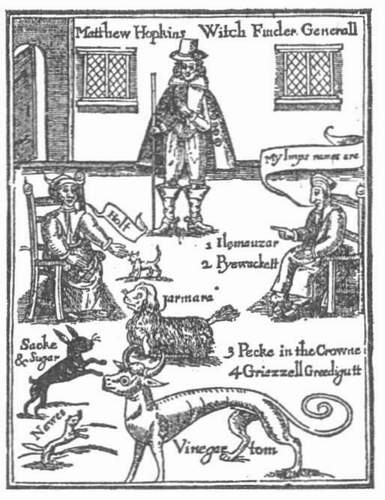
Witchfinder General: Quite the most loathsome product of Revolutionary England was Matthew Hopkins, self-appointed hunter-out of witches under Cromwell. Hopkins was a successful user of the blackmailing tactics so successfully employed by the late Senator McCarthy; any opposition to Hopkins's witch-hunting could bring the opposer under grave suspicion. This cut is the frontispiece of his own book, Discovery of Witches, 1647. It is mainly interesting for the named familiars.
Dr Murray, commenting upon a list of witches of the sixteenth, seventeenth and eighteenth centuries, mostly in England and Scotland, remarks on the prevalence or otherwise of certain names and speculates on their origin. She ends with this passage:
As regards the name Joan, I can offer no explanations or suggestions. / can only call attention to its overwhelming preponderance in comparison with the others. (20)
But now, with our knowledge of the underlying Basque, I can offer a plausible explanation, both of the name Joan, and of its popularity in the Witch-cult.
----
[20] My italics - M.H. 12 177
----
The explanation lies in the meaning of the Basque word, jaun, 'lord'. (21) That jaun is of masculine gender need present no difficulty; 'professed sisters' in the Roman Church often take such names as 'Sister Francis de Sales'; and, in support of the argument that female witches bore the name of their 'Lord' -Jaun Jincoa, 'The Lord God', we have the highly suggestive name of a male witch, Andro Man, charged at Aberdeen in 1597.
This Christian name is commonly regarded as merely 'Andrew', spelt in the whimsical Scots sixteenth-century fashion; but andere in Basque is 'mistress, lady'. 'Our Lady' is Andere gurea. If all the witch Joans bore their name in honour of their Lord, might not all the witch Andros (it is mostly spelt in the usual way, Andrew) have borne their first names in honour of their Lady? Dr Murray remarks upon the large number of Elizabeths - with all the variants on this name: Bess, Bessie, etc. - in the list of witches charged. It is a curious fact that the name of the sparrow - a lively, yet self-effacing creature which can fly quickly from point to point - is elizachori (22) in Basque.
The taking of animal names for the priesthood was a common phenomenon in the religions of the ancient world: the Ephesian priests of Artemis called themselves 'King-Bees'; the temples of Demeter, of Proserpine and of the Great Mother had their Bee-priestesses. The Oracle of Jupiter at Dodona was served by its 'Doves'; the ritual feast of Poseidon at Ephesus by its 'Bulls'; the Bear-priests supervised the Brauronia, where the Greek maidens were 'dedicated to the Bear'. And the 'Wolves' howled in the riotous merrymaking of the Lupercalia (Latin, lupus, 'wolf). Were some of the Witch handmaidens given yet another of these religious zoonyms -'Sparrows'?
I have already mentioned a long invocation, to be said by those desiring to acquire the gift of invisibility.
----
[21] Like all such titles - senor don (elder lord), Heir (lord), sir (senior; elder), etc. -jaun can now mean plain 'monsieur' or 'senor' or 'mister'.
[22] Supposedly 'church bird', from eliza (Latin ecclesia), 'church', and chore, 'bird'. But I am not convinced by this etymology.
----
There is no space in this book to give my etymologizing of the sixty names, some of which are (originally) Latin, Greek and Hebrew, with, some curiosities amongst the 'infernal spirits'' names - 'Helateroy' (Helena Troiae, 'Helen of Troy'! - poor Helen!) and the aforementioned 'Z' - an ampersand promoted to infernal spirit. But of the other names not evidently corrupt Latin, Greek or Hebrew, three-quarters at least echo Basque words appropriate to demon nomenclature.
Even when the name of an invoked demon looks to be Latin, corrupt or otherwise, a kinship with an original Basque will often - almost always - be found. Take, for example, the name Bellis. Now, as a schoolboy could tell you, bellis is either the dative or ablative, both plural, of the Latin neuter substantive, bellum, 'war'. So it is.
But not, I think, here. I think that here, despite the Latin form of the word, we have, not so very altered, the Basque word, beltz, (23) 'black'. The Black One', I feel, does well as a name for a demon.
If all these be coincidences, then they form the most numerous body of coincidences, associated with one enquiry, that I have encountered in many years of puzzle-solving.
To 'get her man', a woman is advised, in another spell, to seek out the chamber where the desired male is sleeping, strip herself naked in an adjoining room, and enter his chamber, reciting to herself this potent cantrip: Kay o kam, avriavel. Kiya mange lei beshel. Is it then, by pure chance, that the first three words of this spell, kay o kam, seem to resemble Basque khe(n), 'strip oneself naked'; o(h)e, 'bed'; and kambera, 'chamber'?
'It has always been recognised,' the late Dr G.B. Gardner wrote in his The Meaning of Witchcraft, 'that Witches had certain words such as Coven and Athame, (24) which did not seem to belong to any known language, and the matter was complicated by the fact that people who were not necessarily witches were known to have used these words in the old days. I was in the Craft a long time before I realised that some of them were aware that there was an "Old Language" known to only a few; I don't think there is anyone who can speak it well, but they do have a tremendous number of words, chiefly relating to things which affect the craft.
----
[23] Especially as, in sixteenth century English and Scottish orthophony, the pronunciation of bellis would have been bell's. Cf. pronunciation of surnames, Faults and Sandys.
[24] See page 161.
----
'Nowadays it has become only a sort of amusing slang, and some of what are said to be "Witch Words" are obviously "cant", as "Kicking the Wind" - their word for being hanged. Obviously dating from the days when Witches and others were publicly executed by being slowly strangled (before the "drop" was invented).
'Some words,' Dr Gardner continues, 'such as "Vavasour" (one who holds land for another) are probably Norman-French. (25) Other words are seemingly Celtic, but the main Corpus of the language is made up of words like "Halch", "Dwale", "Warrik", "Ganch", etc., which seem to belong to some other tongue. Unfortunately they [i.e. Dr Gardner's fellow-witches] will not permit me to give their meanings, or more of the old words.'
Now this is a passage of the highest interest. No etymologist, Dr Gardner cites two words, 'which did not seem to belong to any known language', which are, in fact, English Greek and English Latin. Athame, from the Greek athanatos, 'immortal', we have already considered; coven, an English word derived from the Latin, is the same word and has exactly the same meaning as 'convene', the n of 'convene' (Latin, convenio, 'to come together, to meet together, to assemble') being dropped, and the n of convent has been dropped in the well-known London place-name, Covent-garden.
But Dr Gardner's statement that 'the main Corpus of the language is made up of words ... which seem to belong to some older tongue' is valuable testimony to the correctness of my theory, coming as it does from a self-proclaimed witch.
It is a pity that Dr Gardner could not have let us know the meanings of Halch, Dwale, Warrik, Ganch, etc., for I could hardly begin to trace their origin in Basque unless I knew the meanings that these words bear amongst today's witches.
----
[25] 'Vavasour' is Norman-French; it is our word 'vassal', with the common r/1 alternation already noticed several times.
----

