9 - The I Ching
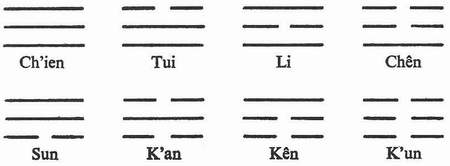
The I Ching is a binary system of divination: the two basic units being the Yin and the Yang, respectively, the female broken line (— —) and the male unbroken line (——). These two elements are formed into trigrams of which there are eight:
These trigrams are then combined one with another to form 8 by 8 combinations, that is 64 hexagrams. The words trigram and hexagram (1) purely indicate the number of lines in each of these two types of figure. It is the hexagrams which are the final product of the divinatory process and which convey the answer to the question posited: each of these hexagrams has a commentary written upon it, depending on the configuration of the lines and their weaknesses or strengths. These interpretations were reputedly made by King Wen and Duke Chou in the 12th century B.C.
The hexagram, just like the Geomantic figure, is derived by a process of mechanical operations which allegedly incorporates into it the conditions of the moment in which the sticks are thrown so as to accurately predict the outcome of the events current at the moment of the throw.
----
[1] Not to be confused with the Western hexagram or Star of David which is two interlocking triangles.
----
It is recommended that the diviner use the traditional sticks instead of using coins, a practice which has come into use as a sort of shorthand stick throwing, but which by its very simplicity and ease seems to vitiate this method of divination, making it such a brief and prefunctory practice that it provides no opportunity to establish that state of mind which is the essence of the interpretation of the hexagram.
It is necessary, therefore, to acquire a set of fifty sticks as one's magical instrument for I Ching divination (traditionally yarrow stalks between one and two feet long). These should be stored in a lidded box never used for any other purpose, retaining the same ritual purity as the four Elemental Weapons. It is also recommended that the Book of Change itself should be kept wrapped in silk or cloth and kept above shoulder level. (2)
Just as with geomantic operation, one of the essential requisites is to frame the enquiry in such a way that there is no possibility for ambiguity of answer. Thus an either/or type of question should be avoided just as a general 'what should I do?' type of question is inadvisable. Also, as the I Ching seldom gives an indication of time it is advisable to incorporate this factor in the question. For example one might ask what is likely to happen to this project or person during such and such a month or year, etc.
The Actual Enquiry
1. The Book of Change, the 7 Ching, (3) is laid upon the altar along with the divining sticks in their lidded box. Also place on the altar an incense burner, two sheets of white card (or two small trays) and a book to write out the result of the divination. (4)
2. The nature of the enquiry worded as specifically as possible to avoid any ambiguity, should now be written at the head of the page in the book.
----
[2] A traditional Chinese mark of respect towards this ancient oracle.
[3] Perhaps the most suggestive translation of the I Ching is Legges' translation, but the easiest to work from initially is Aleister Crowley's version of the text, if one overlooks the doggerel rhymes.
[4] The results should be written up with the relevant hexagram in your Magical Diary.
----
3. The magician now performs the Qabalistic Cross, and the Lesser Banishing Ritual of the Pentagram also if he desires.
4. He moves to the South and faces the North. The stick of incense is lit and the fifty yarrow stalks, the divining sticks, are consecrated with Fire, by taking them in the right hand and passing them three times through the incense smoke in a clockwise circular movement, whilst at the same time concentrating with an absolute one-pointedness on the question written in the Book of Divination on the altar.
5. Replace one of the fifty sticks in its box, and lay the remaining forty-nine on the right-hand sheet of cardboard. Then still using the right hand, divide the sticks into two roughly equal heaps.
6. At this stage is performed a process which is performed six times, to establish on each occasion, one of the lines of the hexagram. When drawing the hexagram one line at a time in the Book of Divination be careful to draw the lines from the lowest one, upwards.
a. From the right-hand pile, take one of the yarrow sticks and hold it in the left hand between the last two fingers.
b. From the left-hand pile, remove sticks four at a time until there are four or less remaining in the pile. Place this remainder between the next two fingers of the left hand.
c. Turning now to the right-hand pile repeat the process by removing the sticks four at a time until there is a remainder of four or less. This remainder is likewise placed between the next two fingers of the left hand.
d. The 'remainders' collected in the left hand will now total five or nine sticks and are placed together on the second card.
e. The sticks remaining on the first card are bunched together again and then rapidly separated into two piles, with the right hand as before.
f. These two piles are then diminished in the same manner as described in instructions (a) to (d), resulting again in the remaining sticks being held in the left hand. These are then placed on the second card, being careful not to mix them with the existing pile on this card.
g. Processes (a) to (d) are again repeated, leaving a total of three piles of sticks on the second card.
The possible combinations of sticks on this card will be:
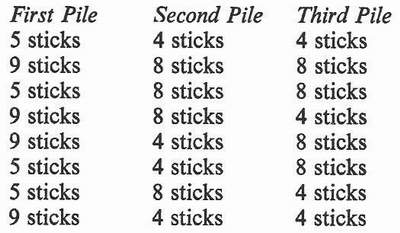
From the number of sticks in each pile one can deduce the nature of the first line of the hexagram (which as you will remember is the bottom line). The following table correlates the numbers in the pile with the appropriate hexagram line:
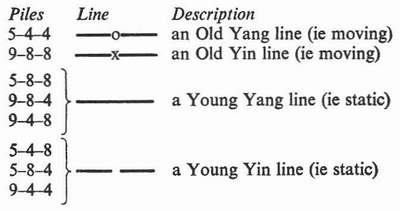
h. Having established the first line of the hexagram, the procedures (a) to (g) are repeated five times to derive the complete hexagram.
7. The hexagram can now be identified. For example:
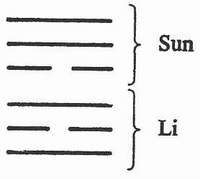
By examining the upper triagram (Sun) and the lower triagram (Li) and checking them in the Table appended below, it is obvious that this hexagram is number 37, (the Chia Jen Hexagram).
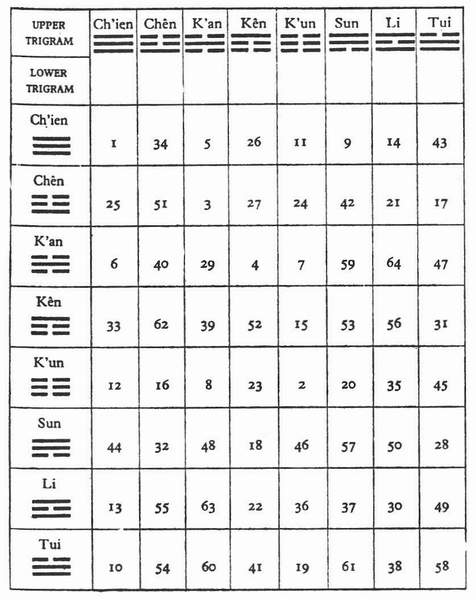
8. It is now simply a matter of referring to the text of the correct hexagram in the text of the I Ching. The text of the hexagram shows the current situation. The moving lines (if there are any) show the development of the actual enquiry, and the second hexagram formed by changing the moving line to its opposite (ie Yang to Yin, and Yin to Yang) shows the outcome of the changing situation.
9. After the interpretation, a second stick of incense is lit and the sticks held in the right hand and passed through the smoke in a clockwise direction.
10. The operation is terminated with the Qabalistic Cross, (and if performed at the commencement, the Lesser Banishing Ritual of the Pentagram).
Interpretation
Carefully read the text of the hexagram impartially without in any way relating the text to your original question. At this stage it is important not to bias the reading with your own conception of the range of possible answers, in fact keep rational criticism or correlation suspended. Bear in mind that the I Ching has a surprising facility for giving answers that cut across the possibilities that had presented themselves to your mind already, and turning up a new and unique solution. There is a curious parallel between the I Ching's answers and Edward de Bono's concept of lateral thinking.
Returning to the practice, the next step is to re-read the text to see if any phrase stands out, usually for no apparent reason: one magician whose facility with the I Ching was considerable, found that important phrases actually appeared to be printed in heavier type (for the duration of the divination).
Write these important phrases down, one under another. Look again, this time slowly through the text for any important phrase which may have been missed.
Then consider the relevance of these phrases to the question: if connections arise also write these down on the same piece of paper. Now go back to the text consciously looking for an answer to your question. Conclude by writing your interpretation of the text, in the light of the question, out in full.
Then consider the moving lines as indications of developments: the interpretation of these should be fairly obvious if the meaning of the hexagram itself has been well established already. In the Chinese texts the ritual number nine refers to a moving line going from Yang to Yin, whilst the ritual number six, refers to a Yin moving to a Yang. Remember that the lines of the hexagram are counted from the bottom line up, so that a 'nine for the second place' means that the line second from the bottom is a Yang line moving to a Yin.
Re-draw the hexagram with the moving lines changed to their opposites and using the Table (page 103), determine the number of the new hexagram, which represents the outcome or end result. Interpret its text in the same manner as is outlined above.
If there are no moving lines then the initial hexagram contains the complete answer to your question.
The wording of the texts at first appears to be very oriental, until familiarity confers the ability to interpret apparently military terms like advance and retreat in a more universal manner, as indicating perseverance or abandonment of a particular course of action. References to what the Superior Man would do, indicate the course of action which would be most noble or benevolent under the circumstances. 'Rebels' indicate those who would undermine your plans. 'No error' or 'no blame' means that if things do not go according to plan, it is not the enquirer's fault. The intuition should be able to apply these principles to the interpretation of other I Ching terminology in the light of the question asked.
Lastly, remember that the divination should be 'without lust of result' as Aleister Crowley so aptly put it; always divine without the slightest desire for an answer, just for the pure pleasure of the process, so that when you finally find an answer on the page in front of you, your surprise at its being there should only be excelled by your surprise at its correctness!
Finally it is quite useful to skry the hexagrams of the I Ching, in much the same way as has been outlined in Chapter Six on tattwa vision, but before doing so it is useful to consider skrying generally and its relation to astral projection.

