8 - How To Make Talismans For Yourself
The word 'talisman' has a remarkably apt etymology. It originates from the Greek word teleo meaning 'consecrate', and it it is exactly this process of 'consecration' which converts a curious drawing on a piece of paper or parchment to an effective vehicle for, 'causing changes to occur in accordance with will'.
A talisman, says one dictionary, is an 'object endowed with magic powers especially of averting evil from or bringing good luck to its holder'. This definition would admirably fit an amulet but is wide of the mark when applied to a talisman, at least as an occultist understands the word. MacGregor Mathers defined a talisman as 'a magical figure charged with the force it is intended to represent'. A talisman should be constructed to attain a definite result, not just generally for 'bringing good luck'. An efficient talisman should be capable of operating in such a way that its effectiveness is obvious immediately, or at least within seven days of its consecration.
Talismans can be made to effect all sorts of things: to acquire money, obtain patronage, recover lost property, influence people, obtain knowledge, disrupt or cause friendships, compel someone's love, and so forth. The possible objectives range from the most laudable to operations distinctly smacking of black magic. Even the last mentioned objective above has been censored by MacGregor Mathers: (1)
'It is but rarely that a Talisman for the love of a person is a right and justifiable thing to construct. Pure love links us to the nature of the Gods (but)... a talisman made for terrestial love would be sealed with the impress of your own weakness, and even if successful would react on you in other ways ...'
----
[1] Israel Regardie, The Golden Dawn. Llewllyn, USA, 1969. Vol 4, P53.
----
Nevertheless, talismanic magic has been one of the longest standing of magical practices, with detailed instructions dating back to the Alexandrian schools of magic in the early centuries of this era.
The advantage of talismans is that once created and charged they can be left to do their work without further attention. This has a distinct advantage over a 'once-off' operation as the stresses set up by the operator continue to work away without having to repeat the operation every day. In fact the talisman works rather like a storage battery. It also has the benefit of being self re-charging if the consecration has been carried out correctly. The talisman is ritually linked up with the planetary force concerned and also linked with the operator so that the magical energy is being continually channelled through to the objective, as more is attracted from the universe.
An ordinary 'mass produced' talisman is simply designed to give confidence to the person who buys it in the belief that it works, and is not at all like the ceremonially charged talisman competently prepared by oneself. Amulets on the other hand have been defined as having 'the more negative function of neutralizing certain causes before they can promote an undesired effect' and are more like a 'safety precaution' than an active battery.
It is quite possible to produce a talisman for the use of somebody else, provided that when the talisman is 'linked up', the contact is made with the person for which the talisman is being made rather than with the magician: otherwise the procedure is the same, with the exception that it is desirable for the person who's having the talisman made to be present at the time of the operation, or to be aware of the time that the magician intends to manufacture the talisman so that they are sufficiently receptive for the magician to easily link them with the talisman.
It is interesting to note that the effectiveness of the charge on the talisman can be objectively checked. One such experiment consisted of placing two charged talismans and eight uncharged talismans in a series of blank envelopes. The envelopes were then checked by a psychic who was able to determine which of the envelopes 'had fire in them', in other words contained the charged talismans.
This experiment which has been repeated a number of times under varying circumstances effectively disproves that a correctly prepared talisman merely gives confidence to its owner rather than having an objective power and existence of its own. It is important when working with talismans to decide under which category your objective comes. The traditional division under the seven planetary heads is a good working start.
Thus for works of earth, establishment, death, agriculture, legacies, sorrow and solidification, a Saturnian talisman would be used; for matters concerned with honour, riches, apparel, position and some church matters, Jupiter would be invoked; for workings concerned with war, imprisonment, weapons and things martial, Mars would be the appropriate category; under the Sun comes works of fortune, gold, rulership, inheritance, sharing as it does some of the functions of Jupiter; Venus obviously controls matters of love, music, pleasure and luxury; whilst Mercury operates in the field of books, learning, gambling, calculation, and theft; and the Moon with dreams, the sea, change, reproduction, childbirth, delusion, and psychical matters. In addition to the seven planets it is useful sometimes to construct a talisman of Earth for the 'earthing' or materialization on this plane of any of the above.
Now although the above list sounds very much like the desiderata of a mediaeval grimoire, or a grab-bag of assorted desires, it is a shorthand way of subdividing the field of action of each type of talisman, so that if a talisman is to be constructed for the promotion of fertility of a crop, it would have to be a Sun/Earth combination talisman to take into account the Sun's contribution to the fertility of the Earth. It would be useless to construct say a Mercurial or a Martian talisman for this purpose.
Therefore it is absolutely essential to very carefully assess under which sphere of influence (or combined spheres of influence) the operation belongs. Having decided this, it is then necessary to formulate, and write down, the exact nature of the objective in one sentence. If there is any room for doubt or ambiguity, then there is room for the talisman to fail, or worse still backfire.
Having specifically delineated the objective in as short and concise a sentence as possible, one should then consider if any other of the planetary influences could possibly come into the achievement of the desired end. For example, a talisman designed to promote the sale of a book would have to take into account the influence of Mercury (the God of books and learning) as well as that of Jupiter and the Sun (the bestowers of riches). If possible however, especially at the beginning, it should be the practitioner's aim to restrict the operation to one sphere only: if it is necessary however to deal with two influences or more, then it must be ascertained which is the key sphere of operation and which is the subsidiary, so that in the case of the book the key sphere would be the Sun (representing the gold - the sale) with the subsidiary aid of Jupiter (the bestower of riches) and Mercury (the book being sold).
Now in theory the ingenuity of the practitioner should be sufficient to devise a symbol or set of symbols which adequately sums up the nature of his objective and the forces operating within the planetary sphere to which it is attributed. In practice, however, it is usually found that except in individuals of extraordinary flair (such as the late A.O. Spare who evolved his own system of sigils) (2) that the best designs are those that have been used again and again in the past for the same purpose, and are therefore fairly closely linked to the collective unconscious of the race.
These symbols fall into six main categories:
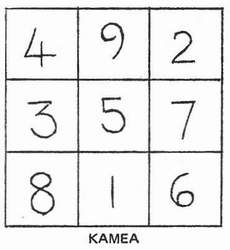
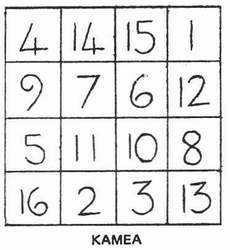
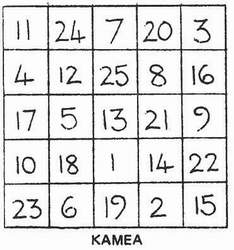
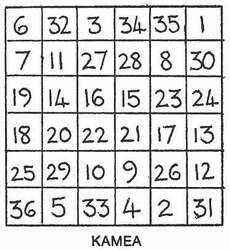
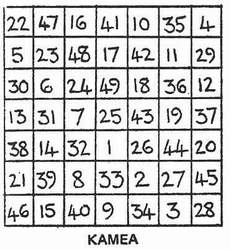
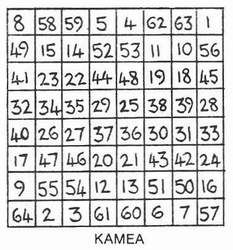
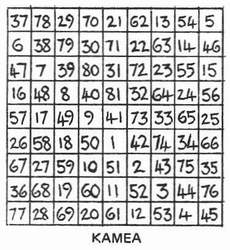
1. The Magical Square, or Kamea.
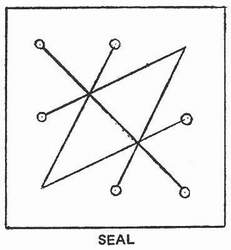
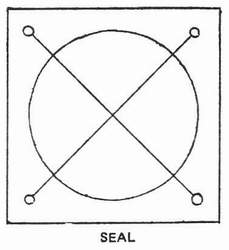
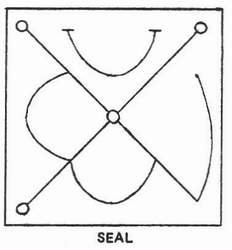
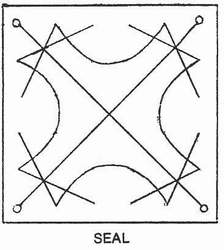
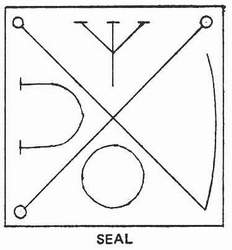
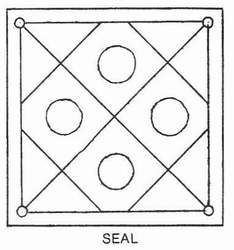
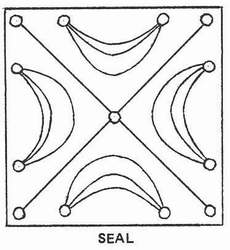
2. The Seal constructed from this square by following the order of the numbers in the square (called the signacula by Agrippa).
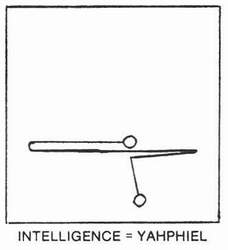
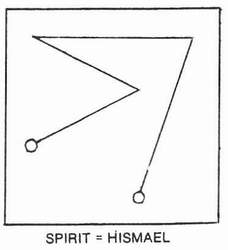
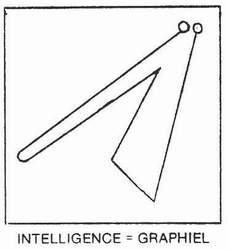
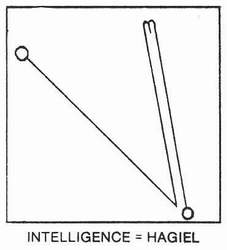
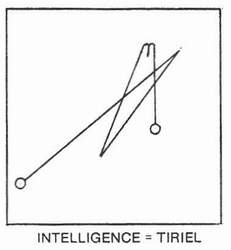
3. The Characters which are formed by joining the numerical values of the Hebrew letters forming the names of the angels on this square.
4. The sign of the Planet.
----
[2] See Drury, N. and Skinner, S. The Search For Abraxas. Neville Spearman, London, 1972. pp47-71.
----
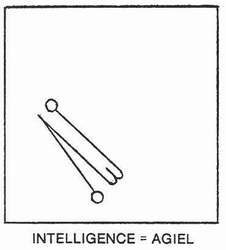
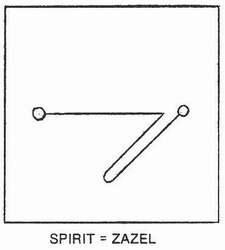
5. The Sigil of the Angel attributed to the planet.
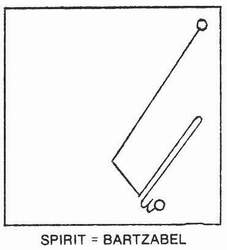
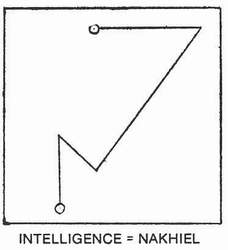
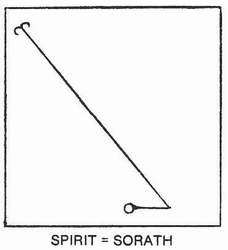
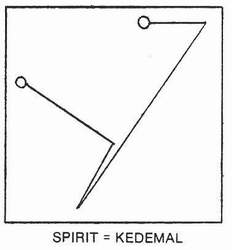
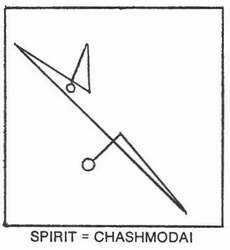
6. The Characters of the various Spirits, Intelligences, Olympic Spirits and Demons associated with this planet.
These are variously used according to the exact nature of the operation in hand. Obviously the sigil of the Demon of the planet would be almost never used in talismanic magic.
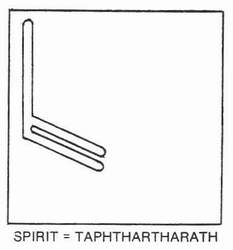
Following are the traditional (3) forms of these figures required for planetary talismans:
----
[3] It may be remarked that some of these appear to differ from other published versions, so that for example, the sigil of 'Tiriel', intelligence of Mercury, appears to be on its side and the sigils of the Moon differ in a number of ways from other versions. This is because even in The Magus by Francis Barrett, the sigils were freehanded by draftsmen after having been worked out on the square. In these reproductions, allowing for the convention of rounded corners where a line doubles back to an earlier letter, the sigils are exactly proportionate to their Kameas, and the right way up, so that they may be superimposed on the Kamea to accurately give the numerical values of the letters comprising the Hebrew name of the entity concerned. In the case of the very complex Moon sigils which comprise up to five separate Hebrew words, the words have been separated into two groups (as is conventional) to avoid the very obscure form generated by superimposing the lines representing all the words one on top of the other.
Saturn
|
|
|
|
|
|
Jupiter

|
|
|
|
|
|
Mars

|
|
|
|
|
|
Sol

|
|
|
|
|
|
Venus

|
|
|
|
|
|
Mercury

 |
 |
 |
 |
Luna

 |
 |
 |
|

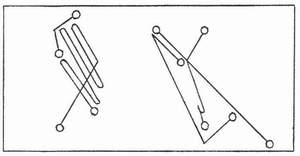
Intelligence Of Intelligences = Malkah Be-Tharshisim Ve-Ad Be-Ruachoth Shechalim
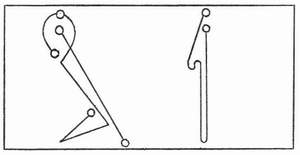
Spirit Of Spirits = Shad Barshemoth Ha-Sharthathan
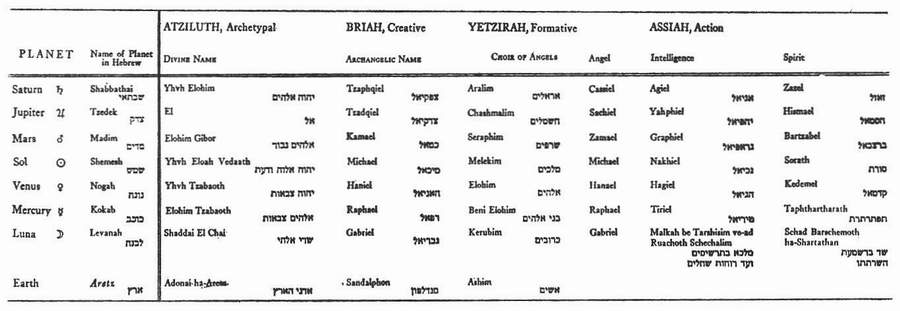
In addition to these figures it is also useful to use the traditional Hebrew names associated with the planet whose talisman is being constructed. It is immaterial whether the words are written in Hebrew or English, but it is essential that whichever language is used the operator must know the meaning of the words that he is writing. If there is room on the talisman perhaps the best compromise for somebody not proficient in Hebrew is to write both the English and the Hebrew or just the English. The appropriate words for each sphere are as follows:
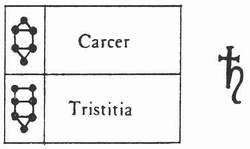
It is also sometimes useful to incorporate the geomantic sigils in the talisman, especially as the meaning of these should now be easily recalled. (4)
----
[4] See Chapter Five for the table of their meanings.
----
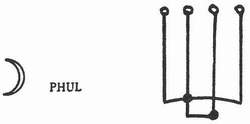
The geomantic sigils are simply formed by joining the dots of each geomantic figure as follows:
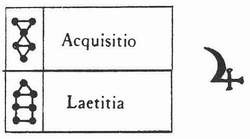
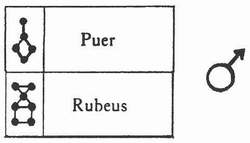
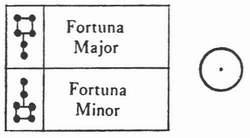
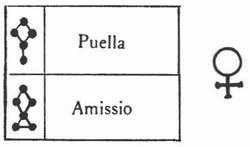
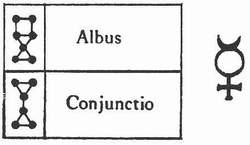
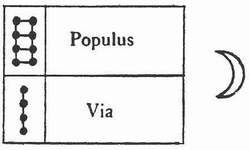
Likewise, under some circumstances, the Olympic Planetary Spirits' Sigils can be incorporated, but usually only when the desired result comes specifically into the sphere of these Spirits who could be evoked (5) at the time of the talisman's consecration.
----
[5] See Chapter Fourteen for details of evocation.
----
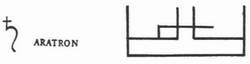
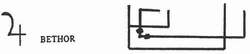
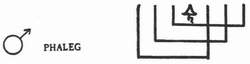
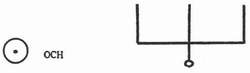
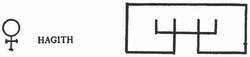
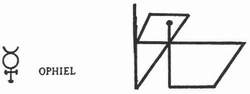
Other traditional requirements of the talisman are that it should be painted in the correct colour, and be cut to the correct shape. Size is immaterial, but to continue the symbolism it is useful to construct the talisman using a specific number of units, be it inches or centimetres. For example, a Venusian talisman should be painted in green and lettered in black or the complementary colour, red. It should be seven sided, with a diameter of seven units, ie perhaps seven inches or seven centimetres. On the other hand a solar talisman would be painted in gold with black lettering on a six sided figure, six units in diameter. The full details of size shape and colour are set out below, and coincides with the ascription of the planets to the ten Sephiroth of the Qabalistic Tree of Life:
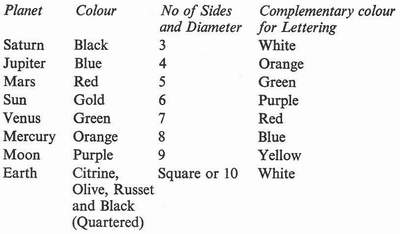
(In each case black may be used for the lettering.)
These then are the essential constituents of the talisman. It is now up to the operator to arrange them in his own particular manner, to decide the material of which he is to make his talisman (bearing in mind the stricture that all his materials must be 'virgin' that is, not used for any other purpose before, and this includes his brush, paint, etc). The size of the talisman, and which of the above constituents he intends to include. Of course it would be possible for him, if he so chose, to engrave, etch, or paint the talisman on a disc or polygon of the appropriate metal. The appropriate metals are Lead for Saturn, Tin for Jupiter, Iron for Mars, Gold for the Sun, Copper for Venus, Mercury or Aluminium for Mercury, Silver for the moon, and Zinc for the Earth. But for the moment we will consider the operation as if a card talisman is being constructed.
Considerations of time now enter into the operation, and it is advisable, working on traditional assumptions (which are well worth maintaining) to set aside an hour during the day which is traditionally allocated to the planet under whose auspices you are working. Thus, for works of Saturn, Saturday; for works of Jupiter, Thursday; for works of Mars, Tuesday; for works of the Sun, Sunday; for works of Venus, Friday; for works of Mercury, Wednesday; and for works of the Moon, Monday. For Earth talismans there is no special day. Although it is often asserted in the older works of magic that it is necessary to pick the correct planetary hour, in practice, except in extremely tricky operations, this can be safely ignored. If however it is desired to calculate this tune then the following should serve as a simple guide:
There are twelve planetary, or unequal hours in each day, and twelve in each night. The total of minutes of actual daylight are added together, and then divided by twelve. This gives the actual number of minutes in a planetary hour of the day. For instance: there are, say, sixteen hours of daylight in a given day. This is equal to nine hundred and sixty minutes. Divided by twelve, this gives eighty minutes in a planetary hour.
A similar calculation will give the length of the planetary hours of the night: eight normal hours ('dial-hours') equal four hundred and eighty minutes. Divided by twelve, this equals forty minutes to each hour of the night.
Then, taking the planets in the following order; Saturn, Jupiter, Mars, Sun, Venus, Mercury, Moon, the first hour of each day will begin with the planet attributed to that day and the others will follow in the above succession, the cycle repeating itself till each of the twelve hours has a planetary ruler. The same applies to the hours of the night.
The talisman should be constructed on the day (and if you wish the hour) of the appropriate planet and consecrated at the same tune or seven days later. Again the procedure for consecration is flexible and depends to a large extent upon the personal preferences of the practitioner. However a short ceremony, based on the four alchemical elements, and the fifth invisible synthesis of these, is set out below. (6)
Equipment needed for the construction and consecration of a talisman
1. A piece of fairly stiff cardboard (or metal sheet if the talisman is to be engraved).
2. Paint of the appropriate colour, preferably waterproof: acrylic paints are the best for this purpose.
3. Brushes both for the main colour and for the lettering. A pen may be used for the lettering if desired.
4. A compass, ruler and pencil for drawing the figure of the appropriate number of sides.
5. Water in a previously unused container.
6. Incense, preferably of a type appropriate to the planet concerned (planetary incenses are supplied by some firms, otherwise the best incenses are for Saturn, myrrh or civet; for Jupiter, cedar; for Mars, tobacco; for the Sun, olibanum; for Venus, benzoin, rose or red sandal; for Mercury, storax; for the Moon, jasmine or jinseng; and for the Earth, Dittany of Crete). Failing this, either Church incense burnt on coals or pure sandalwood joss-sticks are the best all round incenses.
7. Salt.
8. A small cutting instrument.
9. A cloth (preferably real silk) of the appropriate colour.
The ritual for the Consecration of a Talisman
1. Place the talisman on a cloth (if possible silk of the appropriate colour) and visualize above the talisman a large sphere, luminous and of the same colour.
2. State in a single sentence, aloud (for greater emphasis) the written intention and objective of the ceremony.
3. Sprinkle the talisman with the water saying 'I consecrate this talisman with Water to the end that it may (here repeat the intention again).'
----
[6] This is not to be slavishly adhered to but is given as an example of format. By now the magician should have sufficient grasp of the principles to construct elementary rituals of his own.
----
4. Light the incense and pass the talisman the appropriate number of times through its smoke, saying as you do so; 'I consecrate this talisman with Fire to the end that it may (here repeat the intention again).'
5. Breathe upon the talisman the appropriate number of times saying 'I consecrate this talisman with Air to the end that it may (here repeat the intention again).'
6. Sprinkle the talisman with the salt saying 'I consecrate this talisman with Earth to the end that it may (here repeat the intention again).'
On each of the four preceding operations visualize the large coloured sphere suspended in the air above the talisman getting smaller, more compact, more intense, brighter, and more powerful.
7. Finally, linking all these elements into the fifth, Aethyr, visualize the coloured ball descending onto the talisman, and becoming part of it, whilst saying 'I link this talisman with my Life to the end that (here repeat the intention again).' At this point the physical operation most appropriate for the fifth element is to link the operator with the talisman, by anointing the talisman with a small quantity of the operator's blood. This creates the magical link which is so often neglected by many of the authorities on the subject.
8. Finally, wrap the talisman in the cloth on which it is laid, place it in a safe place, and extinguish the incense. Then forget it. This last command is most important, as many magical operations fail because of interference caused by constant worry and conjecture by the operator about the efficaciousness of the operation.
9. Enter the details of desired effect, design and consecration in your Magical Diary, for later confirmation of its efficacy or otherwise.