6 - Tattwa Vision
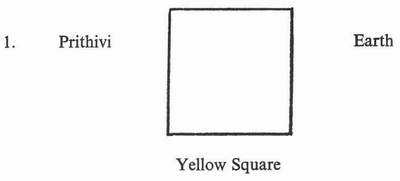
The Tattwas are Eastern symbols of the Magical Elements. They are different from the average symbol, since they are absolutely plain and simple. It is impossible to neglect the finer details on the Tattwas for they have no finer details, but are plain and unornamented geometric symbols, and as such, speak to that part of the mind which is basic, primitive and very deep - which responds on a level operative before even the generally accepted archetypes had formed in the racial subconscious.
Because of this, visions obtained by working with the Tattwas portray the Elemental Forces in very basic terms, and experience of these visions gives the magician an understanding of the elements in a much clearer and more intensive way than would be the case if he neglected to work with the Tattwas.
The Five Tattwa Symbols
These correspond with the four Magical Elements and the fifth (Akasha or Spirit) in the following way:
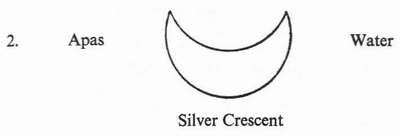
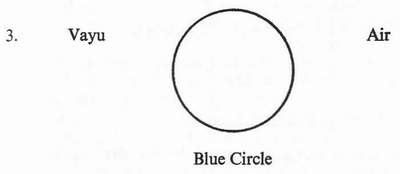
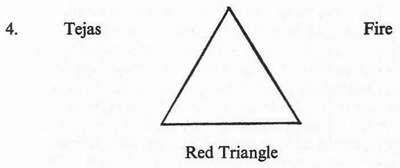
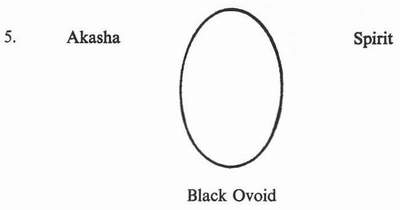
In addition to the five main symbols, it is possible, also, to subdivide these into twenty-five sub-elements. For example Vayu of Prithivi would be the Air aspect of Earth and would be portrayed as a small blue circle on a larger yellow square, thus:
Vayu of Prithivi
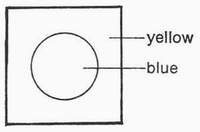
In this way, it is seen that each of the five elements has five aspects composed of four sub-elements plus itself. A little thought will show the value of this manner of looking at the elements. To continue to use Prithivi as an example: Prithivi of Prithivi (Earth of Earth) is obviously as earthy as one can possibly get - very dense, heavy and slow. On the other hand, Apas of Prithivi (Water of Earth), whilst retaining the earth quality underlying, is a much more fluid, less rigid aspect of the element, and the possibility of movement is vastly increased.
Vayu of Prithivi (Air of Earth) is less rigid still - movement is quite rapid, and the whole aspect of Earth is very different from the preceding two aspects, although still 'of earth'. Tejas of Prithivi takes the process a significant step forward and is decidedly more volatile than the others, whereas Akasha of Prithivi (Spirit of Earth) can really only demonstrate its underlying earthy quality by contrast with the other aspects of Akasha!
The same comments apply to the different aspects of the other elements.
It will be seen from the foregoing that the magician who experiences all the sub-elements has a much deeper understanding of and familiarity with the Elements than the magician who attempts to work Elemental Magic with the all-embracing undifferentiated five. It gives him a greater choice of working medium - he can be very much more precise about his intention and the direction of his ritual: the ritual in consequence has a far greater chance of success.
But, as in all magical work, contact with and experience of the Tattwas takes discipline and hard work, and should not, therefore, be undertaken lightly.
In order to experience the Tattwas, the following preparation is needed.
a. A card for each of the elements with the symbol painted on it, large enough to be seen clearly, and in an unambiguous colour.
b. A blank white card, screen, or wall.
c. A note-book or the Magical Diary, (1) with a pen to record the results of each working.
d. A place or room where one can be undisturbed for regular periods, and a comfortable chair, or if the practitioner prefers, a comfortable asana on the floor.
----
[1] The Magical Diary should by now have the daily record of your practice with the Lesser Banishing Ritual of the Pentagram plus the results of several geomantic divinations.
----
The following procedure is followed:
1. Clear the space by using the Lesser Banishing Ritual of the Pentagram (see Appendix I).
2. Place the card bearing the chosen tattwa symbol in the appropriate Elemental quarter at eye-level with the blank white card beside the symbol. Alternately, hang the symbol next to or on the white screen or wall.
3. Sit down facing the symbol relaxed but alert, and gaze for a time at the symbol - not straining, but not allowing the attention to wander.
4. Switch the gaze smoothly from the symbol to the plain white surface and notice that the transference of the symbol is in the complementary colour on the white surface (eg Tejas, the red triangle would transfer as an apple green triangle).
To begin with, it is as well to practise this much only, for a while, with each of the symbols of the elements and sub-elements, until one is thoroughly familiar, not only with the straight appearance of the symbols painted on the cards, but their complementary appearance on the white surface. Once this stage is reached, a little more practice will make it possible to visualize the symbol in the mind's eye, and change it into its complementary version, thus obviating the need for the cards. Assuming facility to this standard, the ritual proceeds as follows:
5. Holding the complementary image of the tattwa firmly in the mind's eye, enlarge it to door size.
6. Imagine yourself passing through the symbol doorway leaving your seated body behind.
7. Look out beyond the 'door' and see what is there. After a little practice it is possible to move further away from the door and explore the elemental/astral terrain beyond the 'door'. If you do venture into the landscape, be sure to return back the same way through the symbol-door.
8. Upon returning switch the complementary colour back to the original colour of the symbol and visualize the door closing behind you, thus establishing your return to normal conditions.
9. Then shrink the 'door' to symbol-size, and perform a ritual gesture to signify the end of the working. (A clap, or a stamp with the foot.)
10. Close with the Lesser Banishing Ritual of the Pentagram.
11. Most importantly, write down a detailed record of the results of the experience.
This kind of working takes a lot of time and trouble to do properly, particularly if all twenty-five sub-elements are skryed, but the persevering and disciplined magician finds that by and large his increased understanding of the elements not to mention his extended skrying abilities and his consequent greater competence when working with them, well repays the effort expended.
It especially pays dividends when the magician comes to consecrating his Elemental weapons, the subject of the next chapter. During this consecration each of the sub-elements is invoked so that each weapon is completely charged.
One of the main things to remember about tattwa visions is that they are very fundamental and basic; to give way to glamourised fantasy surroundings would almost certainly ensure the operator's disappointment.
They must, for best results, be taken on their own terms, and experienced in this way are rewarding beyond expectation.

