5 - Geomantic Divination
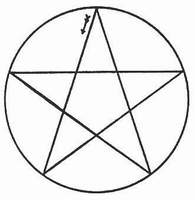
Take a clean piece of paper and on it (a) write out in full the question you wish to be answered (b) draw an invoking pentagram of Earth within a circle, taking care to inscribe the circle first:
and in the centre of the pentagram draw one of the sigils of the planetary 'Ruler', in accordance with the following key:
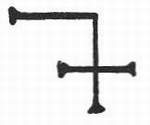
Use the Sigil of Taphthartharath
If the question be of the astrological nature of Mercury - that is to say concerned with science, learning, trickery, theft, knowledge, fish, books, etc. (1)
----
[1] Any good astrological textbook will give details of the further attributions of Mercury and the other planets which succeed it in this table. In many cases it will be found that the question can be attributed to more than one of the planets; use the sigil that seems most relevant to you.
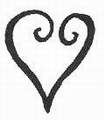
Use The Sigil Of Kedemel
If the question be of the astrological nature of Venus - that is to say concerned with love, music, pleasure, luxury, doves, etc.
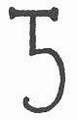
Use The Sigil Of Chashmodai
If the question be of the astrological nature of Luna - that is to say concerned with travelling, fishing, childbirth, reproduction, gynaecology, etc.
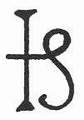
Use The Sigil Of Sorath.
If the question be of the astrological nature of Sol - that is to say concerned with music, feasting, success, power, rulership over others, etc.
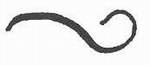
Use The Sigil Of Bartzabel
If the question be of the astrological nature of Mars - that is to say concerned with war, struggle, fighting, victory, weapons, shooting, etc.
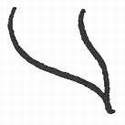
Use The Sigil Of Hismael
If the question be of the astrological nature of Jupiter - that is to say concerned with good fortune, general happiness, church matters, holding office in an organisation concerned with spiritual matters, etc.
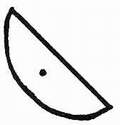
Use The Sigil Of Zazel
If the question be of the astrological nature of Saturn - that is to say concerned with gardening, farming, crops, sorrow, bereavement, death, legacies, long standing problems, etc.
Geomancy In Practice
Take your geomantic box draw the same sigil, circle and pentagram in the sand and then with the wand make a random number of digs into the earth. Invoke the Planetary Ruler by repeating his name. Count the digs and make a note of the number on the paper. Repeat this until you have in all a column of sixteen numbers - for example:
15
15
16
14
__
15
16
15
14
__
12
6
9
7
__
10
11
10
10
__
which you separate into four groups, each of four numbers, exactly as shown above.
By the side of each odd number make a single cross, by the side of each even number make two crosses; thus in the example shown above you will have:
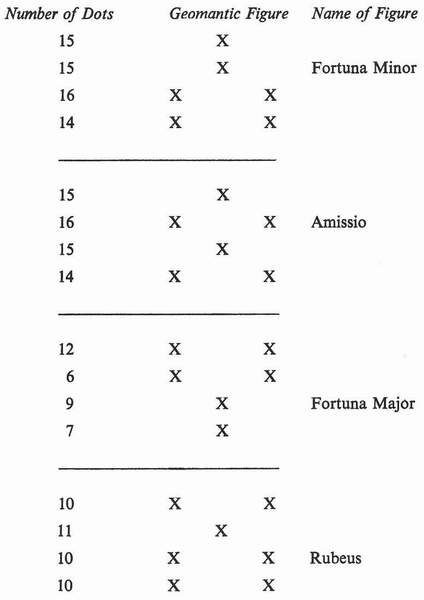
Table
The following table gives the Latin name of each Geomantic Figure with its meaning, Sign, Element, Ruler and Planet:
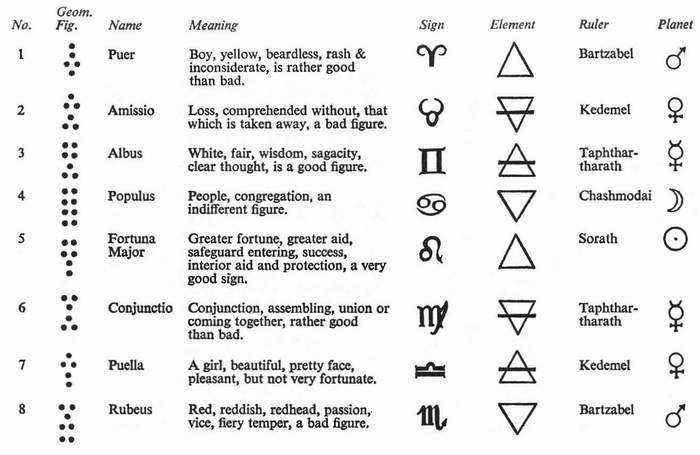
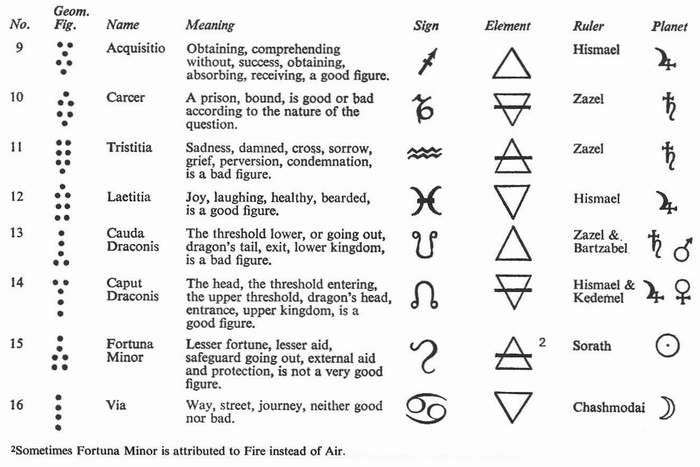
Returning to our example, take the four figures you have obtained and write them out from right to left. Thus in the example given above you will obtain:
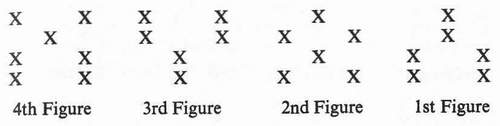
These four primary figures obtained as above are known as the 'Mothers' and from them are derived a further eleven figures. The topmost of the four Mothers form the four lines of the First Daughter; the second line of points of the four Mothers form the Second Daughter; the third line of points of the Mothers form the Third Daughter; and the bottom line of points form the Fourth Daughter. Continuing with the example we get our First Daughter:
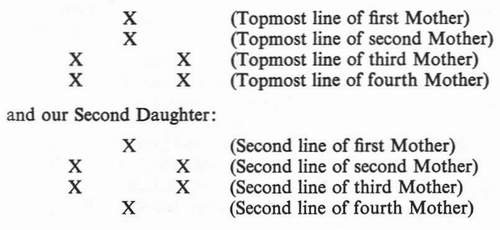
Obtained in the same way from, respectively, the third and fourth lines of the Mothers will be the Third and Fourth Daughters. Thus:
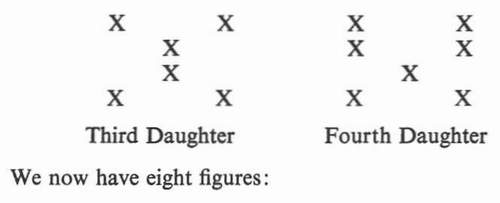
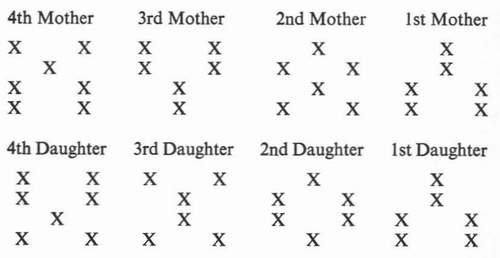
From these eight figures are obtained the Four Nephews. The First Nephew is obtained by adding together across the points of the First and Second Mother and, according as to whether they are odd or even, forming a new line of one or two points. Thus in the example:
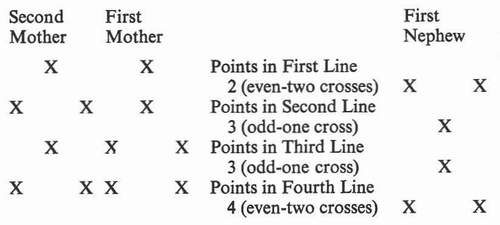
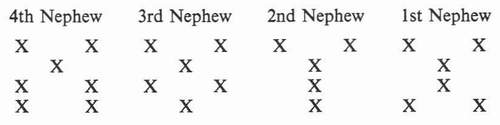
The Second Nephew is now calculated in exactly the same way but from the Third and Fourth Mothers; the Third Nephew in the same way from the First and Second Daughters; and the Fourth Nephew from the Third and Fourth Daughters. So in the example we get:
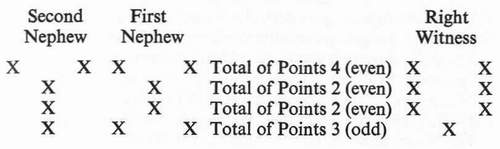
The Mothers, Daughters and Nephews are the twelve principal figures used in any geomantic divination, but three subsidiary figures - the Right Witness, the Left Witness and the Judge - are also employed by many occultists. The Right Witness is derived from the First and Second Nephews in the same way as the Nephews are derived from the Mothers and Daughters. Thus in the example we have:
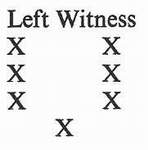
The Left Witness is similarly derived from the Third and Fourth Nephews giving us:
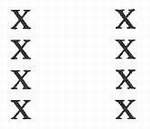
The Judge (3) is derived in exactly the same way from the two Witnesses, and in the example we get the Judge as:
Thus are formed the fifteen figures required for judging the outcome of the geomantic divination, the Four Mothers, Four Daughters, Four Nephews (or Four Resultants), the Right Witness, Left Witness and the Judge.
----
[3] As a test of the correctness of the manipulation of these figures, add up all the points in the Judge, (in this case eight). If the number is odd, then a calculational error has been made.
----
In almost every case a greater clarification is necessary than can be obtained merely by reading off the meaning of the Judge. One such method of clarification is to allocate the first twelve geomantic figures to the twelve Houses of Heaven on an astrological chart. The allocation of the Geomantic figures to the Houses of Heaven is as follows:
• The First figure goes with the Tenth House.
• The Second figure goes with the First House.
• The Third figures goes with the Fourth House.
• The Fourth figure goes with the Seventh House.
• The Fifth figure goes with the Eleventh House.
• The Sixth figure goes with the Second House.
• The Seventh figure goes with the Fifth House.
• The Eighth figure goes with the Eighth House.
• The Ninth figure goes with the Twelfth House.
• The Tenth figure goes with the Third House.
• The Eleventh figure goes with the Sixth House.
• The Twelfth figure goes with the Ninth House.
Using this table draw up a chart of the Heavens, inserting the geomantic figures using either of the following:
The significance of the Houses is as follows:
First House (Ascendant) - Life, health, querent, ec.
Second House - Money, property, personal worth.
Third House - Brothers, sisters, news, short journeys.
Fourth House - Father, landed property, inheritance. The grave, the end of the matter.
Fifth House - Children, pleasure, feasts, speculation.
Sixth House - Servants, sickness, uncles and aunts, small animals.
Seventh House - Love, marriage, husband or wife. Partnerships and associations. Public enemies, law suits.
Eighth House - Deaths, wills, legacies, pain, anxiety. Estate of deceased.
Ninth House - Long journeys, voyages. Science, religion, art, visions and divinations.
Tenth House - Mother, rank, honour, trade or profession, authority, employment, and wordly position generally.
Eleventh House - Friends, hopes and wishes.
Twelfth House - Sorrows, fears, punishments, enemies in secret, institutions, unseen dangers, restriction.
The Interpretation of the Geomantic Figures There are eight basic steps which can be taken to interpret the figures derived from the original marks made with the geomantic wand in your sand box. These are:
1. Assessment of the general nature of the figure from the Judge.
2. Interpretation of the figure in the light of the House to which the question appertains.
3. Interpretation of the Judge and the two Witnesses.
4. Calculation of the Part of Fortune.
5. Estimation of the essential dignity of the figure.
6. Consideration of the aspects of the figure.
7. Interpretation of the meaning of the figure in Fourth House, signifying the end or outcome.
8. Formation of a Reconciler from the Judge and the figure in House to which the question appertains.
Before interpreting any figure however, check to see if either Rubeus or Cauda Draconis are in the Ascendant (the first House). If so, the figure should be destroyed, and the divination begun again after an interval of at least two hours, as the judgement is made worthless by this configuration.
As each of the above steps are carried out, write the answer down on a sheet of paper, numbering the information one to eight, as it is obtained.
1. The nature of the Judge will give a general indication such that if the Judge is Amissio, Rubeus, Career, Tristitia or Cauda Draconis then the figure as a whole bodes ill. Otherwise it is either neutral or auspicious.
2. Using the above table of the qualities of each of the twelve Houses determine which House is most relevant to the question and then refer to the following table to read off the meaning of the figure in this House. (In each case the general meaning of the geomantic figure is placed at the top of the table, and the numbers down the side refer to the Houses.)
Note carefully if the geomantic figure appearing in the relevant House, also appears elsewhere, as this will bring in the influence of the other house in which it appears. For example if the question is related to a financial situation (second House) and there is the same figure in the eighth House (which is concerned with legacies), an increase in fortunes through a legacy is indicated.
Here follows the tables of the 16 geomantic figures in the 12 Houses. Under the heading of each figure is given the general effect of the figure regardless of House.
Acquisitio - (Generally Good For Profit Or Gain)
1. Happy success in all things
2. Very prosperous
3. Favour and riches
4. Good fortune and success
5. Good success
6. Good, especially agreeing with 5th House
7. Reasonably good
8. Rather good, not very, the sick die
9. Good in all
10. Good in suits, very prosperous
11. Good in all
12. Evil, pain, and loss
Fortuna Minor - (Good In Any Matter Where A Person Wishes To Proceed Quickly)
1. Speed in victory or love; but choleric
2. Very good
3. Good, but wrathful
4. Haste; rather evil, except for peace
5. Good in all
6. Medium in all
7. Evil, except for war or love
8. Evil generally
9. Good, but choleric
10. Good, except for peace
11. Good, especially for love
12. Good, except for alteration or serving another
Amissio - (Good For Loss Of Substance, And Sometimes For Love, But Very Bad For Gain)
1. Ill in all but for prisoners
2. Very evil for money, good for love
3. Ill end, except in quarrels
4. Ill in all
5. Evil, except for agriculture
6. Rather evil, except for love
7. Very good for love, otherwise evil
8. Excellent in all questions
9. Evil in all
10. Evil, except for women's favours
11. Good for love, otherwise bad
12. Evil in all
Laetitia - (Good For Joy, Present Or To Come)
1. Good, except in war
2. Sickly
3. Ill
4. Meanly good
5. Excellently good
6. Evil generally
7. Indifferent
8. Evil generally
9. Very good
10. Good rather in war than in peace
11. Good in all
12. Evil generally
Fortuna Major - (Good For Gain In Things Where A Person Has Hopes To Win)
1. Good, save in secrecy
2. Good, save in sad things
3. Good in all
4. Good in all but melancholy
5. Very good in all
6. Very good, except for debauchery
7. Good in all
8. Moderately good
9. Very good
10. Exceeding good, to go to superiors
11. Very good
12. Good in all
Tristitia - (Evil In Almost All Things)
1. Medium, but good for treasure and fortifying
2. Medium, but good to fortify
3. Evil in all
4. Evil in all
5. Very evil
6. Evil, except for debauchery
7. Evil, but in secrecy good
8. Good for inheritance and magic only
9. Evil, except for magic
10. Evil, except for fortification
11. Evil in all
12. Evil, but good for magic and treasure
Puella - (Good In All Demands, Especially Those Relating To Women)
1. Good, except in war
2. Very good
3. Good
4. But indifferent
5. Very good, but notice the aspects
6. Good, but especially so for debauchery
7. Good, except for war
8. Good
9. Good for music, otherwise medium
10. Good for place
11. Good, and love of ladies
12. Good for all
Albus - (Good For Profit And For Entering Into A Place Or Undertaking)
1. Good for marriage, mercurial, peace
2. Good in all
3. Very good
4. Good, except in war
5. Good
6. Good in all
7. Good, except for war
8. Good
9. A messenger brings letters
10. Excellent in all
11. Very good
12. Marvellously good
Puer - (Evil In Most Demands, Except Those Relating To War And Love)
1. Indifferent; best in war
2. Good, but with trouble
3. Good fortune
4. Evil, except in war and love
5. Medium good
6. Medium
7. Evil, save in war
8. Evil, except in love
9. Evil, for war
10. Evil, rather good for love and war, else medium
11. Medium, good favour
12. Very good in all
Conjunctio - (Good With Good And Evil With Evil. Recovery Of Things Lost)
1. Good with good, evil with evil
2. Commonly good
3. Good fortune
4. Good, save for health. Cf. 8th House's figure
5. Medium
6. Good for immorality only
7. Rather good
8. Evil, death
9. Medium good
10. For love good, for sickness evil
11. Good in all
12. Medium, bad for prisoners
Rubeus - (Evil In All That Is Good, And Good In All That Is Evil)
1. Destroy the figure
2. Evil in all
3. Evil, except to let blood
4. Evil, except in war and fire
5. Evil, except for sowing seed
6. Evil, except for bloodletting
7. Evil, except for war and fire
8. Evil
9. Very evil
10. Dissolute, love, fire
11. Evil, except blood-letting
12. Evil in all
Carcer - (General Evil, Delay, Binding, Stay, Bar, Restriction)
1. Evil, except to fortify a place
2. Good in Saturnian questions, otherwise evil
3. Evil
4. Good, only for melancholy
5. Receive a letter in three days; evil
6. Very evil
7. Evil
8. Very evil
9. Evil in all
10. Evil, save for hidden treasure
11. Much anxiety
12. Rather good
Caput Draconis - (Good With Good, Evil With Evil; Gives A Good Issue For Gain)
1. Good in all
2. Good
3. Very good
4. Good, save in war
5. Very good
6. Good for immorality only
7. Good, especially for peace
8. Good
9. Very good
10. Good in all
11. Good for the Church and ecclesiastical gain
12. Not very good
Via - (Injurious To The Goodness Of Other Figures Generally, But Good For Journeys And Voyages)
1. Evil, except for prison
2. Indifferent
3. Very good in all
4. Good in all, save love
5. Voyages good
6. Evil
7. Rather good, especially for voyages
8. Evil
9. Indifferent, good for journeys
10. Good
11. Very good
12. Excellent
Cauda Draconis - (Good With Evil, And Evil With Good; Good For Loss, And For Passing Out Of An Affair)
1. Destroy the figure
2. Very evil
3. Evil in all
4. Good, especially for conclusion of the matter
5. Very evil
6. Rather good
7. Evil, war and fire
8. No good, except for magic
9. Good for science only, bad for journeys, robbery
10. Evil, save in works of fire
11. Evil, save for favours
12. Rather good
Populus - (Sometimes Good, Sometimes Bad; Good With Good, Evil With Evil)
1. Good for marriage
2. Medium good
3. Rather good than bad
4. Good in all but love
5. Good in most
6. Good
7. In war good, else medium
8. Evil
9. Look for letters
10. Good
11. Good in all
12. Very evil
3. Consider the two Witnesses and their relationship with the Judge:
A good Judge made of two good Witnesses is good.
A bad Judge made of two bad Witnesses is bad.
A good Judge made of one good Witness and one bad Witness means success, but delay and vexation.
If the two Witnesses are good and the Judge bad, the result will be obtained; but it will be unfortunate in the end.
If the first Witness is good and the second bad, the success will be very doubtful.
If the first Witness is bad and the second one good, the unfortunate beginning will take a good turn.
4. The Part of Fortune is particularly applicable in all questions of money. It is calculated by adding together all the points of the first twelve figures, then dividing by twelve. The number remaining will indicate the figure to which the Part of Fortune is allocated by counting the figures from the Four Mothers, through the Four Daughters to the Four Nephews. Having found the figure, locate the House in which it falls. The meaning of this geomantic figure will provide, in the context of its House, details concerning the querant's financial position. (See tables set out under the second operation.)
5. The essential dignity of a figure in a particular House is a measure of its strength, the degree to which it will influence the judgement.
By essential dignity is meant the strength of a figure when found in a particular House. A figure is, therefore, strongest when in its own House, very strong when in its Exaltation, very weak in its Fall; weakest of all in its Detriment. A figure is in its Fall when in a House opposite to that of its Exaltation, and in its Detriment when opposite to its own House. The following is a table of these relationships.
Caput Draconis is strong in the dignities of Jupiter and Venus.
Cauda Draconis is strong in the dignities of Saturn and Mars.
Refer to the table of Planetary rulers of the sixteen geomantic figures early in Chapter Five to determine which figures come under which planets.
6. Examine the position of the figures in the Houses in terms of the astrological rules of aspects between Houses. Consider aspects such as Sextile, Quintile, Square, Trine (4) and note which figures are well aspected and which are badly aspected to the figure located in the House related to the question. Note down the aspects, putting good on one side, evil on the other; noting also the strength or weakness, friendliness or hostility to the figure in the House required.
7. Determine the meaning of the geomantic figure located in the Fourth House as an indication of the eventual outcome of the situation. To do so refer back to the tables used for the second operation.
8. Add together the points of the Judge and the figure which is in the House pertaining to the question. By adding odds and evens (in the same way the Judge was formed from the two Witnesses) construct the 16th geomantic figure, the Reconciler which gives a final reading.
----
[4] Refer to any elementary text on Astrology for an explanation of these terms.
----
Thus you will have accumulated eight pieces of information from the geomantic figures interpreted in the light of the astrological Houses into which they have been placed, and final judgement will very much rely on the skill of the practitioner in weighing the importance of each factor, but if the divination has been successful an overall picture should have been formed as the result of each operation is recorded. (5)
We move now onto a more direct technique for obtaining knowledge using skrying rather than the rather cumberous divinatory technique just outlined.
----
[5] When you begin to use geomantic divination regularly, it is useful to have a ritual to protect the magician from, both outside interferences, and the carry over into ordinary life of the forces generated by practical working. Such a ritual is the Ritual of the Rose Cross, for which see Appendix IV.
----

