Phalaris Grass

The Phalaris grasses have got to be the easiest plants to obtain and grow for the DMT alkaloids. Seeds are easily obtained from many mail order catalouges such as 'Of The Jungle'.

These plants look exactly like any other grass plant and grow indiscretely anywhere. They can easily overrun an area. Within a month they can be harvested and within a year you could be mowing your lawn and extracting a lifetime supply of DMT!

Description and General Information Phalaris arundinacea, reed canary grass, grows everywhere in the world outside the polar regions. In Europe, Northern and Eastern Asia (partly in Central-), In North America from New Brunswick to the Southeastern parts of Alaska, from North Carolina to New Mexico, Arizona and Northeastern parts of California. Also in New Zealand. As for Finland (and Scandinavia) where I live, it grows on rocky shores througout the country. It is common.

Phalaris aquatica, also known as P. tuberosa, is native to the mediterranean region, but as a result of agromomic interest and investigation that followed has wide distribution in grassland regions. Most probably this plant can be found in Mediterranean, southern Australia and in US California, Missisippi or Oregon [areas where native aquatica has been found]. Note that this grass can be found in several other places as (escaped) cultivar. There are several other Phalarii, such as californica, canariensis, minor and arundinacea-aquatica hybrids. Excluding the hybrid these are of little interest, except taxonomically. No DMT have been found in any of these. Most likely Phalaris grows on lake- and riverbanks and on seashores, especially rocky. It is often accompanied by Festuca arundinacea, Angelica archangelica ssp. litoralis, Sochus arvensis and Veronica longifolia. Phalaris grows often in rings and in the middle of the spot grows Calla palustris and Bidens-species. Tufts it forms are often only phalaris, but Phragmites, Carex acuta and Iris pseudoacorus may grow amidst it. And especially watch out for Dactylis glomerata, which looks much like Phalaris, but is smaller and has lobed inflorescence.

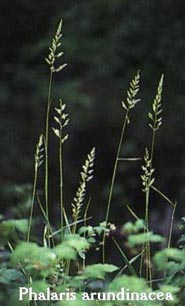
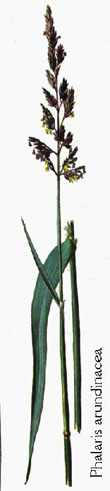
Phalaris arundinacea is tall grass, usually about 1 meter up to 2m., 4 to 7 jointed, hard and smooth (sometimes reddish), leaves 7 to 30cm long and 1-2.5cm wide. The "flower" is 10cm long, dense, the seed is appr. 1,7mm. Pictures and very accurate descriptions of this grass areeasy to find in any library (and I would recommend finding several).Perennial from scaly, creeping rhizomes; culms [stems] 50-150cm tall; leaves usually green, occasionally striped with white (in f. picta); panicle [inflorescence?] 7-40cm long, lobed and branched at the base, the branches up to 5cm long, spreading during anthesis; glumes 3.5-7.5mm long, more or less equal, acute, usually wingless, when winged, the wing very narrow and inconspicuous, glabrous or with a few appressed scattered hairs; sterile florets 2, 1.2-2.3mm long ; subutate, pubescent; grain 1.5-2mm long, 0.7-1.0mm wide, subovoid brown with faintly striate surface; somatic chromosome number 14, 27, 28, 20, 30, 31, 35, or 42; the chromosomes cs. 5.0um long at diakinesis.

Phalaris aquatica Perennial; culms from a dense crown or a loose base with short rhizomes,culms often bulbous at the base, up to 1.5m tall; panicle 1.5-11.0cm long, 1.0-2.5cm wide, usually cylindric, sometimes ovate-cylindric, occasionally lobed at the base; glumes 4.4-7.5mm long, 1.0-2.0mm wide, glabrous, rarely hisute, broadly winged, the wing almost always entire, rarely somewhat erose; fertile floret 3.1-4.6mm long, 1.2-1.5mm wide,lanceolate, densely pubescent; sterile florets 1 or sometimes 2, 0.2- 2.2mm long, when 2 are present the lowermost is often less than 0.5mm long; caryopsis 2.2-2.5mm long, 1.2-1.3mm wide, light brown, surfacefaintly striate; chromosome number n=28, the chromosomes ca. 6-7um long at diakinesis.


Alkaloid Content and Variation: Alkaloid-contents vary considerably in both P. arundinacea and P.aquatica (From study to study AND in real life). Percentages are total alkaloid contents, not DMT-contents Either way these percentages are good only for illustrating the considerable variation. There is now way of knowing your plants alkaloid content without chromatography equipment. P. arundinacea may contain anything from 0.004% of the dry plant matter to 0.121% of the dry plant matter. P. aquatica may contain anything from 0.007 of the dry plant matter to 0.18% of the dry plant matter. [So one might have to smoke about an pound of it, or one might have to 30 grams of the dried matter. About 200 grams of wet grass is roughly equivalent to 30 grams dried.] To be certain all the extraction procedures are worth the try one has to try to maximize the alkaloid content by choosing right strain, and by growing this strain right with stessing tecniques.


How to Grow
Phalaris Grass
Growing Phalaris is very easy - it is an grass that can tolerate floods and extreme drought. A plant dug out of the ground and left without any water for 6 days suffers only minor wilting. Severe wilting occurs after drought over 9 days in duration. Placing the whole plant underwater doesn't kill the plant.


To Achieve Optimum Alkaloid Levels

This takes some skill. Time never stops, and everyone wants to get their phalaris as big and trypty in as short time as possible. Parts you are after are leaves - leaves have the highest alkaloid contents - so dont harvest anything else -highest alkaloid concentrations are found in immature grass and leaf blades, lowest in leaf sheaths, stems and roots. Starting from seeds is easy. Get some shallow (10 cm/4") pots. Tray with edges will do, bucket is fine - anything that can hold some soil together, something that doesn't rot or suck the water from the soil. Regular plastic pots are fine. Dont use clay/unglazed ceramic pots, these hold water. Place soil in the container, wet it thoroughly, and place seeds on the soil. You can soak the seeds for 24 or 12 or 6 hours before if you want to - this will speed up the process a bit. Cover the seeds with thin layer of soil (say like 3 mm). Spray the soil with water, and cover the container with clear plastic so that humidity stays high. If you can raise the temperature couple of degrees (23-25°C), seeds will germinate faster. After couple of days first sprouts should be visible, remove the plastic .Optimum temperature for vegetative growth would be about 20-22°C. Alkaloids in phalarii can be increased with stressing. Stressing, on the other hand, slows the growth and decreases the total yield. I will refer to any action that increases the total alkaloid-yield by stressing. These methods work for both P. arundinacea and aquatica. There are three basic methods in stressing: clipping, shading and moisture-control. Clipping is relatively easy. Take clean scissors into your right hand, hold the plant still with your left hand, and |SNIP|, your plant just got stressed. But simply clipping the plants shorter will decrease your total yield. Wait until the plant is about 10 or 20 cm (1/2 ' ) high. Cut right above the leaf. Wait until you get another leaf, above which to cut, could be two days or two weeks. Clipping increases tryptamine content by 50% to even 400%. The amount of betacarbolines is roughly doubled. Shading is quite controversial issue. Shading slows the growth, and seems to affect different strains different ways. I will try to shed some light into shadows. First of all, you will probably grow your plants indoors, and if these plants are not on the windowsill, they will not be receiving anything near the light plants outdoors do, where all the studies are made. Forget shading. If you grow yours outdoors/near good light source, shading might be useful. Shade the plants for their last 1/4th or 1/5th of the growing-period. In practice, placing a sheet of glass/plexiglass or a thin net between the plants and the light source should work. Glass eats anything from couple to 20% (dirty) of the light. Amount of shading is quite troublesome, too. General mean value would be maybe 5 to 15%. Arundinacea responds to smaller shifts, halve the figures. Shading increases the tryptamine content by 20 to 30% . Moisture-stressing is also quite easy. You dont water for a week or so. Interestingly, plants droughted for a long time, produce some unknown alkaloid. Young plants respond better to drought, whereas older (+30) may not show any response in respect to the alkaloid content. Regrowths grown from droughted plants (which did not show response) had a higher alkaloid content. If you wilt, wilt young plants. No water for a period of 5 to 10 days. If any damage (brown leaf tips etc.) begins to show, stop wilting. Note that although the plants cannot be rotted to death with overwatering, it slows the growth. Let the soil dry out between the waterings. Moisture stress may as much as double the alkaloid content. To get high leaf mass, your plant needs high amounts of water, light, and nutrients. Nutrients, on the other hand, have been shown to have a negative effect on the alkaloid content - adequate fertilization may in fact lower the total alkaloid content. And stressing decreases the leaf mass. So you must walk the fine line between these two. Make a growing program, divided in 4 to 8 parts. During certain parts you maximise the leaf mass. And during certain parts you maximise the alkaloid content.


Example: Simon Sez grows Phalaris aquatica. 1st period goes almost entirely to germination, as the seeds dry out a bit, "Whatta dumb mistake," Simon thinks, as third of the seeds wont germinate anymore. 2nd and 3 rd period Simon has dedicated for growth. Simon gives the plants nutrients; during 2nd period complete, well balanced N-P-K (nitrogen, phosphorus, potassium) and micronutrient (Zn,B,Cu,Fe, Mn, etc.) fertilizer, and during 3rd only natural nitrogen. every now and then he snips the top off 'em. 4th period is about fasting - Simon gives plants no water. During the 5th Simon begins to feel sorry for the plants and after giving them adequate, but not too much!, watering, lets them grow .And at the beginning of the 6th period, Simon thinks that its time to chill out a bit, so he sneaks the plants into large fridge his friend has (after giving it a dose of nitrogen fertilization). Just for a night. Its always above 0°C, but below 6°C. Last days the plants get to grow normally. Then Simon strips the leaves, and lets the plants do their own thing for a while, as he tries to put together the wheat grass juicer he got without any instructions. That would theoretically make 200% for the clipping, 25% for the 4th,10-200% for the 6th. But in reality the increase in tryptamines cannot be calculated so easily. But lot anyhow. Simon smiles happily. The period lenght is also important - alkaloid content rises steadily as the plant grows, and is highest at 30 to 50 days. Simon had 7 day periods =). Fertilizers - problematic. Dont use good, rich soil - if the plants get enough of micronutrients, alkaloid content is diminished. Mix regular gradening soil with sand and rocks to get a good mix (for example 1/3rd of each). When the plant is young, ensure adequate nutrition with liquid fertilizers, then move to only nitrogen fertilization, and finally give only water (for example first quarter, second quarter and last half, resp.) This makes plants grow fast, big and finally tryptish. Phalaris can use fairly large amounts of fertilizers, but stick to the nstructions of the manufacturer until you know what you are doing. Urine is an excellent excellent nitrogen fertilizer - add about half an desiliter (2 oz) per liter of water (1/5gallon?) - fully organic and very soluable.


Cloning - an easy way to get more plants First pick your best plant -healthy, big and high in alkaloids. Wait till you harvest, and then cut the whole stem off, place it underwater, glass or a bucket does fine, cut in 3 cm pieces, add small amounts of seaweed/-extract/auxins and wait couple of days. After that place pieces in pots, and keep humid. It might take as long as 3 weeks for first signs of life, but try to keep the soil relatively humid - not wet, humid. Excess water may attract molds and fungi. You can also take part of the rhizome (root) and do the same thing. Leaves are of no use here, they will only rot away.Harvesting the fruits of labor is very easy. Simply cut out the leaves. If you like you can leave one leaf to speed up the process. Remove parts of the stem above the leaf. Plant will continue growing for a long time. Repotting the plant or dividing the rhizomes often gives plant new vigour. Do this couple of times a year. Time of the day has no effect on the tryptamine content if you are growing indoors or in an greenhouse. Outside, morning harvest may rise alkaloid content if you are producing seeds - dont clip, have at least four of such plants, all from different sources, and of good strain. Let these grow, and when the seed production has started, place a clear bag over the flower. Bags made of loose nylon mesh are best. Plants produced from seed oftenhave more energy than plants that have been cloned from a clone (and so-on). Produce seeds at least once in two years to ensure the vigour of your plants.


Preparation

The simplest way to prepare phalaris is to use a wheat juice extractor. This device presses the juice out of the leaves and stalks. Of course dosage becomes harder to gauge. One report on the internet suggested 1 teaspoon as a good dose and 2 teaspoons as an extreme overdose, resulting in one freaky trip. It appears likely, and has been suggested in some reports, that alkaloid levels drop when the plant dries. By taking the fresh sap, alkaloid levels should be maximized. Extraction of alkaloids can be performed on dry plant materials (based on Dr. Jonathan Ott's reports). An acid is used to exact the alkaloids of both the DMT and the MAOI containing plants. A solution of 1/3 lemon juice and 2/3 water is used to quickly boil the plant material. Pour off and repeat two more times. The dose is easier to determine because it is based on dry plant material. Three grams of MAOIs per dose of DMT provides the required MAOI. Again, increasing the dosage of Syrian rue beyond 3g does not increase the potency of the DMT significantly more than 3g.


IMPORTANT NOTES:

    (1) Without the combination of an MAOI, the DMT will normally be demetabilised when orally consumed.

    (2) There are very strict dietary precautions when using MAOIS. *SEE LIST OF DIETARY PRECAUTIONS

    (3) I have always seen references to staying away from aluminum for all sorts of chemical extractions and procedures. I believe that this is because aluminum bonds with a lot of contaminants that can then find their way into the brew (just think about having to clean calcium deposits off of your aluminum coffee maker with vinegar). Always use nice glass (pyrex is much less likely to break) or stainless steel.


The liquid form can serve as an oral dose, or it can be evaporated GENTLY AND SLOWLY to a goo. This goo can then be smoked for a very intense dose of DMT. Or the goo can be saved for oral doses. I recommend refrigeration. I have no information as to how to best store phalaris products to prevent spoilage and loss of potency.

There are a variety of chemical extraction techniques floating around on the net. I have little ability in evaluating the accuracy and safety of these techniques. I prefer to speak on sources in which I have my faith, such as from James Dekorne (author of the 'Psychedelic Shamanism'). Below he gives a method to produce an extremely potent smokable form of DMT from phalaris grass.

Method;

    1. Pulverize the grass cuttings as much as you can. You must do this to rupture the cellular structure the plant. A good way is to put the plant material in the freezer overnight, remove the next day, thaw it, put it in the freezer again, and then remove and thaw it again. After two or three such cycles it will usually be mushy and easily minced in a blender. Place the phalaris in the blender when it is frozed and the blender will chop it easier.

    2. Next add enough water to the much to make a pourable soup.

    3. Now you must add an acid. Just enough to bring the PH down to about 5. You can use white vinegar, lemon juice, or acetic acid. Check the PH with PH paper, it is usually sold at most drug stores. The acid reacts with the alkaloids in the plant material and converts them into a salt. A good way to facilitate this reaction is to simmer the acidified soup in a slow cooker overnight; leave the lid on, as we don't want any liquid to evaporate.

    4. Strain the plant matter through cheesecloth, then through a paper coffee filter. The bulk roughage may now be discarded because the alkaloids we seek have migrated into the aqueous solution.

    5. Add a small percentage of a defatting solvent such as methylene chloride, ether, chloroform, or naphtha. Naptha is easily available in the form of Coleman fuel or lighter fluid. The reason we do this procedure is to remove the oils and fats which are in the solution - they will migrate into the solvent. Shake up the mixture and put it aside long enough to seperate into two layers, one aqueous, the other solvent. If you've ever made vinegar and oil salad dressing then you've seen this done.

    6. A separatory funnel is useful for this next operation. This is a simple lab tool consisting of a tapered glass container with a tap at the bottom and a stoppered opening at the top. The two liquids are poured in the top (the bottom faucet is closed, of course); The container is corked and shaken about to mix its contents. It is then set aside until the fluids seperate into 2 layers. Then a tap is opened to allow the lower stratum to drain into a container. Just before the descending upper fraction reaches the faucet, it is closed off. You can also do the above separation procedure with a turkey baster :) Discard the solvent (along with the unwanted oils and fats) and now the remaining aqueous solution contains the alkaloids.

    7. The next step is to add a base to our solution. One often used in extraction formulas is ammonium hydroxide, a liquid. If this is unobtainable you can substitute regular lye crystals. This is sold as drain cleaner and is also called sodium hydroxide. Dissolve this is water to a high concentration. This fluid is added in small increments to the aqueous solution, shaking the mixture each time, then testing it until eventually the pH reaches 9 or 10. Be patient. It usually takes a while to get it just right. Now you have 'unhooked' the salt and transformed the alkaloids into their freebase form. They are now no longer a salt, and hence no longer soluble in water... So now the are accessable to extraction by one of the organic solvents mentioned above. Using coleman starting fuel is best and easy to obtain.

    8. A ratio of 10 percent of the aqueous solution should be enough solvent for each extraction. The easiest way to estimate this is to visualize where the 10% line is on your container of aqueous solution, then add that amount of solvent to the whole, increasing the volume to 110% (A super accurate measurement is not necessary) The container must be kept closed tightly so that the solvent won't evaporate from the solution.

    9. Four extractions are made to make SURE that all of the alkaloids are removed. These are done at one 24-hour, and then at three weekly intervals. The solvent layer will soon take on a darker tint, usually yellowish or reddish-brown. This indicates the presence of alkaloids as they slowly move out of the aqueous solution. It will take almost a month to get most of them, and the mixture should be shaken at least twice a day to ensure that all of the alkaloid molecules come into contact with the solvent. At each weekly extraction carefully separate this from the aqeous solution be either of the methods mentioned above. Save these solvent fractions and combine them in one container. each time add fresh solvent to the aqeous solution until the extraction series is complete.

    10. The last step is to pour the combined solvent fractions into a shallow baking dish or pan and allow it all to evaporate in an open space free from flame or sparks. The residue remaining after the evaporation contains the alkaloids, and may be put into gelatin capsules. If it is unduly gummy, one may add small amounts of ordinary flour to the gum until it thickens.


Ok, well that's about it for now. Remember to not smoke more than 25 mg your first time. You can gradually raise the dose over time as you become more experienced.
