What are common contaminants of the mushroom culture?
Most specialty mushrooms are grown on sterilized substrates, and
once a contaminant gets a foothold, it flourishes in the absence of
competition from other contaminants. In nature, complex interactions
among hundreds of other fungi, bacteria, nematodes, etc. maintain an
ecological equilibrium. In a sterilized medium, the grower provides
ideal conditions for the contaminant to prosper. In sawdust bags,
contamination usually involves another fungus living off the waste
products or on the remains of the cultivated fungus, or sometimes on
the living mycelium or fruiting body of the cultivated fungus. The
only competition for these contaminants is the cultivated fungus
itself.
Wet Spot; Sour Rot - Bacillus sp.
In grain spawn jars, one commonly encounters Bacillus,
which sometimes survives the sterilization process as heat
resistant endospores. . A dull gray to mucus-like brownish slime
characterized by a strong but foul odor variously described as
smelling like rotting apples, dirty socks or burnt bacon.
Bacillus makes uncolonized grain appear excessively wet,
hence the name "Wet Spot". Pallid to whitish ridges along the
margins of individual grain kernels characterize this contaminant.
Bacillus primarily reproduces through simple cell division.
In times of adverse environmental conditions, especially heat, a
single hardened spore forms within each parent cell body -
bacterial endospores, which can survive high temperatures for
prolonged time. The most practical method for eliminating
bacterial endospores involves soaking the grain at room
temperature 12 - 24 hours prior to sterilization. Endospores, if
viable, will germinate within that time frame and then be
susceptible to standard sterilization procedures. And, new
endospores won't form in the moist environment of the resting jar
of grain.
Yellow to brown lesions form on mushrooms. Typically, spotting
occurs at or near the edge of mushroom caps. Blotch occurs when
mushrooms remain wet for a period of 4 to 6 hours or longer after
water has been applied. The bacterium is spread in air-borne soil
particles. Controls include lowering humidity and watering with a
150 ppm chlorine solution (calcium hypochlorite products are used
since sodium hypochlorite products may burn caps). If the mushroom
stays wet, however, chlorine has little effect since the bacterial
population reproduces at a rate that neutralizes the effect of the
oxidizing agent. Shiitake caps are affected by a bacterial disease
caused by Pseudomonas gladioli (Burkholderia
gladioli). Sanitation is a critical component of control
measures.
Bacterial
Blotch
Cobweb mold or Dactylium Mildew (Hypomyces sp.)
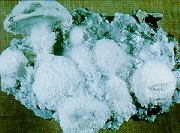
A cottony mycelium grows over casing. When it contacts a
mushroom, the mycelium soon envelopes the mushroom with a soft
mildewy mycelium and causes a soft rot. It is also a parasite of
wild mushrooms. Cobweb mold is darker than mycelium... almost
grey as compared to white. The difference in color is sometimes
hard to tell for somebody that hasn't seen them side by side
before. Cobweb has several other indicators... the one that sticks
out is the speed of growth. A small patch the size of a dime will
spread to cover an entire jar/casing in just a day or two. Cobweb
is also very very fine strands, while mycelium tends to be thicker
ropes. Cobweb mold is favored by high humidity. Control
strategies include lowering humidity and /or increasing air
circulation.
Green Mold - Trichoderma harzianum, T. viride, T.
koningii
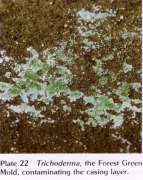
Green mold caused by Trichoderma harzianum is
characterized by an aggressive, white mycelium that grows over the
casing and onto mushrooms, causing a soft decay. Masses of spores
that eventually form are emerald green. Heavily infested patches
of compost are barren. This is currently the most important
disease in the U.S. Agaricus industry. Many farms spread salt on
the compost in affected areas when green mold is first recognized.
Strict sanitation is essential. Shelving, trays, walls, floors,
etc. may be surface disinfested as a matter of routine, but it is
done with a sense of urgency following an outbreak of a disease.
Many commercial products are available for cleaning surfaces. The
base ingredients in these materials include chlorine, iodine,
phenol, or quaternary ammonium, among others. Surface
disinfectants are used farm-wide, from equipment sanitation to
room washdowns to foot-dip solutions to picking basket prewash.
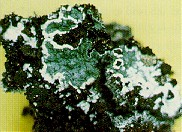
Other Green Molds may be better defined as indicators sin ce they
don’t seem to be as aggressive as T. harzianum. These
species of Trichoderma also sporulate on the casing surface
and may sporulate on infected mushrooms. These fungi indicate that
carbohydrates are available, possibly due to inadequate nitrogen
supplementation during Phase I or undercomposting. T.
viride reportedly produce toxins that dissolve mushroom cells
walls. A wet compost low in ammonia prior to pasteurization,
flies, poor sanitation, anaerobiosis, and other factors influence
green mold. These fungi are common in sawdust and commonly occur
in the production of specialty mushrooms. Trichoderma is
often mistaken for Penicillium
or Aspergillus
molds(and vice versa), being that all three look very similar and
are not easy to tell appart without the use of a
microsope. Sime pictures underneath possibly show any of the
three genuses out of the aforementioned reason.
Cinnamon Brown Mold – Chromelosporium fulva (Peziza
ostrachoderma)
The color of this mold ranges from yellow gold to golden brown
to cinnamon brown. It grows rapidly in circular patches. It is
very common in soil, and flourishes on damp wood. Areas in compost
overheated during spawn run may be colonized. Improperly
conditioned compost will also support growth, but it is most
commonly known as a recolonizer of overly pasteurized casing,
possibly living on dead microorganisms. It often occurs on
sterilized soil. Sexual fruiting bodies may appear several weeks
after the first appearance of the mold. Spores are airborne.
This fungus colonizes compost or casing. As spores mature, the
color of the mold changes from white to pink, to cherry red, and
finally to dull orange. It is slow growing. Spores spread in air,
during watering, and on pickers. The lipstick mold utilizes
certain fats in the compost. It is an uncommon problem. Control is
centered around sanitation.
Pink Mold; Red Bread Mold – Neurospora
Commonly to occasionally seen on agar and grain.
Neurospora is fast growing, sometimes taking only 24 four
hours to totally colonize a media filled petri dish. It is
ubiquitous in nature, occurring on dung, in soils and on decaying
plant matter. Since this fungus grows through cotton stoppers or
filter discs, a single contaminated jar, though sealed, can spread
spores to adjacent spawn jars within the laboratory. This
condition is more likely if the filter discs or cotton plugs are
the least bit damp; or if the external humidity is high.
Furthermore, Neurospora spores germinate more readily at
elevated temperatures. The pink mold seen in mushroom culture is
most frequently Neurospora sitophila, a pernicious
contaminant that is difficult to eliminate. All infected cultures
should be removed as soon as possible from the laboratory and
destroyed. A thorough cleaning of the laboratory is absolutely
necessary. If contamination persists, remove all spawn and start
anew.
Sepedonium Yellow Mold – Sepedoniumspp.
This white, sparse mold grows in the compost during spawn run.
With age, it turns dull yellow to tan. Spores are airborne.
Thick-walled spores may survive peak heat. The mold colonizes
compost considered ideal for spawn growth.
Black Whisker Mold – Doratomyces spp.
This fungus produces black powdery spores that appear as smoke
when disturbed. This mold indicates the presence of certain
carbohydrates in the compost at spawning time. It also indicates
that the straw has been incompletely caramelized or underheated in
Phase I (therefore, carbohydrates are in a form easily utilized).
The proportion of carbohydrates, particularly cellulose, may be
too high. The black whisker mold is also present in compost that
overheated during spawn run. Simple carbohydrates are utilized by
this fungus but it can also utilize lignin. Doratomyces,
Aspergillus, and Penicillium produce copious numbers
of spores and may cause respiratory problems (nasal and throat
irritation, chest congestion, breathing difficulty, etc.).
Blue-green Molds – Penicillium spp
.
Abundant blue-green spores are produced on the surface of the
substrate. Similar to Aspergillus.
Favorable conditions parallel those for the black whisker mold.
Penicillium spp. utilize simple carbohydrates, as well as
cellulose, starch, fat, and lignin. These fungi are very common on
specialty mushrooms and are one of the chief concerns in agar and
grain culture. Spores are airborne and ubiquitous.
Black Mold (also Yellow Mold
and others) – Aspergillussp.
Very common in agar and grain culture, and in compost making.
Found on most any organic substrate, Aspergillus prefers a
near neutral to slightly basic pH. Well used wooden trays and
shelves for holding compost are frequent habitats for this
contaminant in the growing house. Species range in color from
yellow to green to black. Most frequently, Aspergillus
species are greenish and similar to Penicillium.
Aspergillus niger, as its name implies, is black;
Aspergillus flavus is yellow; Aspergillus clavatus is
blue-green; Aspergillus fumigatus is grayish green; and
Aspergillus veriscolor exhibits a variety of colors (greenish
to pinkish to yellowish). These molds, like many others, change in
color and appearance according to the medium on which they occur.
Several species are thermophilic. Some Aspergillus
species are toxic. Aspergillus flavus, a yellow to yellowish
green species, produces the deadly aflatoxins. A. flavus
attacks cottonseed meals, peanuts and other seeds high in oil that
have been stored in hot, damp environments. Of all the biologically
produced toxins, the aflatoxins are the most potent
hepatacarcinogens yet found. The toxicity of this species was
largely unknown until, in 1960, 100,000 turkeys mysteriously died
from an outbreak of this disease in Great Britain. Since A.
flavus grows on practically all types of grain, this species is
of serious concern to mushroom spawn producers. Careful handling of
any molds, particulary those of the genus Aspergillus, should
be a primary responsibility of all managers and workers in mushroom
farms. Aspergillus fumigatus and Aspergillus niger,
two thermotolerant mesophiles, are also pathogenic to humans in
concentrated quantities. The affliction is called aspergilliosis or
"Mushroom Worker's Lung Disease". Spent compost is the most frequent
source of Aspergillus fumigatus.
Aspergillus flavus
Aspergillus nidulaus
Aspergillus niger
Aspergillus flavus
Inky Cap – Coprinus spp.
These are evidence of free ammonia in the compost. Ammonia
seems to be a nitrogen source. Their delicate gray caps autodigest
quickly. Inky caps are indicators of nitrogen oversupplementation
or a poorly managed Phase II compost. If there is too much
residual ammonia, Phase II thermophilic microflora may be unable
to convert all the ammonia into microbial protein. In addition,
areas in the compost that did not remain within the range of 115
to 135 F from 72 to 96 hours after pasteurization may contain
residual ammonia. This fungus is strongly cellulolytic.
Oedocephalum (Brown) Mold – Oedocephalum spp.
This mold makes light gray growth on compost surface, later
becoming brown as the spores mature. It forms erect spore-bearing
structures with spherical clusters of large spores at its top end.
This mold indicates that ammonia and amines were not completely
eliminated during Phase II (which might be the case when carbon
sources are limiting and nitrogen can’t all be converted into
microbial protein). Its ecology is similar to Coprinus, and
often occurs with it.
Olive Green Mold – Chaetomiu m spp.
Fruiting structures of this mold look like olive-green
cockleburs – 1/16 inch in diameter – that develop on compost.
Although its heat tolerant spores survive 140 F for 6 hours, the
mold appears only in compost improperly managed during Phase II,
especially where Phase II ventilation is inadequate. Lack of
oxygen when compost temperatures are greater than 142 F permits
formation of compounds produced in anaerobic conditions. These
compounds are toxic to spawn growth but are utilized by the olive
green mold. It is highly cellulolytic.
Pin Molds – Rhizopus spp.
A very fast growing fungus. Once it sporulates, it forms many
tall aerial hyphae adorned with black-headed pins. It grows on
readily available carbohydrates. Along with Aspergillus and
Penicillium, species of this genus are the primary
contaminants of grain spawn. It is also very common on straw.
Plaster Molds and Flour Molds – Papulaspora byssina,
Thielavia thermophila, Botryotrichum piluiliferum, Trichothecium
spp., and others
These molds develop when nitrogen sources (ammonical compounds
and amines) from Phase I are not completely utilized by the
microbes during Phase II and when the nitrogen is not converted
into microbial protein. They are often seen in raw compost. Aerial
hyphae aggregate on compost surface, resembling plaster of paris.
White plaster mold (Botryotrichum piluiliferum) forms dense
white colonies. T. thermophila is thermophilic (unique
among the indicator molds), and may grow rapidly during the last
days of Phase II. It indicates hot spots during spawn run,
inhibiting spawn growth (resulting in black areas). Brown plaster
mold (Papulaspora byssina) forms dense brown colonies on
compost.
La France Disease – an isometric virus
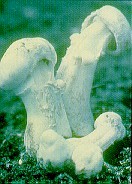
Symptoms of this disease include a degeneration of the
mycelium, suppression of fruiting, and rapid dying of mushrooms.
In time, the mushroom mycelium disappears. Infected mushrooms are
off-white and drum-stick shaped. Other fruitbody symptoms include
dwarfing, premature opening of veil, development of an elongated
spindly stem with a small cap, formation o f a thickened stem with
a thin flat cap, and malformed or absent gills. Mushrooms should
be picked before the veil opens since spores may carry virus
particles (75% infection rate of spores from infected mushrooms).
Pasteurization of wood after the compost has been removed is
essential. Initial sources include infected spores or mycelium in
or on wood, compost, casing, people, and equipment. Wood should be
cleaned, disinfected, and steamed. The virus may enter a mushroom
farm from neighboring farms and from wild mushrooms. Controls
include pasteurization (145 F for 6 or more hours) of compost,
spawn, equipment and empty rooms), cleaning HEPA filters, and
general sanitation. In 1962, Hollings first identified viruses in
mushrooms, also the first report that fungi had viruses. Another
virus with a lipid membrane is found in all hybrid spawn; its
effect is unknown. PCR is now used by makers of spawn for early
detection of viruses. An outbreak of viruses on a farm can be
devastating.
Symptoms of infected Button mushrooms include curved stems
surrounded at the base by an overgrowth of mycelium. Internally,
stems have water-soaked, longitudinal streaks. Caps are tilted and
dwarf. Tissues become spongy and dry (mummified). Sanitation and
reducing free water are control measures.
Symptoms include malformed mushrooms with swollen stipes and
reduced or deformed caps. Undifferentiated tissue becomes necrotic
and a wet, soft rot with an offensive odor may follow. An amber
liquid appears on infected mushrooms. Mushrooms become brown in
color. Bubbles may be as large as a grapefruit. The fungus is
spread via airborne dust and contaminated casing. It is also a
parasite of wild mushrooms. Controls include sanitation and in
some countries the use of the compound Sporogone, which is also
very effective against Verticillium. Wet bubble is the most
important Button mushroom disease in China.
Dry Bubble –Verticillium
This disease is caused by Verticillium, a species which
produces sticky spores. The symptoms produced vary with the
developmental stage of the mushroom at the time of infection.
'Early' infection at pin head formation results in the production
of malformed pin heads, which turn a grey/brown colour and remain
leathery. Infection at a later stage causes a thickening of the
stipe especially at the base, and also a crooked mushroom with a
tilted cap and backward peeling stalk. Cap infection can occur at
a very late stage in the development of the mushroom, resulting in
circular superficial spots, initially pale brown in colour which
become grey with age.
Verticillium sp. commonly occur in the soil which may be a
primary source of the infection, however, it is more likely that
they come with casing or by transfer of infection from house to
house by pickers, flies or machinery. Spores can lie dormant until
they come into contact with mushroom mycelium which stimulates
them to grow. Because the spores are sticky the disease is
spread on dust particles from the movement of earth or spent
compost. This dust can contaminate fresh casing, or can enter
through fans or doorways or be carried in by flies, pickers or
even mites. The disease within the production house can be
spread by water splash. The spores can also be spread on any other
equipment used in an infected growing house. Appearance of the
disease at pin head formation signifies infection at an early
stage of development, probably at the time of casing. Development
of the disease at later stages of the production cycle usually
indicates infection has occurred from other cropping houses or
from outside sources. Spread by water, flies and pickers can
result in 30% of the crop being infected at the third flush and by
the last flush virtually all of the crop. The highest standards
of hygiene are essential for the control of Verticillium. Other
methods of control are as follows:
Control: 1. Avoid soil movement near mushroom houses
especially on windy days. Take measures to avoid the accumulation
of dust in the vicinity of mushroom houses and also dust movement
into the vicinity of mushroom houses. 2. It is essential to
control flies and every effort should be made to prevent their
entry into cropping houses. 3. As diseased mushrooms appear
they should be removed from the beds using a cloth or sponge
soaked in disinfectant and then placed in a bucket containing
disinfectant. 4. Table salt on top of tissue paper can be used
to contain disease.
Fungus gnats (Sciarids) (Lycoriella spp.) and phorids
(Megaselia spp.)
Adults are small (1/8 inch long), fragile grayish to black
flies with long, slender legs and thread-like antennae. Their
wings are clear or smoky-colored with no pattern and few
distinct veins. Larvae are clear to creamy-white and can grow to
about 1/4 inch long. They have shiny black head capsules.
They are attracted to the mushroom crop and their larvae
feed directly on mycelium, swarm over the mushroom, and tunnel
into the developing or developed mushroom. Tissues that have
been physically damaged by flies often become colonized by
bacteria which cause soft rot, thereby accentuating the problem.
Controls include strict sanitation and general farm hygiene. For
example, the grow room must be air tight. Fresh air that is used
is filtered. Even a small crack will serve as an entry for the
flies. Most farms use sticky tape or some other method that
allows monitoring of populations. A biocontrol using nematodes
offers effective control when populations of flies are low. In
addition to the damage which fly larvae cause by eating mushroom
mycelium or killing pins, the adults also carry diseases such as
Verticillium, Mycogone and Cobweb.
;
Mites
Many mites are commonly found in straw and manure, most species
are beneficial to mushroom growing as they feed on eelworms and
other mites, although some can cause damage. Mites, like fly
larvae, may feed on mushroom mycelium and on the mushrooms, where
they can cause surface discoloration. They may also live on other
fungi (weeds and indicator molds) found in mushroom culture. One
example is the red pepper or pygmy mite (Pymephorus spp.).
These mites are commonly associated with Penicillium and
Trichoderma molds, upon which they feed. Pygmy mites do not
feed on Agaricus. These mites have the ability to change into
an intermediate stage called a hypopus, wherein they develop
flattened bodies and a sucker plate with which they attach to moving
objects, like flies. Mites at this stage swarm on top of
mushrooms.
1. Tarsonemid mite
These mites are pale brown and are so minute that they are
only visible with the aid of a microscope. They cause damage
by feeding entirely on hyphae of mushrooms and the grower will
know if he has these mites present, as the base of the stem of
the mushroom will show a reddish brown discolouration. Where
severe infestations occur the whole base of the mushroom may be
detached from the growing surface.
Control 1. As with eelworms little can be done when mites
are present in the growing house, therefore efficient composting
and peak heating must take place to ensure that they are killed
during the pasteurisation process. 2. Good hygiene should be
practised around the farm, especially in the clearance of crop
debris.
2. Tyroglyphid mites (Tyrophagusspp)
These mites can be identified as they are slow moving,
translucent, with long hairs on their bodies.
If these mites are present in abundance they eat small pits
in the caps and stalks. These pits then suffer from bacterial
decomposition, which breaks down tissues just below the surface.
This results in the skin collapsing which leaves an open pit.
Tyroglyphids may also feed on mushroom mycelium, where they are
present in large numbers, crop reductions can be
caused. Mites usually gain entry into the compost by clinging
onto Sciarid flies when the mites are the migratory stage. These
migratory stages are normally produced when mites become
overcrowded. The mites should not be a problem where
efficient composting and peak heating takes place. Organic
debris should not be allowed to accumulate around the farm as it
provides a breeding ground for mites.
3. Red Pepper Mites (Pygmephorous spp)
These mites are not regarded as primary pests, their presence
is usually an indicator that Trichoderma (green mould) is
present in the compost. These mites feed on various weed moulds
but not mushrooms, thus their presence indicates that the
compost is unsatisfactory. The mites are yellowish-brown in
colour, 0.25 mm in length and have a flattened appearance, they
also are capable of rapid rates of reproduction. As already
stated these mites are secondary pets and they often swarm on
the casing and mushroom surfaces. Where this happens their
presence makes the mushrooms unsaleable. These mites can also
spread spores of Trichoderma from bag to
bag.
Nematodes – Aphlelenchoides composticola and
Ditylenchus myceliophagus
These nematodes are common inhabitants of most agricultural
soils. Symptoms include a degeneration of mushroom mycelium and
failure of mushrooms to form. Normally, an infestation is noticed
at the time of third break. Mycelium in affected areas is
completely destroyed and as the compost decomposes, it turns black
and a medicinal odor is detectable. An effective Phase II is the
primary control.
Abnormalities
Several disorders have abiotic origins. Common ones include:
Browning – tyrosinase (phenolase) is the main enzyme
responsible for browning in Agaricus. Calcium chloride in
irrigation water decreases bruising by increasing the integrity of
vacuole membranes (thus, tyrosinase is not released).
Flock, hardcap, and open veil physiologically
induced malformation of cap and gill tissue. Cap opens
prematurely. Causes include some diseases, petroleum based
materials, and genetic abnormalities. Hollow core and brown pith –
related to water stress, but exact factors unknown. Long stipes
and small caps – insufficient light and/or fresh air.
Rosecomb condition where pink gill tissue, often with
a porous appearance, develops on the surface of a mushroom cap.
The cause has been attributed to contamination by petroleum based
materials.
Scaling the natural reaction of the mushroom cap to
dry air.
Stroma dense mycelial growth without fruiting.
Stroma occurs if spawn is mishandled or exposed to harmful
petroleum-based fumes or chemicals. It also occurs in dry
environments.
Weepers mushroom exudes water from cap. The cause is
not known, but it is seen in low-moisture compost and
high-moisture casing.
axonius meant to say that people in Brazil consider the Shroomery
the reference for Mushroom related stuff.....we at SiB
(www.shroomsinbrazil.org) often use the info here to help us out in
the FAQs and doubts....