 |
| Source: Backyard Chickens, Corny Caleb NJ Mar 26 2014 |
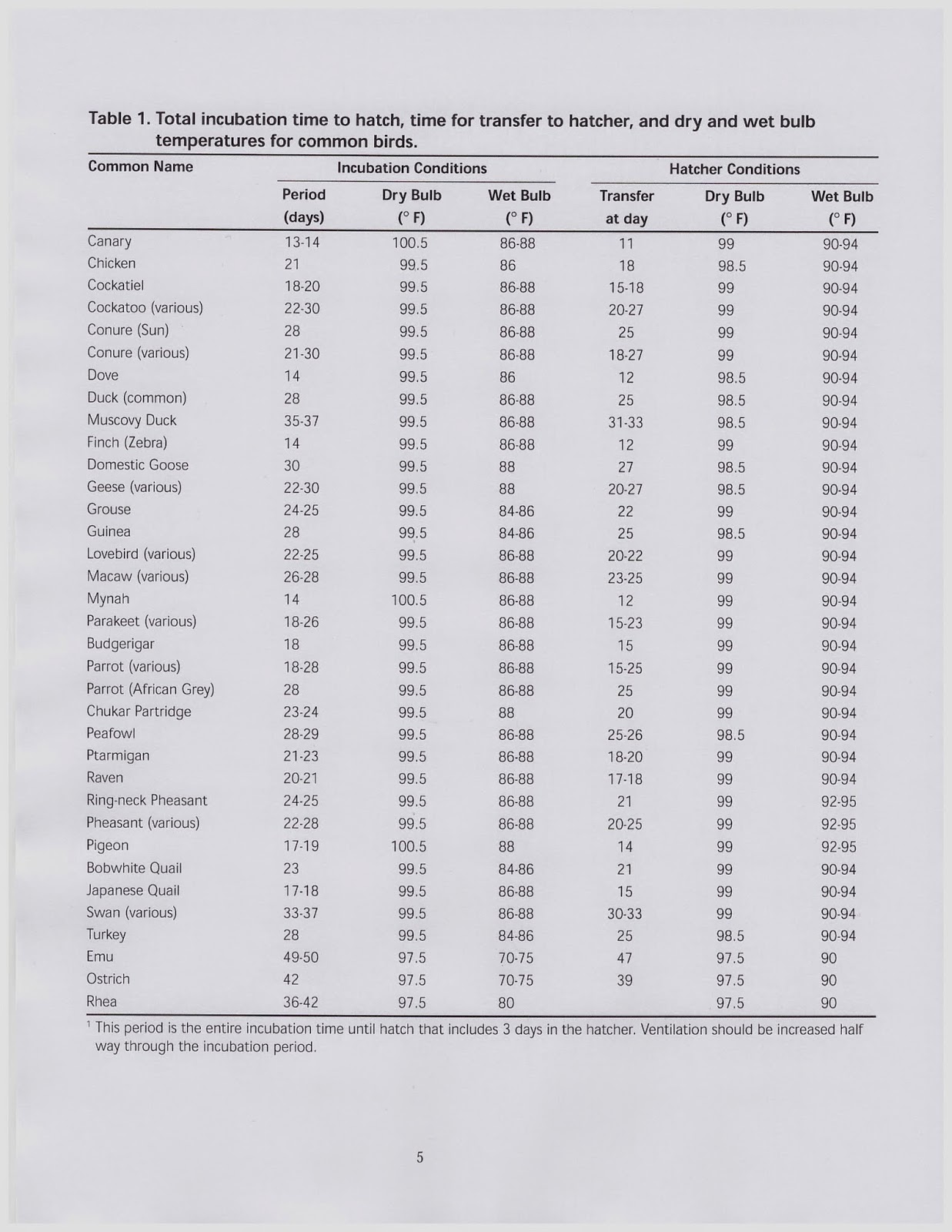
The first principle is to maintain a constant temperature throughout the incubator. Emu eggs are incubated best at temperatures between 97.0F-97.5F ( see chart 1 below). This will allow for healthy embryo development and a usual hatch time of about 50-52 days. Commercial incubators allow for even air temperature to be circulated around all the eggs from top to bottom. Other styles that have a fan located at the top of the units might require homemade defectors on the glass at the front to redirect warm air evenly to the bottom shelves. It is a good idea regardless of how sophisticated the incubator to have at least a couple of additional thermometers monitoring the inside temperatures. High temperatures during incubation cause more harm than low temperatures.
 |
| www.thermoworks.com RT8100MAT |
Access to a generator is a must if
power outages are a possibility and a supply of spare parts for the incubator
ensures quick reaction time.
The second principle is to maintain constant fresh air exchange in the incubator room and hence in the incubator itself. As the emu eggs incubate they expel carbon dioxide which needs to be exhausted from the incubator. Fresh air can be brought in passively through a cracked window from the outside avoiding a direct draft to the incubator air intake.
 |
| www. titancontrols.net Apollo 7 - 24 Hour Digital Timer |
We use a ceiling exhaust fan to circulate the air and exhaust the CO2. One that has a timer will give the flexibility to adjust for local outside weather conditions. We use the one pictured here from Home Depot.
The third principle is to adjust humidity when required.
 |
| Air In....... Moisture Out |
As the emu embryo develops moisture from inside the egg is
expelled through the pores in the shell. The air coming in weighs less than moisture
going out so the emu egg will decrease in weight. The ideal rate of weight loss for emu eggs is15% of the original egg weight for successful hatch. This weight loss can be
monitored and is the measurement most commonly used by emu farmers.
As the
weight loss (ie evaporation rate) is determined adjustments to the humidity
conditions in the incubator can be made to speed up or slow down the developmental
process.
In summary:
In summary:
- When the air cell growth is too slow then the evaporation rate in the egg is too low and can be identified as a slower than ideal rate of weight loss.
- When the air cell growth is too fast then the evaporation rate in the egg is too high and can be identified as a faster than ideal rate of weight loss.
- So the goal is to maintain the egg weight loss at an ideal of 15% and within a range of 13-17%. At 10% weight loss (or 20% on the other end of the scale) the conditions for proper chick development are severely jeopardized.
 |
| Click image to enlarge |
A. Measuring weight loss
Good record keeping is the key to this process. As each egg
is collected from the nest its breeder pen ID is noted on the egg with a china marker ie 3/mar 4 means breeder pen 3 and lay date of March 4. When ready to
incubate a batch each egg is weighed and recorded on the shell of the egg as
well as on a paper/computer record for future comparisons. An accurate scale is
necessary when weighing incubating eggs. It must be able to measure in tenths
of a gram rather than in pounds.
A simple set of formulas is applied to the weight of each
egg. To monitor a 15% weight loss progress use the following example:
·
original egg weight of 641g
·
2nd day egg weight of 637g
·
total length of incubation is 50 days
Start Wght Predicted
Final Wght Predicted
Daily Wght Loss Actual Wght
Loss
641g 641–(641 x .15)=545g (641
x .15)/50 days=1.9g (641-637)/2 days=2.0g
Some emu farmers weigh their eggs every day for the first week to ensure the ideal weight loss and then randomly for the remainder of the hatch. Others measure every week for the first 3 weeks. As critical embryo development occurs in the first third of the hatch it is this farmer’s opinion that the first option is the safest.
Some emu farmers weigh their eggs every day for the first week to ensure the ideal weight loss and then randomly for the remainder of the hatch. Others measure every week for the first 3 weeks. As critical embryo development occurs in the first third of the hatch it is this farmer’s opinion that the first option is the safest.
B. Measuring the humidity in the incubator
 |
| http://www.forestry-suppliers.com/ Taylor® Mason’s Hygrometer |
Emu eggs develop best at humidity readings between 24 and
35% (see charts 1 & 2 below). These conditions are a little more flexible than temperature readings and
can be adjusted.
Incubators frequently have digital readouts to show the humidity
conditions under which the eggs are incubating. To back up this technology we
use a manual system with the aid of a hygrometer. Hygrometers measure dry and
wet bulb temperature conditions. We use the Taylor version.
 |
| Source: aggie-horticulture.tamu.edu lee-cartwright-incubating-and-hatching-eggs.pdf |
Chart 1 to the left explains the ideal conditions for incubating emu eggs. The hygrometer should read 97.5 deg dry bulb and 70-75 deg wet bulb. To enlarge this chart click on it, search for the pdf and the information is on page 6.
Chart 1 to the left explains the ideal conditions for incubating emu eggs. The hygrometer should read 97.5 deg dry bulb and 70-75 deg wet bulb. To enlarge this chart click on it, search for the pdf and the information is on page 6.
 |
| http://www.berryhill.ca/ |
Chart 2 to the right then converts those ideal dry and wet bulb readings to the % humidity range of 24-35.
So if the emu egg weight loss is out of spec ie below 13% (1) or above 17% (2) the incubator humidity is:
(1) lowered closer to 24%
(2) raised closer to 35%
There are other options available if raising or lowering humidity is not getting the results that you need:
There are other options available if raising or lowering humidity is not getting the results that you need:
(1) move the egg away from the humidity source, dehumidify
the incubator room, move egg(s) to another incubator with a lower humidity setting
(2) tape off (using electrical or duck tape) some of the
pores on the shell, humidify the room
The fourth principle is to turn eggs (in a rocking motion) through 180 degrees frequently per day.
In the natural setting a male emu will move the eggs that he is incubating many times during the day. This instinct ensures proper contact by the embryo with the food material contained in the egg. In artificial incubation conditions the egg must be rocked back and forth through 180 deg. It is never fully turned through 360 deg. as this will disorient the growing chick. Ideally this rocking is done as frequently as every two hours to a minimum of 3 times in 24 hours so that the egg isn't in the same position through the long period at night.
Well that's a lot of detail to digest. Keep in mind that there are just four main principles to successful emu egg incubation.
Three of them are defined:
The fourth principle is to turn eggs (in a rocking motion) through 180 degrees frequently per day.
In the natural setting a male emu will move the eggs that he is incubating many times during the day. This instinct ensures proper contact by the embryo with the food material contained in the egg. In artificial incubation conditions the egg must be rocked back and forth through 180 deg. It is never fully turned through 360 deg. as this will disorient the growing chick. Ideally this rocking is done as frequently as every two hours to a minimum of 3 times in 24 hours so that the egg isn't in the same position through the long period at night.
- temperature holds at 97.0-97.5 degrees
- constant fresh air needs to be available
- eggs need to be rocked through 180 deg (not 90 deg as with other eggs)
Incubating emu eggs is not a difficult process but does require attention to detail and good equipment and record keeping. Good luck with your endeavours and enjoy the rewards!
 |
| Source: Wikipedia |

Amazing explanation!
ReplyDeletedo you increase the humidity towards the end of the hatch
ReplyDeleteFrequently asked question Loretta, thank you. No we do not increase the humidity towards the end of the hatch. The internal membrane in emu eggs is thick and if the humidity is increased it becomes elastic and difficult for the chick to puncture. We in fact lower the humidity by 5% at lock down (49 days) and throughout the hatch.
Deletenice
ReplyDeleteThanks for this, I was recently given 5 Emu eggs. As I have been hatching duck, chicken and quail for years, I was asked if I could help out with these eggs. I knew nothing about emu eggs! But thanks to this, I have built an incubator to fit the eggs, humidity and temp are perfectly stable, and I am hoping for success! Thanks again, great info!!
ReplyDeleteGlad to be of help and good luck.
DeleteMy eggs are almost losing too much weight and I can't get my humidity down below 40 do you have any suggestions on how to get the humidity down
ReplyDeleteThe general rule is eggs that are loosing too much weight ie too quickly, are not getting enough humidity. In other words the air outside the egg is too dry and water inside egg is leaving the egg too fast for proper chick growth. 40% seems high for incubator humidity (if you trust your humidity instrument) so you might also try taping off some of the pores to minimize moisture loss.
ReplyDelete24 to 35% humidity??? The breeder I bought my eggs from indicated 45% humidity and online many articles say 45% humidity. So I don't understand your low humidity.
ReplyDeleteGreat question. The expert on emu farming since the early 1990s in the US is Maria Minnaar. She recommends this humidity range for incubating emu eggs. From her second book "The Emu Farmer's Handbook" pg 141 "The emu eggshell,... makes up almost 20% of the egg by volume (compared with the chicken egg, whose shell makes up only 10% of the egg). Emu eggs are usually incubated under much drier conditions than poultry eggs". Maria has two publications Vol 1 & 2 with the same name. They are interrelated and a must for any emu farmer's library in my opinion.
ReplyDeleteHello any tips on sexing Emu chicks? I have 2 due to hatch in 2 weeks! Im so excited 😀
ReplyDeleteOnly reliable way is to get feather DNA testing in our opinion. We use http://www.healthgene.com/avian-dna-testing/1306/feather-collection/
ReplyDeleteI got an emu egg after the male got off the eggs when something disturbed him I am not too sure how many weeks he had been sitting If the egg got cold for 24 hours would the chick have died? Or is it possible to still hatch the egg in an incubator?
ReplyDeleteThanks for your question. Emu eggs are very resilient with 7 layers of protection. As you would expect the overnight temperature will be a factor however, if only 24 hours of exposure I would definitely try incubating the egg. Good luck.
DeleteThis comment has been removed by the author.
ReplyDelete