Cheese of Antiquity
by Lady Katerina Owcza Kobieta
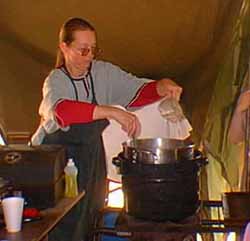
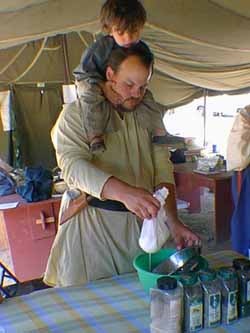
Lady katerina adding rennet
 |
To give you an idea of how old the art of cheesemaking is, the
history books tell us that man must have known about making cheese
before he invented writing. A Greek historian named Zenophon, born in
349 B.C., wrote about a goat cheese that had been known for centuries
in Peloponnesus. I've read that the oldest cheese is the Arabian Kishk
which was made from coagulated goat's milk and then dried. This is
probably the cheese that David carried with him when he heard about
Goliath.
It's interesting to speculate how cheese might have been
discovered. Most have heard the story about the nomad who poured the
milk for his midday meal into a bottle made from a sheep's stomach, and
set out on his journey across the desert. When he stopped for lunch and
tipped the skin to drink the milk, he discovered solid chunks, and
instead of the white milk, a yellowish liquid. The rennet from the
lining of the stomach had curdled the milk, separating it into curds
and whey.
More about cheese ....
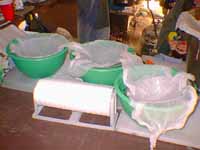
Cheese cloth ready for the curds and whey
 |
The first step in cheesemaking is to coagulate milk solids
into a curd. The two basic ways of doing this are acid coagulation and
rennet coagulation. Each way has many variations, and sometimes both
methods are used in combination to produce varieties of cheeses.
You can cause acid coagulation either by adding an acid such
as vinegar or lemon juice, or by adding a bacterial starter culture
which turns the lactose (milk sugar) into lactic acid. When adding
vinegar or lemon juice, the important thing to remember is that the
lower the temperature, the more acid is required to coagulate the milk;
the higher the temperature, the less acid is required. When a starter
culture is added to milk at room temperature, the bacteria consume
lactose and produce lactic acid as a byproduct. Over a period of time,
the starter bacteria produce sufficient lactic acid to coagulate the
milk.
Rennet is an enzyme that coagulates warm milk and causes the
cheese curds to form. Although enough acidity alone will coagulate
milk, rennet helps speed the curding process and forms a stronger,
firmer curd.
It is important to develop the proper amount of acidity in the
milk. The lactic acid that the bacteria produce helps the rennet
coagulate the milk, aids in expelling the whey from the curds, and
helps control the growth of pathogens (bad bacteria) in the finished
cheese. This starter culture is also responsible for much of the flavor
development in aged cheese. In cheese made from raw milk, it's common
to use no additional starter culture at all, relying instead on the
lactic bacteria normally present to ripen the milk and depart a
characteristic flavor. Milk that is increasing in acidity due to
starter activity is refered to as "ripening," and milk that has reached
the proper degree of acidity is considered "ripened."
When the milk has ripened for the proper amount of time and is
still at the right temperature, it is time to add the rennet. The
diluted rennet is stirred into the milk and allowed to set undisturbed
until a solid curd is formed. A curd is considered "set" when a finger
(or dairy thermometer) can be inserted into it, and the curd breaks
cleanly all around as you lift sightly. Then the curd is cut or handled
according to the directions for the cheese you're making.
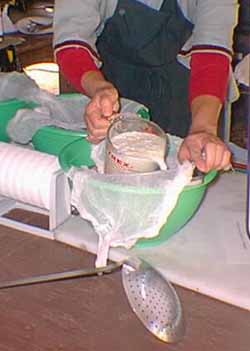
Seperating the curds and whey
 |
More about bacterial starter cultures ...
There's a great variety of starter cultures that produce an
enormous selection of cheeses. Starter cultures are combinations of
dairy bacteria introduced into the milk to help produce the flavor of
the cheese. They are classified as either mesophilic or thermophilic.
The mesophilic, or moderate temperature, bacteria are used when the
curds aren't going to be warmed to over 102 degrees Fahrenheit. This
would include cheeses such as cheddar and Gouda. Thermophilic bacteria
can withstand greater temperatures and are used when heating the curds
as hot as 132 degrees F. The bacteria responsible for producing Swiss
and Italian cheeses fall into this category.
As an example, mesophilic cultures include streptococcus lactis, streptococcus cremoris and streptococcus diacetilactis. Examples of thermophilic cultures would include streptococcus thermophilis and lactobacillus bulgaricus.
For most home cheeses, we can utilize store-bought cultured buttermilk
as a source for mesophilic cultures, and cultured yogurt as a handy
source of a thermophilic culture.
More about rennet ....
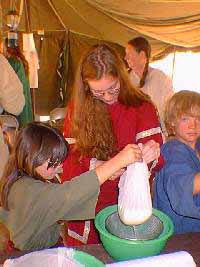
Everyone gets into it
 |
Rennet is available as both animal and vegetable derivatives.
Rennet that is an animal derivative contains an enzyme called rennin
and is found in the fourth stomach of calves, lambs, kids and similar
animals. Today, calf rennet is the most readily available animal
rennnet. Vegetable rennet is an enzyme derived from the mold mucor
miehei. Both animal and vegetable rennets are marketed in tablets or
liquid form. The tablets are easier to store and keep longer than the
liquid, but the liquid is easier to measure accurately. Both should be
stored in the refrigerator and kept away from long exposure to light.
Vegetable rennet may be preferred by some people, but calf rennet will
produce the highest quality cheeses.
Both animal and vegetable rennet were used in ancient times.
From what we know from obscure references, in some areas plants were
the chief agents used to clabber milk. After a time these methods
gradually fell into disuse, until by now they are almost totally
forgotten.
There are a number of plants that have coagulating properties.
In ancient Rome, cheesemakers used an extract made from the bark of the
fig tree. Zeus was supposed to have eaten a cheese made by coagulating
milk with fig juice. Rumor has it that once upon a time farmers in
northern Europe would feed a plant called "butterwort" to their animals
just before milking time. It was believed that this would cause the
milk to automatically coagulate within a few hours after milking. The
flower of the thistle plant (cynara cardunaculus) is used in Portugal to make sera de estrella cheese.
One plant that can be used for a rennet is stinging nettle (urtica gracilis).
To make, boil a pound of stinging nettle in just enough water to cover
for twenty to thirty minutes. Strain off the liquid and add as much
salt as will dissolve with agitation. With home-brewed extracts, it's
difficult to know how much of the infusion to use because of the
variability of its strength and the milk's acidity. A good starting
point would be one-half cup of nettle infusion per gallon of milk.
Note: the high salt content of this type of infusion makes it
unsuitable for cheeses that are ripened a significant length of time
after the rennet has been added because the salt inhibits the ripening
characteristics of the curd. It will work best for cheeses that are
salted shortly after the curd has formed, and less salt will be needed
during the salting step.
The dried flowers of the cardus species of sunflowers can also
be used. Dry the blossoms and grind them to powder with a mortar and
pestle. Dissolve a couple of teaspoons of the powder in one-half cup of
water, then add the infusion to the milk the same as if using a rennet
solution.
Papain and bromelin from papaya and pineapple have been used,
but with inferior results. There are various other microbial sources of
substances that seem to do a fairly good job, but they are not yet of
practical interest to the home cheesemaker. Regular rennet from animal
sources seems to be the most effective, both as far as the quality of
the curd and in the curd's ability to expel the whey.
Before the days when modern laboratory technology produced a
standardized rennet, most cheesemakers made their own on the farm. When
they slaughtered a lamb, calf or kid, they cleaned and salted the
stomach and hung it up to dry. Then it was stored in a cool place, and
at cheesemaking time, they broke off a small piece of the dried stomach
and soaked it in cool water for several hours. Then they added a bit of
the solution to the ripened milk to produce a curd.
Another farm method involved the stomach of a calf or a kid
slaughtered at not more than two days old. The stomach would contain
milk with a high percentage of colostrum. This first milk was carefully
removed, and set aside while the stomach was thoroughly cleaned inside
and out. Then the colostrum was returned to the stomach which was
sealed and hung in a cool place to age. The colostrum would set into a
lard-like substance, which would then be cold stored in a tightly
covered container. A "thumbnail's worth" of this paste would be used to
set two gallons of milk. Some folks also added some finely grated
cheese to the colostrum as it was returned to the stomach to age. This
produced a finished rennet that was culture and coagulant all in one.
Another variation on this theme requires a young animal that
has been milkfed only. After slaughter, the stomach is removed and
treated so that it will not be exposed to flies and bacteria while
drying out. The ancient way was to just roll the stomach in the ashes
of a campfire since the lye in the ash would prevent fly eggs from
hatching. Once it was thoroughly covered in ash, it would be hung up
somewhere safe to dry. Once fully dried, the stomach was taken down and
opened up. The milk, which by now has been reduced to a brownish
powder, was collected and stored as a source of rennet. It's important
to store this type of rennet in a cool place, since heat will cause the
enzyme to break down.
Take a teaspoon of the brownish
powder and grind it thoroughly. Remove an eighth teaspoon and put it in
a cup. Add a drop of water and mix it in. Keep adding drops of water,
one at a time, until you have a thick paste. Add lukewarm water to
dissolve the paste, just as you would when using a commercial rennet
tablet. This will produce enough rennet to coagulate 8 to 12 gallons of
milk.
One student gets the best view
 |
FETA
Feta is a heavily salted cheese which has its origins in the
mountains of Greece and was made from sheep or goat milk. Its
manufacture is quite similar to queso de cabra which is
probably the most ancient true cheese. It is very likely that this is
just a variation of that same cheese passed down from generation to
generation from ancient times, and then preserved by the mountain
shepherds of Greece. To this day, it remains the staple cheese of these
people. It is a soft cheese which is ready to eat in a week, but can be
stored in a cool place in a brine solution for a month.
As might be expected for a cheese made in relatively primitive
circumstances, it is easy and fast to make. No starter is needed since
fresh, raw milk is used, but adding a small amount of cultured
buttermilk to the warm milk will help develop some acidity and add
flavor to the cheese. The temperature of the milk should be between 86
and 90 degrees F. and should not be allowed to go below 86 degrees at
any time during the process. This process works best on a warm day,
with milk fresh from the goat.
To make feta cheese, start with 2 gallons of fresh, whole goat
milk still warm from the morning milking. Add 1/2 cup cultured
buttermilk and stir. Allow to ripen for 1 hour.
Dissolve 1/2 rennet tablet (or one teaspoon liquid rennet) in
1/2 cup cool water. Stir gently into the milk for about 2 minutes.
Cover and allow to set for 1 hour. This will form a solid curd.
Cut the curd into 1/2 inch cubes. Allow to set undisturbed for
10 minutes; then gently stir the curd for 20 minutes. During this
process, the curds firm up and express the whey.
Line a colander with cotton muslin cheesecloth. Pour the curds
into the lined collander. Tie the four corners of the cheesecloth into
a knot and hang to drain for 4 hours.
Take the bag down and slice the curd into 1 inch cubes. Place
the cubes in a bowl or crock and sprinkle with 4 to 6 tablespoons of
coarse flake salt making sure that all the cubes are covered with salt.
Cover bowl and allow to age in the refrigerator 4 or 5 days.
If a stronger flavored cheese is desired, store the feta in a
brine solution in the refrigerator for up to a month. The brine
solution is made by adding 1/3 cup of coarse salt to a 1/2 gallon of
water.
Index for Notes
----
The Home Page


