10 - Ritual Magick
Ritual magick is no different from any other activity that you may carry out in a systematic way. Yes, it is true, it is more formal than folk magick: you are using special tools and following a series of preordained steps based on traditional practice. But this does not mean that it has to be so complicated as to be beyond the capabilities of any normal person. You do not need special powers; and the preparation is just the same as you would do if you were redecorating a room, servicing your car or preparing your annual accounts.
When you decide to do any of these tasks, you set out the necessary equipment in advance, so you are not constantly dashing off to find what you need. You check that it is all in working order and you probably consult a reliable reference book, computer software or calculator to clarify the necessary stages and finer points of the method. And that is exactly what preparing for ritual magick is like.
First, you need to collect any relevant information; for example, you must find out which tools, herbs, candle colours, etc. you may require. Then you must check that your magical tools are charged with power. You must check whether the hour and the day are well chosen to benefit from the energies and are most aligned to the focus. If you are working with a group, you must decide in advance who is to carry the salt and other elemental substances round the circle, who will perform particular parts of the ritual, such as welcoming the Spirit Guardians.
This preparation is important, although, as I have previously said, many of the words and actions in the best rituals remain spontaneous within the basic framework. You do not even need to belong to a coven to create beautiful rituals. Indeed, practising alone, you will find that as you increase in confidence, the natural rhythm of the ritual cycle will amplify your own innate powers and you will feel angelic or devic forces joining with you as you walk around the circle and hear their voices mingling with your chants.
You should not allow yourself to be overawed, as I have been in the past and still occasionally am, by books and practitioners who vaunt their knowledge of obscure magical phrases, measure their circles down to the last millimetre and insist that only their form of working is authentic.
What matters is the actual connection you make in your ritual with the storehouse of natural and higher energies - and that can be done with a kitchen candle if the need is great and the intention pure. Ultimately, the power is within you, and as you become skilled with magick, you may find that the external form becomes less important.
However, formal magick does have its place, for a special need or for raising spiritual awareness, or for focusing magical energies through the accumulated power of tools charged and regularly used for positive purpose. Some people believe also that in ritual you tap into the energies of all those before you who have created circles of power and protection, and within them have raised and called upon the elemental qualities to bring desires and needs from the thought to the material plane.
The Aims Of Formal Rituals
Rituals and spells at all levels cause a positive change or effect, whether for oneself, a loved one or the whole ecosystem, as they bring healing, peace, reconciliation or whatever is needed in the spell-caster's life. But over and above all these is the purpose of raising one's own levels of awareness so that perhaps for a few moments you feel connected to a higher power, perhaps even the source of divinity, and this is best expressed though the more ceremonial forms of work. The awareness you attain may be experienced as a sense of deep peace, of being filled with golden light, of floating through clouds or a certainty of being loved and protected, perhaps even as a glimpse of a Divinity.
Formal rituals do not have to be focused on a particular aim, however. Sometimes, you may wish to carry out a ritual without having any specific purpose in mind. In this case, you can simply cast a circle and raise the energies gently through a natural focus of herbs, flowers or fruit, allowing wisdom to be channelled through you and then giving thanks for blessings received as you close the circle.
The Tools Of Ritual Magick
Formal ritual magick requires its own special tools. These may be real or symbolic.
The list I give here is intended only as a guide: some of these may not be relevant to your own way of working. I have listed the areas of the circle in which each tool is traditionally placed. There are many sources of magical tools and, as I mentioned in the section on spells, you may already have a number in your home. You do not need to spend a great deal of money unless you wish, but I would suggest that you take time in finding the right items. Even if you work in a group, you may like to build up a set for your own personal work.
Some people prefer to make their own magical tools and this certainly does endow them with energies. I have suggested books that tell you how to make your own candles for special ceremonies and even your own knife. Woodcarvers are an excellent source for small staves suitable as wands and will often make items to order. In time, you will build up a collection of items and by personalising and charging them, you make them not only powerful, but also your own.
Keep your magical tools in a special place, separate from your everyday household items, wrapped in a natural fabric. You can buy excellent hessian bags and may wish to keep fragile or items that will scratch in separate ones. You can also use silk. Secure your bags with three protective knots.
You may have heard various warnings about needing to destroy charged tools on the demise of the owner, and the dire consequences of their being touched by any outsider. This is real late-night-cinema stuff. But common sense dictates that you should not leave knives, sharp wands, etc. where children might harm themselves and on the whole it is better to keep magical items away from the curious and the sceptical.
There is really no reason why you should not use your kitchen knife for cutting vegetables and then, after a quick purification in water or incense, chop herbs in an impromptu spell, or open your circle with it. But on the whole it is better to keep a separate knife for your special ceremonies.
I believe that even formal tools are like electrical devices that are lying unplugged and unused: they contain the potential to help or harm only if misused. What is more, without your personal vibes, which act as your password, the power cannot flow; you have not created an independent life form.
The following tools are commonly used in formal magick.
The Athame
An athame is, quite simply, a ceremonial knife. It is one of the ritual tools that entered the tradition through the influence of magicians and witches who set out the wisdom, mainly at the beginning of the twentieth century and in the upsurge of covens during the 1950s. Gerald Gardener, one of the founding fathers of Wicca, considered ritual knives and swords of prime importance in modern formal witchcraft.
You can obtain an athame from a specialist magical shop, but as I said before, any knife - even a letter-opener - will do, although it should preferably have a silver-coloured blade. Athames are traditionally double-edged and black-handled, but a single-edged blade is better if you are new to magick, to avoid unintentional cuts.
There is a vast array of scouting and craft knives available, with black wooden handles on which you can engrave magical symbols such as your zodiacal and planetary glyphs with a pyrographic set obtained from an art shop. You can also paint moons, stars, spirals, suns, or crosses with silver paint. I use a curved-bladed knife with a silver engraved scabbard, which I bought from a souvenir shop in Spain.
The athame is set in the East of the altar and represents the element of Air. Like the sword, it is traditionally used for drawing magical circles on the ground and directing magical Air energies into a symbol. When you are casting a circle, you can point your athame diagonally towards the ground, so that you do not need to stoop to draw (which is not very elegant and bad for the back). With practice, the movement becomes as graceful as with a sword.
The athame can also be used as a conductor of energy, especially in solitary rituals, being held above the head with both hands to draw down light and energy into the body. This uses the same principle as that of arching your arms over your head to create a light body as described on page 124. One method of releasing the power is then to bring the athame down with a swift, cutting movement, horizontally at waist level, then thrust it away from the body and upwards once more to release this power. If others are present, direct the athame towards the centre of the circle. After the ritual you can drain excess energies by pointing the athame to the ground.
An athame may be used to invoke the elemental Guardian Spirits by drawing a pentagram (see page 203) in the air and for closing down the elemental energies after the ritual. With its cutting steel of Mars, it is effective in power, matters of the mind, change, action, justice, banishing magick, protection and for cutting through inertia and stagnation. The athame is sometimes also associated with the Fire element.
If you don't like the idea of a full-sized athame, there are some lovely paper knives in the shape of swords or with animal or birds' heads.
Some covens give each of their members a tiny athame, to be used for drawing down energies during ceremonies. The main athame is used by the person leading the ritual who may draw the circle, open all four quarters and close them after the ritual.
An athame with a white handle is used for cutting wands, harvesting herbs for magick or healing, carving the traditional Samhain jack-o'-lantern, and etching runes and other magical or astrological symbols on candles and talismans. Some practitioners believe that you should never use metal for cutting herbs but instead pull them up, shred them and pound them in a mortar and pestle, kept for the purpose. Pearl-handled athames are considered to be especially magical.
The Sword
Like the athame, the sword stands in the East of the circle as a tool of the Air element. Swords are the suit symbol of Air in the Tarot and are also one of the Christian as well as the Celtic Grail treasures. Each of the Tarot suits and the main elemental ritual items in magick, represented by these four suits, is associated with one of the treasures of the Celts. The treasures belonged to the Celtic Father God, Dagda, and are said to be guarded in the Otherworld by Merlin. There were 13 treasures in total, but four have come into pre-eminence in magick and Tarot reading.
These four main sacred artefacts - swords, pentacles, wands and cups, or chalices - have parallels in Christianity and were associated with the legendary quest of the knights of King Arthur, who attempted to find them. The Grail Cup was the most famous of these. The Christian sword of King David, identified in legend with Arthur's sword Excalibur, appears in Celtic tradition as the sword of Nuada whose hand was cut off in battle.
With a new hand fashioned from silver, he went on to lead his people to victory. According to one account, the Christian treasures were brought in AD 64 to Glastonbury in England by Joseph of Arimathea, the rich merchant who caught Christ's blood in the chalice as He was on the cross and took care of His burial after the crucifixion.
Some present-day, peace-loving witches, myself included, do not really like the concept of using swords, even though they are pretty spectacular for drawing out a circle on a forest floor, and swords are rarely used in home ritual magick. If you do want to use one, however, you can obtain reproduction ceremonial swords.
The sword is the male symbol to the female symbol of the cauldron, and plunging the swords into the waters of the cauldron can be used in love rituals and for the union of male and female, god and goddess energies as the culmination of any rite. However, the chalice and the athame, or wand, tend to be used for the same purpose, unless it is a very grand ceremony.
The Bell
The bell stands in the North of the circle and is an Earth symbol. It is an optional tool and can be made from either crystal or protective brass. Best for magick is the kind that you strike.
The bell is traditionally rung nine times at the beginning and close of each ritual; the person ringing the bell should stand in the South of the circle, facing North. (Nine is the magical number of completion and perfection.) It is also rung to invoke the protection of angels or the power of a deity and in ceremonies to welcome departed members to the circle. You can also sound the bell in each of the four elemental quadrants, before creating the invoking pentagram, to request the presence of each elemental guardian. It can also be sounded as you pass your chosen symbol around each quadrant of the circle. However, you should not use the bell to excess - it is better under-utilised.
The Broom
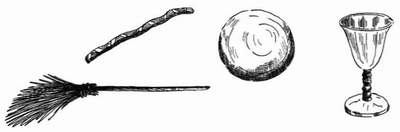
The broom, or besom, was originally - and still is - a domestic artefact. It represents magically the union of male and female in the handle and the bristles and so is a tool of balance. Brooms have several uses in magick. A broom is sometimes rested horizontal to the altar to add protection, and couples jump over one in their handfasting ceremony. Most important, you should use your broom to cleanse the ritual area before every ritual.
Brooms are easily obtainable from any garden centre (you want one in the traditional 'witches' broomstick' shape, not an ordinary brush). Brooms made with an ash handle and birch twigs bound with willow are traditionally recognised as being especially potent, being endowed with protective and healing energies. Some practitioners carve or paint a crescent moon at the top of the handle, others decorate theirs with their personal ruling planetary and birth sign glyphs entwined.
When cleansing the area for rituals, you might like to scatter dried lavender or pot pourri and sweep it in circles widdershins, saying:
Out with sorrow, out with pain,
Joyous things alone remain.
You can also sweep areas of your home such as uncarpeted floors, patio paths and yards to cleanse the home of negativity. Remember to sweep out of the front door, away from the house and eventually into the gutter, or if in you live in a flat, you can collect the lavender and dust in a pan and send it down the waste disposal unit.
You may also wish to cleanse the area further by sprinkling salt and pepper dissolved in water after sweeping. If you are working on carpet, you can use a very soft broom (some modern witches even hoover in circles widdershins and sprinkle the area with water in which a few drops of a cleansing flower essence, such as Glastonbury Thorn, has been added).
The broom is an Earth artefact.
The Cauldron
The cauldron is the one ritual tool that is positively charged by being the centre of domestic life and can replace the altar as a focus for less formal magick spells. If you can obtain a flameproof cauldron with a tripod, you can, on special occasions such as Hallowe'en, light a fire out of doors and heat up a brew of herbs and spices in the cauldron. When not in use, you can keep your cauldron filled with flowers or pot pourri.
If your circle is large enough, you can place your cauldron in the centre. Then, if you are working in a group, form your circle of power around it, so that the altar is within the outer consecrated circle and you make a human inner circle with the cauldron as the hub. If you are working alone, you can have your altar in the centre with the cauldron in front of it. Alternatively, you can have a small pot or cauldron in the centre of the altar.
Experiment with the different positions both for group and solitary work and walk or dance your way around to work out the logistics. Some practitioners do not use a cauldron at all.
In your rituals, you can light a candle in front of the cauldron, fill it with sand in which to stand candles, or surround it with a circle of red candles to represent Fire. Wishes written on paper can be burned in the candles. Water darkened with mugwort may be placed in the cauldron, especially on seasonal festivals such as Hallowe'en and May Eve, and white candle wax dripped on the surface to create divinatory images that offer insights into potential paths.
You can cast flower petals into the cauldron water to get energies flowing. For banishing, add dead leaves and tip the cauldron water into a flowing source of water. You can also burn incense in the cauldron if this is the focus of a ritual.
The cauldron is a tool of Spirit or Akasha, the fifth element.
The Chalice
The chalice, or ritual cup, used for rituals is traditionally made of silver, but you can also use crystal, glass, stainless steel or pewter. The chalice represents the Water element and is placed in the West of the altar. Like the sword, it is a sacred Grail treasure and is a source of spiritual inspiration.
The Grail cup is most usually represented as the chalice that Christ used at the Last Supper, in which His blood was collected after the crucifixion. As such, it signifies not only a source of healing and spiritual sustenance, but also offers direct access to the godhead through the sacred blood it once contained. Tradition says that the original Grail cup was incorporated by Roman craftsmen into a gold and jewelled chalice called the Marian Chalice after Mary Magdalene. In Celtic tradition, it became the Cauldron of Dagda.
In rituals, the chalice can be filled with pure or scented water with rose petals floating on top. I have also mentioned its ritual use with the athame in male/female sacred rites, as the symbolic union of god and goddess that has in many modern covens replaced an actual sexual union (that now tends to occur in privacy between established couples only).
The chalice is also central to the sacred rite of cakes and ale that occurs at the end of formal ceremonies - the pagan and much older equivalent of the Christian holy communion. The offering of the body of the Corn God is made in the honey cakes on the pentacle, or sacred dish, and the beer or wine in the chalice is fermented from the sacrificed barley wine. In primaeval times, actual blood was used to symbolise the sacrifice of the Sacred King at Lughnassadh, the festival of the first corn harvest. The rite goes back thousands of years.
The cakes and ale are consumed by the people acting as High Priestess and Priest in a dual energy rite or by those initiated in those roles. Crumbs and wine are first offered to the Earth Mother or poured into a libation dish (a small dish for offerings). Then the priestess offers the priest a tiny cake and then takes one herself and he offers her the wine before drinking himself. The dual roles work just as well in a single-sex coven. The cakes and ale are then passed round the circle and each person partakes of the body and blood of the Earth, offering a few words of thanks for blessings received.
In some groups each person has an individual chalice set before them, but everyone still drinks one after the other, offering thanks, unless there is a communal chant of blessing before drinking.
The chalice can be filled with wine or fruit juice or water, depending on the needs and preferences of the group.
The cakes and ale ceremony and the male/female chalice rite can both be easily incorporated into a solitary ritual.
The Pentacle
The pentacle is a symbol of the Earth and is familiar to users of Tarot packs. It is placed in the North of the altar.
It consists of a flat, round dish or disc, engraved with a pentagram within a circle. The pentacle has been a magical sign for thousands of years. The five-pointed star of the pentagram within it is a sacred symbol of Isis and the single top point is considered by many to represent the Triple Goddess.
You can place crystals or a symbol of the focus of the ritual or charged herbs on the pentacle to endow it with Earth energies. It can then be passed through the other elements or empowered by passing over the pentacle incense for Air, a candle for Fire and burning oils or water itself for the Water element. The pentacle can be moved to the centre of the altar once the symbol on it has been fully charged.
It is very easy to make a pentacle of clay, wood, wax or metal, and on it mark a pentagram with the single point extending upwards. This is what you might call the all-purpose pentagram - drawn this way it always has a positive influence.
You might also like to make a larger pentacle for holding the tiny cakes for the cakes and ale ceremony. You can find special recipes for these cakes in books I have suggested on page 301, but any tiny honey cakes will serve well.
The Wand
The wand is a symbol of Fire and should be placed in the South of the altar.
The wand is sometimes represented by a spear. Both the wand and spear, like the athame and sword, are male symbols. The spear, another Fire symbol, is not used in magick, except occasionally in the form of a sharpened stick in sacred sex rites, when it is plunged into the cauldron or the chalice as a symbol of the sacred union of Earth and Sky, Water and Fire.
The wand is traditionally a thin piece of wood about 50 centimetres (21 inches) long, preferably cut from a living tree (some conservationists disagree unless the tree is being pruned). After a strong wind or in a forest where trees are being constantly felled, it is often possible to find a suitable branch from which the wand can be cut. It should be narrowed to a point at one end and rubbed smooth.
You can make a series of wands from different woods for your ceremonies.
Ash is a magical wood, associated with healing and positive energies.
Elder wands are symbols of faerie magick and so are good for any visualisation work.
Hazel comes from the tree of wisdom and justice and is linked with the magick of the Sun. The wand should be cut from a tree that has not yet borne fruit.
Rowan is a protective wood and so is good for defensive and banishing magick.
Willow is the tree of intuition and is said to be endowed with the blessing of the Moon.
You can also use a long, clear quartz crystal, pointed at one end and rounded at the other, as a wand. In its crystalline form, especially, the wand is used for directing healing energies from the circle to wherever they are needed.
The wand is used for directing energies and for making circles of power in the air - hence the image of the faerie godmother waving her wand - deosil for energies to attract energies and widdershins for banishing. It can be used to draw pentagrams in the air at the four quarters and it can also be used for drawing an invisible circle when you are working on carpet or another fabric that cannot be physically marked.

In some traditions, the wand is a tool of Air and so this and the athame, or the sword, are fairly interchangeable. However, the wand seems more effective for casting and uncasting circles, invoking quarters and closing power. It is also particularly good for directing energies in rites of love, healing, fertility, prosperity and abundance.
Symbols Of Magick
Although you can carry out rituals using absolutely anything, you may like to create a special set of symbols for a variety of rituals. These you can keep in a separate box within your main store of magick artefacts so they do not get scattered or broken.
You may include a thimble to symbolise domestic affairs, a tiny padlock for security at home, a wooden toy boat for travel, a silver locket for fidelity, a key charm for a house, tiny painted wooden eggs for fertility in any venture - just to suggest a few. You can also use small fabric dolls to represent people, for example in a love spell.
Tarot cards also provide excellent symbols for magick: the Emperor for power, the Empress for fertility, the Ten of Pentacles for prosperity, the Lovers for romance, the World or the Eight of Wands for travel, Temperance for harmony, Justice for matters of law, etc. Even if you do not use Tarot cards for divination, a brilliantly illustrated pack, such as the Rider Waite or the Morgan Greer, will by their pictures suggest all kinds of images for your work. My book Tarot Talks to the Woman Within (Quantum, 2000) contains many examples of Tarot spells and in spite of its title, the book is very male-friendly. The Tarot is also very portable.
You may also find a supply of white clay useful for creating impromptu symbols and if the clay is soft you can empower it with written words or symbols. I am not suggesting you create waxen images of the kind you see in B-movies, and I certainly don't want you to collect nail clippings or hair in an attempt to harm anyone in any way; this is merely a representation of a person or desired object. It may be possible to find a natural source of clay.
A beach near my home provides me with an abundant supply. You can also buy the natural, untreated potters' material. After using the clay in a ritual, you can return it to the soil. Clay is especially good in binding spells or banishing spells when the actions to be bound or the destructive habit are to be re-absorbed by the Earth. It is also excellent in group rituals as a number of people can mould into it their collective energies.
The Substances Of Magick
The substances of magick for formal rituals are the same as those used in informal magick. I have already described their magical associations in informal spells and in ritual magick the correspondences in colour and fragrance are exactly the same. Each is set in its own quarter of the circle and used to charge the focus of the ritual with power. They can also be used for empowering and cleansing your ritual tools.
If you make your own candles or incense for your rituals, you can endow energies by chanting the purpose for which they are being made. Some practitioners prepare their ritual substances the day or the evening before the ceremony, at the right planetary or angelic hour for its purpose. But you do not need to do this - the days of apprentices and long hours devoted to a single ritual are gone and even the most complex ceremony need take no more than an hour, many much less.
Salt
Salt rituals are among the oldest forms of magick and salt can form the focus of magick for health and prosperity ceremonies as well as for psychic protection. The kind used is most usually sea salt and represents the Earth element. It should be kept covered and separate from domestic salt and it must be empowered before use.
The salt should be placed on the altar to the left of your Earth ritual tools, in a small ceramic dish with a silver spoon. Use new salt for each ritual and tip any remaining into flowing water, watching it carrying away your wishes to fruition.
A very simple crescent moon ritual for attracting money involves piling magically charged salt in a central cone, surrounding this with coins and filling them all with power. Then take the empowered coins and leave them in an open jar in the moonlight until the full moon. On the day after the full moon, spend them on giving happiness to others.
After the ritual, dissolve the salt in sacred water and tip it into a flowing source of water to get the money energies moving.
In a formal ritual for the same purpose, focus the energies by casting a formal circle, inviting the guardians of the elements (see page 200) to lend their power to the endeavour. Pass the elemental tools, incense, candles and water over the salt and money, thus concentrating the energies. Dissolve and tip the salt away in a tub of water that has been swirled nine times to get the power flowing as the climax of the ritual. The difference is one of degree of intensity.
Incense
I have already described in detail the different kinds of incense and how to use them, starting on page 139.
Incense is placed in the East of the altar to the left of the ritual tools.
Incense is, as well as an elemental substance, an easy but powerful way of marking the boundaries between the everyday world and the magick. Frankincense, myrrh or sandalwood is sometimes burned on the altar before a ceremony to purify the area, especially if the room is used for other purposes, and to raise the vibrations from the mundane to the more spiritual. If you are using the granular kind you burn on charcoal, you will need a censer, but a bowl containing sand will serve for incense sticks or cones.
As the incense is burned, so the energies are released.
Candles
All rituals and spells use a number of candles but they are particularly significant in formal magick. I will repeat very briefly the basic information you need for a formal ritual, but you might like to read through again Chapter 5, as candles are such an important part of magic.
You will need one or two altar candles in white, cream or natural beeswax. From the altar candle(s), you will light all the other candles used in your rituals. If you have only one, it will stand in the centre. If two, they are usually placed symmetrically to the right and left of the altar, the god candle on the left and the goddess candle on the right.
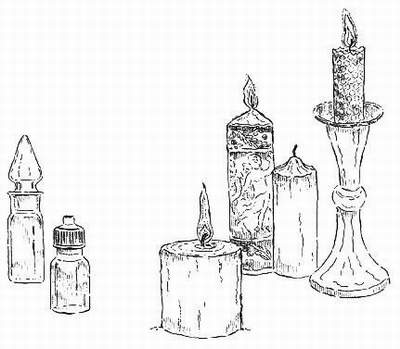
You will also need four elemental candles, to represent Fire, Air, Water and Earth, in appropriate colours, though if you are carrying out a ceremony in which the power of one element predominates, you could use four candles of this same element. If you are working entirely on the altar, these can be small candles, placed in a line nearer to the perimeter. More usually, however, the candles mark the outer perimeter of the circle at the four compass points. You can, place these on small tables or plinths, or have floor-standing candle-holders.
Green is for Earth, midnight, winter and the North. Place the candle at the 12 o'clock position on a clock, aligned with magnetic North (use a compass if necessary).
Yellow is for Air, dawn, spring and the East. Place the candle at the three o'clock position.
Red, orange or gold is for Fire, noon, summer and the South. Place the candle in the six o'clock position.
Blue is for Water, dusk, autumn and the West. Place the candle in the nine o'clock position.
Light elemental candles after the altar candles if they are within the circle, but before any wish or astrological candles, and begin in the North. If you wish, you can light each candle as its Guardian of the Quarter is invoked (see page 200) and thus called in the ascending flame.
You may also use a candle to represent the petitioner in the ritual. This may be yourself or the person for whom you are performing a ritual. The candle should be in the appropriate zodiacal colour according to the petitioner's birth date and one the colour of the need.
In love rituals, light two candles, one for each lover, and place them slightly in front of the altar candle(s): the male lover's candle should be placed next to the goddess candle and the female's by the god candle, if applicable.
If you have a central cauldron, you can stand any candles of need or petitioners' candles in it.
Empowering Candles
Usually candles are so powerful that they are already full of magical energies, However, in more formal and elaborate magical ceremonies, you may wish to inscribe or anoint those candles representing a need or person with either olive oil or a ready-prepared, fragrant, anointing. In my book, Candle Power (see page 298), I have written in detail about making your own candle oils and ways of inscribing candles with magical alphabets.
Inscribing Candles
Carving your wishes and intentions into a candle endows the candle with your special energies and as you etch each letter or symbol, these energies become concentrated.
If you anoint a candle, you should engrave it afterwards, although you may feel that inscribing it is sufficient. Engraving candles is not difficult, but you must use a very light touch and choose good-quality candles. Beeswax is not so easy to inscribe, but because it is very malleable, you can push tiny symbols, such as coins, etc., into the wax or you can buy sheets of beeswax and even if you do not fashion your own candles, you can add tiny beeswax symbols. You can also buy beeswax candles - and some ordinary ones - in different shapes, for example entwined lovers for a love ritual, or a beehive for abundance.
Anointing Candles With Oil
You can anoint, or dress, candles with scented oil or use candles that have fragrance already added. When you anoint candles with oils, they become more flammable, so you need to be extra cautious about sparks. For safety, stand your candlesticks on a fireproof tray.
Generally, the anointing is performed in silence. You can use virgin olive oil for dressing candles for any need. Some people add a pinch of salt for purification and life-giving properties.
Before beginning, pour a small quantity of the oil into a clear glass or ceramic dish and gently swirl it nine times deosil with a ceramic or glass spoon, visualising light pouring into it and endowing it with healing and magical energies. You need use only a small quantity as the anointing action is symbolic. Rub the oil into the candle in an upward motion, starting in the middle of your candle. Use a previously unlit candle as this will not have absorbed any energies apart from those with which you endow it. Rub in only one direction, concentrating on the purpose of your ritual. See the qualities of your oil and your need entering the candle.
Then, starting in the middle again, rub the candle downwards, again concentrating on your goal. A few practitioners will rub from base to top for attracting magick and from top to bottom for banishing magick; it is also usual to use a white candle for attracting energies and a black for banishing.
By physically touching the candle with the oil, it is said that you are charging the candle with your personal vibrations so that when it is lit, it becomes an extension of your mental power and life energy. If the candle represents another person and they are present, ask them to anoint their own candle.
If you light a candle for a formal ritual on successive days, you should re-anoint the candle each time, visualising the partial completion of the goal.
Water
Water represents its own element and stands in the West in a dish to the left of the chalice. See page 163 for instructions on how to make and empower sacred water. You can also use water to which rose petals have been added or you can float lavender or rose essential oil on top (this water should not be consumed internally).
Charging And Cleansing Your Tools
Once you have prepared your elemental substances, you can charge your tools ready for use. If they have been bought, whether new or second-hand, you might also like to cleanse them first. You can also cleanse them after a formal ritual or when their energies seem depleted.
If the ritual is important or arduous, you can recharge the tools before each use, but usually this is not necessary, as the cleansing from a previous ritual will automatically restore the energies. However, as you polish your candlesticks or athame before putting them on the altar, you may wish to focus on the intention of the ceremony and visualise light entering the tools.
Charging With Power
You can charge your tools separately as you obtain them. Alternatively, group them together on a table before their first use in ritual and create a circle of light around them with small purple candles at the eight main compass points (North, North-east, etc.). Start at the North candle and end with the North-west candle.
* First create a circle of salt round the tool(s), beginning in the North, to offer the tool(s) the protection of the ancient Earth element, saying:
Mother Earth, charge with the power of the ancient stone circles and the wise ways of the ancestors this - [name the tool(s)] of magick and healing, that my work may be rooted in what is possible and help create abundance and prosperity for others and the land, as well as for my own needs.
* Next, draw a circle of smoke deosil in the air around them, using a frankincense or myrrh incense stick, saying:
Father Sky, charge with the power of the mighty winds and the limitless potential of the cosmos this - [name the tool(s)] of magick and healing, that my work may be focused, filled with energy and bring positive change to ever-widening horizons.
* Now, using a golden or scarlet candle in a broad-based candle-holder, mark an inner circle of fire in the air, around the artefact(s), saying:
Brother Fire, charge with the power of ancient ritual fires and the brilliance of the Sun, this (these) tool(s) of magick and healing, that my work may be filled with light and inspiration and purged of all self-seeking and negativity.
* finally, sprinkle sacred water or rainwater that has not touched the ground before collection on top of the circle of salt saying:
Sister Water, charge with the power of mighty oceans, wide rushing rivers and deep still pools this (these) tool(s) of magick and healing, that my work may release stagnation and bring fertility and peace, not only to myself and my loved ones, but to people whose lives are blighted by polluted places and, especially, water.
Cleansing Using The Forces Of Nature
Leave your artefact(s) on a piece of white silk in a sheltered, safe place out of doors or near an open door where children, pets or the curious cannot reach them. Begin at dusk where they can absorb the light of the Sun, the Moon and the stars, for 24 hours. This will be effective even if you cannot see any of these heavenly bodies in the sky.
Charge at the time of the waxing moon to the full moon if possible; if not, let them stand for 48 hours. If the Moon is waning and so not good for energising, create a circle of alternate moonstones and crystal quartz for the powers of the Sun and Moon, and leave the tools within this circle for the full 48-hour cycle.
Sprinkle the tools with nine drops of sacred water that was collected under the full moon or rainwater that has not touched the ground, saying a variation of this old magical rhyme whose origins are unknown:
One for joy, two for gladness,
Three and four to banish sadness,
Five and six do life renew,
Seven, eight, nine bring power anew.
Few of these old chants are great poetry, but that was not their purpose - they were created in the days before widespread literacy as a way of remembering magical rituals. If you prefer, you can substitute your own, composed by you or a coven member who may have a gift for such work. The rhymes served like simple mantras to build up power - some people recite the chant several times, very fast, while sprinkling the water slowly.
Cleansing Using A Crystal Pendulum
Hold a clear crystal pendulum over the tool(s) and make nine circles widdershins.
Plunge the pendulum in cold running water to cleanse it, shake it dry and circle it nine times deosil over the tool(s) to restore energies. You may need to repeat this several times if a tool seems lifeless or after you have been carrying out a banishing ritual.
The Four Elements
The four elements - Earth, Air, Fire and Water - play an important part in all kinds of magick. Plato, the Greek philosopher who lived around 360 BC, was the first to identify these elements as the components that made up the whole universe and right until Elizabethan times people still believed that our nature was influenced by our elemental composition.
Indeed, Jung, the twentieth-century psychoanalyst, used this concept in his personality types, renaming them as Earth/sensations, Air/thinking, Fire/intuition and Water/feelings. Jung also thought that we each had a predominant element, a secondary one and a shadow one that we denied or projected on other people whom we then unconsciously disliked because they mirrored our faults.
In formal magick, the four elements are seen as providing natural energies for transforming wishes into reality. Together they combine to form the fifth element - Ether, or Akasha - that represents pure Spirit, or perfection. Medieval alchemists attempted to create this elusive substance, called the philosopher's stone. It was said to turn base metal into gold and, as an elixir according to the Eastern tradition, to cure all ills and offer immortality.
These elements form the basis for raising power in formal magick and in less formal spells too and are represented by Devas, the Guardians of the Watchtowers or the four main Archangels.
Earth
Earth represents midnight, winter and the quarter and direction of the North. It is the most magical of directions.
Earth is the realm of the actual and material, where magical wishes and intentions find expression and so it is very important. It is also the element invoked for abundance and in prosperity rituals, as well as matters concerning your home and family. It is also used for magick concerning animals, all who work with their hands, especially in agriculture, horticulture and environmentalism, in finance or maintaining law and order, for banks and financial and legal institutions. Earth can thereby form a focus for rituals where justice and authority are an issue.
Its elemental creatures are gnomes, with their stores of hidden treasure, wisdom and, above all, common sense. They are a reminder that what is of worth does not necessarily offer excitement or instant results.
Earth's colours are green or brown. Its zodiacal signs are Taurus, Virgo and Capricorn.
Air
Air represents dawn, spring and the quarter and direction of the East. Some practitioners open their circles facing this direction, rather than the more usual North.
Air is the realm of potential of new beginnings, change, action, travel, house or career moves, knowledge and learning, communication, the media and technology. It can therefore be used for magick concerning all who work in commerce, medicine, teaching, the retail trades, the media and science and all who are studying. It also can be used in rituals for health.
Its elemental creatures are sylphs, gentle spirits of the air who can be seen fleetingly as butterflies, offering ideas, ideals and a reminder to enjoy happiness while you can.
Air's colour is yellow and its zodiacal signs are Aquarius, Gemini and Libra.
Fire
Fire represents noon, summer and the quarter and direction of the South.
Fire is the realm of light, the Sun and lightning, and so forms the focus of magick for fertility, power, joy, ambition, illumination, inspiration, achievement, all creative and artistic ventures, poetry, art, sculpture, writing, music, dance, religion and spirituality, psychic powers and mystical experiences, passion and sexuality.
It can be invoked by those who work in the arts and those who seek or are required to be leaders and for those in all dangerous professions, especially involving fire, furnaces or metalwork. It is also potent for destruction of what is now no longer needed, for binding and banishing and so for protection.
Because it is the most powerful of the elements, it must be used only with care in a pure, calm frame of mind and for a positive purpose.
The elemental creature of Fire is the salamander, the mythical lizard that lives within Fire (the name is nowadays given to a species of amphibious newts). The salamander offers an understanding of mystical processes and visions to inspire future paths and ventures.
The colour of Fire is gold, orange or red and its zodiacal signs are Aries, Leo and Sagittarius.
Water
Water represents dusk, autumn and the quarter and direction of the West.
It is the realm of love, relationships, sympathy, intuition, healing and the cycle of birth, death and rebirth. Water can form the focus for rituals of purification, healing, all water and sea magick, Moon magick, reconciliation and peace, harmony in oneself and with others, restoring balance, unconscious wisdom and divination, especially scrying. It is also potent for overcoming stagnation and inertia and for moving forward after an impasse, for friendship and for travel by sea. It is linked with work in the caring professions and all healers, with those who work in the psychic arts, sailors, people who live or work on or near water and for those in the hospitality industry.
Water's elemental creatures are undines, spirits of the water. The original undine was created without a soul, but gained one by marrying a mortal and bearing him a child. However, she also lost her freedom from pain and her immortality and so she is a reminder that love may have a price, but that without it life does not have meaning.
The colour of water is blue and its zodiacal signs are Cancer, Scorpio and Pisces.
The Four Quarters Of The Circle
Every magical circle is divided into four quarters that are in ceremonial magick called the Watchtowers. The higher essences who protect the quarters are invoked as the Guardians, who control and direct the elemental powers. Sometimes they are called Kings, sometimes Devas, or they may be pictured as the four main archangels, Michael, Gabriel, Raphael and Uriel.
How you perceive your guardians in the ritual circle is up to you. As with all magick, there are disagreements about which archangel represents each element. This is because angels are found in a number of different traditions and religions and so may serve different functions under similar names.
Previously, I have associated Raphael with the North and Uriel with the East, seeing Raphael in his aspect as a healer and protector, and Uriel as the fiery dawn in the East. However, recently I have started to use a more traditional association of Raphael as the messenger in the East and Uriel as sentinel of the North and I have found that this works better. Do read about angels and experiment to see what suits you. I have listed source material on pages 201-2 and you can find more information on the Internet. Use the elemental candle colour to represent the angel you want. You can also use angels in the four quarters to invoke protection in less formal magick by lighting candles in the four quarters when you feel afraid or alone.
I have also seen Michael listed as archangel of the dawn and East, but I think he is better placed as archangel of the Sun in the South. If you feel uncertain, simply refer to each guardian as Archangel of the North', etc., then the celestial being can reveal itself in the form that is right for you.
The angelic colours I have given vary slightly from the elemental ones and if you are carrying out a personal angelic ritual of protection or meditating on the archangels, you can use the archangel colours for your candles.
Some practitioners do not greet the Guardians of the Watchtowers at all, but instead light each elemental candle in turn, visualising golden energies pouring from each direction into the circle.
Uriel
Uriel, whose name means Fire of God, is associated with earthquakes, storms and volcanoes and is the archangel of salvation. He is sometimes linked with the courage of Mars. He warned Noah of the impending flood and led Abraham out of Ur. Believed to have given alchemy to mankind, he also imparted the wisdom of the Kabbalah, the book of sacred writings, to Hebrew mystics. He stands as wise protector and keeper of the sacred mysteries, hence representing the direction of magick and initiator of all who seek the mysteries.
Uriel stands in the North and his colour is the deep blue or purple of midnight.
Raphael
Raphael is the healer and travellers' guide and is often associated with Mercury, the messenger of the dawn. He is the angel who offers healing to the planet and to mankind and all creatures on the face of the Earth and in the skies and waters and the promise that tomorrow really is another day.
He is also guardian of the young. He is depicted with a pilgrim's stick, a wallet and a fish, showing the way and offering sustenance to all who ask.
Raphael stands in the East and his colour is yellow.
Michael
Archangel of the Sun and Light, Michael is the warrior angel. He appeared to Moses as the fire in the burning bush and saved Daniel from the lions' den. As commander of the heavenly hosts, Michael, with his flaming sword, drove Satan and his fallen angels out of the celestial realms; as Angel of Judgement, he also carries a scale for weighing the souls of the dead. According to the Koran, the cherubim were created from Michael's tears.
He offers power to overcome any obstacles and challenges, and brings wisdom and illumination as to the right path.
Michael stands in the South and his colour is gold.
Gabriel
Archangel of the Moon, the messenger archangel and the heavenly awakener, Gabriel appears many times in the Bible. He visited the Virgin Mary and her cousin Elizabeth, mother of John the Baptist, to tell them that they were to bear sons who would lead mankind to salvation. It was Gabriel who parted the waters of the Red Sea so that the Hebrews could escape from the Pharaoh's soldiers.
Gabriel is usually pictured holding a sceptre or lily. To the followers of Islam, Gabriel is the spirit of truth who dictated the Koran to Mohammed.
Gabriel brings wise words of truth and the clear voice that speaks of hope and a new purpose in life, but also compassion and the acceptance of the weaknesses of oneself as well as others.
Gabriel's protection can be felt with each new moon, especially on the day before the crescent is visible in the sky.
Gabriel stands in the West and his colour is silver.
Pentagrams
The pentagram, as I have already mentioned, is one of the most sacred geometric forms in magick. Some witches wear a gold pentacle, a pentagram in a circle (see page 189), on a chain as a sign of their craft.
Each of the five points of the pentagram represents one of the five elemental powers, so that the uppermost single point is symbolic of Spirit, or Akasha or Ether. It is dedicated to the Goddess in her triple aspects. It is the realm of spirituality and the divine spark within all life.
The top left point of the pentagram symbolises Air and the fixed sign of Aquarius, representing logic, intelligence and the conscious awareness that enables us to reach beyond the material and follow steps to knowledge of what is hidden.
The top right point is the element Water and the fixed sign of Scorpio. It represents the feelings that endow magick with purpose, desire whether for love or spiritual development and the compassion and empathy that make us care about ourselves, others and the world we live in. It forms the interconnectedness of all life.
The bottom left point of the pentagram symbolises the element Earth and the fixed sign of Taurus. It connects with the Earth Mother, ecology and the basis from which we explore spirit and also the material plane in which ideas are manifest.
The bottom right point in the pentagram symbolises Fire and the fixed sign of Leo, flaming ever upwards, the impetus and illumination that transforms thought into action and enables us to see potential, not least our spiritual potential.
These positions correspond with the zodiacal positions on an astrological wheel.
On another level, the pentagram is seen as representing the human body with the four limbs outstretched and the head touching the clouds.
Drawing A Pentagram
Pentagrams are remarkably easy to draw. They are created in one continuous line, moving from point to point, and ending where you began. In ritual magick, pentagrams are drawn in the air at each of the four compass directions of the circle, either with an athame, a wand or the index finger of your power hand. It is best to draw really big, strong pentagrams.
Pentagrams can be drawn either to attract the elemental guardians (invoking, or attracting pentagrams) or to close their energies (banishing pentagrams).
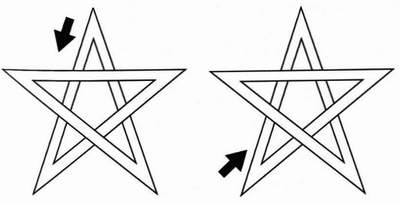
There are various rather complicated ways of drawing pentagrams, but I suggest you use the basic methods given on the previous page for attracting when opening your four quarters and banishing when closing. If you wish to find out more, I recommend you read Dion Fortune's Applied Magick. If you do not wish to draw pentagrams at all in your circle work, you can instead call the Guardians in the candle flame.
Preparing For Ritual
Preparation for ritual is important. Despite this, even magick has to conform to the needs and customs of the modern world, and so witches today often do not fast for 24 hours or abstain from sex for the same period. But you should try to slow your activities down in the hours before a formal ceremony, eat only a light meal and turn off all phones, faxes and computers if you are working from home.
Make sure you have all the basic tools and ingredients for the ceremony and that the room is ready.
About an hour before the ritual, prepare yourself, by having a bath in which a sprinkling of sacred salt and a few drops of cleansing oils, such as pine or eucalyptus, have been added. Light purple or pink candles in the bathroom and allow all your daily concerns to flow out of your body into the water, to be transformed by the candlelight. When you are ready to get out of the water, swirl the reflected light three times widdershins and as you take out the plug, say:
Go in peace, flow in harmony to the sea of eternity.
Wear something light and loose for the ritual. You may like to keep a special robe for your magical work, ready washed and pressed. Though some witches work skyclad, in groups this can result in self-consciousness and sometimes unnecessary emotional complications that can detract from the magick. Also, in Northern climes it is usually too cold! But the choice, of course, is yours.
Next sweep out and cleanse the area you will be working in and set up the altar, either in the North or the centre of your circle. Practitioners who work from the East of the circle may want their altar there. The position of the altar really does not matter. (See also page 42 for working in the southern hemisphere.)
If the altar is placed centrally or in the North, you follow the tradition, as I do, of working from the North; this means that you cast the circle from the North and enter the circle from the South so you are facing the North. If, however, you work with the altar in the East, you will cast from the East and enter from the West, facing the East. A central altar will work for either direction and it also means a group can easily circle it. After all, for most of us space is at a premium, and sometimes it is a question of marrying metaphysics with logistics.
Creating A Temple
Before you begin a formal ritual, you must cast an astral or spiritual temple above and surrounding the circle and the location. In your mind's eye, visualise your own temple, perhaps one from the ancient world, resplendent with gold and jewels, with a statue of a deity in marble, gold or silver. The roof of the temple may form a crystalline pyramid or be open to the stars. (Readers of the late Dion Fortune's occult novels will have no difficulty in forming images of such splendid edifices.) Or you may create a grove of oak or olive trees or one of the ancient stone circles as your working place or a castle room whose battlements are lashed by a stormy sea.
The altar in your temple may be pure gold, ornate stone or beaten copper, and the candles may be set in ancient lamps. With practice, you may find that a particular temple form automatically creates itself in your mind's vision, but if this is not helpful, then concentrate on the magick that exists your own very special working place.
Let us go through a formal ritual. I have created this one for a solitary practitioner, but it adapts well for a group.
A Formal Ritual To Restore Prosperity
Such a ritual could be used, for example, to boost employment in a town that has become an urban wasteland.
* Set four floor candles in the elemental colours in the four main compass points of what will be the circle. The altar is in the centre.
* Place a single large beeswax candle in the centre of the altar. Arrange your tools and the four elemental substances, also on the altar, to form a square around the central candle: salt in the North, frankincense, fern or cinnamon incense in the East, a gold candle in the South, for abundance, and a jug of water and two small dishes in the West.
* Set the pentacle containing a honey cake in the North, and place the athame in the East, the wand in the South and the chalice of juice or wine in the West.
* Place a ball of clay or dough within the elemental square, on a dish in front of the candle so that light shines on it.
* Facing North, light the altar candle.
* Take the salt from the North and stir it deosil with your athame, saying:
Power of new life, power of healing, power of regeneration, enter this salt, I ask, mother and father of light and love.
You can substitute the names of gods and goddesses associated with success, prosperity, fertility and renewal into the ritual if you wish.
* Take next the water from the West and pour some into one of the dishes. Stir it deosil, saying:
Power of growth, power of fertility, power of prosperity, enter this water, I ask, mother and father of abundance and increase.
* Now take the salt to the water and tip a little in it, stirring it once more with the athame, saying:
Dissolve and disperse, flow far and free to attract rebirth to -[name the town] and its inhabitants.
* Now cast the circle around the elemental candles, with your wand, starting from the North in a single unbroken movement, visualising as you do a stream of light emanating from it that encloses you above, around and beneath. (If you are working with a group, they can stand or sit within a circle while you cast around them. This is better than slowing the ceremony by having people entering the circle separately after it is cast and then having to close the circle after each one.) Say:
I cast this circle of light, of power and of protection. May the circle that is cast always be unbroken. Bless my workings this night [or day], O mother and father of rebirth and renewal, unified and yet two, and all that is and has been and shall be, creative spirit of the universe, the cosmos and the smallest blade of grass.
Pick up the bowl of salt water and sprinkle a second circle deosil around the perimeter of the first, saying:
Salt and water, enclose, bless and protect you who have sustained life from the beginning and will so to the end.
If others are present, a second witch or the High Priest then sprinkles all present individually with the water, saying 'Bless and protect'.
* Light the incense in the East (or add to it if it was lit before the ritual).
* Create a third circle around the perimeter, saying:
Breath of life, bring purity, clarity and focus, force of life itself that flows alike within plant, tree, bird, animal, human and stone. Bless and protect.
You are now going to light the elemental candles, and as you do so invoke the Guardians. Re-light the taper from the central candle as necessary.
* Light a taper from the central candle and carry it to the North, saying:
Lord [or Lady] of the Northern Watchtower, I call upon your strength and persistence to restore the prosperity and stability to this town where new industry and investment are so badly needed.
* Light the green candle of the North.
* Go to the East, saying:
Lord [or Lady] of the Eastern Watchtower, I call upon your swiftness and clarity of purpose, to bring technologies and opportunities into this town to attract new kinds of work, perhaps from overseas.
* Light the yellow candle of the East.
* Go next to the South and say:
Lord [or Lady] of the Southern Watchtower, I call upon your cleansing fire and spirit of inspiration to purge what is redundant and corrupt and to bring hope and energy to this town where decay and despair have taken root.
* Light the red candle of the South.
* Go finally to the West and say:
Lord [or Lady] of the Western Watchtower, I call upon your healing and restoration to heal bitterness and divisions between the people who have experienced such hard times and whose town has become ravaged and neglected.
* Light the blue candle of the West.
Now you are going to empower the clay. If working as a group, once the clay has been empowered with the ritual substances, you could pass it round for each person to fashion it and add their energies.
* Take the salt and sprinkle a few grains on the clay, saying:
Make new buildings rise, new industries grow, new houses and parkland, schools and health centres be created, that this town may be a worthy home to those who work in it.
* Take the incense and circle the clay nine times, saying:
Bring retraining, new investment, government grants, new technology and new equipment so that the town may become a hive of activity and generate ever more opportunities into the next century and beyond.
* Light the gold candle in the South (in this case it will be different from the candle of the southern watchtower) and pass it over the clay so that single drop of gold wax falls on it, saying:
Bring gold of prosperity, gold of abundance, fire of inspiration and creativity so that this town maybe rich in opportunity, in the arts and in culture, as well as in material wealth.
* Finally, sprinkle the clay with a single drop of water from the jug or a second dish, saying:
May the lifeblood of the town be restored and fertility course through the veins of the people that their children and grandchildren may know happiness and lives unclouded by sorrow and anxiety for their livelihood and their dwellings.
* Taking the clay between your hands, begin to mould it, using a marking tool if you wish, to make a tool, such as a wheel, or a figure, a bridge, a loaf, a house or a flower, or any abstract symbol that represents the rebirth of the town through its people. Endow it with your wishes, visualising the place growing and prospering, perhaps reciting:
Go forth, increase and multiply,
or
Rise again from the ashes, rise anew, rise glorious, rise, rise again.
Chant faster and faster until at last you toss the ball into the air and catch it, saying;
Go far, go free,
bring life to thee.
In a group, you could pass the endowed clay round a second time, tossing it from person to person while chanting.
* Return the clay to the altar and take your honey cake on its dish.
* Hold it over the central candle, saying:
Bring abundance to those who need it, enough for their needs and a little more, joy and hope.
* Bite into the cake and scatter a few crumbs on the clay, instead of in a libation dish.
* Take the athame and plunge it into the chalice, saying:
God to goddess, join thus thy power and give power to thy people who are in need this hour.
* Drink from the chalice and instead of dropping some wine in the libation dish or on the ground, let a drop fall on the clay, saying:
Fruit of the vine, harvest gathered and transformed, transform likewise what is barren to what is fruitful and living.
If you are in a group, you can pass the cakes and wine round and each person can contribute a positive thought or perhaps voice any personal worries they may have about employment and ask for blessing.
* Sit in the candlelight, seeing the new town rising from the old, and if you have any special fear about your own job security or those of loved ones, let these too flow away as the released energies multiply. Allow any excess energies to drain back into the Earth, by pressing with your hands, feet and body.
* Beginning in the West, blow out the candle, saying:
Lord [or Lady] of the Western Watchtower, I thank you for your healing and your harmonising light. Go now in peace.
* Move next to the South. Blow out this candle, saying:
Lord [or Lady] of the Southern Watchtower, I thank you for your inspiration and your cleansing light. Go now in peace.
* Move next to the East. Blow out this candle and say:
Lord [or Lady] of the Eastern Watchtower, I thank you for your clarity and your life-restoring light. Go now in peace.
* Move finally to the North. Blow out this candle and say:
Lord [or Lady] of the Northern Watchtower, I thank you for your grounding power and your protecting light. Go now in peace.
* Take again your wand and, starting from the North and working widdershins, close the circle just once, saying:
May the circle be uncast but remain unbroken, may light and love and healing still remain and fall on whoever needs their blessing.
* Leave the clay and allow the central and elemental Fire candle and the incense to burn away. When they are burned through, clear them away and bury the clay beneath a living tree or in a large plant of lavender or basil.
There are many other things you can add to a formal ritual, for example, ringing the bell or drawing pentagrams. In this ritual, you could also have passed the elemental tools over the clay to give it additional power. Ceremonies are really a glorious mix and match and this is just a sample of how you can combine the tools and the forms to create the ceremony you want.
You may like to record in your Book of Shadows those rituals that work well and others that did not seem so potent, together with any reasons why you think this is so. In time, you will develop perhaps three or four basic ritual 'templates' for coven or personal work, and with practice the preparations and stages will become almost automatic. As your energies ever more creative and spontaneous, they will, within a formal framework, become incredibly potent.

