6 - Vengeance And Attack
As you will have gathered from the last chapter, the art of magical warfare is not one to be undertaken lightly, if only for the reason that should the bolt misfire, it will inevitably rebound on the sender. Having accepted this possibility, however, many witches put the discomforting idea totally out of their minds, and proceed merrily on their nefarious ways without giving it another thought. Should you also be of that lighthearted frame of mind, then you will obviously want to learn some of those time-honoured methods of speeding effective curses on their way.
True to the general principles of witchcraft, the means used for effecting destructive ends is exactly the same as those used for constructive purposes. The only difference lies in the magical intent and symbolism involved. The medium for the transmission of power remains exactly the same of course, namely, the deep minds of both parties concerned.
The type of power to be raised for these operations of wrath and chastisement can take two forms: a binding, inhibitory power for inducing inertia or "tying someone's hands" - this pertains to Saturn; and a scorching, blasting power for blighting and burning (which is what people generally mean by a curse) - this pertains to Mars.
Those spells of a Saturnian nature make use of the same symbolism you have already encountered in the last chapter, namely that of Hertha, the Great Mother, seen in her negative aspect as the dark, terrible, Stony Bringer of Inertia, and Dame Habondia in her aspect of Noticula-Hecate, Lady of Night and Death.
The Mars Spells, however, introduce you to the fourth and final witch entity: He partakes of the nature of the last remaining magical element to be covered in this book, namely, fire.
You have, of necessity, already encountered this being in two places already, although without too much contact. He is none other than Cernunnos, the Horned One. The first instance being your manufacture of the Athame with all its implied Martial symbolism, the second the section on sex magic. He is a spirit of fire and energy, as symbolized by the torch he sometimes carries in his hand and the horns or antlers he wears upon his head. A light-bearer also, hence his title, Lucifer. In view of this, he is often represented carrying a blazing torch or candle on his head, which has sprung from between his antlers, in addition to the one he carries in his hand.
He is known by a variety of names to witches in addition to that of Lucifer: Cernunnos, Mamilion, Robin, Dumus, Hu, Janus or Dianus, Barabbon or Barabbas among others. His symbolism is partly akin to that of Thunor, the Norse Thunder God of Battle, and again of Pan and Dionysus, the classical gods of ecstatic debauch and revelry. In his alignment with fire, he evokes memories of Vulcan (Hephaestus) and Wayland Smith. As Vulcan is the suitor of Venus and Pan of Diana, so is the Horned One the pursuer of Habondia.
However, many witches who belong to female-oriented covens which focus their attentions more on the goddess than the god argue that the boot is actually on the other foot. Their contention is that it was, and is, the goddess who took the initiative in the chase. Examples ranging from the Gospel of Aradia to the legend of Actaeon are cited as chapter and verse here.
Cursing
Before embarking upon the ceremonial side of cursing, let us reconsider the more general aspects of overlooking, seen solely from the point of view of your pyramid power. As already mentioned, spells will always work better when the ground is well laid beforehand, and this is particularly true in the instance of curses. The person who knows he has been laid under a curse, whether he believes in the practitioner's powers or not, is actually in a far more receptive state of mind than he who remains in ignorance of the fact. It is for this reason that the conveyed voodoo doll comes in so handy, providing, of course, the spellbinder is quite sure there is no chance of its being used for any countermagic against her.
This eventuality can only be said to be completely out of the question when it is definitely known for a fact that the victim will either be too frightened to reply with countermagic or, as is more often the case, if he is the type of person who feigns total disbelief in witchcraft, deeming it all medieval nonsense. The latter is the readiest victim for your doll technique! You will know he can never condescend to indulge in any countermagic, and give full play to his superstitions. Of course, it is remotely possible that, due to his run of unbelievably bad luck, loss of wife, estate, and possibly all his hair, he may decide to review his past attitudes towards medieval superstitions; at that point he may take the step of consulting either a known witch or coven or, alternately, a sharp lawyer who specializes in cases of psychological intimidation. Then lazily sticking pins in dolls won't be enough. You will really have to use your wits; the battle will have just begun.
If you have the taste for actual physical confrontation, then the personally delivered verbal curse is really the most handy way of accomplishing the "act of information." Try to make sure you get your victim alone for this, though, of course, in some cases, particularly those of an impromptu nature, this won't always be possible.
Again, as in any act of fascination or close-quarter projection of your witch power, three types of contact may be employed - eye, hand, or breath. Owing to the nature of the operation, however, it is usually the first method which is mainly relied upon, hence the old term, the evil eye. As in love magic, you must first catch the glance of your victim and then hold it. This may prove harder than you think, particularly if your victim is aware of your reputation as a witch. You may have to accomplish it by saying something to the effect of "I never trust a person who won't look me directly in the eye" or even, as a last resort, "Have you ever noticed how one of my eyes is a different colour from the other?"
For delivering your curse, make use of the hand-of-power gesture - left arm outstretched, fist clenched, first two fingers pointed at victim. It definitely has dramatic appeal, especially when combined with a certain Druidic method of projecting your witch power. This involves standing solely on the alternate foot (the right) to the pointing hand, closing the alternate eye (also the right), glaring down the length of your outstretched arm with the open one, and delivering a full jolt of witch power.
As you do this, pronounce your curse evenly and clearly; some witches prefer to keep it dark and general in content, specifying nothing more than misfortune and misery. Others relish the graphic approach, revelling in a description of the torments they are about to unleash. The choice of approach is yours; however, I would counsel you to suit the approach to the victim. Above all, you don't want to be laughed at. This process of confrontation of the victim should then immediately be followed up with your ritual of wrath and chastisement unless, of course, you have sufficiently developed your powers to inflict a curse immediately without further ado. At this stage, however, this is highly unlikely. That kind of ability one is either born with or acquires only after years of practice.
In order to make your curse into something more than an empty threat, you are going to have to build a dark current or vortex. The utmost effort on the part of your pyramid powers will be called for here, combined with a pattern of constant repetition. Should you belong to a coven, then your task is that much easier, calling, as it does, on the combined pyramid powers of a group.
You are going to have to contact the abyss within you, and dredge up all those repressed hostilities and dark hatreds you have banished to the cellars of your mind from childhood onward. This can take time; to whip your emotions into that state of frenzy which will make the magic work is not a task that can always be accomplished at one sitting. It can be a work of some days at least, and because of the caustic energies it deals with and the harm they can quite obviously inflict on the user himself, it is not to be lightly embarked upon. This without even taking into consideration the possibility of the return current should the victim be adequately protected. Before embarking upon any operation of wrath and chastisement, truly calling as it does upon the powers of fire and darkness, make very, very sure in your own mind that the risk is worth taking. Only a mind in which no qualms or second thoughts are present can house and effectively manipulate the requisite forces.
One of the simplest ways of setting the dark current in motion by yourself alone is the time-honoured Black Fast method.
Every mealtime you should, if possible, confront what you would consider a delicious meal either in actuality or the imagination, and sternly reject it, in favour of a morsel of food, a glass of water, and maybe a vitamin pill or two to keep body and soul together. You must keep this up for a limited state of time, beginning and ending the fast within a properly cast circle, with the circumambulations performed "widdershins," against the sun, and naming your intention in the form of a curse, that "[victim's name] so come to grief." Repeat this same curse to yourself every time you refuse food. The process should last for two weeks - beginning at the full moon, or just after, and ending at the new moon. As the moon wanes, so the dark tide flows swifter.
This practice can be effectively camouflaged from your non-witch friends by the simple excuse of dieting. There is more to a so-called hunger strike than meets the eye.
The second simple way of laying a curse on somebody is by the Candle of Bewitchment.
Here again we make use of constant repetition as a magical device. Traditionally, the hour chosen for this operation is the stroke of midnight, but actually the best time for the attack is when you feel your victim is fast asleep, and therefore at his most defenceless. In most cases this would be sometime during the early hours of the morning.
You must begin the first of this series of bewitchments, as with your Black Fast, on or just after the new moon, that period of the lunar month known in the craft as the dark of the moon.
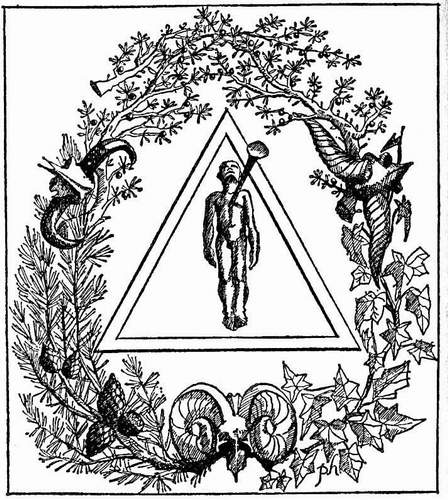
Every night, at exactly the same time if you can manage it, cast a floor triangle similar to the one in Chapter 4, using a Martial Incense of Wrath and Chastisement in the thurible; on your altar should be a phial of your Sabbat oil (see last part of Chapter 7 for this), your lamps of art, and of course your chalice; the cord, Athame, and workbook should be present as usual. Depending on the nature of the operation, one of Saturnian binding or Martial destruction, surround your altar triangle with a circle of cypress twigs, marble graveyard chips and pieces of bone, on the one hand, or your Cernunnos paraphernalia of holly, fir, ivy, and animal horn on the other. Within the altar triangle itself should be your candle of bewitchment, black for a ritual of binding and suppression, red for one of strafing and torment. It should be exorcised beforehand. For both Saturnian and Martial operations, a little powdered rue herb or myrrh should be mixed with the wine of consecration.
You must now tune your deep mind to the correct wavelength. For Martial operations using a red candle, you may use the conjuration of Cernunnos described in Chapter 4, beginning "Eko, Eko Azarak ..." In your mind's eye, see the Rampaging One: Between Cernunnos' horns from his forehead juts a blazing torch. In his right hand he bears either a flaming sword, a trident, or, alternatively, supports an immense burning staff of gold entwined with serpents and ivy and surmounted by a great gleaming pinecone: the Lord of Misrule!
With his coming, give full play to all the rage and torment within you. Feel the fiery blood of anger coursing through your veins! Allow yourself to be possessed by wrath and fury as you again perform your circumambulations widdershins, anticlockwise! Then take your scarlet candle in your right hand, and with your left begin to anoint it with Sabbat oil. Start at the centre of the candle and work first up, then down, up again and then down again. Keep this up for a full five minutes. It is the most important part of the spell. With each stroke, you should chant a jingle of your own devising encompassing your intent. It doesn't matter how simple or absurd it may be, as long as it suitably expresses your feelings toward the victim, and can be kept up rhythmically as you do your anointing. With all the power of your imagination, and all the faith and intent you can muster, you must actually try to see your spell working its mischief, visualizing your victim suffering all the pangs you wish on him. This type of spell is perhaps best employed for encouraging general misfortune rather than any specific disaster, relying purely as it does on the use of the fortified imagination for contact between the respective deep minds. Specific disaster should be left for envoutements using an object link, as described later in the chapter. On the other hand, should your candle burning be a Saturnian type of operation, that is, one aimed at the induction of inertia, forgetfulness, or frustration of some sort or other, then you must invoke the dark power Habondia, in her dark aspect, Nocticula, using a black candle. The conjuration such as the one to be described below can be used with effect here.
The magical landscape to be visualized should be one of darkness and mystery. One of those traditionally associated with the dead is as follows:
Night has fallen, winter has set in; the air is chilly. Two monolithic pillars of granite rise from the gentle hill, and between them winds the path of the dead, pale in the starlight. The two pillars mark the entrance to the realm of the dead, back of the north wind. Between them stands the representative of the dark power itself. The figure is neither distinguishable as male or female, an ancient robed in black, still and silent. The face is hidden beneath the shadow of a cowl drawn over the head. In one withered hand a staff of blackthorn is grasped; in the other a torch flickers with a resinous, smoky flame. An owl, the symbolic bird of death, is perched on the being's shoulder. In the far distance, the baying of dogs or wolves can be heard ringing in the chill night air. Their keeper, Nocticula, Ruler of the Dead and Warden of the Tower Adamantine, walks abroad!
This is the basic Saturnian image. Embroider on it with your own fantasies by all means. The more personal and sinister they are to you yourself, the more effective your magic will become. The one thing to remember is that they should evoke in you all those childhood fears of the dark, the deserted churchyard by night, the opening tomb, and the Thing in the cellar' All the horrors and bugbears that you can conjure up from your worst childhood fantasy should be pressed into service here, must be dredged up and put to use in initiating the dark vortex!
The floor triangle should be drawn in the usual manner, save for your altar decorations. A Saturn Incense of Wrath and Chastisement should burn in your thurible.
Repeat your conjuration to the four quarters, tracing a circle cross such as you used in your necromancy ritual at the four quarters with your Athame, the symbol of death!
Here is the incantation:
Agency of Ineffable Name and Vast Strength!
Ancient, Dark One; Thou cold, barren, mournful and pernicious!
Thou whose word is as stone and whose life is abiding.
Thou Ancient and Alone Impenetrable One!
Thou who keepest promises,
who art weak and weary;
whose cares are greater than any other,
knowing neither pleasure nor joy;
Thou Old and Cunning, supreme in artifice!
Bringer of ruin and despair,
be present here and lend thy aid!
Consecrate the black candle with Sabbat oil in exactly the same way you did the red one, reciting your charm of intent as you do.
When you have completed the anointing, whether it is a red or black candle, place it within the altar triangle, and trace a glowing blue circle cross in the air above it with your Athame. Light it with the words "So mote it be!" Then settle down to a vigil of concentrated hate or rage. Keep this up until the candle burns itself out. (Because of the strain involved in doing this, it is best to employ fairly slender, short tapers.)
If your deep mind has been sufficiently attuned during the operation, your victim should begin to feel signs of depression or anxiety within about a day or so. Witchcraft of this sort doesn't always take effect immediately. It sometimes appears to need about twenty-four hours to percolate through the lower levels of the deep minds concerned and begin to manifest itself in waking consciousness. The secret of success here, however, remains as always in whipping up your passions to the required intensity, and at the same time alerting your deep mind by the correct degree of concentration and repetition.
While we're on the subject of Saturn-type operations, it is a good time to consider the whole subject of ligature in greater detail. Ligature, as we have already seen, simply means magical binding, usually performed by means of a symbolic cord or chain. As such, it pertains to the sphere of Saturn. In ancient times the Dark One's newest subjects were often laid to rest in the earth, bound hand and foot.
Before considering ligature proper, however, we should note in passing a process of a similar nature, using the same name but differing considerably in its aim.
On an earlier page, I referred to a certain use of the witches' cord wherein it is used by the practitioner to bind himself. This is done on two occasions. First, many witches believe that by restricting the use of limbs and blocking up the avenues of the senses, the inherent witch power can be let free to wander abroad, either in an invisible form as a disembodied and clairvoyant astral body, or a semiembodied, half-materialized fetch.
The witches' cord itself is often used for this purpose of immobilization. For the sensory deprivation itself, a mask is worn, covering the entire head but leaving the mouth free to breathe. This is sometimes referred to as a witches' cradle or witches' bridle (not to be confused with the old Scottish instrument of torture of the same name). Second, the mask and the cord are both also used in ceremonial coven initiations, and here they symbolize the blindness and bondage imposed by the mundane world upon the candidate.
In neither of these cases is the cord ligature a process of dark intent. Rather the opposite in fact.
Not so ligature proper.
Should you as a witch wish to bind someone to prevent his carrying out some action or other, one of the best methods of accomplishing your aim is by using one of the variants of the spell known to many practitioners as The Tanglefoot Charm.
Obtain an object link from your victim, either a strand of hair which you must plait into a cord with some red twine, or an article of clothing in which you can tie knots comfortably. On a night when the moon is waning, preferably a Saturday midnight just before the new moon, cast your triangle with a Saturnian fumigation, having bitter wine in the chalice, and stone twigs and bones upon your altar. In the altar triangle should be your specially prepared cord. Invoke the dark power, using the circle crosses and the counterclockwise circumambulation, and when you feel that chilly, numbing presence is at hand, only then begin your spell.
Take the cord in your left hand (always the left hand for operations of darkness), and tie nine deliberate knots in it, starting with one at either end and working inwards. As you do so, chant this incantation, employing your witchly imagination to strongly visualize the result of your spell upon the victim. See him unable to speak or perform whatever the action is you wish to prevent.
[N] I conjure thee,
by night your eyes are blinded!
By clay your ears are stopped!
By earth your mouth is sealed!
By rock your limbs are bound!
Having tied the last knot, chant "So mote it be!" Take the knotted cord, and bury it in the ground somewhere, softly chanting these words as you do:
Twist and tangle [N]
never to rise up again.
Your eyes are dimmed,
your limbs are bound.
Thus I lay you down to rest
still and silent in the ground!
You carry out a little symbolic funeral in fact.
Incidentally, should you wish to unbind this spell, you must perform a ritual which does everything in reverse. Invoke the powers of the air to release the victim. Dig up the cord on a Wednesday while the moon is waxing. Cast a circle, using a Mercurial incense, and invoke Herne with your square of Mercury. Begin by untying the centre knot and working outwards, in the reverse sequence you tied them in, chanting a jingle with each knot, such as,
By the winds your limbs are freed,
by the breath your mouth is opened,
by the word your ears are opened,
by the light your eyes are brightened.
[N] I conjure thee,
awake, arise; so mote it be!
While doing all this, you must wield your powers of imagination to see the magical bonds falling from the erstwhile victim.
Ligature is a comparatively mild method of chastisement (unless, of course, it is applied as it was on occasions in the past, to one of the victim's natural processes such as the ability to produce children or urinate). The more vicious and well-known method is of course envoutement, the immolation of a wax or clay image or puppet, as it is known in the craft.
This is usually accomplished with the aid of steel or iron, in the form of your Athame blade, or by dagydes, steel pins. As with the magic of defence, the magic of attack often makes use of steel or iron in its practices. This metal, symbolizing as it does fire and destruction, accords well with the nature of the Horned One in his aspect as a spirit of the wild hunt. The Athame is strictly your main magical implement of aggression. However, many witches, when they band together to form a coven, use a sword for group-work. The symbolism is exactly the same. A sword is merely more dramatic in its effect, especially when used during initiation rites. But magically speaking, the simpler witches' knife is just as effective.
To consecrate a sword, you proceed in exactly the same way as your Athame, buying and exorcising the sword previously without bargaining over the price. Astrologically speaking, iron is the metal ruled by Mars, and it is the raw energy of this stern principle that we canalize in our invocations of Cernunnos in his aspect of Horned God of Warfare and destruction. I shall return to the subject of envoutement later under the heading of "Grand Bewitchment." Meanwhile, whenever you wish to contact "Mars" within you, whether it be for purposes of sending the Horned One, grand bewitchment, or storm raising, a good device to make use of initially is the talismanic square of Mars, a process similar to those of Mercury and Saturn, which you have already encountered.
| The Square Of Mars | ||||
| 11 | 24 | 7 | 20 | 3 |
| 4 | 12 | 25 | 8 | 16 |
| 17 | 5 | 13 | 21 | 9 |
| 10 | 18 | 1 | 14 | 22 |
| 23 | 6 | 19 | 2 | 15 |
(The numbers in each line, vertical or horizontal, add up to 65.)
On a Tuesday night, when the moon is waning, take your exorcised talisman square and divide it up into twenty-five compartments, five down, five across, with pen and ink of art. In your thurible, burn a Martial Incense of Wrath and Chastisement. (See the last section of this chapter.) Now devise a jingle, phrase, or word for yourself which you feel suitably represents the power of war and destruction in your mind. Again, it can be a list of the names of war gods from a variety of pantheons such as "Thunor, Balor, Ares, Mars!" or a name of the Horned One himself such as "Barabbas, Barabbas!" or the old witch curse "Rentum tormentum!" ("Rend and torment them !") or a word which you feel conjures up the full burning, terrifying presence of destruction such as "Hiroshima ! Hiroshima! Hiroshima !"
Each number must now be written in, infused with the fiery intensity of a repetition of your charm, using your witchly imagination to whip up a series of suitably terrifying and aggressive thoughts in your mind. Again, as always in operative witchcraft, it is only your personal imagination that can really trigger off the powers of your deep mind. It is at this point that you must feel frenzied enough to gnash your teeth, as I mentioned earlier. This was no idle comment. When you have completed the number 25, seal the square with the triple cross and "So mote it be!" You should be fairly exhausted by now after expending so much violent emotion. If you aren't, then maybe you weren't using enough effort, and the talisman will not be nearly as effective. You will really have to push yourself. Such passion is not in a person's normal run of emotions.
Wrap the square in an exorcised cloth and keep it in a safe place. You will be making full use of it for any Martial "tuning-in."
The Spell of the Black Cross or Reversed Pentagram
Either of these two symbols can be used for this spell, depending on whether you wish to curse or bind. The Black Cross is none other than our necromantic circle cross, signifying death purely and simply, as the skull-and-crossbones motif does normally; it should be used for binding. The upside-down pentagram, however, with two points aloft, signifies either the horns of Cernunnos or, more properly, man dominated by the power of the four magical elements, as opposed to dominating them (one point aloft). It should be used for cursing. First, obtain a reasonably recent photograph of your victim. Now on a night when the moon is waning, preferably in its darkest quarter, cast a circle using an Incense of Wrath in your thurible.
On the altar, place your Athame, fire, water, lamps of art, pen and ink of art, and wand. In the altar triangle, the photograph. Now, approaching the altar and facing north, state the purpose of the magical work you are about to perform as concisely and forcefully as you can, calling upon and visualizing intensely Cernunnos or Nocticula-Hecate, depending on whether the magic is one of cursing or binding. You are merely calling these entities to witness the use of your own witch power, rather than summoning their actual presence with which you propose to identify temporarily. Hence the use of a circle as opposed to a triangle.
Having stated your intention clearly, you must name the photograph by asperging and fumigating it three times, stating each time: "Creature of paper, I name thee [N]! Thou art [N]!" Then, with your wand of divination and air, you "breathe life" into the photo symbolically by writing the person's name in glowing blue witch fire above it thrice, chanting it out loud each time as you do. Now, as in your necromancy and Vassago rituals, bear the photograph around the circle, clockwise, carrying your wand in your right hand as you do. Display the image at the four quarters, beginning with the east, and chant the victim's name at each of them. Finish at the north.
This completes your identification of the photograph with the victim. Now you must embark upon the darker element of the ritual. Moving, always clockwise, to the west of the circle, face east across the altar, replace your wand, and take in your left hand the pen of art. With it, draw the circle cross of death or the reversed pentagram on the photograph, very slowly and deliberately, chanting as you do: "I [witch name] inflict upon thee [victim's name] such and such sorrow or misfortune," or some statement of intent. Remember, your own words are always best. Now, replacing your pen of art, take up the Athame in your left hand, and repeat your words and actions using the blade instead of the pen. At this point, you must really narrow down your attention and pour all the concentrated anger or loathing you feel towards your victim into your actions. See the blue witch fire from your blade crackle about the photograph! Burn him with murderous intent!
Complete the initial ritual by exhibiting the charged photograph held in your left hand to the north, west, south, and east, in that order three times consecutively. Twelve times in all. Each time you raise the symbol, announce at each quarter:
As the symbol dwindles
so shall my words prove effective!
This is the reverse circumambulation known as the path of darkness, performed widdershins; northways, against the sun, and it completes the first half of the process. The second half deals with the facilitation of the power transfer by means of a power object, following the principle laid out in Chapter 4.
The next day (ideally the selfsame night) visit the home of your victim in secret, and draw lightly in Sabbat oil or gum Arabic the circle cross or reversed pentagram, whichever you happened to use, on the threshold of the house or apartment. Trace over this symbol with your Athame, charging it with witch power. Should it be impossible to get to the threshold, trace the symbol at a point where you know your victim will have to pass and set his foot. This work of magic is, in fact, nothing less than the erection of a psychic booby trap. Hence the use of oil or gum to form the basis of the symbol: It must remain invisible to the physical eyes of your victim. Incidentally, the symbol is programmed solely to react to the victim's presence, so it should in no way endanger any other passer-by.
All that remains to be done now is to destroy the photograph slowly. The best way to accomplish this is to dissolve it in a pan of dilute nitric or hydrochloric acid (a photographer's developing pan is ideal for this) face up, so that you can watch the image fading. Failing this, simply tear a small piece off the photograph every night at approximately the same time as that which you performed your ritual. This process, sometimes known as the lesser bewitchment, is, as you can see, a rather unpleasant one. Most of the operations detailed in this chapter are similarly so, involving as they do the sustained forces of hate and fear. But if the Powers of Darkness fail to worry you and you remain determined to make your weight felt as a witch and equally determined to risk the consequences, then these are the processes to use. But when you sup with the devil, you must needs use a long spoon; and as I mentioned before, the only "spoon" really long enough is that rather unethical method of getting someone else to do the dirty work for you. And even then you will still have to consider the possibility of magical reprisals, should you be found out. As I mentioned at the beginning of Chapter 5, your occult activities never go by completely unnoticed. It is my belief that "something" if not someone is always alerted whenever occult balances are tipped one way or another by the considered use of witch power by an individual or group.
The Barabbas Spell
Here is a ritual of wrath and chastisement passed down to us originally by the witches of medieval Spain.
It is a conjuration of the Horned One, using his Christianized titles, "Barabbas," "Satanas," and "the devil." In his destructive aspect, Cernunnos could well be allied with those images, although nothing like the usual Christian theological background for his existence is accepted by present-day members of the craft. However, the spell is impressive, and traditional, even with the implied theological red herrings.
Cast a triangle on a night when the moon is waning, using an incense of wrath and chastisement. Decorate your altar with your usual Cernunnos embellishments. In the centre of the triangle, place your glowing thurible.
Summon Cernunnos with the incantation, "Eko, Eko Azarak, etc." Then take a small amount of purified salt, coriander seed, and a small carnelian, or sardstone. Not only is this a magical "accumulator" or fascination gem, but it is also a Martial red in colour. Place it in your pestle and mortar, and grind the substances together. They don't have to be pulverized to a powder, just sufficiently to mix well with one another. Divide the resultant mixture into three heaps.
As midnight strikes, scoop one of the heaps into your left hand, and chant the first part of the spell, passing it from hand to hand, to and fro, as you do:
Salt and coriander, I conjure thee
by Barabbas, by Satanas,
by the devil cursed be!
Not as salt and coriand I call thee
but the heart of [victim's name]!
With that, cast the mixture into the thurible fire with your left hand. As it blazes up, continue:
As thou burnst, so let the heart of [N] burn;
and bring it here to me!
Conjured by the Queen of Sard,
by the underworld itself,
by the sailors on the sea!
[N] I summon thee
by Barabbas, by Satanas,
by the devil conjured be!
By the underworld itself,
Spirit of the Sard,
enter in [N]
and bring him quickly here to me!
Powers of the abattoir,
guide him here to me!
Powers over Cocodover,
bring him quickly here to me!
With more messages I send to call thee,
by the Queen of Sorcery,
by the Queen of Elvenhome
who walks the fields by day,
the crossroads haunts by night
spinning wars and enmity!
I join you all! Now go we all
enter [N] silently,
from thence I return home yet again
after twisting his side,
his lungs,
and the strings of his heart most terribly!
Repeat this three times in all, using the second and third heap of powder for each repetition. At the end of the third repetition, seal with the triple cross made with the left hand, and the words "So mote it be!"
Before you deal with the great keystone of destructive witchcraft, "Grand Envoutement," or bewitchment, I would mention three considerably less sinister though traditional minor processes which cater to the jealous witch.
Three Simple Spells for the Jilted Witch
Rise before sunrise on a Saturday or Tuesday when the moon is waning Select a branch (traditionally of hazel, but any tree will do) of one year's growth and lop it off with your Athame, chanting these words as you do:
I sever thee, thou virgin branch, in the name of [victim's name] for the purposes of his downfall!
Return home with this switch, and that night, when you feel sure your enemy is sleeping, cast a circle using an incense of wrath and chastisement. Then visualizing the face of your victim in the altar triangle, and beginning at the east, begin circling the altar and rotating on your own axis counterclockwise. As you do, chant these words with each personal revolution; make as many of these pirouettes as you can fit in.
Droch ! Mirroch ! Esenaroth!
Betu! Baroch ' Maaroth!
Whenever you find yourself facing the altar, strike it hard with the switch held in your left hand. Make three complete revolutions of the circle. When you finally reach the east after your last circuit, drop to the floor, completely "letting go" and chanting the words "So mote it be !"
Traditionally, the person who has offended you will feel the blows, if not actually on his face, then at least dealt out by fate. However, as this spell uses no power object or object link, it relies solely on the witch power of the operator, and as such must be classified as an elementary, less complicated process than most.
Another uncomplicated bit of sorcery, which uses a power object in the form of a philter to be made into cakes or cookies; these must be sent to the unsuspecting victim and his newlywed wife, hopefully as a wedding gift, shall we say.
Lovers' Dissension Spell
When the moon is waning, cast your circle; in the altar triangle place your chalice. Wreathe the triangle as for your Hecate-Nocticula spells. Within it, place the following items:
A pinch of grated orange peel, a pinch of salt, and a few grains of pepper, cumin seed, and powdered rue. On top of this, pour a small amount, say a quarter cup, of boiling, distilled water, which should also be on hand. As you pour the water onto the mixture, chant the following charm, and visualize strongly those persons caught in the hostile predicament it is designed to effect.
I [witch name] make this philter.
May it bear
malediction, deep affliction,
here upon this married pair,
[X] and [Y] [their names].
May they never be united,
may they quarrel every day,
may their marriage-bond be blighted
ere a year has passed away!
This shall be the life between them,
let that life be as it may!
Seal the spell with "So mote it be!" and three crosses made with the left hand. Finally, introduce the philter as you would any other, in chocolates, cookies, a bottle of homemade wine or in whatever way you can best accomplish it. You may also wish to reinforce the potency of the philter by backing it up with this third process, which may be put into operation on the same evening, within the same circle.
The Sending of Eight
This spell, dating back to medieval times, makes use of the device of sending out "devils," or small magical servitors. Though called upon by such dog-Latin appellations as devorator ("devourer") and seductor ("seducer"), they should not be thought of as constituting independently existing entities, but rather as the witch's objectified desires, small scintillations of magical fire formulated by the imagination and sent out to accomplish a specific goal. In this case one of amatory disenchantment!
Here is the method:
Obtain photographs of each of the erstwhile lovers, on which within a properly cast circle in the waning moon should be written their respective names with pen and ink of art. Name them with fire and water, as you did in the spell of the reversed pentagram, exhibiting them likewise to the four quarters, thus identifying the photographs firmly with their owners in your magical imagination.
Having done this, proceed to glue the photographs together, firmly, back to back. Now, move to the south side of your altar table, facing north across it, and place a small amount of sulphur powder or asafetida gum on the hot coals in your thurible. Hold the photographs in the fetid smoke with your right hand, and press the Athame blade point, held in your left, against them. Chant the conjuration. As you speak each of the eight names, imagine a bolt of witch power flashing down your magical weapon into the photographs!
Soignator! Usor! Dilapidator!
Dentor! Concisor! Devorator!
Seductor et Seminator!
You who sow discord, where are you?
You who infuse hate and propagate enmities,
I direct, conjure, and constrain you
By the Dark One and her Horned Consort,
As the face of one image be set
contrary to the other,
So let the face of [X] be set contrary
to the face of [Y] [victim's names]!
Similarly, when you arrive at the section about setting the face of the one contrary to the other, actually see the quarrels and upsets in your fortified witchly imagination! "It could not be otherwise'' must be your attitude here, of course.
Finally, bury the photographs in the earth for twenty-four hours and dig them up the following night, chanting these words softly as you do:
Soignator' Usor! Dilapidator!
Dentor! Concisor! Devorator!
Seductor et Seminator!
You who sow discord, where are you?
You who infuse hate and propagate enmities,
I direct, conjure, and constrain you
By the Dark One and her Horned Consort,
Go!
Accomplish that which is commanded of you!
Seal with "So mote it be" and the left-handed triple cross; to complete the spell, you must now somehow contrive that the photographs pass into the victims' possession. Concealing them in the binding of a gift book is one of the best methods here. Or possibly hidden under a false bottom in the box in which you send your "philtered" chocolates. As a last resort, you can bury the symbol under their threshold or on their property. This is the traditional method.
One of the darkest, most potent operations of adverse witchcraft is that of grand envoutement, or to give it its English titile, "The Operation of Grand Bewitchment."
To effect its aim, this spell makes use of all the magical tricks it can muster; repetition, evocation, object link, power object, the power of iron, incense of wrath and chastisement, the square of Mars, baneful herbs, and the candle of bewitchment! It is rather complex, as you will see, and should be performed only as a last resort when all else fails.
The operation of grand bewitchment
On a Tuesday at midnight just before the new moon (ideally speaking, the nearer the winter solstice the better), tape a triangle around your altar pointing north. Similarly, line the table of practice itself up so that the altar triangle also points north. Within it should be placed your paten pentacle bearing your chosen modeling material, clay or wax, while wreathed about it should be your usual Cernunnos paraphernalia - horns, evergreens, etc. Outside the altar triangle, place:
Your thurible burning an incense of wrath and chastisement
Your chalice of bitter wine (rue or myrrh)
The wand
The cord
The Athame
An unlit candle of bewitchment (red)
Lamps of art
Phial of Sabbat oil
Your square of Mars
Object links
Baneful herbs and graveyard dust (see end of chapter)
Your Dagydes, or exorcised needles of art
In this type of complicated ritual there is generally no room for the workbook on the altar, so you will probably have to either learn the process by heart or do what many witches do, namely, place the book on an exorcised book or music-stand beside the table.
Begin your operation by performing a meditative numerical progression on the square of Mars to attune your deep mind, using the same form of words you spoke in its consecration. (In order to preserve them exactly, these may be recorded with pen and ink of art on the back of the square.) Having alerted your deep mind to the right Martial level, return your square to the altar, and proceed to consecrate the floor triangle with your wine and Cernunnos invocation, "Eko, Eko, Azarak, etc." When you have brought the Horned One's presence to your proceedings, you may turn your attention to the pestle and mortar.
Place therein the herbs of bane and graveyard dust, grind them to a powder, and softly chant your intention to yourself over and over rhythmically.
I work to the destruction of [victim's name]!
I work to the destruction of [victim's name]! etc....
Mix the resultant powder with the clay or beeswax in the Paten Pentacle, kneading it in well, continuing your chanted intention.
Then begin to model your puppet (making it anywhere from five to eight inches long), this time slowly chanting the name of your victim over and over to yourself. Again, as in the case of your amatory puppet, model the figure to the best of your capabilities. Some witches incorporate a photograph of the victim's face into the puppet's quite effectively. This is not essential,however; the main thing to remember is that the image must be recognizable as the victim by you. Make sure the puppet has the correct sex; it also helps if you concentrate on accenting the detail of those parts of the body where you intend to focus the attack. If it is in the head, make sure the face has eyes, nose, mouth, and ears. If it is in the feet, make sure there are some, even if they are only blobs at the end of the legs.
When you feel the puppet is completed to your satisfaction, insert the hair or nail clippings at the appropriate places. (If the object link is liquid, like blood or saliva, incorporate it into the base material before you begin modelling.) This done, engrave on the puppet with the point of your Athame, the victim's name, and underneath it, these words of power: Cabye. Aaaze. Hit. Pel. Meltat.
Then consecrate the puppet with a dab of wine, chanting your intention and projecting the victim's image onto it in your mind's eye:
"In the name of Cernunnos, the Horned One
Creature of wax (or earth) I name thee [N]!
Thou are [N]!"
Transferring the puppet to the right hand, and taking the wand in your left, infuse "life" into the image by tracing over it with the victim's name written in witch fire. Complete the identification by exhibiting the puppet at the north, west, south, and east, chanting the victim's name at each quarter. Then place the figurine in the altar triangle with its head pointing to the north.
This completes the first section of the ritual.
Now take up your scarlet candle of bewitchment, and begin rhythmically anointing it in the correct manner with Sabbat oil, softly chanting a litany of hate and destruction directed at the victim as you do; specify the exact torment you wish to inflict upon him, and let yourself wallow in the fantasy evoked. Keep this up for a previously decided upon number of times, until the message has well and truly sunk into your deep mind. Eighty-one is a good number, but some practitioners would advocate more.
When you have completed the anointing, place the candle at the northernmost tip of the altar triangle, beyond the puppet's head, and light it. Then move to the north of the triangle yourself and, facing south across the altar, cross your arms upon your breast in the traditional gesture of the God of death. Chant the words of identification:
"It is not my hand which does this deed,
but that of Cernunnos, the Horned One!"
As in your Amatory Puppet Spell, feel the Horned God standing behind you. Feel him guide your left hand to the enchanted needles of art, the Dagydes! Feel him burn within you, with rage and passion and intensity! Again forcibly mentally project your victim's face onto the image before you. Accelerate your pulse by swift, sharp breathing at this point. Let the Homed One grasp a Dagyde with your left hand! Hear him chant the dog-Latin words of the medieval grand envoutement through your lips. See the "devil" sparks flit about the needlepoint like moths around a lamp!
Arator, Lapidator, Omtator!
Somniator, Subaerfor, Iquator!
Signator, Sudator, Combustor!
Pugnator, Ductor, Seductor!
Comostor, Oneator!
Vos omnes ministri odey et destructiones,
et Seratore discorde,
et qui libiter opera facitis et tractibus.
Quod eat noce!
Vos conjurase idec nos conjuro et deprecur
quod ministrare et consecrare ista imaginem
et odid fiat mier alve [victim's name]!
Let the God of Wrath now vengefully stab the Dagyde into the part of the puppet designated for torment with the words "So mote it be!" If the torment be one of head pains or loss of hair, stab it into the crown of the head; stomach or heart pains, into the central body; rheumatism in the limbs, a Dagyde to each extremity; and so on.
Should general wasting away be required, the traditional method of accomplishing this is by transfixing with a single Dagyde through the heart, and then dissolving the image slowly in fire if it is made of wax, water if of clay.
After the immolation has been accomplished the candle of bewitchment should be left to burn itself out.
Needless to say at this stage, for best effect a ritual such as this should be repeated on several occasions, thus ensuring the formation of an irresistible vortex, cone, or pyramid of power. It is, or rather, should be extremely taxing for the individual witch, involving considerable strain and sometimes risk, and for this reason is often left, like the operation of necromancy, for full coven performance. The actions here are still performed by a single operator, though the words and visualization are joined in by all, in the manner of responses. In this instance a circle surrounding the floor triangle should be used as well.
There exist, of course, many variants of this process, some of them remaining in extremely rudimentary form. One such primitive example involves the hammering of three iron nails in triangular formation into the north side of a tree, naming the victim's name at each blow; I believe this is still practised in the Ozarks to this day. On the other hand, some ultramodern practitioners on the European continent have embroidered upon the theme and, instead of using the traditional Dagyde as an instrument of immolation, mix a small quantity of iron filings into the modelling matter of the puppet, and then proceed to connect the head and feet of the image to the input and output leads of an electric generator. At the appropriate moment, the switch is thrown, and the doll is either dissolved by the heat if it is a waxen one or, if it is made of dried clay, shattered to small pieces! Those practitioners who would rather not rely merely upon their own witch power, fortified though it be with the magical images of Cernunnos or other witch entities, may also supplement their bewitchment by a separate conjuration of that demonic being of fire and destruction, the giant Flauros, of whom it is said in the Lemegeton:
... A strong and mighty duke, appearing primarily as a terrible leopard, but assuming the body of a man with burning eyes and dreadful aspect at the command of the Operator ... He will destroy and incinerate those who be enemies of the Operator, should he so desire it...
Needless to say, there is the greatest peril attendant upon performing this conjuration. It should, moreover, be performed within a grand circle of protection, fully fortified by the four Watchtowers. A triangle of manifestation should also by drawn at the north, wherein should be placed the sigil of Flauros drawn on exorcised paper with pen and ink of art. The date of its performance should be when the moon is two, four, six, eight, ten, twelve, or fourteen days old, between sunrise and noon when the weather is clear.
----
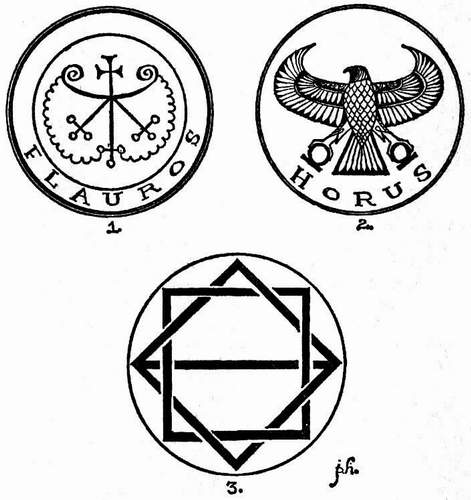
1. Sigil of Flauros
2. Its original derivation
3. Symbol for top of witches' drum
----
Again a Martial incense or pure asafetida gum should be burned in your thurible, and the sigil of Flauros worn, with your pentacle of protection on your breast. (It can be tucked into the same chamois or silk sachet.) The words of power in this process are : "Themesho - Masanin!"
Conjuring to visible appearance is most inadvisable. It is unnecessary in most cases and quite undesirable in this one. If ever a demonic manifestation could be classified as satanic, that of Flauros can.
In order to further enforce the obedience of the demon, after performing the initial identification ritual with fire, water, and wand, many practitioners incorporate into the spell part of the initiation ritual to be found in the last chapter. The sigil is taken from the operator's breast, bound with the cingulum and "hooded" with a black cloth, and then carried around to the various quarters of the circle to the "challenged" with the sword, or Athame, at each quarter. It receives further consecration of fire and water and is finally unveiled and placed within the altar triangle, at which point Flauros himself is constrained to concentrate his presence within the triangle of manifestation.
After charging the demon with his mission of destruction, the operator should not only "licence him to depart," but follow this up with a thorough purification of the room with fire and water, burning in his thurible one of the exorcism incenses mentioned in Chapter 5.
I treat this conjuration sketchily, as it pertains to the field of study of an advanced practitioner, who should be more equipped by dint of experience to handle demonic manifestations of a violent nature, if needs be.
Storm Raising
As a process which can obviously be put to mischievous uses (and in the medieval Christian mind always was), I deal with storm raising and its more far-reaching concomitant, weather working, under this particular chapter heading as a matter of convenience rather than one of hard definition.
Far back into recorded history, powerful practitioners of the occult have generally been credited with powers of weather working. From Kublai Khan's eastern shamans, to the Druids of the British Isles, they have all possessed one skill in common, the mysterious power of controlling wind, rain, mist, and thunderbolt. During the Middle Ages, however, in Christian lands, at any rate, this skill, where demonstrated, was seen simply as another manifestation of ever-present Satan's power. The orthodox Christian doctrine ran thus:
Almighty God in the depths of his wisdom and for reasons best known to himself had temporarily delegated the power of control over the elements to Satan, under whose regency the world had been placed until such a time as the Second Coming took place. Hence, Satan's title, "Lord of this World." This power Satan in turn conferred on witches, wizards, and other practitioners of the Black Arts, all seen as being if not subservient to, then at least in league with him.
The delegated power of weather working was then used either for the ignoble purpose of blighting the crops of God's faithful or, should the effect produced be a benevolent one leading to increase of crops, as a means of leading the unwary astray from the path of righteousness by dint of heretical reliance on devilish practices. Whatever the ecclesiatical dogma, however, witches had their own beliefs and apparently managed to maintain them fairly consistently throughout the various periods of persecution in Europe and England, although the years of total secrecy contributed much to the almost total fragmentation and hybrid diversification of the knowledge such as it exists today.
Apart from the direct application of witch power, whether inherited as an inborn talent or learned in a coven, the actual methods of accomplishing the feat of weather working are about as varied an assortment as you are ever likely to encounter. To one familiar with the weather-working practices over the centuries, at least nine different processes of rain making, for instance, will come to mind. There is the one involving the burning of the desiccated liver of a chameleon on the rooftop; another specifying the casting of flints behind one's back; the flinging of sand into the air; beating up a spray of water from a river with a besom. Boiling hogs' bristles in a cauldron; vigorously stirring the water in a hole in the earth with your ringer; sprinkling cold water over a naked virgin; and, finally, sacrificing a coal-black cockerel.
Most all of these are what Frazer would have categorized as "sympathetic" magical gestures, processes designed to effect their aim by reason of the magical axiom that if you perform an action symbolically, that which it represents may in fact occur, due to the oneness of the universe, the interaction of the microcosm with the macrocosm. This, of course, is the basic working thesis of witchcraft. What Frazer leaves out, however, and it is the thing which differentiates a child's game of make-believe from a genuine witch's magical operation, is that vital occult factor of the deep mind's part in the work. Unless that underlying stratum of physical coexistence here designated as the deep mind is penetrated, the "magic" remains totally within the personal sphere of the operator, at best remaining purely an exercise of surface autosuggestion; at worst, a fantasy game to be taken to in refuge from a hostile outside world. Only when the "deeps" are contacted, only at that point does any real witchcraft take place.
This principle applies as much to the process of weather working as to any other magical field. Most of the work being done in this direction by present-day covens is concerned mainly with the direct use of personal or collective witch power used to "split" or dematerialize cloud formations while under personal scrutiny, and is often performed in an impromptu manner rather than as an elaborately thought-out ritual. The "splitting" process consists of simply a bending of your pyramid powers toward the event which you wish to take place, namely, the dissolution of the cloud mass, an operation taken thus far and no farther. In fact, it is a simple process of binding, in this instance performed on a natural phenomenon rather than on another living person. You "see" the clouds as splitting and parting, harrying them with your fortified will and imagination.
However, for those witches who would prefer a more deliberate approach, the seeds of the process will lie in the use of the archetypal symbolism of the four elements of the wise. In order to raise a tempest or wind, whether it be used to split clouds or tear up trees, contact has to be made with the powers of the air, using as many magical images congruent with the airy principle as appeal to you. The square of Mercury may be of use and Herne invoked. The Kerubic Eagle, or Great Bird, from the watchtower of the east should be called upon. The wand should be used as the emblem of power in your ritual, and you should seek to call up all the stormy, howling, blustering, wind-swept memories of gale and hurricane within your experience, and augment them by rhyming spell within a circle properly cast with Mercurial incense.
For a benevolent zephyr, invoke on a Wednesday with the moon waxing at 8 A.M., 3 P.M., or 10 P.M.; for a destructive storm, conjure at one of the same hours on a Thursday with the moon waning. For an electrical storm, call upon Cernunnos and all the powers of fire on a Tuesday with the moon waning. The Great Lion from the watchtower of the south must be invoked, and your fiery Athame or sword must be brandished as a magical emblem; burn an incense of wrath and chastisement. Thunor and all the storm gods must attend on you! Finally, for mist, cloud, or rain, invoke the Lady Habondia as Ruler of the Great Waters, and that Serpent of Old, Mighty Tiamat, from the watchtower of the west. Burn your lunar incense from Chapter 3, and use your chalice of salt water as the magical weapon of invocation, performing the operation on a Monday at 8 A.M., 3 P.M., or 10 P.M.
Should you wish to "pre-set" the storm for a future unspecified time, an old witch device is to bind the invoked force into a talisman which is then "discharged" at the appropriate moment. About the best device for this purpose is the knotted cord.
Construct your elemental ritual around the action of braiding a cord of red ribbon or yarn, as in the creation of your original cingulum, binding in the invoked forces by means of a repeated jingle of your own composition.
Complete the operation by tying three deliberate knots in the cord, two on the outside, one last in the centre, with words to the effect of:
"As these knots are loosed, so mote the weather be!"
At the time the effect is desired, the operator should take the cord in hand and turn to the correct direction, east for gales, south for thunderstorms, west for rain. He must then summon up all the powers of the required element from the depths of his being with all the force of his will, faith, and imagination. Traditionally, he should at this point whistle thrice for a wind, clap thrice for thunder, or spit thrice for rain. A metrical incantation of intent devised by the operator should then be thundered forth, punctuated by the untying of the three knots in reverse order to that in which they were tied.
Should you be disposed to combine the powers of all three elements and raise a hurricane, then you must perform your three operations on separate occasions, tying the knots on top of the previous knots in the same cord, making three large triple knots in fact. When you release them, again make sure you work in the reverse order, chanting an all-embracing spell which effectively enumerates all the elemental images concerned.
The important thing to observe throughout is that the operator be "possessed by a wave of godhead," using as a triggering device all the previously activated archetypal element images within him. This is where the knack lies.
Weather working is a thing that has to be worked at. The all-important factor is contact with the archetypal elemental powers in their most fundamental form. As a beginner, you would be wise to begin experimenting with this type of magic at a season when the type of elemental activity you are trying to induce would not prove too uncommon. As I have said elsewhere, don't strive for the "impossible." Not yet, anyway, stick to the "improbable" for the time being. You must take great care not to impair your newly established magical faith in yourself at this early stage of your career.
Herbs and Incenses
Finally, to conclude this chapter of magical methods of aggression, here are some leads to the baneful herbs traditionally in accord with such matters. However, I would strongly advise the avoidance of the poisonous varieties in your sachets and incenses; keep to the more chemically harmless ones. Remember, you are seeking to use magical, not physical, power. To pin a case of magical assault on anyone and make it stick is very difficult, whereas the use of very real botanical poisons could easily be construed as a highly antisocial activity, regardless of how the herbs happened to be administered.
The herbal compositions, like the other subject matter of this chapter, fall into two distinct categories; those of a Saturnian or inertia-inducing nature, and those of a Martial one, the herbs of torment. I shall deal with the latter first.
Martial Incenses
This traditional magical Martial Incense of Wrath and Chastisement was composed of the following ingredients:
Gum ammoniac, euphorbium, bdellium, black and white Hellebore roots, powdered lodestone or magnetized iron filings and sulphur, mingled with a few drops of blood of a man, a black cat, and the brain of a hart.
Many of these ingredients are, not surprisingly, poisonous, and two at least of the last difficult, if not objectionable, to get hold of.
In view of that, an alternative more modern Martial incense may be composed more readily of the following:
4 parts powdered dragon's blood resin
4 parts dried powdered rue
1 part dried ground peppercorns
1 part dried ground ginger
1 pinch sulphur
1 pinch magnetized iron filings or powdered lodestone
Alternatively, you may burn pure dragon's blood, sulphur, or asafetida in your thurible. The last two are of an extremely offensive and pungent odour and should not be used in large quantities. Sulphur especially should be used very sparingly owing to its choking fumes.
Martial Sachet Powders
"Fell," or "baneful," amuletic herbal sachets, better known in the United States as hex powders, can be composed from the following herbs and woods used simply or in combination. If required in sachet form, they should be bound with red ribbon or yarn in the waning moon, preferably in the day and hour of Mars (8 A.M., 3 P.M., or 10 P.M.). Most of them should never be administered for consumption in philter form, being extremely poisonous. They are traditional witch herbs, however, and deserve to be mentioned for that reasons, though maybe best left well alone.
The first listed are not poisonous and, as such, are those you should find a place for in your witch's cabinet.
"Strafe" - blackthorn leaves (Prunus spinosa)
Pepper - black, white, and cayenne
Ground ginger root
Dried chilis
Dragon's-blood resin (used as stain by violin makers)
Powdered sulphur (flowers of sulphur)
Pulverized holly chips - Ilex aquifolium (do not eat)
Pulverized ash chips - Fraxinus excelsior (do not eat)
Pulverized hickory chips - Carya alba
Dried stinging nettles - Urtica dioica (and any other herbs or spice of an astringent nature)
Euphorbium - Euphorbia corollata (in the United States, "Snow on the Mountain" - poisonous)
Gum bdellium - balsamodendrum
Wolfsbane - monkshood, Aconitum anglicum (of the same family as the field buttercup, Ranunculaceae - poisonous)
Gum ammoniac (formerly used as a cement - poisonous)
Death cup mushrooms - Amanita phalloides (deadly)
The remaining complement of baneful herbs are those of a Saturnian nature.
The traditional Saturnian incense of wrath and chastisement is composed of black poppy seed, henbane, mandrake root, powdered lodestone, and myrrh. This should be well mingled together and incorporated with the brain of a cat and the blood of a bat.
However, for your purposes, the following recipe can be used quite satisfactorily:
4 parts gum myrrh
1 part dried, powdered yew or juniper
1 part dried elderberry leaves or twigs, powdered
1 part dried, powdered Cyprus twigs
1 part patchouli leaves (or a few drops of patchouli oil)
1 pinch of magnetized iron filings or lodestone dust
Failing this, pure gum myrrh may be burned alone in the thurible.
Graveyard Dust
To the experienced practitioner of witchcraft, this may mean one of three things:
1. Either purely dust or earth taken from a churchyard.
2. Dried, powdered mullein herb (Verbascum thapsus.)
3. Bone ash and asphaltum, also known as mummy dust, originally obtained by grinding up Egyptian mummies. This is a great rarity nowadays for obvious reasons.
Any or all of these graveyard dusts may be used singly or in combination in Saturnian hex powders or sachets, designed to bring inertia or restriction of some sort. Similarly the following "simples" may also be used:
Pulverized myrrh wood
Black poppy seeds
"Holda" berries, leaves, and flowers (elderberry or Sambucus nigra)
Rue (Ruta graveolens] - edible but bitter
Bitter aloes
Sourgrass (sorrel) - Rumex acetosa (edible but sour)
Hawthorn blossoms (Crataegus oxyacanthus)
Periwinkle blossoms (Vinca major or minor)
Pulverized juniper wood and berries (Juniperus Communis)
Pulverized yew wood and berries (Taxus baccata)
Felonwort (bittersweet or woody nightshade - Solarium dulcamara - poisonous)
Dwale (deadly nightshade, devil's herb - Atropa belladonna - poisonous)
Enchanter's nightshade (circaea lutetiana - poisonous)
Twilight sleep (henbane - Hyoscyamus niger - poisonous)
Devil's apple (Jimson weed, Thornapple, devil's trumpet - Datura stramonium - poisonous)
Mark of Gain (Hemlock - Conium maculatum - poisonous)
The last seven may be traditionally magical herbs, but they also happen to partake of the nature of powerful vegetable drugs. Again, as in the instance of the Mars variety, be careful.

