11 - Mopping-up Operations
In his excellent book, Witchcraft, (1) Pennethorne Hughes, talking of the late fifteenth century, says that 'The Papacy fought against the new nationalism, and the new municipalities, with only partial success - and against the Old Religion with an abandon comparable to the last anti-Jewish furies of the retracting Reich in 1945'. The analogy is valid if - and only if - we may accept that the Roman Church felt itself to be as near inevitable defeat as did the Nazi high-command in 1945. May we ...? Yes, I think that we may. I think that the Roman Church realised that, if it was not precisely 'finished', then its spiritual-temporal overlordship in the West was about to be actively challenged, and - perhaps - rejected by the New Men.
Throughout the century, the Church's apparent successes had multiplied. Though the English master-heretic, Wiclif, escaped prosecution through his being protected by another master-heretic, John of Gaunt (faithful to the traditional Plantagenet Old Religion), the Church had been more successful in extirpating heretics in continental Europe. John Huss, for instance, travelling to a conference of Roman clerics under a safe-conduct, had learnt too late how valuable a Roman safe-conduct, issued to a heretic, could be. Huss was burnt in 1415.
In 1457, Bernardo di Bosco was given a commission by Pope Calixtus III to 'root up and utterly extirpate' the witches in the neighbourhood of Brescia.
In 1414, Henry IV of England, had 'obliged' the Church by burning Sir John Cobham, Lord Oldcastle, and other Lollards; but political, rather than religious, considerations induced the Plantagenet (and so Pagan) King to move against the English heretics.
----
[1] London: Longman, Green, 1952.
----
Yet, even with these notable fifteenth-century successes, those in charge of the Church must have reflected that Witchcraft, the Old Religion, having been designated an heretical sect by the Church two centuries before, should (as the Dominicans never tired of reminding their less energetic fellow-churchmen) have been completely stamped out long since. What put the necessary 'extirpating' power into the Dominicans' hands was a 'proof' that Almighty God - the Almighty God of the orthodox Christian, of course - had been so offended by Christian laxity, by Christian infidelity, by Christian backsliding, by Christian tolerance of the heretic and the unbeliever, that He had permitted a Pagan people to eliminate the surviving half of the ancient Roman Empire.
To the hardly Christian princes of the Church, already paganized through their nostalgic, snobbish addiction to the classic works of Greece and Rome, the fall of Constantinople in 1453 had a significance far different from that which was to be read into it by the 'Hounds of God'. The humanist Cardinal Aeneas Silvius Piccolomini, afterwards Pope Pius II, wrote despairingly to Pope Nicholas in July, 1453: 'How many names of mighty men will perish; It is a second death to Homer and Plato! The fount of the Muses is dried up for evermore!' (2)
The Dominican of today is no uneducated man; he was not uneducated in the fifteenth century. But the possible loss of ancient Greek manuscripts was a catastrophe that he did not labour, did not even mention, when he set out to make European flesh creep at the spectacle of the Turks' conquest of the Empire of the East.
For - and this is a fact of history that hardly one person in ten thousand now remembers - the Eastern Church was not, as Constantinople fell, 'Orthodox' any longer. It was no longer separated from Rome by the Orthodox refusal to accept the 'filioque clause'. The last Emperor and his prelates and his court and his generals had assembled in St Sophia, and there, as the price of the military assistance that Rome promised (though never gave), accepted the principles of Roman Christianity, and healed the five-hundred-year breach between the two branches of Christendom. It was a city of fellow Roman Catholics that God, in His not-so-inscrutable-as-all-that wisdom, had permitted to fall to the devil-worshipping Turk.
----
[2] Despite this and similar evidence of widespread classical learning in the West long before the fall of Constantinople, the foolish myth goes on being repeated, that only with the fall of Constantinople and 'the flight of Greek scholars with ancient MSS,' did the Renascence begin.
----
The Dominicans, in fact, did what Hitler was to do in his search for power five hundred years later: offer to 'restore order'. It is an appeal to which the comfortably-off bourgeois and small tradesman and petty artisan can rarely be indifferent. And the fifteenth century, for all its wars and epidemics and fears of the Barbarian at the Gates, was a century in which what we know now as Big Business first made its appearance.
It was in this most formative of all centuries that a Benedictine monk established the profession of accountancy by inventing the double-entry method of book-keeping; and the great international banking families, such as the Fuggers of Austria, anticipated the wealth and the influence of the Rothschilds. As Sir Thomas More was to observe in the next century, great changes had come upon agriculture; in his telling phrase, 'the Sheep had eaten up the Men' - and landowners found it more profitable to use their land for grazing than for crops. (The Black Death, by halving the population, had forced the price of labour up, but it needed only one or two shepherds to control a flock of a thousand strong.)
To return to Hitler. It was his dangling the prospect of Order's preservation before hopeful human eyes which enabled him to convert his conquered enemies into his most active and ruthless helpers - at the war's end, the elite Waffen SS, 800,000 strong, contained no fewer than 400,000 foreign ex-prisoners of war: French, Dutch, Belgians, Poles, and so on. Every second man in the Waffen SS was a converted enemy of the Fuehrer. And why had they accepted service in the Waffen SS, these 'lifelong enemies' of the Nazis? To fight for Hitler, to fight for the Third Reich, to fight for National Socialism? Not a bit of it! To fight for that shadowy but very real desideratum: Order. To fight - as, indeed, men have always fought - to repel the Barbarian at the Gate ....
They had been a backward people, whether or not they sprang from the abnormal union of female demons with travellers heedlessly making their way through the dark Hercynian forest. For centuries they had boasted of their contempt for, and resistance to, the luxuries which (in their opinion) had sapped in other peoples the strength, the ruthlessness, the tolerance of pain, the maniac will-to-win which (in their opinion) were the glories of the Natural Man; the particular merits of the Germans - 'The People', as they called themselves. Everything about them was simple: their way of living, their food, their huts, their abstention from city-making, their rejection of an hereditary in favour of an elective monarchy, their coronation rite (merely raising the new King on a shield), their simple theology and cosmogony, the simple attributes of their simple Gods.
Long after the rest of Europe, with the exception of their fellow-Teutons, the Scandinavians, had accepted - at least outwardly - the forms of Christianity, the Germans remained obstinately 'pagan', though, when they fell, as did the Franks, under any really established and persuasive cultural influence, such as (in the Franks' case) that of Romanised Gaul, their self-conscious Teutonism could not put up an effective resistance. The Franks accepted Roman institutions, Roman speech, Roman ideals. But the hard core of Germanism, behind the Rhine and rivers further east, remained almost unaffected of that synthetic but still essentially Roman culture which had been influencing men's ideas for a thousand years. Not until the first millennium of our present Era had passed could it be said of the Germans that they had accepted Christianity even nominally.
However, they resembled others in this: that they displayed all the zeal of the reluctant and tardy convert.
Inherent in their genetic formula must have been a genius for organisation; still with them, and expressed in many ways, from their 'neatness' and love of physical cleanliness, to their affection for written records and statistics; (3) from their passion to be regulated by 'authority' to their passion for imposing conformity to their own standards on others.
----
[3] One of the least human addictions brought to America by German immigrants, and now re-exported by 'native' Americans for the threatened dehumanising and not-so-far-distant destruction of the world.
----
The Old Religion had survived, in a more or less pure form, until two Germans, strong, ruthless with all that humourless efficiency which has made this regrettable racial type the Scourge of God, assumed the responsibility of extirpating the Old Religion and that corrupt aspect of it to which, properly, the name 'witchcraft' should be reserved - that is to say, the Old Religion perverted by the conversion of its original Life-Death dualism into a Faith where Death has become the dominant.
As Pennethorne Hughes says:
In 1208 the Albigensian Crusade was preached by Pope Innocent III, and the vigorous, greedy cavalry of the north, led by Simon de Montfort, uncle of the hero of the text-books, pillaged the south and brought flames and desolation to the valleys of Languedoc. The Holy Inquisition of St Dominic was deputed to move in, with the full powers of the later black-coated police of totalitarianism, to stamp out the heresy which remained ...
With persistence and with pious thoroughness the Inquisition did its work, and then turned north to grapple, aided by increased experience, with the manifestation of Satan in the north: witchcraft ...
There are many instances in the examinations of the Cathari and of the Templars ... of conceptions which were to become more apparent in the evidence of the witch-trials ... It may well be that the Master Devils of the witches, who often were educated men, had a knowledge of the Eastern cults which were incorporated in these throw-backs into increased asceticism. If so, it would account for the fact that the palaeolithic memories of the witch-cult coincided so conveniently for the Inquisitors with the external practices of the very different heresies of the south. But a skilful Inquisitor can manufacture many parallels ...
As, for the next two-and-a-half centuries, the world was to be shewn ...
In any religious Who's Who, the academic records of Heinrich Kramer and Jakob Sprenger would read impressively. Kramer's intelligence and diligence early earned him generous rewards; whilst hardly out of his teens, he was appointed Prior of the Dominican House in his native Schlettstadt, some twenty-six miles south-west of Strassburg. With the high Dominican distinctions of Preacher-general (P.O.) and Master of Sacred Theology (S.T.M.), Kramer's well-disciplined zeal soon brought him to the attention of the Highest in the Church. At some time before 1474 he was appointed Inquisitor for the Tyrol, Salzburg, Bohemia and Moravia (hotbeds of heresy, these last two!). 'His eloquence and tireless activity' - especially the latter - 'received due recognition at Rome,' and he was appointed Spiritual Director of the important Dominican church of Salzburg, and the indispensable 'Goebbels' of Salzburg's Archbishop, who - in official letters at least - had high praise for his dedicated, bigoted, zealous, man-hating 'assistant'.
Here, though not imprisoned save by the lunatic constrictions of his own mind, Kramer wrote his Mein Kampf - that treatise on Witchcraft which circulated in MS, and which, later, was to be printed and circulated throughout the West as the notorious Malleus Maleficarum - 'A Hammer for the Witches'.
Jakob Sprenger was a Dominican of similar background, and of almost identical psychic pattern. Entering the Order at the age of sixteen, Sprenger soon impressed by 'his extraordinary genius'. Graduating, as a matter of course, as Master of Theology, Sprenger earned the warm commendations of his spiritual superiors by his zeal as a reformer within the Teutonic Province of the Dominican Order, and in 1468 (when he was little more than thirty), the General Chapter of the Dominicans sent him to lecture on the Sentences of Peter Lombard at the University of Cologne.
On June 30, he was elected Dean of the Faculty of Theology at Cologne; in the following year, the Master-general of the Order, Fra Salvo Cassetta, appointed Sprenger Inquisitor-extraordinary for the provinces of Mainz, Treves and Cologne (three Roman military towns, in which the tradition of 'paganism' was still strong). 'His activities were enormous, and demanded constant Journeyings through the very extensive district in which he had been assigned.' In 1488, Sprenger was elected Provincial of the whole German Province, 'an office of the first importance'. (4)
----
[4] Montague Summers. From the Introduction to his translation of Malleus Maleficarum; London: John Rodker, 1928.
----
But, in the meanwhile, he had met and formed his literally diabolical partnership with Heinrich Kramer.
How did they meet? They were, we know, members of the same energetic, officious, sadistic Order; both had been 'marked for promotion' from the moment that they joined the Dominican Pabstjugend. Both were Masters of Sacred Theology; both were of the kind which is always 'news', especially the 'news' which concerns itself with interdepartmental 'shop'.
'Heard the latest about Kramer?' 'Heard what's happened to Sprenger?' And it was always interesting; even though it might have provoked jealousy among the less talented, the less zealous, the less vigorous, the less lucky ... the more human. • When they met, and the separate glittering careers were offered the brighter promise of an even more glittering partnership, the rapport must have been instantly, instantaneously, established. They can have needed no words to lay out and sign their devilish compact in all its horrible implications, any more than Burke and Hare needed to spell out the vampire dynamic of their instantaneously proposed and ratified partnership.
Who brought the pressure to bear on the weakling Pope Innocent VIII - that pressure which was necessary to secure the one essential element that Rome (and not the Order) had to supply - we cannot say. That the pressure originated in the Kramer-Sprenger partnership is beyond dispute; but who undertook the personal contact with His Holiness? - whose task was it to blackmail the Pope into commanding the Holy War against the Heretic? - the blackmail here being implicit in the request: 'Do you wish the world to know that you won't give battle to Satan?'
Pope Innocent VIII knew a losing hand when he saw what he was holding. He was a 'modern' Pope, product of the new Humanism. He certainly did not believe in the Devil; indeed, except in a highly academic fashion, it may fairly be doubted that he believed in Christianity - a Palestinian peasant, ignorant of both Latin and Greek, was hardly a Renascence Pope's idea of a worshipful God.
But he knew when he was beaten.
He signed on the dotted line ... in the warmly argued ('Yes, yes, We approve your reasoning ...') interest of Law and Order.
On 9th December, 1484, speaking to the Faithful, urbe et orbi, as the Vicar of Christ, Innocent issued what is still the Papacy's most important and most famous Bull, Summis desiderantes affectibus.
In this Bull, Innocent, 'Bishop, Servant of the Servants of God', deplores the power and prevalence of the witch organisation, and deputes Kramer and Sprenger to 'inquire' into these dangerous matters throughout Northern Germany, particularly in the provinces and dioceses of Mainz, Cologne, Treves, Salzburg and Bremen, 'granting both and either of them an exceptional authorisation, and by Letters Apostolic, requiring the Bishop of Strassburg, Albrecht von Bayern (reigned 1478-1506), not only to take all steps to publish and proclaim the Bull, but further to afford Kramer and Sprenger every assistance; even calling in, if necessary, the help of the secular arm.' (5)
Kramer had already written Malleus Maleficarum, and this had had a considerable circulation, in manuscript, among interested persons. However, when the now Papally-authorised Kramer and Sprenger decided to publish the work, as the complete manual of heresy-hunting and heretic-exterminating, a difficulty presented itself: though not a difficulty that Kramer (6) or Sprenger found insuperable.
The book appeared in printed form in 1486, a year in which the University of Cologne was still responsible for the censoring of all theological works. When, in the usual and the required way, Malleus Maleficarum was submitted to the University censors for a 'purely formal' imprimatur, only four of the censoring body could be found to give the book their reluctant and guarded approbation, whilst the rest - the majority - of the Board of Censors refused to comment. 'Nothing daunted,' says Dr Gardner, 'this precious pair of rascals proceeded to forge a document which purported to shew the approbation of the whole Faculty.'
----
[5] Montague Summers, op cit.
[6] He is sometimes known by the Latinised form of his German name, Institor (not 'Institoris', as is sometimes given). Both Institor and Kramer mean 'stallholder, petty shopkeeper, huckster'.
----
In the following year, to 'teach them a lesson', the Censors of Cologne were deprived of their function, and the task of censoring theological works transferred to the Bishop. The forgery was not discovered until 1758; though not then made public. Not before 1898 did the then archivist of Cologne, Josef Hansen, reveal the simple but effective means by which Kramer and Sprenger had deceived the world.
Copies of Malleus intended for circulation in Cologne had the forged Approbation omitted; others included the forgery - and though the fraud must soon have been known in Cologne, the Censors deemed it wiser to say nothing. The fraud was eminently successful, since both Catholic and Protestant witch-hunters came to accept Malleus as the final authority.
And, indeed, so it is.
Montague Summers, though writing of Malleus with approval - 'There can be no doubt that Father James Sprenger was a mystic of the highest order, a man of most saintly life' (7) -is right when he says: 'Certain is it that the Malleus Maleficarum is the most solid, the most important work in the whole history of witchcraft.' It may be doubted that many people will agree with Mr Summers when he adds that 'One turns to it again and again with edification and interest' - it must churn the bowels of all but the psychopath — but one will agree that 'From the point of view of psychology, from the point of view of jurisprudence, from the point of view of history, it is supreme. ...
'What is most surprising,' Summers continues, 'is the modernity of the book. There is hardly a problem, a complex, a difficulty, which they [Kramer and Sprenger] have not foreseen, and discussed and resolved.
'Here are cases which occur in the law-courts today, set out with the greatest clarity, argued with unflinching logic, and judged with scrupulous impartiality.
----
[7] A remark as hard to account for as Winston Churchill's already-quoted reference to Stalin - made after a full account of the 'cynical betrayal' of the Poles in German-occupied Warsaw - as 'that great and good man'.
----
'It is a work which must irresistibly capture the attention of all men who think, all who see, or are endeavouring to see, the ultimate reality beyond the accidents of matter, time and space.
'The Malleus Maleficarum is one of the world's few books written sub specie aeternitatis.'
Josef Goebbels, who also had the advantage of a religious education, could not have praised more warmly this most evil of all the world's books.
It is true that Malleus Maleficarum 'has everything' - there is not the smallest nut, screw or bolt in the complicated mechanism of Terror that these two priestly Untermenschen have overlooked, and whose dimensions and functions they have not meticulously described. Perhaps, though he did not intend it as such, Summers's tribute to the 'impartiality' of Malleus Maleficarum may be justified. In its inhuman way, Malleus Maleficarum is impartial. Only the Orthodox are right; all others are wrong.
It is impartial in that its terrifying code makes no distinction among shades of Non-conforming. All Non-conforming is wrong; all Non-conforming is criminal; all Non-conformers must be stamped out. Armed with this 'authority', the Orthodox - all Roman Catholics up to about 1530; after that 'Independent Catholics', Lutherans, Calvinists, etc., as well as 'genuine' Roman Catholics - went to work to stamp out Non-conformity. It is the opinion of this writer that very great success attended their efforts.
As Dr H.C. Lea said: 'Malleus Maleficarum fastened on European jurisprudence for nearly three centuries the duty of combating the organised society of the Witches.' Summers adds: 'The Malleus lay on the bench of every judge, on the desk of every magistrate. It was the ultimate, irrefutable, un-arguable authority ....'
Indeed, if for the word 'witchcraft', one substitute the words 'sabotage', 'anti-social behaviour' or even 'Communism' or 'Fascism' in the text of Malleus, one will agree with Summers's comment on the modernity of the book. Here, for the guidance of Nonconformity-extirpators, is the priestly injunction to practise every fraud, every dirty trick, every miserable deception, upon the accused, in order, to convict them. As for 'evidence', even the hearsay evidence of a convicted 'witch' should be sufficient, 'for God would not permit a false accusation to lie'.
Here is the true Diabolism. To read through the seemingly endless, so gravely written, list of 'Questions', is to find oneself in the panic claustrophobia of nightmare.
Question XIII. Of the Points to be Observed by the Judge before the Formal Examination in the Place of Detention and Torture ...
Question XIV. Of the Method of Sentencing the Accused to be Questioned: and How she must be questioned on the First Day: and whether she may be Promised (8) her life ...
Question XV, Of the Continuing of the Torture, and of the Devices and Signs by which the Judge can recognise a Witch; and how he ought to Protect himself from their Spells. Also how they are to be Shaved in those Parts where they use to Conceal the Devil's Marks and Tokens, together with the due Setting Forth of Various Means of Overcoming their Obstinacy in Keeping Silence and Refusal to Confess ...
Estimates of the number of accused who suffered the extreme penalty for having been so unlucky as to have attracted a neighbour's spite or an Inquisitor's notice varies between 200,000 and 400,000 - the rate of accusations and killings jumped considerably when the lawyers, seeing the lucrative nature of the business, clambered on to the financial bandwagon: at Toulouse, 400 people were put to death in a single day; in the district around Lake Como, a single year's toll of victims was more than one thousand.
No one, at the beginning of this Terror, dared oppose it. In sending Kramer* and Sprenger forth, armed with plenary powers to hunt out and destroy 'heretics' and 'Devil-worshippers', Pope Innocent VIII used a quite unambiguous threat.
----
[8] It is explained, for the guidance of Inquisitors, that this 'solemn' promise need not - nay must not - be kept!
[9] Kramer is no uncommon name in Germany. Yet the reader must already have been struck by the sinister coincidence between the name of one of history's two Arch-Inquisitors and that of 'The Beast of Belsen'. There is an heredity of the soul more dominant than that of the body.
----
We decree and enjoin that the aforesaid Inquisitors be empowered to proceed to the just correction, imprisonment and punishment of any persons, of whatever rank and high estate, correcting, mulcting, imprisoning, punishing as their crimes merit, those whom they have found guilty. THEY are authorised to call on the help of the secular arm, and anyone, of whatever rank, pre-eminence or dignity who opposes them is threatened with excommunication, and yet more terrible penalties and punishments, without right of appeal.
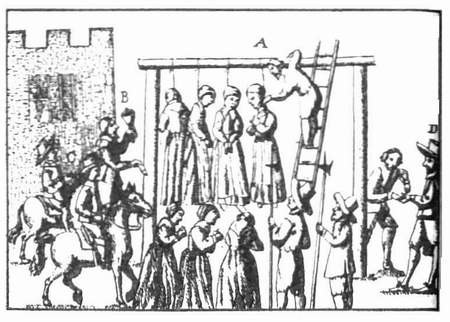
Hanged by the neck: Here are seven witches up for topping; four despatched, three still to be served. 'A' is hangman, 'B' the bellringer, 'C' two constables, and 'D' the witchfinder taking his reward in cash.
It may well be that the Pope, in authorising plenary powers to the two Inquisitors, was submitting to no light pressure, nevertheless, it was Christ's Vicar who signed the document, and those named in it would see that its conditions would be observed to the last letter of a new Law. Thus were handed over to Kramer and Sprenger not only the estates and lives of all Christendom (Jews were not 'heretics', and were generally exempt from the Terror), but those social and legal rules by which the society of the late fifteenth century had been slowly organised.
One is reminded of the careful stock-keeping, in specially-printed ledgers, of the 'yield' from those who were murdered in the German prison-camps. The shoes, down-at-heel, the shabby clothing, the false teeth, the trusses, the artificial eyes and limbs, the eye-glasses, the tattered suitcases and hold-alls, and, last but not least, as they say, the hair, the bones and the minimal fat.
To the quartermasters' staffs who picked over the rags and bones; who sorted the pitiful (but still valuable) loot; who recorded, in the neat German script or on the always-well-serviced German typewriters, the meticulously accurate totals, and presented them for 'signature' to the departmental head; this most squalid of all graveyard prowlings must have seemed like 'just another job'.
A job which earned its holder pay; promotions to higher rank, greater 'responsibility'; a pension ... What supported the death-dealing regime of the Nazis was not merely the negative pressure of the threat - 'Join us, or else ...!' - but the positive pressure of financial advantage to those who put their decency aside and opted for a share of the loot
Sprenger and the earlier Kramer understood very well the pressures to which all human being are vulnerable; and the first constructive step that any tyranny may take is in the creation of vested interests among the uncommitted - those Laodiceans who are prepared to serve any master, or none, provided always that it be worth their while.
Kramer and Sprenger saw to it that it was worth their while. All 'miracles of German recovery', no matter in which century one unhappily encounter 'the miracle', are characterised by that strict record-keeping, that 'honest' attention to the details of accountancy, that generally 'business-like' attitude towards all the malversations of life and perversions of death which have so impressed the American capitalist and scientist, and have so endeared the 'hard-working', 'efficient' Germans to their modern conquerors. Sprenger and Kramer were just as 'businesslike'. There was no funny business in the accountancy of Terror; crime and punishment moved to a fixed and 'official' scale of charges.
A Tariff of Torture (10) from 'saintly, civilised' Cologne has survived from the days when the Inquisitors set up the mechanism of physical and spiritual mass-murder. There are forty-nine items in the tariff, all the charges of which were authorised by the Archbishop of Cologne. As Edgar Peel and Pat Southern observe, in their The Trials of the Lancashire Witches, cutting out the tongue and burning the mouth with a red-hot iron was, in the opinion of the Archbishop, when 'costing' the torturers' work, equal in value to five times that given for the flogging of a prisoner.
Admirers of the current 'German miracle' will, no doubt be interested in the orderly manner in which the Archbishop-authorised charges for torture are set forth:
For terrorising and shewing the instruments of torture: 1 thaler
For arranging and crushing the thumbs for the first degree of torture: 1/4 thaler
For the second degree of torture, including the setting of the limbs afterwards: 2 1/4 thalers
'Those in charge of tortures and executions,' write the authors of The Trials of the Lancashire Witches, 'were instructed to "submit afterwards their accounts, with all their vouchers, to the Treasury of the Archbishop." And, in an instruction which should delight the heart of any good trade unionist, it is made clear that "only the executioner, and no stranger, shall be employed for whatever executions have to be done." All these costs formed part of the heavy expenses of a trial, and had to be paid for eventually by the family of the accused.'
It was, doubtless, the envy aroused by 'seeing all this good money go to waste' which attracted lay lawyers to the cannibal feast, and which, in the next century, led to the transfer of the actual witch-hunting and witch-prosecution to the 'pious' civil authorities, which, for all practical purposes, meant the lawyers. If the 'restoration of Law and Order' had been undertaken by the Dominicans, the noble adventure was happily taken up and continued by sadistic, officious and money-mad laymen lawyers.
----
[10] The document is reprinted in Rossell Hope Robbins's Encyclopedia of Witchcraft and Demonology, and quoted in The Trials of the Lancashire Witches; Newton Abbot, 1969.
----
I once underwent a 'suitability test' for a well-paid and fairly important position with an international firm, which trusted its management to produce millions of pounds' worth of highly saleable electrical apparatus, but not to select additions to its staff. We were on the 'short list', and by invitation assembled in a large room, where we were given printed forms, all of which bore the name of an 'educational test' supplier in Chicago. The tests were not difficult: simple arithmetic, spelling, visual and written puzzles - a test not half as advanced as that taken by any pre-1939 British soldier when gaining his corporal's stripes.
I remember one question of all the printed dozens - which is why I recall the 'test' in this book: 'Which would you rather be: a farmer or an insurance agent?'
Now the catch was this. One was not permitted, by the rules of this exercise in mumbo-jumbo, to answer 'Neither!', nor was one permitted to leave the question unanswered. One had to make a choice. So, as I would - driven by necessity - rather spend my servitude on a farm than in an insurance office or (my trousers neatened with bicycle clips) on suburban housewives' doorsteps, I answered, 'Farmer'.
There must have been fifty people in that room - not all rivals of mine, by any means; the firm was large, and it gathered all its 'short list' applicants-for-jobs together, and examined them in the same place on the same night.
And each of us had had to express a preference for the life of a farmer ... or of an insurance agent. We had no choice. Up to fifty of us must have expressed the desire to be farmers; up to fifty must have expressed the desire to be insurance agents. The computer, which would 'analyse' our replies, would -never having been told of the Hobson quality of our choice -register in its damfool innards the 'fact' that some of us wished to be fanners; some insurance agents.
Perhaps, in some insane 'readjustment of the labour valency', some evil UnterSprenger will knock at my door, hand me a railway-warrant and a pitchfork (or a pair of bicycle clips) and tell me to report for the work for which, long ago, I expressed a preference. Well, I did, didn't I ...?
What, in the opinion of so many - of far too many - people, has justified, not the cruelty of the witch-hunters, but their claim that they had something 'evil' to extirpate, is the so-called 'unanimity of the evidence'. Save for unimportant differences - names of towns, composition of the covens, choice of ritual masking (goat, stag, bull, etc.) in which the Black Man appeared, to feast and sexually possess the female worshippers with his artificial penis - the evidence is substantially identical, whether it come from Kilkenny in 1324, Lorraine in 1496, Essex in 1566, Aberdeen in 1597, the Basses-Pyrenees in 1609, Lille in 1661 or Salem, Massachusetts, in 1692.
What one should remember is that the evidence taken under threat of torture or torture itself could not have varied greatly from country to country or age to age. The accused did not tell what 'abominations' they had committed at the covens - they were not invited to tell. All that they were invited to do was to confirm what the judges told them that they had done; and what the judges knew had happened was all to be found in Malleus Maleficarum and the books of commentary that it had generated - Lawyer Henri Boguet's Discours des Sorciers ran into twelve editions in the first twenty years of its existence. As Summers said, Malleus was on the bench of every judge, the desk of every magistrate: the ultimate authority.
Now all that witches did - or were supposed to do - was described in outline in the Bull of 1484; in minute details in Malleus. The Questions were all drawn up: all that an inquisitor, religious or lay, had to do was to question the accused on the lines laid down in Malleus. Later commentaries; of Bodin, De l'Ancre, Boguet and the rest; loaded the scales even more heavily against the witches, for these 'guides' to witch-hunting, contained besides the original Questions of Kramer, actual cases, giving the name of the accused, of the witnesses, the evidence and the — almost always - confession (which never failed to agree completely with the points of the charge).
It was the old Farmer or Insurance Agent? choice, five hundred years ago and in far more sinister circumstances.
Since there was a vested interest in finding and condemning witches, does this mean that the three-hundred-year Witch-Hunt was a vast fraud, and that, despite the torture-extracted 'confessions', there was no such activity - anti-social or otherwise - as organised Witchcraft?
There was a fraud - a gigantic fraud - but there was also organised Witchcraft. The fraud was in persecuting Witchcraft as though it had been organised to undermine the existing social structure, and as though the Old Religion of the worship of Nature through the 'sacrament' of the act of physical reproduction were the same as its dark offshoot, Diabolism.
It is clear that those who organised this attack on 'Heresy' were aware of the differences between the 'white' witchcraft of the Old Religion and the 'black' witchcraft of the true sorcerers and diabolists. There were, of course, sound political reasons for the attack on the Witches, just as there were sound political reasons for some later Germans' no-holds barred persecution of Jews, Gypsies, Jehovah's Witnesses, Seventh Day Adventists, Quakers and other non-conformers. In both cases, that of the Roman Church and that of Hitler, it was a show-of-strength, in the one certain way of getting the message home: by a display of Frightfulness.
Why the Church's well-planned and ruthlessly executed effort failed - or only partially succeeded - where Hitler's persecution frightened the rest of the world into giving him his own way for seven years, was because the Church could not gain the undivided attention of a shocked world. There were distractions - distractions on which the Church planners had not reckoned, and against which they could not guard.
In 1492, Columbus broke the trade-secret of the trans-Atlantic route, by crossing to Haiti (thinking that he had landed in India); five years later, Vasco da Gama rounded the Cape of Good Hope; a year or two more, and Magellan had opened up the western route to the Far East by rounding Cape Horn. Printing had been put on a commercial basis, and men were reading - not always what the Church ordered them to read.
Worst of all, though non-Christian royalty had abandoned all but a token respect for the Old Religion, they had given their allegiance to the more 'practical' Diabolism - or, rather, to that sorcery associated with Diabolism which offered chemical triumphs: the control of the political situation through the poisoning of enemies, and an adjustment of shaky national balance-sheets by the alchemical manufacture of gold. (Henry VIII, having spent his father's private fortune of £4,000,000 -worth some £1,000,000,000 in today's rocky currency - preferred to balance his books by debasing the coinage; the Emperor Rudolph II, by encouraging alchemists.)
Then there was the Reformation, and though both Reformers and Romanists stepped up the persecution of witches, they were not united in the attacks - the attack was not made for a common purpose: to 'restore Law and Order, to extirpate Heresy, and to Defend Christianity against the Barbarian at the Gate'.
The first printed Bull (1506) promised eternal damnation to those who bought their alum - for the 'white tawing' of leather and other purposes - from the Turks; the reason for the threat of hell-fire being that two Italian families, allied by blood and marriage to the Pope, had the control of alum in Europe. Even the most dedicated Roman Catholic who needed alum at prices cheaper than those of the Italian monopolists, defied the threat of hell-fire, bought himself an Indulgence, and got his supplies from the Infidel.
A persecution which had begun in a narrow, still-mediaeval world had been carried through to a world of suddenly and immensely expanding horizons, of a sudden access of wealth, of a sudden access of secular learning, of the beginnings of organised religious and political freedom, and of more than the beginnings of the mechanisation of industry - the stocking-frame for the mechanical knitting of stockings, caps, etc., was introduced in the first Elizabeth's reign. And, most significant of all, scientific methods of soil-care, tilling, reaping and cultivation generally upset the ages-old traditions of the countryside.
There is a connection between Louis XIV's refusal to sign the death warrants, in 1667, of some condemned Norman witches and the decay of the feudal system in France; it was Louis who, by causing his nobility to gather around him in his court, dissolved the last remaining links which bound the Lord to his tenants. And, in the following century, a Norwich solicitor, Jethro Tull, by inventing the mechanical dibber, was to create such unemployment on the land that the proletariat necessary to launch the Industrial Revolution as factory-hands would be ready and waiting.
The fact is that, even as Kramer and Sprenger launched their all-out attack on witchcraft, the social conditions which had produced and protected the Old Religion for so long were changing. The religion of the countryside would have died of malnutrition; there was no need to torture it out of existence.
It was the regulated invariability of the questions put to the accused witches which produced the apparent invariability of the evidence. But, over and above the torture-extracted, despairing admissions of 'guilt' (Kramer and his followers recommend the now popular torture of 'deprivation of sleep'), there seem to be what the Inquisitors claimed: free, frank, voluntary, spontaneous and almost, one would say, enthusiastic declarations of loyalty to the Old Faith.
It is not merely among the old, the diseased, the poverty-stricken, that one finds the voluntary confession; as though, suicide feared or despised, the confessant looked to a certain means of ending a life grown intolerable. On the contrary, we have the voluntary confessions of the young - sometimes of the very young. Girls of tender age, attractive, comfortably-off, with a lifetime of bourgeois comfort promised them. Some -many, if we may accept the testimony of their persecutors -went to death 'joyously', impressing judges and torturers with the victims' brave-proud bearing, as they went to death 'in sure and certain hope of the Resurrection to eternal life'.
The all-out campaign of the Nazis against 'dissidents' lasted for little more than four years; that mounted against the Old Religion covered a century, even at its peak. Why did the witches, if they had an organisation powerful enough to tempt the Church (and later the non-ecclesiastical authorities) into attacking it, and numerous enough to supply victims for nearly four hundred years after the Bull of 1484, not rise against their persecutors? According to the Church, the Witch Organisation penetrated into every social stratum; included members from the highest, as well as the lowest, social ranks. Why did they not resist?
The same question was asked of the persecuted Jews in the Nazi Terror - and not answered. It is true that the Jews rose in Warsaw - and were exterminated; but (say those who were not in the prison-camps), would it not have been better to die resisting the Nazis than to rot to death, tortured or not, in Dachau, Maidanek, Belsen and all the other foci of evil?
To answer that question, one would have to put it to those who had - by our hypothesis - a choice. Perhaps the answer is to be found in the fact that, for all the totality of 'the Final Solution', men and women and children did survive the infamous torture-chambers and the hardly less horrible life-in-death of the prison-camps. For such survivors, their hope-against-hope was justified in the event. They did survive. As they had hoped, against all the evidence, against all reason, to survive.
And - this must clearly be borne in mind - though a French lawyer of the sixteenth century, Nicolas Remy, could boast of having burnt nine hundred witches in sixteen years, all the psychological disciplines of terror were devised long before the Nazis came to power. The slander-campaign, the house-calls, the organised ostracism, the night-arrest, the disappearance into prison, the secret trial, the accusations of friendly neighbours - even of members of the accused's family: all these were well understood in the fifteenth century; nor were the general warning punishments so familiar to us from Nazi practice lacking to terrorise a population into submission, and to persuade them of the uselessness of protest.
The ancestors of the men who erased the Czechoslovakian village of Lidice, the French village of Oradour, and God knows how many villages in the lands of the 'sub-human' Russians and Poles, had fully mastered, by the sixteenth century, these specialised techniques in Frightfulness; they had certainly learnt the arts of Erasure.
Two villages near Treves were completely erased; in another two, only a handful of people were permitted to survive. The techniques of Oradour, where the victims of the Herrenvolk's sadism were burnt alive in church and barn, may be recognised in sixteenth-century Rhineland, where a favourite method of mass-murder of witches was by burning them in a hut of straw; another World War II technique may be recognised at Niesse, in Silesia, where a specially-built oven consumed forty-two living men and women.
Then again, were the judges sane? It is no proof of insanity -merely of evil - when the French lawyer, Henri Boguet, lays down that:
I maintain that not only a child witch who has reached the age of puberty, but even one who has not, should be sentenced to death. Yet I would not in such case employ the usual penalty for witches, but some gentler means, such as hanging.
Boguet, who dedicated his manual of witch-hunting to the Vicar-general of Besangon, recommended that a child witch be made to watch the killing of its witch-mother.
But Boguet is certainly exhibiting signs of insanity when he gravely testifies to the effect on the victims of spells laid by witches:
Witches cause him whom they have bewitched to void, sometimes from the mouth and sometimes from the bottom parts, needles, hairs, stones and papers. I myself have seen an infinite number of such articles, among them balls, locks of hair and pig's bristles ... one of his sons voided by the penis five or six paper notes and some peas. The notes were covered in strange characters and the peas were wrapped in hair.
Most witches, brought at last before the judges - ecclesiastical or lay - could look for as much impartial justice as, say, the surviving plotters of 20th July attempt on Hitler's life could have expected from the bestial judge, Fritsch. From the very beginning of the attack on the Old Religion, the accused must have realised that an accusation meant a condemnation, no more, no less. There were no acquittals. To be suspected even was a crime ....
The hundreds of thousands of accused were taken singly; and in their arrest they served to terrify those not yet taken, If we think that the twentieth century has 'revealed' the subtle mechanisms by which Terror imposes itself on mankind, it is only because we have not studied the operations of those who mounted the all-out, no-holds-barred attack on the Old Re-legion at the end of the fifteenth century.
In abandoning the true Old Religion for the dubious practices of Diabolism, the royal and aristocratic Old Believers, whose influence had protected the upper, middle and lower class Believers - especially those members of the Roman clergy who still clung to the ancient Faith - now stood aside and lifted no finger no protect the Faithful from the assault of the witch-hunters. The Old Religion had ceased to be fashionable; it seemed now to be a peasants' faith - even a peasants' superstition. Toxicology and alchemy, and, in the seventeenth century, true Diabolism, mixed with blasphemous perversion of the Christian Faith. Unprotected by their once powerful protectors, the men and women of the still uncorrupted Old Religion found themselves deprived of everything but their pride.
It is this fact which explains their apparent lack of resistance; their willingness to proclaim their Faith in lyrical terms, and to go joyously to the death of martyrs. It is true that they even managed to wring from their persecutors the reluctant testimony to the Old Believers' constancy in their faith.
In two centuries and a half, most organisations may be wiped out, and the Witch-Cult, deprived of its organisation, was bound, at last, to die. All the upper class had abandoned the Old Religion; those of the middle classes who remained true were killed or frightened off. In the middle of the seventeenth century, a Madame Bourguignon, of Lille, managed a home for girls of the lowest class, 'poor, base-born, from bad homes; and, for the most part, so ignorant of the facts of their eternal salvation that they lived as ignorant of it as beasts'. In 1661, Madame Bourgugnon found that thirty-two of these girls were 'worshippers of the Devil', and went regularly to the Sabbat Already, we see, the Old Religion is now the faith only of those 'of the lowest class'.
By the end of the seventeenth century, in all the more advanced countries of Western Europe - and even in the American colonies - fashion will give the coup de grace to a dying faith. It will survive, of course, in the most out-of-the-way places, reviving with a curiously impressive strength at times of national calamity, when orthodox helps to faith and hope seem ineffective. And some of the beliefs from the Old Religion will survive as mere superstitions, as mere unthinking mental reflexes. When the gallant British tars of 1805 'tapped the Admiral' they were obeying an ancient impulse earlier perhaps than the first stirrings of a conscious religious sense.
To bring back the corpse of Nelson to England for burial, the ship's surgeon had the dead Admiral placed in a cask filled with rum. When the cask arrived in England, the admiral was found to be 'high and dry'. The sailors had 'tapped the Admiral'; drunk the rum.
This story is often quoted to shew the depths to which an addiction to strong liquors would bring the early nineteenth century matloe; but the story has quite a different significance. The sailors, in 'tapping the Admiral', were not broaching a rum-cask, but partaking of the mana, the virtue, of a dead Hero. In other circumstances, the hero-worshipping sailors would have eaten the body - preferably alive.
From remote Ireland, from tucked-away Essex villages, from Mexico, and other parts not in the mainstream of fashionable life, the tales still come which indicate the persistence of beliefs neither 'modern' nor readily assimilable into the corpus of orthodox opinion.
Pennethorne Hughes (11) quotes an interesting example of 'outdated thinking' from the Egyptian Gazette of November 11, 1944.
Beat Patient To Death
Hussein Ayad, a Cairo 'jinn doctor', admitted at the Assizes that he had beaten his patient to death. 'I refused to treat him,' he said, 'but his family insisted, in fact, threatened me. When I saw the sick man I discovered that he was obsessed by a jinn.' The Judge asked if the prisoner had beaten his victim. 'I had to scare the jinn out of the man,' he replied. 'And in doing so you killed your patient,' commented the Bench, condemning Ayad to five years' hard labour.
In the universal revolt against organised Christianity, Roman or otherwise, will the Old Religion make a 'come-back'?
Yesterday, as I walked along the main road at Brighton, I saw a poster advertising a 'Satanic Festival'. For the past twenty-five years, the newspapers have regularly carried articles 'revealing' the growth of the Witch-Cult in Europe and America; notably in France and Britain; California and Brazil.
----
[11] Witchcraft, op. cit.
----
So long as modern man remains completely divorced from the production of his food - and even the farm-worker, with his mechanised farms, is being rapidly divorced from knowing what is happening to the land that he is cultivating - so long will his mind and spirit be incapable of seeing the Godhead in the growth-cycle of Nature.
It is a different matter with Diabolism; one does not need to know more about bread than that it comes sliced in waxed paper to be a fully experienced Diabolist. From the quieter evil of the Income Tax vampires to the more active evil of those who invent and use napalm and such 'weapons', there is so much evil around us that it is hard to know why Diabolism is not more flourishing than it is.
As for the Old Religion, it is gone, and, until after the anarchy into which the social system is inevitably and obviously slipping, will not be revived. But there is one aspect of the Old Religion which seems to be reasserting itself, and which, not being dependent upon a wondering sense of affinity with animals and plants, with Sun and Moon, may well return to displace newer modes of approaching the Ultimate.
As I write, I have before me a book, printed in Ireland, which bears the title, Legio Marioe - the Legion of Mary.
Officially approved, the book describes an organisation of Roman Catholics whose purpose must be given in the writer's own (officially approved) words:
The Legion of Mary is an Association of Catholics, who, with the sanction of the Church and under the powerful leadership of Mary Immaculate, Mediatrix of All Graces (who is fair as the moon, bright as the sun and - to Satan and his legionaries - terrible as an army set in battle array), have formed themselves into a Legion for service in the warfare which is perpetually waged by the Church against the world and its evil powers. The Legionaries hope to render themselves worthy of their great heavenly Queen by their loyalty, their virtues and their courage. The Legion of Mary is therefore organised on the model of an army, principally on that of the army of ancient Rome, the nomenclature of which is adopted also — but the army and the arms of Mary are not of this world.
Here is a very curious religious manifestation indeed; though one that we have certainly met before. On page 69 is a drawing of the Vexillum Legionis, 'The Standard of the Legion', a note explaining that 'the Vexillum Legionis is an adaptation of the Standard of the Roman Legion'. After a description of the emblems and symbols incorporated into the design of the Vexillum, the explanatory passages ends with these significant words: 'The whole design conveys the idea that the world is to be conquered by the Holy Ghost acting through Mary and her children.'
Here, then, is once again the Great Mother, 'conquering the world' through the operation of the Divine Spirit. We have met Her in many aspects - as Adraste, as Astarte, as Baalat, as Tanit, as Venus, as Ishtar, as Brigid, as Cybele, as Isis (the memory of a shrine of whom is preserved in the name of the Essex village of St Osyth). With her 'Legion', organised 'on the model of the Roman Army', this theophany of the Great Mother of the Gods recalls rather the aspect of the stern and ruthless Cybele than of the gentle Kwan-Yin. Cybele was not only stern, she was the Great Mother in her unfruitful aspect; served by castrated, insane priests. She was Woman the Denying, rather than Woman the All-Giving.
Perhaps, in an age where one great fear amongst many great fears is that we shall procreate ourselves out of existence, the Cybele-aspect is that most suitable for the Great Mother of these desperate times.
