Ritual Appendices
Appendix I - Pentagram Rituals
The Pentagram
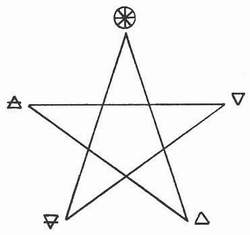
The Pentagram represents the four elements with the fifth, Akasha or Spirit at the topmost point. The fifth element is the underlying unity of the others, their essence and matrix.
The elements are allocated to the four quarters of the compass, which for the purpose of the pentagram rituals are:
Air - East
Fire - South
Water - West
Earth - North
Akasha - Centre
(The quarters are sometimes allocated slightly differently, water and earth being interchanged.)
The Pentragram should in all cases be traced with the single point of the Spirit upwards, not with the dual points upwards forming the ears and horns of the Goat of the Sabbat, as is sometimes suggested by the more dubious works on magic.
The symbols of the elements attributed to the Pentagram are the Wheel which 'answereth to the all pervading Spirit: the laborious Ox is the symbol of Earth: the Lion is the vehemence of Fire: the Eagle (Scorpio), the Water flying aloft as with wings she is vaporized by the force of heat: the Man is the Air, subtle and thoughtful, penetrating hidden things.' (1)
The Lesser Pentagram Ritual is used for a number of things, and should be mastered in detail. It will repay you for the time you spend perfecting it by providing a good working atmosphere every time you work, as it is universally applicable to all ceremonial. It can be used for:
1. An opening and closing for any piece of practical work.
2. An opening and closing for the day, being used in the morning on rising, and in the evening before going to sleep.
3. A method of ridding yourself of disturbing or obsessing ideas as follows:
a. Face East.
b. Make a clear mental picture of your obsession or disturbing worry.
c. Project this image away from you beyond a circle of flame with a gesture of ejection.
d. Prevent the return of the image by taking a step backwards and placing the index finger of the right hand on the lips in a gesture of silence.
e. Now bring the image into clear vision, but still away from you and perform the Lesser Banishing Ritual of the Pentagram to disintegrate it, seeing it dissolving on the outside of your ring of flame, in your mind's eye.
4. A preparation for astral projection.
Seat yourself in a meditation posture: either cross legged or in the 'godform position' (on a chair knees together, back straight). Visualize yourself standing in the centre of the room. Project your consciousness into this figure as well as you are able. Then 'feeling' yourself in this figure, by walking around, touching things and even opening your eyes (in your imagination), go towards the East. Perform the Lesser Banishing Ritual of the Pentagram mentally, vibrating the words and trying to feel them as coming from the form.
----
[1] Regardie The Golden Dawn. Llewellyn Publications, St. Paul, 1971. Vol3, p10.
----
Finish in the East and try to see your results in the Astral Light, (2) then walk back and stand behind the head of your body and let yourself be re-absorbed.
5. A minor form of exorcism, useful for dispelling unwelcome atmosphere. For this purpose it should be used in conjunction with libations of Holy Water. (See Chapter Four for instructions for the manufacture of Holy Water.)
Success in banishing is indicated by a 'feeling of cleanliness' in the atmosphere, while success in invoking is apparent by a 'feeling of holiness'.
The Lesser Ritual Of The Pentagram
This is composed of four parts:
1. Qabalistic Cross.
2. Inscription of Pentagrams.
3. Invocation of the Archangels.
4. Qabalistic Cross.
The ritual should begin facing East. The gestures are performed with the right hand. The lines should either be traced with a steel dagger or with the sign of benediction. To form the sign of benediction extend the first two fingers, whilst covering the last two with the thumb.
Stand facing East, after completing the circle about the place of working. (3)
1. Qabalistic Cross
a. Touch the forehead and say ATEH (thou art) ('Ah-teh')
b. Touch the breast and say MALKUTH (the Kingdom) ('Mal-kooth')
c. Touch the right shoulder and say VE-GEBURAH (and the Power) ('Vay-geb-or-rah')
d. Touch the left shoulder and say VE-GEDULAH (and the Glory) ('Vay-ged-you-lah')
----
[2] An occult term made popular by Theosophy and Eliphas Levi designating the substance of the astral plane upon which imagination acts whilst working ritual.
[3] Either drawn or painted on the floor or visualized strongly at the beginning of any working. This can be reinforced by actually circumambulating with a sword so that its point traces out the circle.
----
e. Cross the hands on the breast and say LE-OLAM (to the ages), AMEN. ('Lay-orh-lahm, Ar-men')
Whilst performing this the practitioner should strongly visualize the hand as drawing a line of white light through the crown of the head, pouring into the body, and descending to the solar plexus, and from there to the feet, the microcosmic location of Malkuth. Also draw a line of light from the right shoulder to the left shoulder whilst saying 'Ve-Geburah, Ve-Gedulah', thus forming a cross. At the centre of this cross visualize a rose, either natural or in the stylized form of the rose-cross, when vibrating 'Le-Olam, Amen'.
This completes the so-called 'Qabalistic Cross', a ritual devised, in its modern form at any rate, by the chiefs of the Hermetic Order of the Golden Dawn; (4) it should always be used at the beginning and end of every ritual, no matter how minor, and should be committed to memory.
2. Inscription of Pentagrams
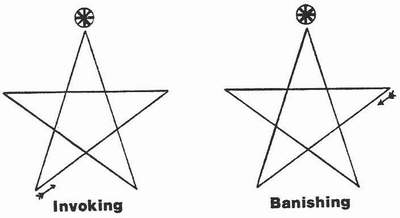
For the purposes of the Lesser Ritual of the Pentagram the type of pentagram used is the pentagram of Earth, thus:
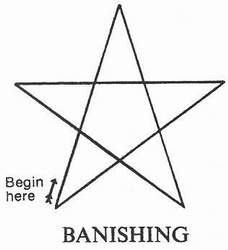
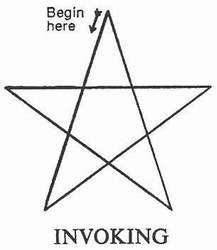
This is inscribed in the air by keeping the arm straight and bringing the hand from the vicinity of the left thigh to a point level with the forehead and then back to a position near the right thigh, thus inscribing an inverted 'V'. Then, bring the hand up to a point just left of the body at the same height as the shoulders. Draw it across in front of the body to the same shoulder height position at the right side of the body. Complete the pentagram by returning the hand to the left thigh position.
----
[4] It actually dates back quite some centuries, and the equal armed cross is not derived from Christianity, but has its roots in the Qabalah.
----
When proficiency is gained with the movements, they can be synchronized with the breathing, taking an in-breath for an upwards stroke, an out-breath for the downwards strokes, and holding for the cross-stroke.
This is only one form of the pentagram, the form depending on the direction of inscription and point of commencement. Other forms are used in the Greater Ritual of the Pentagram.
a. Still facing the East inscribe the first banishing Earth pentagram, then taking an in-breath as you draw your hand back to your chest, stab the centre of the pentagram and vibrate the Godname, YHVH (Pronounced Ye-ho-wah) using the full out-breath.
b. Keeping the hand extended, turn to the South, repeat the same process and vibrate ADNI (Ah-doh-nai).
c. Then turn to the West, repeat the process and vibrate AHIH (Eh-he-yay).
d. Finally turn to the North, repeat the process and vibrate AGLA (Ah-gla) then with hand still outstretched, return to the East.
The main visualization work for this section of the ritual is to see the lines of the pentagram cut in the air and flaming so intensely that anything beyond them diminishes in intensity, thus focusing the practitioner's attention on the limits of the circle which his hand has traced whilst turning from quarter to quarter with his hand extended. As each Godname is pronounced imagine it carrying to the very limits of the Universe, in the quarter in which it is vibrated.
3. Invocation of the Archangels
a. Extend the arms in the form of a cross and proclaim:
'Before me, Raphael (Rah-fay-el)
Behind me, Gabriel (Gab-ray-el)
On my right hand, Michael (Mee-kay-el)
On my left hand, Auriel (Or-ray-el)
For about me flames the Pentagram,
And above me shines the six-rayed star.'
The visualizations that are most important for this sector of the ritual are the anthropomorphic shapes of the Archangels.
To the East, Raphael, Archangel of Air, is seen towering above the practitioner robed in yellow which as it rustles in the breeze blowing from the rear of the figure flashes with purple overtones, flickering across it like the colours on shot silk. He holds a Wand.
To the West, Gabriel, Archangel of Water, holds aloft a Cup from which flows water. His robe is of shimmering blue with overtones of orange.
To the South, Michael, Archangel of Fire, is clothed in robes of red, flashing with the complementary green, holds aloft a flaming Sword.
To the North, Auriel, Archangel of Earth, is clad in the colours of the seasons, rich and fertile, citrine, olive, russet and black. He stands on a Pentacle.
The last two lines re-affirm the presence of the Pentagrams (which are then re-visualized) and the hexagram (Star of David) which is visualized above the circle.
4. Qabalistic Cross
This completes the ritual cycle, and is a repeat of the first section.
More About Pentagrams
The Greater Ritual of the Pentagram should only be used after the place of working has been prepared and stabilized by the Lesser Ritual of the Pentagram.
The Greater Ritual is used specifically to open an Elemental Ritual, or to invoke a particular Element as for example, may be required for the consecration of an Elemental Weapon, or the creation of an artificial Elemental.
This Ritual can also be used to invoke or banish the forces of the Zodiac, by using the Elementary Pentagram appropriate to the Zodiacal Sign, and inscribing therein the Zodiacal Sign. In the case of Zodiacal Signs, the point of invocation must be determined by the position in the heavens of the Sign at the time of working.
The attributions of the Pentagram for the Greater Ritual are a little more complex, as they involve the introduction of Enochian (5) words as well as the usual Hebrew Godnames.
----
[5] Derived from Dr John Dee's work during the period from 1581-1607. Dr Meric Casaubon's book A True and Faithful Relation of what Passed for Many Yeers between Dr John Dee ... and some Spirits ... (1659), reprinted by Askin Publishers in 1974, contains much of the original diary material, while Enochian Magie by Stephen Skinner contains all the important unpublished Dee MSS on Enochian Magic.
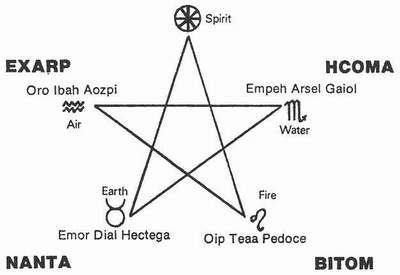
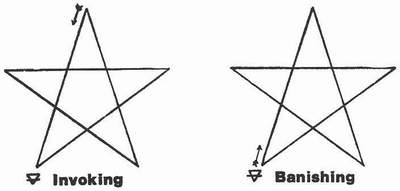
The framework of this ritual relies upon inscribing the pentagrams with due regard to the Element being banished or invoked. It is therefore essential to memorise the correct ascription of the elements and Godnames to the points of the pentagrams:
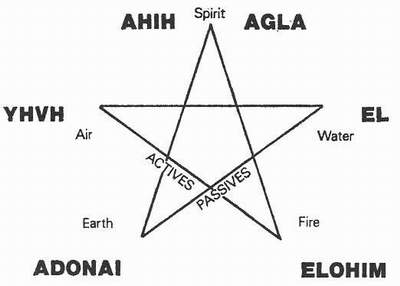
From these elemental points are derived the different pentagrams. All invoking pentagrams are drawn towards the point of the element being invoked. All banishing pentagrams are drawn away from the point of the element being banished. The exceptions are the Pentagrams of Spirit which operate along the lines marked 'active' and 'passive' on the diagram (page 192). For this reason there are four possible Spirit Pentagrams. The passive pentagrams being used in conjunction with the passive elements, water and earth, whilst the active pentagrams are used in conjunction with the active elements, fire and air.
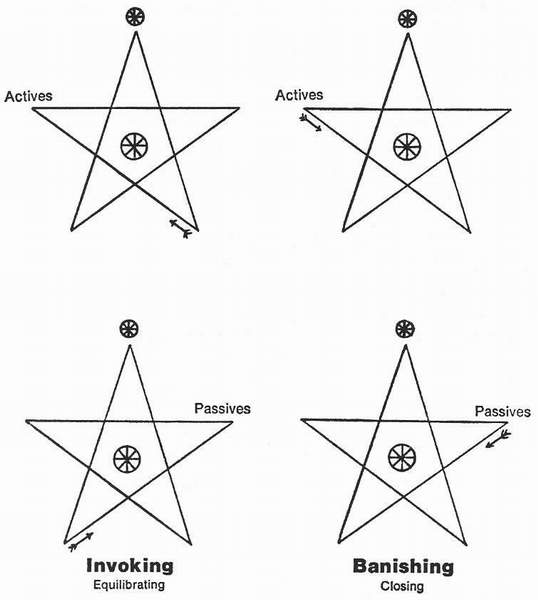
The Pentagrams of Spirit
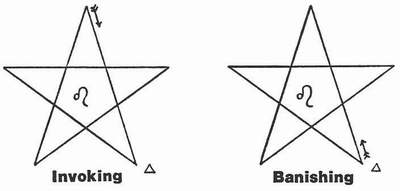
The Pentagrams of Fire are formed along the Fire/Spirit axis
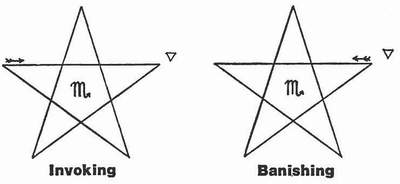
The Pentagrams of Water are formed along the Water/Air axis
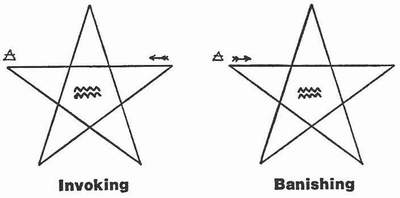
The Pentagrams of Air are formed along the same axis
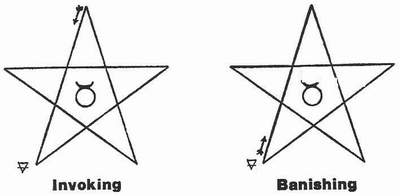
The Pentagrams of Earth are formed along the Earth/Spirit axis
The Pentagrams of Earth are the only ones used in the Lesser Banishing Ritual as already detailed.
If the pentagrams are to be used by themselves (that is, not in the Greater Ritual of the Pentagram) for talisman charging for example, where the force needs to be concentrated on the symbol, then inscribe the pentagrams inside a circle. Otherwise draw them without encircling them.
If the ritual is to be used for invoking a particular Element, use the invoking pentagrams listed on the left-hand side of the page, and the Equilibrating Spirit Pentagram, active or passive depending on the Elements thus: If it be an active element as Fire or Air, use the Equilibrating Pentagram for Actives only and the Element's own invoking Pentagram, and not those of the other Elements. If it be a passive Element (Earth or Water) then make the Equilibrating Pentagram of the Passives only and the invoking Pentagram of the one Element at the four Quarters. In closing and banishing follow the same law.
Various arrangements of the Elements with Cardinal Points have been used, including the attribution relying on their position in the Zodiac (Fire in the East, Earth in the South, Air in the West, and Water in the North), their attribution to winds, and so forth. In this book we have adhered to the traditional ascription of Air in the East, Fire in the South, Water in the West, and Earth in the North.
To each angle of the Pentagram certain Hebrew divine Names and words from the Angelic Tablets are allotted. These are to be pronounced with the invoking and banishing Pentagrams and are set out in the text of the Ritual. The attributions of the angles of the Pentagram is the key of its Ritual. During ordinary invocation (without the use of the Tablets of the Elements) use the Divine Name El with the Pentagram of Water, Elohim with Fire, etc. However, if you are working with the Elemental or Enochian Tablets, use the Divine Names in the Enochian or Angelic language; for Earth, Emor Dial Hectega, and so on. The two types of working can be combined.
In the pronunciation of all these Names take a deep breath and vibrate them as much as possible inwardly with the outgoing breath, not necessarily loudly, but with vibration thus: Eh-he-yay, or Em-or-r Di-a-l Hec-tay-gah.
The Greater Ritual Of The Pentagram
The ritual is divided into the same four parts as the Lesser Ritual of the Pentagram:
1. Qabalistic Cross.
2. Inscription of the Pentagrams.
3. Invocation of the Archangels.
4. Qabalistic Cross.
The ritual commences in the East, after completing the circle about the place of working.
1. Qabalistic Cross (as in the Lesser Ritual of the Pentagram)
2. Inscription of the Pentagrams
The East Point
a. Make the equilibrated Active Pentagram of Spirit, whilst vibrating Exarp (Ex-ar-peh).
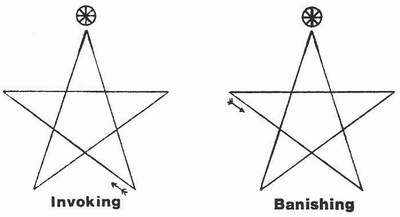
Make the Sign of Spirit  in the pentagram whilst vibrating AHIH (Eh-he-yay). Give the Sign of the Portal: extend your hands in front of you, palms outwards, and separate them slowly as if you were parting a veil or a curtain if invoking. Bring them together palms inwards, as if closing a veil if banishing.
b. Make the Invoking Pentagram of Air, whilst vibrating Oro Ibah Aozpi (Oro E-bah-ha Ay-o-zod-pi).
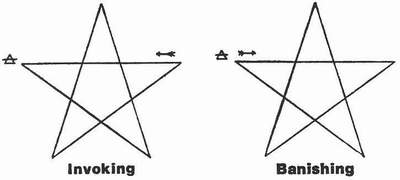
Make the Kerubic Emblem of Air  in the pentagram whilst vibrating YHVH (Yeh-ho-wah). Give the Grade Sign of Air: stretch both arms upwards and outwards, the elbows bent at right angles, the hands bent back, the palms upwards as if supporting a weight.
The South Point
a. Make the equilibrated Active Pentagram of Spirit, whilst vibrating Bitom (Bee-to-ma).
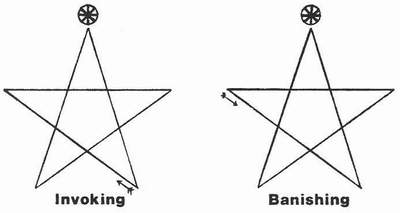
Make the Sign of Spirit
in the pentagram whilst vibrating AHIH (Eh-he-yay). Give the Sign of the Portal (as at the East Point).
b. Make the Invoking Pentagram of Fire, whilst vibrating Oip Teaa Pedoce (O-ee-peh Tee-ah-ah Ped-o-key).
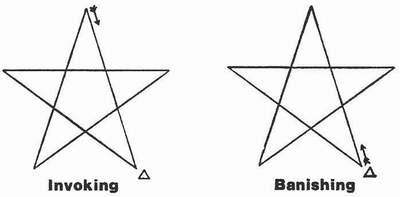
Make the Kerubic Emblem of Fire  in the pentagram whilst vibrating ALHIM (El-o-heem). Give the Grade Sign of Fire: raise the arms above the head and join the hands, so that the tips of the fingers and of the thumbs meet, formulating an up-pointing triangle.
The West Point
a. Make the equilibrated Passive Pentagram of Spirit, whilst vibrating Hcoma (Ha-co-ma).
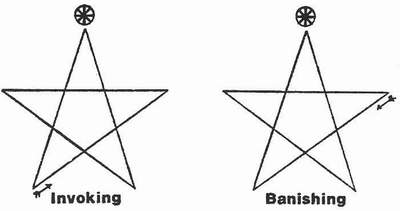
Make the Sign of Spirit
in the pentagram whilst vibrating AGLA (Ah-gla). Give the Sign of the Portal (as at the East Point).
b. Make the Invoking Pentagram of Water, whilst vibrating Empeh Arsel Gaiol (Em-peh Ay-ar-sel Gay-ee-ol).
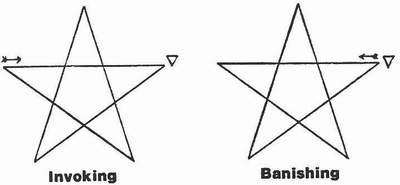
Make the Kerbuic Emblem of Water  in the pentagram whilst vibrating EL (El). Give the Grade Sign of Water: raise the arms till the elbows are on a level with the shoulders, bring the hands across the chest, touching the thumbs and tips of fingers so as to form a triangle apex downwards.
The North Point
a. Make the equilibrated Passive Pentagram of Spirit, whilst vibrating Nanta (Nan-taa).
Make the Sign of Spirit
in the pentagram whilst vibrating AGLA (Ah-gla). Give the Sign of the Portal (as at the East Point).
b. Make the Invoking Pentagram of Earth, whilst vibrating Emor Dial Hectega (Em-or-r Di-a-l Hec-tay-gah).
Make the Kerubic Emblem of Earth  in the pentagram, whilst vibrating ADNI (Ah-doh-nai). Give the Grade Sign of Earth: advance the right foot, stretch out the right hand upwards and forwards, the left hand downwards and backwards, the palms open.
3. Invocation of the Archangels (as in the Lesser Ritual of the Pentagram).
4. Qabalistic Cross (as in the Lesser Ritual of the Pentagram).
Appendix II - Hexagram Rituals
The Hexagram
As the pentagram is the symbol of man or of the four elements surmounted by the fifth, Akasha, so the Hexagram is the symbol of the universe, the double interlaced triangles, the Star of David. Again just as the pentagram is referred to the elements, so the hexagram is referred to the seven planets, and to the letters of the seven lettered name ARARITA. This divine name is made up of the initial letters of the Hebrew sentence: 'One is his beginning. One is his individuality. His permutation is one.'
The method of attribution of the planets to the hexagram is seen simply by placing the hexagram on the glyph of the Tree of Life, so that the path between Chesed and Geburah coincides with the base of the inverted triangle, whilst the base of the upright triangle coincides with the path between Netzach and Hod. The lower point then falls on Yesod and the upper point falls in Daat. Superimposed on the Tree of Life it looks something like this:
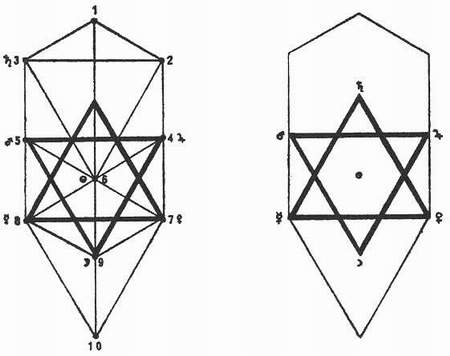
The Hexagram's planetary attributions are then obvious.
The colour correspondences of the Hexagram (in the Queen's Scale) are:
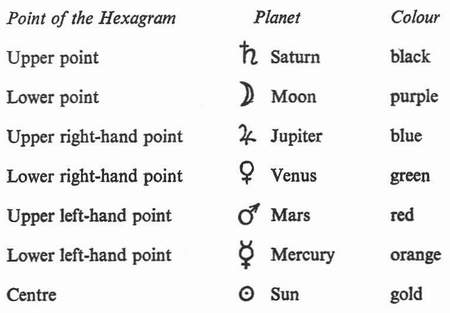
Note that the uppermost point although falling on Daat, is in fact attributed to Saturn, the only planetary attribution of the Supernal Triad, (6) above Daat.
The hexagram is formed of two separate triangles,
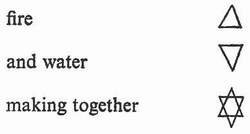
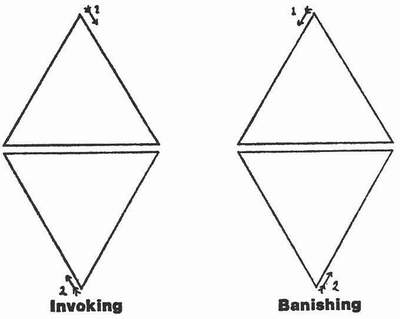
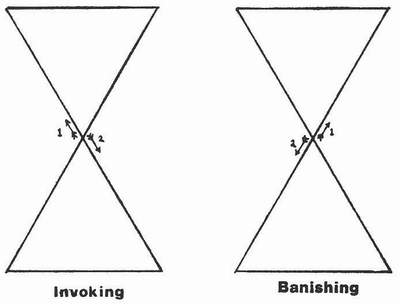
All invoking hexagrams are traced clockwise, and all banishing hexagrams are traced anti-clockwise.
----
[6] The Supernal Triad are the three Sephiroth, Kether, Hokmah and Binah. Daat was traditionally an abortive production of the latter two, but in this context also represents Binah, to which Saturn is ascribed.
----
A different attribution of Cardinal Points to Elements is used in the Hexagram Rituals. Unlike the Pentagram Rituals which use:
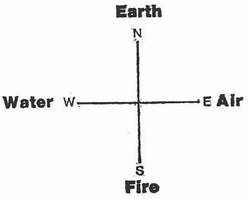
the Hexagram Rituals use the Zodiacal attributions of:
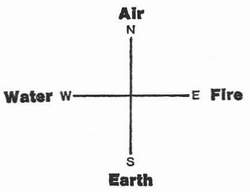
The Hexagrams of Saturn  may be used in general and comparatively unimportant operations, even as the Pentagrams of Earth are used in the Lesser Ritual of the Pentagram.
Begin at the angle of the planet under whose regimen you are working, inscribing clockwise to invoke, reversing the direction to banish.
For the Lesser Ritual of the Hexagram, the disjointed forms are used as shown overleaf.
Thus, in the East (Fire - Zodiacal attribution)
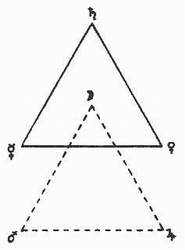
in the South (Earth - Zodiacal attribution)
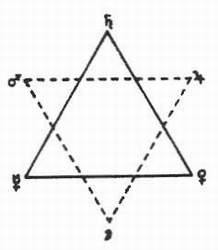
in the West (Air - Zodiacal attribution)
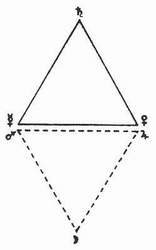
In the North (Water - Zodiacal attribution)
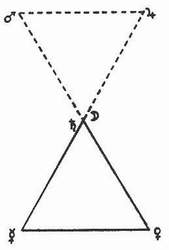
In all Rituals of the Hexagram, as in those of the Pentagram, first complete the circle of the place. Do not trace an external circle round each Hexagram itself unless you want to confine the force, as in charging a talisman.
The Lesser Ritual Of The Hexagram
The Lesser Ritual of the Pentagram should be performed before this ritual is commenced. There are three Points in this Ritual:
1. Analysis of INRI.
2. Inscription of the Hexagrams.
3. Analysis of INRI.
After completing the circle of the place of working, stand facing the East, feet together, left arm at your side with the right arm across the body, holding the Dagger or Wand vertically in front of you.
1. Analysis of INRI
Extend your arms in the form of one crucified (the Sign of Osiris Slain) and say:
'Yod Nun Resh Yod' (pronounce as spelt)
L. Keep left arm extended, stretch right arm vertically upwards, bow head towards left arm (the Sign of the Mourning of Isis) and say:
'Virgo, Isis, Mighty Mother'
V. Raise the arms making a V above the head, which is thrown back, (the Sign of Apophis and Typhon) and say:
'Scorpio, Apophis, Destroyer'
X. Cross the arms on the breast, and bow the head (the Sign of Osiris Risen) and say:
'Sol, Osiris, Slain and Risen'
Gradually raise your arms, saying:
Isis, Apophis, Osiris
When your hands are fully extended upwards raise your head as though looking upwards at the Sun and say:
I.A.O. (pronounced Eee-ay-ooo)
Repeat the L V and X signs, saying as you do so:
'L-V-X - LUX - LIGHT'
Fold hands on breast, bow head and say:
The Light of the Cross'.
2. Inscription of the Hexagrams
a. With the magical weapon trace the Hexagram of Fire in the East, saying, as you bring the Weapon to the centre of the Hexagram, ARARITA (pronounced as written but extend the word as long as possible on one breath).
When vibrating ARARITA take a deep breath, then a pace forward with the right foot. Raise the arms towards the quarter, palms an inch or so apart, and project the word between your hands, using the full breath to vibrate it.
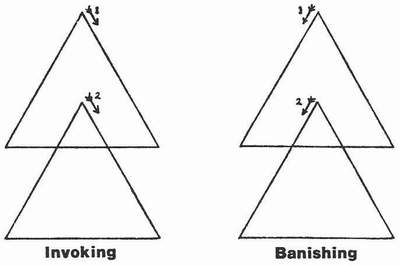
b. Trace the Hexagram of Earth (or Saturn) in the South, vibrating ARARITA.
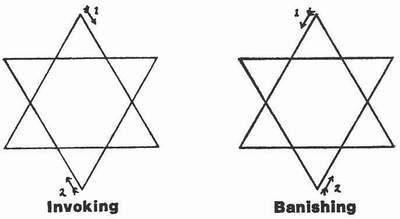
c. Trace the Hexagram of Air in the West, vibrating ARARITA. This Hexagram is like that of Earth, but the bases of the triangles coincide, forming a diamond.
d. Trace the hexagram of Water in the North, vibrating ARARITA. This hexagram has the lower triangle placed above the upper, so that their apexes coincide.
3. Analysis of INRI
Repeat section 1.
More About Hexagrams
To invoke or banish planets or zodiacal signs, the Hexagram of Earth alone is used. Draw the hexagram, beginning from the point which is attributed to the planet you are dealing with. Thus to invoke Jupiter, begin from the upper right-hand point of the
 triangle, inscribing the line clockwise, and complete; then trace the
 triangle from its lower left-hand point and complete. Trace the astrological sigil of the planet in the centre of your hexagram.
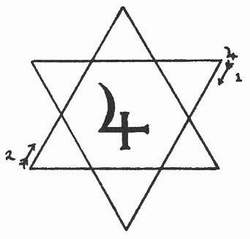
The tracing of the hexagram always commences from the point attributed to the planet concerned, and the second triangle is commenced from the opposite point. For example, an invoking hexagram of Saturn is inscribed clockwise, commencing at the point of Saturn (the uppermost point). When the first triangle has been completed, the second triangle is commenced from the opposite point (the lowermost point), and also inscribed clockwise.
After the hexagram has been traced, the sign of the planet to which it is attributed is then inscribed in its centre.
The following are the planetary hexagrams:
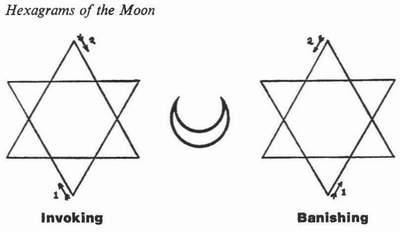
When inscribing the symbol of the moon be careful to use  if the moon is in her increase, but
  if she is in her decrease, the latter representing restriction, and therefore not a good time to work moon invocations unless restriction is the desired end. At full moon, use (O) but at new moon use
 .
.
If the lunar hexagrams are used for the invocation or banishing of Cauda or Caput Draconis, use
 and
and  respectively, otherwise proceeding as you would for a lunar hexagram. Bear in mind that
is a malefic, and it is inadvisable for the beginner to work with this point, or in fact to deal with either Cauda or Caput Draconis during an eclipse.
respectively, otherwise proceeding as you would for a lunar hexagram. Bear in mind that
is a malefic, and it is inadvisable for the beginner to work with this point, or in fact to deal with either Cauda or Caput Draconis during an eclipse.
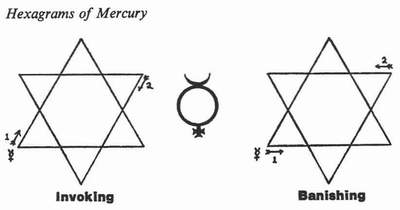
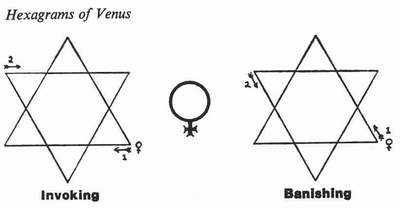
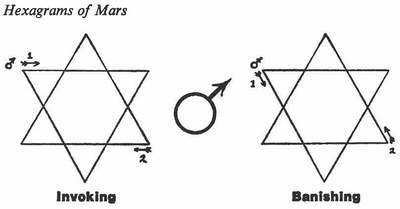
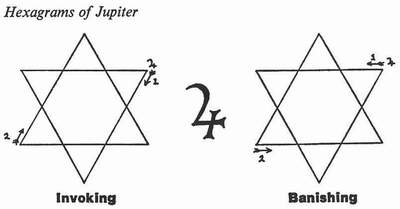
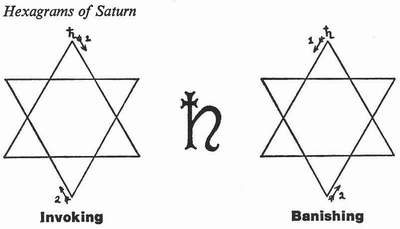
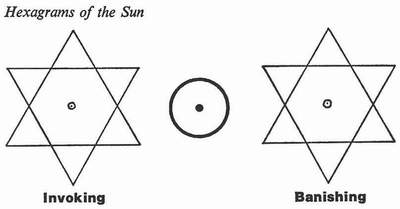
For solar hexagrams, the problem arises that no point on the hexagram itself is actually ascribed to the Sun, and it used to be Golden Dawn practice to inscribe successively all six of the other planetary hexagrams, thus 'generating' a solar hexagram. However, in practice it is much more practicable to inscribe a circle and then whilst placing a point in the centre of the circle, visualize a completely formed hexagram being projected from the palm of the hand and enlarging in size as it moves away from the practitioner until it takes its place around the inscribed circle.
The Planetary Hexagram can be used to:
1. Invoke the forces of one particular Planet. When using them for this purpose turn towards the quarter of the Zodiac where the planet is situated at the time of invocation. For this purpose you must construct an astrological chart of the heavens for the time of the operation.
First, perform the Lesser Banishing Ritual of the Hexagram, being careful to trace all the hexagrams from the angel of the Planet required.
Then turn to the quarter of the planet in the Heavens and trace its invoking Hexagram. Simultaneously, vibrate ARARITA together with the Godname ascribed to that planet (for which see Chapter Eight).
This is then followed by the invocation of the appropriate Angels or Planetary Spirits.
2. Invoke Zodiacal forces. Use the same approach as outlined above, using the hexagram of the planet most consonant with the Zodiacal Sign concerned, and inscribe the Zodiacal sign rather than the planetary Kerubic Emblem.
3. Invoke the planetary aspect of Sephirothic forces, or as an opening to a Sephirothic working. If you are dealing with any of the Supernal Triad of the Sephiroth (that is Kether, Chokmah or Binah) use the Hexagrams of Saturn; for Chesed those of Jupiter, for Geburah those of Mars; for Tiphareth those of the Sun, and for Netzach those of Venus, and for Hod those of Mercury, and for Yesod and Malkuth those of the Moon. Then proceed as you would normally.
Appendix III - Middle Pillar Exercise
1. Perform the Qabalistic Cross and Lesser Banishing Ritual of the Pentagram. (See Appendix I.)
2. (Kether) Stand facing east and visualize slightly above the top of the head a sphere, approximately a foot in diameter, effulgent with brilliant white light, radiating in all directions. When this sphere is sufficiently concrete for one to feel its presence, visualize a line of white light descending from it into the top of the head at the same time vibrating AHIH (pronounced Eh-he-yay).
3. (Daat) The descending shaft of light penetrates as far as the throat where it blossoms into a second sphere coloured a brilliant purple. As soon as this sphere has expanded sufficiently to enclose the throat you will vibrate YHVH Elohim (pronounced Ye-ho-wah El-o-heem).
4. (Tiphareth) The shaft of white light moves down through the body to the region of the solar plexus where it produces a brilliant golden sphere. Here one vibrates YHVH Aloah va-Daat (pronounced Ye-ho-wha El-o-ah va-Da-art).
5. (Yesod) The light shaft descends again to the region of the genitals where it generates a glowing purple sphere. The god-name to be vibrated at this point is Shaddai el Chai (pronounced Shah-dai El Chai - with the Ch sounding rather like the 'ch' in 'loch').
6. (Malkuth) The light then reaches the soles of the feet where it forms a large black sphere upon which the feet stand, rather in the same manner that the first sphere was above the head. The godname is ADNI ha-Aretz (pronounced Ah-don-ai ha Ah-retz).
Appendix IV - Ritual of the Rose Cross
The Rose Cross - A Ritual of Protection
As soon as you start the serious practice of geomancy or, indeed, any other occult technique, it is likely that the invisible world, (or if you prefer a different terminology, certain factors in your own unconscious mind) will start interfering with your everyday life. This interference may take the form of a series of odd coincidences, of inexplicable events, or even of the traditional mysterious 'bumps in the night'.
At first this sort of thing can be extremely stimulating - as Aleister Crowley once remarked there is a sort of satisfaction to be derived from being hit over the head by a spirit of whose existence one was previously unsure - but after a time it can become a bore. One of the purposes of the Rose Cross Ritual is to protect its user against just such outside interference; 'it encloses the aura', wrote Wynn Westcott '... it is like a veil. The Pentagrams protect, but they also light up the astral and make entities aware of you ... When much distracted use the Ritual of the Rose Cross to maintain peace.'
There are other reasons for using the ritual. It can be used, as will be explained later, to help others who may be in pain or difficulty and, as is said in one of the instructional documents of the Hermetic Order of the Golden Dawn, 'it is a call to another mode of consciousness and withdraws you from the physical. It is a good preparation for meditation and ... a form of Invocation of the Higher Wisdom which is helpful when solving problems or preparing for a difficult interview, or in order to be calm and strong to help another ... It is a protection against psychic invasion from the thoughts of others or from disturbed psychic conditions, such as there might be in a place charged with fear, where terrible things have happened.'
The ritual should be carried out as follows:
Light a stick of incense - an astringently scented variety of joss-stick, such as sandalwood is best; under no circumstances is it advisable to use the sickly-sweet perfumed 'co-respondent' varieties.
Go to the south-east corner of your temple and outline with your incense a large cross and circle thus:
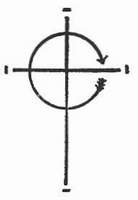
The topmost point of the vertical component of the cross should extend from slightly above your head to a little below your solar plexus. The horizontal arm of the cross and the circle should be made proportionately.
Hold your joss-stick to the centre of your cross and say: YHShVH (pronounce Yeh-hesh-oo-ah)
With arm outstretched on a level with the centre of the cross, and holding the joss-stick go to the south-west corner of the temple, make a similar cross and circle and repeat the word (YHShVH) as before.
Move to the north-west corner of the temple, make cross and circle and repeat word as before.
Go to the north-east corner of the temple, make cross and circle and repeat word as before.
Return to the south-east corner, imagine that you see before you the first cross and circle and bring the glowing point of the joss-stick to the central point of the visualized cross.
Hold the joss-stick high and walk diagonally across the temple towards the north-west corner. Pause at the centre of the temple, make cross and circle above your head and repeat the word. Continue to the north-west point, imagining that you see before you the cross and circle you drew at that point, and bring the point of the joss-stick to the centre of the visualized cross.
Point the joss-stick downwards, retrace your steps towards the south-east, pause at the centre, make cross and circle towards the floor and repeat the word. Continue to the south-east, visualize the original cross and bring the point of the joss-stick to its centre.
Raising the joss-stick high above your head, return to the centre of the temple, visualize the cross you made above your head and repeat the word. Go to the north-east, visualize the original cross made there, bring the point of the joss-stick to its centre and repeat the word.
Walk round the temple in a clockwise direction, pausing at the visualized crosses in the north-west and north-east and repeating the word. When you reach the site of the original cross and circle in the south-east draw it again but larger; as you draw the lower part of the circle say the word as before, but as you draw the upper part say:
YHVShH (pronounce Yeh-hev-ash-ah)
Return to the centre of the temple, face east, and visualize the six crosses outlined around you in a protective network. Extend your arms in the form of one crucified (the Sign of Osiris Slain) and say:
'Yod Nun Resh Yod' (pronounce as spelt)
L. Keep left arm extended, stretch right arm vertically upwards, bow head towards left arm (the Sign of the Mourning of Isis) and say:
'Virgo, Isis, Mighty Mother.'
V. Raise the arms making a V above the head, which is thrown back (the Sign of Apophis and Typhon) and say:
'Scorpio, Apophis, Destroyer.'
X. Cross the arms on the breast, and bow the head (the Sign of Osiris Risen) and say:
'Sol, Osiris, Slain and Risen.'
Gradually raise your arms, saying
'Isis, Apophis, Osiris.'
When your hands are fully extended upwards raise your head as though looking upwards at the Sun and say:
'I.A.O.' (pronounced Eee-ay-ooo)
Repeat the L V and X signs, saying as you do so:
'L-V-X - LUX - LIGHT'
Fold hands on breast, bow head and say:
'The Light of the Cross.'
Visualize a stream of white light coming into existence above the crown of your head, pouring into your body - right down to your feet - and filling your body with energy. Say:
'Let the Light Descend'
as long as you continue this visualization which can be usefully extended to two or three minutes.
Thus ends this rite, perhaps a little forbidding at first sight but in practice easy both to perform and to commit to memory. Once you are quite familiar with it you can perform it in your imagination, visualizing your 'double' walking around the room, whilst your physical body remains seated.
If possible try to feel yourself acting out the rite from the position of your double, rather than just watching. Whilst doing this, the physical body should maintain a fairly deep rhythmic breath cycle. The climax of the ritual, the analysis of INRI should be done standing behind your physical body and the descent of Light should be seen as pouring into your physical body bringing peace and a deep sleep.
If you wish to carry out the rite for the benefit of someone else in difficulty or pain, modify the working by introducing into the centre of the room an astral image of the person concerned, affirming a strong connection between this image and the person. Call down the light as before, but direct it into the astral form of the person. At the close of the ceremony, bid the figure to return to the person it represents taking with it the peace of YHShVH.
To recap, the Rose Cross Ritual is a protection and a veiling which cleanses the place in which it is performed without stirring up and attracting surrounding astral entities, as do the Pentagram Rituals. At the same time, when combined with the analysis of INRI (also an integral part of the Hexagram Ritual) it is able to act as a channel for Light which can heal and bring rest.

