11 - The Magic of the Tarot Cards
So far two instruments of divination have been considered, geomancy and the I Ching, the first dating back in Europe to classical times, the second an Eastern method which has been very definitely assimilated into the Western tradition.
The limitations of geomancy are obvious from the limited number of possible answers, sixteen in all, which even if taken in combination or referred to the relevant Houses are still restricted to a fairly fixed wording. The I Ching on the other hand has the same degree of visual appeal as geomancy, (the hexagram being of a perhaps more intrinsically evocative nature than the geomantic figures) but has an infinitely more fluid text, which according to the insight or frame of reference of the operator is capable of a much more detailed interpretation.
The Tarot however has an enormous range of symbolic combinations: a visual richness which fires the subsconscious in a much more direct manner than the other two systems. Although Aleister Crowley preferred to use the I Ching for day-to-day answers to mundane questions, it lacks the complex and essentially Western images which make the Tarot definitely the most visually fertile of all the systems of divination.
The traditional Tarot packs consist of seventy-eight cards of which twenty-two are the Major Arcana (or picture cards) and fifty-six are the Minor Arcana (being more akin to ordinary playing cards) having four suits made up of numbered cards from one to ten (the first being an ace), and four court cards apiece.
The Major Arcana or Tarot Atus (trumps) consist of twenty-two cards picturing symbolically the various Situational and personal archetypes met with by the magician. Each card has a title and a meaning, varying slightly from pack to pack. The choice of which particular version to buy is largely a matter of personal preference, for each individual responds differently to the different portrayals of the cards. The most common packs are the 'Marseilles' pack (a rather mediaeval design, but of fairly recent date) and the A.E. Waite pack (issued early this century). Other packs include those designed by Knapp, Oswald Wirth, C.C. Zain, Paul Foster Case (a black and white version of the Waite pack), Aleister Crowley, and more recently R. Gardener, David Sheridan and the Aquarian Pack.
There is also a school of thought amongst various occult fraternities which holds, with some validity, that one really only understands the Tarot trumps when one has made one's own pack, but for the beginner a commercial pack is quite satisfactory. Of these the Aquarian pack and Aleister Crowley's Thoth pack are the most aesthetically pleasing, but the former suffers from oversimplification and the latter from the introduction of too many symbols, (many of them understandable only in the context of Crowley's own philosophy).
The Waite pack despite its many drawbacks, or an uncoloured Case pack (to be painted in by yourself) are probably still the best packs for the beginner. For those who have made a special study of Crowley's works, his pack can shed much light on the meanings of the Atus. However the best source of meaning is that discovered by meditation on and skrying the cards for yourself. Techniques for the latter are outlined further on in this chapter. At this stage we will just examine the basic designs of the Atus which are common to most packs.
The Major Arcana:
0. The Fool. A man in motley garb with a care-free expression about to step over a cliff. His possessions are in a bundle over his shoulder, and a dog snaps at his heels. An image of Divine Folly.
1. The Magician. A stylised figure standing in front of a table which holds the four Elemental Weapons. His right hand points upwards to show the direction from which his power comes, his left points downwards to show where it is directed. He is often portrayed with an infinity symbol (oo) over his head, or as part of his headgear. The magician is the archetypal juggler of forces.
2. The High Priestess. A mysterious woman seated on a throne between two pillars - a curtain behind her, and under her arm a scroll. Her feet rest upon a crescent moon, and in the Waite pack she is coloured with the blue of the Virgin Mary.
3. The Empress. A pregnant woman, seated, surrounded by nature in its most bounteous form. An aspect of the richness of Isis.
4. The Emperor. A figure who appears very stern, seated in full armour upon a granite throne in barren and desolate surroundings. Thought by some to be the apotheosis of Mars.
5. The Hierophant. A much be-decked religious pontiff, enthroned and blessing or teaching two acolytes who kneel before him. Often entitled the Pope.
6. The Lovers. A man and a woman on each side of the card, with a mountain rising in the background and an angel overhead. (Alternatively portrayed as Perseus rescuing Andromeda from the Dragon of fear and the waters of Stagnation.)
7. The Chariot. A man standing in a chariot, apparently drawn by two sphinxes - one black and one white. However, the sphinxes are seated, and there are no reins or harness on them.
8. Justice. A stern enthroned female figure holding a pair of scales - and definitely not blind.
9. The Hermit. A bearded and bent old man with a staff and a lantern. This card is sometimes entitled 'Prudence'.
10. The Wheel of Fortune. A wheel surrounded by the four holy creatures of Ezekiel. At the top sits a sphinx and a red demon-like creature falls off one side, while another appears to be ascending on the other. The figures on the wheel are traditionally the Plutonian cynocephalus (a type of ape venerated in Ancient Egypt), the Sphinx, and sometimes the Serpent.
11. Strength. A beautiful young woman, wreathed and robed in white, holds a lion's jaws open apparently without effort. Often portrayed with the infinity symbol (oo) over her head.
12. The Hanged Man. A man with a halo round his head, crucified upside down, hanging by one foot over an abyss. The other leg is bent and crosses the straight one at right angles, forming a triangle. A symbol of the reversal of values at initiation.
13. Death. A skeleton on a horse or with a scythe stalks across the land reaping a harvest of people, whose limbs appear dotted about the countryside, lying almost as if planted, in open furrows. This card signifies drastic change - not necessarily physical death. A card of transmutation - the skeleton surviving whilst the flesh is sloughed off.
14. Temperance. An archetypal angel stands on verdant grass beside a pool - one foot is in the water and one on the land, pouring water from one vessel into another. An image of balance which is occasionally portrayed by the figures of the torch-bearing lion and water-bearing eagle chained together.
15. The Devil. A traditional type of devil with an inverted pentagram between his horns - a man and a woman are chained to him in an illusory bondage.
16. The Tower. A tower which has been struck by lightning the top is destroyed and the figures of a man and a woman are shown hurtling to the ground. Destructive, but a case of energy striking at inertia.
17. The Star. A naked female figure kneels by a pool of water. A large (usually seven pointed) star shows in the background, and like the zodiacal sign of Aquarius, she has two vessels of water, but pours one back into the pool and the other on to the earth.
18. The Moon. Moonrise on a primitive landscape. Two standing stones or towers are shown in the background whilst a dog and a coyote bay at the moon, and a scaley lobster-like creature crawls out of the water towards a path that wends its way between these towers.
19. The Sun. A bright sunny day with a naked child galloping past a wall on a white horse. An alternative design shows two children holding hands in front of the wall. A third design shows a pilgrim in the same position.
20. Judgement. The last trumpet sounds and the angel with the trumpet is shown summoning the dead from their coffins. Three figures, man, woman and child arise from the coffins surrounded by the sea.
21. The World. A naked woman with a scarf draped across her, stands with a wand in each hand. She is surrounded by a garland, and the four holy creatures (Eagle, Man, Bull and Lion) occupy the four corners of the card.
It is with the Major Arcana that the magician does most of his practical work, the Minor Arcana (the remaining 56 cards) being mainly used for divination (in which the whole pack is employed) and for some elementary types of magic.
Path Working
One of the commonest ways in which the Major Arcana or Tarot trumps are used, are as 'keys' to a particular area of what has been termed the 'astral plane'. The technique is simple to explain and to read about, but requires a considerable amount of really hard, disciplined work on the part of a beginner to this sort of activity. 'Practice makes perfect' in magic, as well as in other perhaps more mundane aspects of life, however, and familiarity with the technique breeds, not contempt, but an ever-growing enrichment of psychic experience.
Briefly, the technique may be described as follows:
• a. Clear the working area using the Banishing Ritual of the Lesser Pentagram.
• b. Visualize the card; also have the card physically present.
• c. Use the visualized card as a 'door' or 'curtain' through which to penetrate.
• d. Have a look at what appears on the other side of the 'door'.
• e. Come back through the 'door'.
• f. Visualize the card in place against the closed door.
• g. Re-affirm one's presence in the physical world.
• h. Signify the end of the working by using the Banishing Ritual of the Lesser Pentagram.
• i. Write up the experience in full.
Most of the above points appear self-explanatory, but a few further comments are needed:
a. Clear the working area
This is usually done ritually by means of the Banishing Ritual of the Lesser Pentagram.
b. Visualize the card
It will be readily seen that before one is able to clearly visualize a single card in this way, one must be extremely familiar with the card in question. An extended period of meditation on and contemplation of the cards is therefore recommended before attempting to do a path working.
c. Use the visualized card as a 'door' or 'curtain'
In order to perform this part of the technique, a certain facility with the use of the imagination is necessary. Having clearly visualized the card in detail, the operator must enlarge his visualization to door-size whilst losing none of the detail of his original visualization. Actually passing through the door may be done in several ways.
i. One can astrally project and then pass through the door.
ii. Visualize your own figure on the other side of the curtain, and transfer consciousness to that figure.
iii. Visualize a heavy curtain with the card on it gradually becoming more transparent until the landscape beyond is clear enough to see in detail.
iv. Use a symbolic gesture, such as the Portal sign of rending the veil. This is simply a movement of the hands as if parting a curtain.
d. Have a look at what appears on the other side
In the first instance, the beginner is advised to have a good look round and return immediately to his original state. As he becomes more advanced, however, he may venture further and further into the area revealed by the card. He should always remember, however, no matter how far he explores to return by the same route, leaving by the same door which he visualizes firmly as closing after him. If you are working with a system such as the Qabalistic Tree of Life, you may find alternative 'ways home' by returning to Malkuth via other Paths. In any case, it is a good rule to follow, always to exactly retrace one's steps on a path working.
e. Come back through the door
This is almost too obvious to be stated as a separate step. However it is as well to remember especially when beginning this sort of working, that the 'door' exists in the first place by virtue of the original visualization, and it is sometimes necessary to consciously strengthen the image, at this stage, in order to see clearly where one is.
f. Visualize the card in place against the closed door
This is so that one returns exactly to 'square one' as it were, and the door is seen as closed, so that there is no 'leakage' into everyday life.
g. Re-affirm one's presence in the physical world
This is done by speaking a phrase, a single word, or clapping. Again it is to avoid the inter-penetration of levels.
h. Signify the end of the path working
Use the Lesser Banishing Ritual of the Pentagram.
i. Write up the experience in full
This step should be considered part of the working, not only because it provides a record of what happened for future reference - not just because it, like the rest of your work, should be entered in the Magical Diary - but also because it serves to 'earth' the experience and the magician.
The Minor Arcana:
This consists of the remaining fifty-six cards of the Tarot pack which are divided into four suits of fourteen cards, like the standard playing card pack, plus one extra court card in each suit represented variously in different packs by the 'Page' or the 'Princess'.
Each of the Tarot suits is ascribed to one of the four Magical elements, thus:
• Swords - Fire - (Diamonds in the ordinary pack)
• Wands - Air - (Clubs in the ordinary pack)
• Cups - Water - (Hearts in the ordinary pack)
• Pentacles - Earth - (Spades in the ordinary pack) (Coins or Discs)
The major value of the Minor Arcana is divinatory. As has been mentioned, both Arcanae are used in divination, but on a purely statistical basis, naturally it is the cards of the Minor Arcana which provide the bulk of the Tarot 'spread' or layout for the purpose of obtaining the answer to the question. It is advisable for the operator to develop his own intuition with regard to the interpretation of whatever answer the cards give to his divinatory questions, but only after memorising all the divinatory meanings. Each of the cards of the Minor Arcana has a divinatory title, and these titles act as a mnemonic of the divinatory meaning. They are:
• Ace of Swords - Root of the Powers of Fire
• 2 of Swords - Peace Restored
• 3 of Swords - Sorrow
• 4 of Swords - Rest from Strife
• 5 of Swords - Defeat
• 6 of Swords - Earned Success
• 7 of Swords - Unstable Effort
• 8 of Swords - Shortened Force
• 9 of Swords Despair and Cruelty
• 10 of Swords Ruin
• Ace of Wands - Root of the Powers of Air
• 2 of Wands - Dominion
• 3 of Wands - Established Strength
• 4 of Wands - Perfected Work
• 5 of Wands - Strife
• 6 of Wands - Victory
• 7 of Wands - Valour
• 8 of Wands - Swiftness
• 9 of Wands - Great Strength
• 10 of Wands - Oppression
• Ace of Cups - Root of the Powers of Water
• 2 of Cups - Love
• 3 of Cups - Abundance
• 4 of Cups - Blended Pleasure
• 5 of Cups - Loss in Pleasure
• 6 of Cups - Pleasure
• 7 of Cups - Illusionary success
• 8 of Cups - Abandoned Success
• 9 of Cups - Material Happiness
• 10 of Cups - Perpetual Success
• Ace of Pentacles - Root of the Powers of Earth
• 2 of Pentacles - Harmonious Change
• 3 of Pentacles - Material Works
• 4 of Pentacles - Earthy Power
• 5 of Pentacles - Material Trouble
• 6 of Pentacles - Material Success
• 7 of Pentacles - Success Unfulfilled
• 8 of Pentacles - Prudence
• 9 of Pentacles - Material Gain
• 10 of Pentacles - Wealth
The Court Cards, the King, Queen, Knight and Page are usually used as 'significators', that is as the card representing the Querent, so as to establish the relationship between him or her and the other persons and events shown in the divinatory spread. The Court Cards are usually allocated as follows:
a. Kings. Older men. The King of Swords is usually a dark, somewhat stern person. The King of Cups is generally fair and friendly. The King of Wands would be of medium colouring, and with a good intellect, while the King of Pentacles is generally of very dark colouring, and more concerned with business, trade, or other pursuits of a 'down-to-earth' type. (1)
b. The Queens are older women, and their colouring and attributes are approximately the same as the Kings.
c. The Knights are younger men with the same colouring and characteristics as their elders.
d. The Pages or Princesses are younger women or children, again with the colouring and attributes as before.
----
[1] There is some disagreement over the physical characteristics of each suit, and often picking the significator intuitively according to the temperament of the Querent works better. A third alternative is to use the birth sign, so that Fire signs (Aries, Leo or Sagittarius) are allocated Swords; Air signs (Aquarius, Gemini or Libra) are given Wands; Water signs (Cancer, Scorpio or Pisces) have Cups; and Earth signs (Taurus, Virgo or Capricorn), Pentacles.
----
Divination
There are many different ways of laying out the cards (spreads) to aid the magician in his work. However, before going further it is as well to remember that whilst divination can be a fascinating study and valid occult activity in itself, for the magician it has and must retain an ancillary and assistant emphasis.
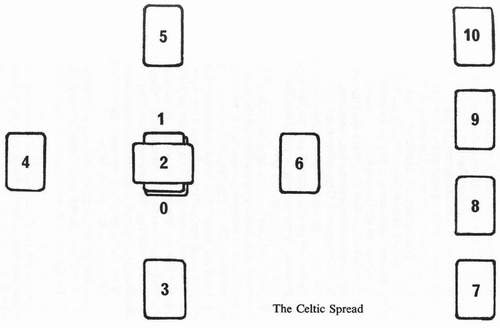
Of the many possible spreads the easiest for the beginner is probably the Celtic Spread. Others may be obtained from one of the many excellent books on the subject available in most occult bookshops. (2)
Select the Significator representing the Querent (selected from the above descriptions of the sixteen Court Cards) or the situation (selected from the rest of the pack, or by dealing it after the shuffling and cutting stage).
After the Significator has been removed from the pack (in the case of a Court Card representing a Querent) ask the Querent to shuffle the pack well. Impress upon him that he must think earnestly about the problem (which should be fairly specific) that he has in mind whilst this process is continuing. (It is not necessary for the Querent to mention the question to you, the diviner.) Alternatively if you do not want other people to use your consecrated Tarot pack, you can shuffle whilst keeping as blank and receptive a mind as possible. The Querent meanwhile concentrates on the problem. Once the Querent feels that the cards are imbued with the question they are placed on the table and, with his left hand he cuts the pack (face downwards) into three roughly equal piles.
----
[2] Including, Paul Foster Case, The Tarot. Macoy Publishing Co, New York, 1949; Aleister Crowley, Book of Thoth. Samuel Weiser, New York, 1970; Gareth Knight, A Practical Guide to Qabalistic Symbolism. (Vol 2). Helios, Cheltenham, 1965.
----
Gather up the piles, in the reverse order to that in which they were laid, with your left hand and deal the cards in the following pattern whilst reading the ritual phrase connected with each position together with the title of the card. For example you might have a spread which could read: Here be the King of Swords, (the name of the Querent), the Emperor covers him, the Tower crosses him, the Three of Pentacles is beneath him ... etc.
The order of the spread is as follows:
The Celtic Spread
0. The Significator. This is either cut for and placed face up on the table in the case of a Situational question (where it represents the situation) or selected beforehand from one of the Court Cards and laid face upwards before shuffling and cutting the cards at the start of the divination, in which case it represents the person primarily involved in the question and should be the card nearest in description and character to that person. (The details of the sixteen Court Cards from which the Significator may be drawn have already been listed in the section on the Minor Arcana.)
The sentence accompanying the laying of the Significator in this spread is, 'Here he be.'
1. The Cover. This card is laid face upwards directly over the significator and represents those circumstances in favour of it. The sentence is, This covers him.'
2. The Cross. This card is laid at right angles, to the significator and the cover, horizontally across them, and represents those influences working against them. The accompanying sentence is, 'This crosses him.'
3. The Base. (3) This card is laid face upwards below the three in the middle, and represents the foundation of basis of the influences working on the situation or person. The sentence spoken is, This is beneath him.'
4. The Card Behind. This card is laid to the left of the middle cards, and represents the influence that has just passed. The appropriate sentence is This lies behind him.'
5. The Crown. This card is placed immediately above the three middle cards and represents the influences that may come into being. The sentence reads, This crowns him.'
6. The Card Before. This card is laid immediately to the right of the middle cards and represents approaching influences. The sentence is, This lies before.'
The last four cards are laid out in a column to the right of the cross shape already formed around the significator.
7. The Querent. This card is laid to the right of the pattern and represents the person asking the question - it may be regarded as a minor significator again and the sentence is, 'He comes to rest.'
----
[3] Positions 3-6 are often set out in a different order. As long as you consistently stick to one particular order, so your answers will be consistent.
----
8. The House. This establishes the ambience of the Querent in relation to the question. It is concerned with the Querent's environment, family and friends. The sentence reads 'In the House of ... (the name of the card).' It lies immediately above the seventh card.
9. Hopes and Fears. This card lies immediately above the 'House' and represents the hopes and/or fears of the Querent in relation to the question. The sentence reads, 'He hopes or fears ... (the name of the card).'
10. The Outcome. This is the final card of the spread laid above the 'Hopes and Fears' and contains, in essence, the answer to the question. The sentence reads, 'It thus will be.'
In the above spread, some people deal the cards in order one at a time, whereas others deal down seven cards between each card laid in the spread. Either way is effective and will work so long as the operator is consistent throughout.
Having completed the layout, allow your intuition to guide your vision to the most important cards, or to make up stories concerning the cards. Don't hold these back but say what comes to mind. Then either look up or recall the exact divinatory meanings of each card and go through the spread again one card at a time. Don't be afraid to look up the meanings: this you will need to do for some time anyway and it should not embarrass you any more than a chemist would be embarrassed at having to check something in his reference library. After all the more times you look it up the sooner you are going to know it.
The key words of the Minor Arcana have already been given, the divinatory meanings of the Major Arcana follow:
0. The Fool. Idea, thought, spirituality. (That is, if the subject which is enquired about is spiritual.) If the Divination is about a material event of ordinary life, this card is not good, and shows folly, stupidity, eccentricity, and even mania, unless with very good cards. It is too ideal and unstable to be generally good in material things.
1. The Magician. Skill, wisdom, adaptation. Craft or cunning always depending on its dignity. Sometimes occult wisdom.
2. The High Priestess. Change, alteration, increase and decrease. Fluctuation (whether for good or evil is again shown by cards connected with it). Compare this card with Death and the Moon.
3. The Empress. Beauty, happiness, pleasure, success, also luxury and sometimes dissipation, but only if with very evil cards.
4. The Emperor. War, conquest, victory, strife, ambition.
5. The Hierophant. Divine wisdom. Manifestation. Explanation. Teaching. Resembling in some respects, the meanings of the Magician, the Hermit, and the Lovers.
6. The Lovers. Inspiration (passive and in some cases mediumistic, thus differing from that of the Hierophant, Magician and the Hermit). Motive, power, and action, arising from inspiration.
7. The Chariot. Triumph. Victory. Health. Success though sometimes not stable and enduring.
8. Justice. Eternal justice and balance. Force, but arrested as in the act of judgement. Also in combination with other cards, legal proceedings, a court of law, or a trial at law.
9. The Hermit. Wisdom sought for and obtained from above. Divine inspiration (but active as opposed to that of the Lovers). In the mystical titles of the cards, this with the Hierophant and the Magician are the three Magi.
10. Wheel of Fortune. Good fortune and happiness (within bounds), but sometimes also a species of intoxication with success, if the cards near it bear this out.
11. Strength. Courage, strength, fortitude. Power not arrested as in the act of judgement, but passing on to further action, sometimes obstinacy.
12. The Hanged Man. Enforced sacrifice. Punishment, loss. Fatal and not voluntary. Suffering generally.
13. Death. Time. Ages. Transformation. Change is involuntary as opposed to the Moon. Sometimes death and destruction, but rarely the latter, and the former only if it is borne out by the cards with it. Compare also with the High Priestess.
14. Temperance. Combination of forces. Realisation. Action (material). Effect either for good or evil.
15. The Devil. Materiality. Material temptation; sometimes obsession, especially if associated with the Lovers.
16. The Tower. Ambition, fighting, war, courage. Compare with the Emperor. In certain circumstances, destruction, danger, fall, ruin.
17. The Star. Hope, faith, unexpected help. But sometimes also dreaminess, deceived hope, etc.
18. The Moon. Dissatisfaction, voluntary change (as opposed to death). Error, lying, falsity, deception. (The whole according whether the card is well or ill-dignified.) (4)
19. Sun. Glory, gain, riches. Sometimes also arrogance. Display, vanity, but only when with very evil cards.
20. Judgement. Final decision. Judgement. Sentence. Determination of a matter with appeal on its plane.
21. The Universe. The matter itself. Synthesis. World. Kingdom. Usually denotes the actual subject of the question, and therefore depends entirely on the accompanying cards.
As a general rule, a large number of the Major Arcana in a spread indicate a lot of macrocosmic (external) forces operating in the Querent's life. Court Cards (like the Significator) usually indicate people in the Querent's life who will correspond to the cards in either appearance or temperament. If there is a predominance of Pentacles, there are strong indications concerning worldly wealth and possessions; if of Cups, strong emotional indications; if of Swords, intellectual pursuits; and if of Wands, an indication of fundamental changes.
Continued work with the Tarot will considerably improve your intuition so that you will find that in ordinary everyday situations it will become increasingly clear how to act: the under-currents of life and motivation will begin to show themselves in quite an amazing manner, so that after a while the Tarot becomes useful for only the most knotty problems. This heightening of the intuition is a faculty which will stand you in good stead in the next step on your way: self initiation.
----
[4] That is, according to whether its relationship to the adjacent cards is sympathetic or not.
----

