 |
Philip Nowland - G4NVS |
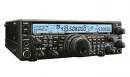
Yaesu FT-817ND Mine is the FT-817ND, fitted with the YF-122C filter for CW, and was purchased during 2006. Some of the differences with the earlier models of the FT-817 are not obvious, so do not just assume that the only difference is the addition of the 5MHz band (on USA models). Note this when considering suggestions for modifications that were published with the FT-817 in mind. Some of the information widely publicised as modifications for the FT-817, as found on mods.dk and Ham DMZ sites, are incorrect for the recent models (i.e. 2006 and 2007) of this transceiver, especially the configuration for wideband, or extended, HF transmit. The FT-817ND is an ideal piece of equipment for when I am away from the shack, as a /P station, and enjoy operating it, on its internal batteries, sitting on the road-side picnic tables often found at road-side stops. Used in conjunction with a Miracle Whip (actually a Miracle Ducker) with a modified 52 inch telescopic whip from Maplin (fitted with a BNC connector). This is a great little transceiver. However, it is a little fiddly to use, with the front panel menu system, but I have got used to this and can move around its facilities with little or no problem.
Helpful Accessories I use the FT-817ND for /p opereration with the supplied MH-31 microphone for SSB and FM operation. For CW operation I use the tiny Palm Portable Key (PPK), manufactured in Germany, it is available from ML&S (Martin Lynch & Sons Ltd). It isn't cheap. From the same manufacturer as the the Palm Portable Key, there is the Peg Leg tilt stand kit for the FT-817, also available from ML&S. I have fitted one of these tilt stand kits to the transceiver, and this must be the neatest way of improving the operation of the the rig when it sits in front of me in /P use.
Battery Power Normally when operating on battery power (i.e. without external power supply) the 5W maximum output power default drops to 2.5W to conserve battery life. However, this can be over-ridden and 5W output can be restored when using batteries. Actually, if you are concerned about drain on the batteries, you should be aware that the FT-817ND does draw a reasonably high amount of current on un-squelched receive (around 450mA), which is how you would mainly use it for SSB or CW operation. This is just short of a quarter of the current draw at 5W transmit. That is quite a high ratio. So, it is not such a big issue to attempt to save current by reducing transmit output power to 2.5W. Use the transmit on 5W, and stand a better chance of being heard, and live with it. Overall though, the transceiver has a reasonable life on the internal battery pack (FNB-85). For battery power, I start operations using the supplied FNB-85 Ni-MH battery pack (FT-817ND models are provided with this), and if this battery pack runs down, I switch to using the FBA-28 battery case (also provided with the FT-817ND) which I have fitted out with 8 x AA size 2500mAh NiMH batteries. So I can operate for a long time with this set up. If I want to work for longer I can always hitch up a sealed lead acid battery (which I only carry with me if I am near the car), and the 7 Ah package is ideal, connected to the FT-817 with the supplied E-DC-6 DC power cable. Please note, I always remove the FBA-28 battery case from the transceiver, and replace it with the FNB-85 NiMH battery pack, before connecting the FT-817 to the external supply (via the E-DC-6 DC power cable). The FBA-28 has no protection circuitry for use with rechargeable batteries. Take care over this point. The Yaesu operating manual for this transceiver says that the FBA-28 should only be used with the alkaline cells, because of this. Do not attempt to use an external power source (via the E-DC-6 DC power cable) to charge batteries in the FBA-28 battery case inside the transceiver. I always charge my 2500mAh AA batteries in an external charger unit. A number of people have suggested ways of charging AA size NiCad or NiMH batteries in the FBA-28 case, utilising the FT-817's internal charging circuits, because it is possible to change the charging rate and charging time. I have considered this is a risky business, and warn people against this. If Yaesu thought it was a good practice, they would have suggested it themselves as it would be a good selling point. But they do not, and that should be taken as a salutary warning over this. Remember ... the many episodes of fried Yaesu FT-290's in the 1980's, and be warned. I always charge my AA NiMH batteries outside of the transceiver, and only charge the FNB-85 battery pack within the FT-817ND.
Fixed station operation (in the shack) However, when used (in the shack on an available long wire, or coax antenna), this rig comes into its own, when used in conjunction with Ham Radio Deluxe (HRD) software. I tried a number of other programs, including FT-817 Commander, but find HRD the most suitable. It controls the functions of the FT-817 brilliantly, including selection of narrow/wide filtering and power settings. My main rig is Yaesu's excellent FT-847, which I can also control using CAT. The FT-817ND functions (in the shack) as an excellent alternative receiver for monitoring purposes, with the bonus that I can use it on transmit (albeit at maximum 5 Watts. However see below.) when necessary. It lacks the 4M (70 - 70.5 MHz) coverage of the FT-847, which is a pity, but does cover the VHF (band 2) FM broadcast band on receive, which the FT-847 lacks.
Computer Programs for use with FT-817 I have already mentioned Ham Radio Deluxe, a most creditable program for use with a wide range of amateur rigs. This program is packed with features, its DX Cluster feature (used in conjunction with a broadband Internet connected computer) is extremely helpful. It also provides a lot of support for the various data type modes. This is provided by Simon Brown (HB9DRV) and can be downloaded (free of charge) from the website: http://hrd.ham-radio.ch/ Ham Radio Deluxe (HRD) is an excellent program, and really enhances the use of the FT-817 when employed for fixed station use, and provides virtually complete control of the all of the transceiver's operational functions. Thus the criticisms of the necessity for use of this miniature transceiver to rely upon the front panel menu driven controls is overcome. HRD even switches the FT-817 on an off from the PC. However, this final feature only appears to be operational if you power the transceiver from an external power supply. If the transceiver is to be used on its internal batteries you can still control its functions with the software, but it is necessary to switch it on with its front panel power button on prior to attempting to communicate with it using HRD. Another computer program that I have found very helpful, is FTBasicMMO. This program comes from Bob Freeth (G4HFQ). This is a memory manager program that works both with the FT-817 and my FT-847. It also works with the FT-857 and FT-897. Normal CAT programs do not read or modify the transceiver's memory, but this one does. The Yaesu FT817, with 200 memories, it is quite fiddly when manipulating its memories, and and it is quite laborious to enter these without the use of a program like FTBasicMMO. Once read the memory list and details can be saved to disc, and then recalled later to send back to the transceiver. If you ever have to do a reset, where you lose transceiver memories, you will realise the value of such a program. An added bonus with FTBasicMMO is that the data read from the transceiver can be integrated to with data from a different model transceiver. As a result I have been able to copy the 78 memories available in the FT-847 into the first 78 memory locations in the FT-817, which means that for the majority of applications the two transceivers have some commonality. G4HFQ's (Bob Freeth's) website is: www.g4hfq.co.uk The FT-817, unlike the FT-847, does not have RS232 level converters onboard (the same is true of the FT-857 and FT-897), so you must use a CAT cable that has these level converters built into the cable. This explains why CAT cables for these rigs are quite costly. Power for the extra circuitry within can be provided from the rig or from the computer RS232 interface. I prefer to get the power from the rig, for that is always predictable, and then the set up can be used with a wide range of computers. Yaesu supply a connecting serial lead (CT-62) for CAT purposes, which usually sells for around £30. However, I obtained an alternative from G4ZLP who produces a wide range of cables for Yaesu transceivers. I purchased the XM232 (CT-62-P) Yaesu powered CAT cable. The price for this is around £10 or £11 pounds, around a third of the price of the Yaesu cable, and works perfectly. G4ZLP's website is found at http://www.g4zlp.co.uk
Extended (or Wide-band) Transmit Coverage Original FT-817 models may not cover the "new" section of of 40M (i.e. 7.1 to 7.2 MHz), or 60M (5MHz). As a result you might consider it necessary to extend the transmit coverage of this transceiver. The FT-817ND model comes configured for the new section of 40M, so this advice is unnecessary to use the newer frequencies in that band. However, you wish to transmit on the 60M band (i.e. 5MHz) if you have been issued with the notice of variation (NOV) to your UK license to allow you to do so. This can only be achieved by a fiddly modification which requires going in to the rig behind the front panel and changing the configuration of the six configuration links, or linking pads, i.e. solder-blob technology. This should not be necessary on earlier FT-817 transceivers (i.e. prior to the introduction of the ND series model). There is a program (called Softjump) which which works with earlier FT-817 transceivers, and is used in conjunction with the CAT cable to change the configuration without making or unmaking the solder pads. Softjump is available for download from a number of sources, and has been provided free of charge from Peter May (VK2JCG, now VK2IT). His website is http://www.vk2it.net. This is a much preferable solution, with the only downside being that you have to re-run the program again if you ever do a reset on the transceivers micro, which should not happen to often, especially if you stay away from the transceiver's hidden service menu. This software works with earlier FT-817 transceivers, but ... Softjump does not work on the current versions of the FT-817ND (it might have worked with some of the earlier ND models, but it does not now). I have spoken to VK2IT regarding this, and his explanation is, that when Yaesu introduced the D models of the FT-857 and the FT-897 (along with the FT-817ND), they changed the location of the address that holds the data copied from the solder pads, and made it inaccessible via the CAT cable. So the solution for these more advanced models of these three modern transceiver models, is to go inside and change the configuration of the solder link pads. That's progress ...! The same is true regarding later models of the FT-817ND, with respect to the Widebander program from M0BMN, which was used to wide-band earlier FT-817ND. It seems that Yaesu were placed under pressure from the FCC in the US to hinder the ability to obtain wide-band transmit facility via external software programming.
This modification information sheet is very clear, and describes what is necessary to get to, and change the configuration of the solders pads (J4001 to J4009). This information sheet was issued prior to the introduction of the FT-817ND model. On the basis of the configuration of these solder pads as found on current (2006 to 2007) models of the UK specification FT-817ND, the information effectively suggests opening the solder link J4005, which will extend the amateur band transmit facility wider than the UK bands, but not full transmit capability in the HF band (i.e. it does not give transmit capability on 5 MHz frequencies). However, if you also close the solder link J4009, your transceiver will have full HF transmit (i.e. 1.8 MHz to 33 MHZ), and thus the FT-817ND can be used to transmit in the 60 metre (5 MHz) UK NOV frequencies. This final piece of information (regarding J4009) is not included in the Yaesu tech sheet, it is provided by me, but you should take note of the warnings (etc) made by Yaesu in their information, and should exercise every care to ensure that you do not transmit outside of the band limits as presented in your radio amateur license (or any notice of variation). In short you do the following: Open J4005 and close J4009. This is very different to the information being published to achieve the same end on the FT-817 as found on mods.dk and Ham DMZ sites (which will not work on the current FT-817ND). To download a copy of the Yaesu tech sheet - click here. This is a PDF file, so Adobe Acrobat Reader (or similar) is required to open and view this file. If your browser crashes out when downloading the PDF file, it has nothing to do with me, it is most likely because Internet Explorer currently seems to have problems picking up PDF files. Try Firefox - t should give you less problems!
Hidden Service Menu Power up the transceiver, at the same time as pressing all three buttons on the MH-31 microphone, and the rig will power up and display the service menu. This will allow the initiated, and test equipment enabled, to make careful changes to the settings of numerous set-up features. Or ... for those who have not been initiated in the black magic art of radio engineering - you can completely muck things up! If you fall into the latter group, forget anything that you read in this paragraph! I am currently testing out a procedure which allows 10 watt output, on HF, which only requires changing some settings via the Service Menu, and does not loose VSWR protection or over-current protection. This would be ideal for CW operation. If satisfactory and safe, I will publish my findings here. The procedure does not require that the covers are opened up, or that any internal adjustments or modifications need to be made, and is entirely carried out by use of the front panel. It is very easy to return the transceiver to its initial factory settings, should it be necessary to do so, and restore the transceiver's normal maximum of 5 watts.
|
|
|