
MAGNETIC LONGWIRE BALUNS
Do these things do exactly what they say they do - or are they total hogwash? - Patrick lifts the lid on the MLB
Have you seen the ads? This device will match your long wire to your receivers 50 ohm input? Firstly a long wire on HF would be on 28 MHz longer than 120 foot and on the lower bands it just an end fed “EF”
We
can also get rid of the “magnetic” and give the balun its true name of
voltage balun. My interest in the MLB was started after a friend went out and
paid £30 for one and started to tell me how this little device will produce a
50 ohm match at all frequencies. Any aerial will have differing values of
impeadence depending on what band it is used, a 66 foot wire on 80m is about 30
ohms and on 40m the impeadence is about 1000 ohms.
For
any sort of balun to be able to match different impeadences to 50 ohms you need
to be able to vary one or more of its components. And when you can do this, the
balun will match most things to 50 ohms, but you would call this type of balun
an ATU. An ATU is a variable balun.
But
theory is one thing and practice is another. So mainly for some thing to do I
decided to make some MLB’s and see what mystical properties they have. The
first balun was made “by the book” using the correct wire SWG and ferrite
ring with a type 63 core for 1 to 30 MHz. I used a friend’s MFJ analyser for
the tests and a 35 foot wire aerial.
The
balun did improve the match to the receiver. Only near the resonant frequency of
the aerial was any match close to 50 ohms or a VSWR of 1 to 1, as you would
expect. On all other frequencies the match varied from 3 to 1, to 5 to 1 VSWR.
Without the balun the match was horrible!
In
the real world this means I had some thing like a increase of signal from 1 to 4
“S points” on the receiver from 1 MHz to 30 MHz.
The
“VMR version” MLB was made from scrap.
3 core 2 amp lighting flex and an old ferrite rod. The results are just
the same as the posh version!
You
need about one yard of 3 core, 2 amp flex and a ferrite rod with a length of
about 6 inches or longer.
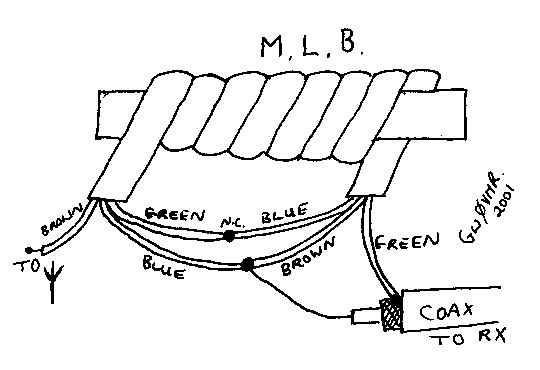
Using
3 core flex it is easy to wire because it is colour coded. Tape one end of the
flex to the rod leaving 6 inches for the connections, then wind on as many turns
as possible (mine has 10 turns) and again fix the wire with tape etc at the
other end. Now you can just twist the wire connections together or better solder
them. Connect it up as shown. Blue right hand side to Green left-hand side.
Brown right to Blue left. Inner of COAX, to Brown/Blue. Braid to single Green.
Aerial to single Brown. Then just bung it into a box.
So
is a MLB worth having? They do produce a “better” match to the receiver but
you could get an ATU kit for about the same price, which will always produce the
right match. If you buy surplus VC’s you can make an ATU for under £10. Find
a couple of broken tranny radios and you can make one for free.
The
main advantage of the MLB is you can use COAX to the feed point of the aerial
out side and get a reduction in noise pick up from TV’s etc in your home. I
would not spend money on one, but a home made MLB in a box is worth having.
Because it is a pain to keep peaking the ATU as you tune up the SW bands and
anything that helps to give a better match is better than having nothing at all.
If
you need more help, again a SAE or cyber world people mail to qrper@QRMbigfoot.com
(Remove the
interference first!)
Have fun.