Breaking VISA PIN
by
Luis Padilla Visdómine
Foreword
Have you ever wonder what would happen if you loose your credit or debit
card and someone finds it. Would this person be able to withdraw cash from an
ATM guessing, somehow, your PIN? Moreover, if you were who finds someone's card
would you try to guess the PIN and take the chance to get some easy money? Of
course the answer to both questions should be "no". This work does not deal with
the second question, it is a matter of personal ethics. Herewith I try to answer
the first question.
All the information used for this work is public and can be freely found in
Internet. The rest is a matter of mathematics and programming, thus we can learn
something and have some fun. I reveal no secrets. Furthermore, the aim (and
final conclusion) of this work is to demonstrate that PIN algorithms are
still strong enough to provide sufficient security. We all know
technology is not the weak point.
This work analyzes one of the most common PIN algorithms, VISA PVV, used by
many ATM cards (credit and debit cards) and tries to find out how resistant is
to PIN guessing attacks. By "guessing" I do not mean choosing a random PIN and
trying it in an ATM. It is well known that generally we are given three
consecutive trials to enter the right PIN, if we fail ATM keeps the card. As
VISA PIN is four digit long it's easy to deduce that the chance for a random PIN
guessing is 3/10000 = 0.0003, it seems low enough to be safe; it means you need
to loose your card more than three thousand times (or loosing more than three
thousand cards at the same time :) until there is a reasonable chance of loosing
money.
What I really meant by "guessing" was breaking the PIN algorithm so that
given any card you can immediately know the associated PIN. Therefore this
document studies that possibility, analyzing the algorithm and proposing a
method for the attack. Finally we give a tool which implements the attack and
present results about the estimated chance to break the system. Note that as
long as other banking security related algorithms (other PIN formats such as IBM
PIN or card validation signatures such as CVV or CVC) are similar to VISA PIN,
the same analysis can be done yielding nearly the same results and conclusions.
VISA PVV algorithm
One of the most common PIN algorithms is the VISA PIN Verification Value
(PVV). The customer is given a PIN and a magnetic stripe card. Encoded in the
magnetic stripe is a four digit number, called PVV. This number is a
cryptographic signature of the PIN and other data related to the card. When a
user enters his/her PIN the ATM reads the magnetic stripe, encrypts and sends
all this information to a central computer. There a trial PVV is computed using
the customer entered PIN and the card information with a cryptographic
algorithm. The trial PVV is compared with the PVV stored in the card, if they
match the central computer returns to the ATM authorization for the transaction.
See in more detail.
The description of the PVV algorithm can be found in two documents linked in
the previous
page. In summary it consists in the encryption of a 8 byte (64 bit) string
of data, called Transformed Security Parameter (TSP), with DES algorithm (DEA)
in Electronic Code Book mode (ECB) using a secret 64 bit key. The PVV is derived
from the output of the encryption process, which is a 8 byte string. The four
digits of the PVV (from left to right) correspond to the first four decimal
digits (from left to right) of the output from DES when considered as a 16
hexadecimal character (16 x 4 bit = 64 bit) string. If there are no four decimal
digits among the 16 hexadecimal characters then the PVV is completed taken (from
left to right) non decimal characters and decimalizing them by using the
conversion A->0, B->1, C->2, D->3, E->4, F->5. Here is an
example:
Output from DES: 0FAB9CDEFFE7DCBA
PVV: 0975
The strategy of avoiding decimalization by skipping characters until four
decimal digits are found (which happens to be nearly all the times as we will
see below) is very clever because it avoids an important bias in the
distribution of digits which has been proven to be fatal for other
systems, although the impact on this system would be much lower. See also a
related
problem not applying to VISA PVV.
The TSP, seen as a 16 hexadecimal character (64 bit) string, is formed (from
left to right) with the 11 rightmost digits of the PAN (card number) excluding
the last digit (check digit), one digit from 1 to 6 which selects the secret
encrypting key and finally the four digits of the PIN. Here is an example:
PAN: 1234 5678 9012 3445
Key selector: 1
PIN: 2468
TSP: 5678901234412468
Obviously the problem of breaking VISA PIN consists in finding the secret
encrypting key for DES. The method for that is to do a brute force search of the
key space. Note that this is not the only method, one could try to find a
weakness in DEA, many tried, but this old standard is still in wide use (now
been replaced by AES and RSA, though). This demonstrates it is robust enough so
that brute force is the only viable method (there are some better attacks but
not practical in our case, for a summary see LASEC memo and for the dirty
details see Biham
& Shamir 1990, Biham
& Shamir 1991, Matsui
1993, Biham
& Biryukov 1994 and Heys 2001).
The key selector digit was very likely introduced to cover the possibility
of a key compromise. In that case they just have to issue new cards using
another key selector. Older cards can be substituted with new ones or simply the
ATM can transparently write a new PVV (corresponding to the new key and keeping
the same PIN) next time the customer uses his/her card. For the shake of
security all users should be asked to change their PINs, however it would be
embarrassing for the bank to explain the reason, so very likely they would not
make such request.
Preparing the attack
A brute force attack consists in encrypting a TSP with known PVV using all
possible encrypting keys and compare each obtained PVV with the known PVV. When
a match is found we have a candidate key. But how many keys we have to try? As
we said above the key is 64 bit long, this would mean we have to try 2^64 keys.
However this is not true. Actually only 56 bits are effective in DES keys
because one bit (the least significant) out of each octet was historically
reserved as a checksum for the others; in practice those 8 bits (one for each of
the 8 octets) are ignored.
Therefore the DES key space consists of 2^56 keys. If we try all these keys
will we find one and only one match, corresponding to the bank secret key?
Certainly not. We will obtain many matching keys. This is because the PVV is
only a small part (one fourth) of the DES output. Furthermore the PVV is
degenerated because some of the digits (those between 0 and 5 after the last,
seen from left to right, digit between 6 and 9) may come from a decimal digit or
from a decimalized hexadecimal digit of the DES output. Thus many keys will
produce a DES output which yields to the same matching PVV.
Then what can we do to find the real key among those other false positive
keys? Simply we have to encrypt a second different TSP, also with known PVV, but
using only the candidate keys which gave a positive matching with the first
TSP-PVV pair. However there is no guarantee we won't get again many false
positives along with the true key. If so, we will need a third TSP-PVV pair,
repeat the process and so on.
Before we start our attack we have to know how many TSP-PVV pairs we will
need. For that we have to calculate the probability for a random DES output to
yield a matching PVV just by chance. There are several ways to calculate this
number and here I will use a simple approach easy to understand but which
requires some background in mathematics of probability.
A probability can always be seen as the ratio of favorable cases to possible
cases. In our problem the number of possible cases is given by the permutation
of 16 elements (the 0 to F hexadecimal digits) in a group of 16 of them (the 16
hexadecimal digits of the DES output). This is given by 16^16 ~ 1.8 * 10^19
which of course coincides with 2^64 (different numbers of 64 bits). This set of
numbers can be separated into five categories:
- Those with at least four decimal digits (0 to 9) among the 16 hexadecimal
digits (0 to F) of the DES output.
- Those with exactly only three decimal digits.
- Those with exactly only two decimal digits.
- Those with exactly only one decimal digit.
- Those with no decimal digits (all between A and F).
Let's calculate how many numbers fall in each category. If we label the 16
hexadecimal digits of the DES output as X1 to X16 then we
can label the first four decimal digits of any given number of the first
category as Xi, Xj, Xk and Xl. The
number of different combinations with this profile is given by the product 6
i-1 * 10 * 6j-i-1 * 10 * 6k-j-1 * 10 * 6
l-k-1 * 10 * 1616-l where the 6's come from the number of
possibilities for an A to F digit, the 10's come from the possibilities for a 0
to 9 digit, and the 16 comes from the possibilities for a 0 to F digit. Now the
total numbers in the first category is simply given by the summation of this
product over i, j, k, l from 1 to 16 but with i < j < k < l. If you do
some math work you will see this equals to the product of 104/6 with
the summation over i from 4 to 16 of (i-1) * (i-2) * (i-3) * 6i-4 *
16 16-i ~ 1.8 * 1019.
Analogously the number of cases in the second category is given by the
summation over i, j, k from 1 to 16 with i < j < k of the product
6i-1 * 10 * 6j-i-1 * 10 * 6k-j-1 * 10 *
616-k which you can work it out to be 16!/(3! * (16-13)!) *
103 * 6 13 = 16 * 15 * 14/(3 * 2) * 103 *
613 = 56 * 104 * 613 ~ 7.3 * 1015.
Similarly for the third category we have the summation over i, j from 1 to 16
with i < j of 6 i-1 * 10 * 6j-i-1 * 10 *
616-j which equals to 16!/(2! * (16-14)!) * 102 *
614 = 2 * 103 * 615 ~ 9.4 * 1014.
Again, for the fourth category we have the summation over i from 1 to 16 of
6i-1 * 10 * 616-i = 160 * 615 ~ 7.5 *
1013. And finally the amount of cases in the fifth category is given
by the permutation of six elements (A to F digits) in a group of 16, that is,
616 ~ 2.8 * 1012.
I hope you followed the calculations up to this point, the hard part is
done. Now as a proof that everything is right you can sum the number of cases in
the 5 categories and see it equals the total number of possible cases we
calculated before. Do the operations using 64 bit numbers or rounding (for
floats) or overflow (for integers) errors won't let you get the exact result.
Up to now we have calculated the number of possible cases in each of the
five categories, but we are interested in obtaining the number of favorable
cases instead. It is very easy to derive the latter from the former as this is
just fixing the combination of the four decimal digits (or the required
hexadecimal digits if there are no four decimal digits) of the PVV instead of
letting them free. In practice this means turning the 10's in the formula above
into 1's and the required amount of 6's into 1's if there are no four decimal
digits. That is, we have to divide the first result by 104, the
second one by 103 * 6, the third one by 102 * 62
, the fourth one by 10 * 63 and the fifth one by 64
. Then the number of favorable cases in the five categories are
approximately 1.8 * 1015, 1.2 * 1012, 2.6 * 1011
, 3.5 * 1010, 2.2 * 109 respectively.
Now we are able to obtain what is the probability for a DES output to match
a PVV by chance. We just have to add the five numbers of favorable cases and
divide it by the total number of possible cases. Doing this we obtain that the
probability is very approximately 0.0001 or one out of ten thousand. Is it
strange this well rounded result? Not at all, just have a look at the numbers we
calculated above. The first category dominates by several orders of magnitude
the number of favorable and possible cases. This is rather intuitive as it seems
clear that it is very unlikely not having four decimal digits (10 chances out of
16 per digit) among 16 hexadecimal digits. We saw previously that the
relationship between the number of possible and favorable cases in the first
category was a division by 10^4, that's where our result p = 0.0001 comes from.
Our aim for all these calculations was to find out how many TSP-PVV pairs we
need to carry a successful brute force attack. Now we are able to calculate the
expected number of false positives in a first search: it will be the number of
trials times the probability for a single random false positive, i.e. t * p
where t = 2^56, the size of the key space. This amounts to approximately 7.2 *
10^12, a rather big number. The expected number of false positives in the second
search (restricted to the positive keys found in the first search) will be (t *
p) * p, for a third search will be ((t * p) * p) * p and so on. Thus for n
searches the expected number of false positives will be t * p^n.
We can obtain the number of searches required to expect just one false
positive by expressing the equation t * p^n = 1 and solving for n. So n equals
to the logarithm in base p of 1/t, which by properties of logarithms it yields n
= log(1/t)/log(p) ~ 4.2. Since we cannot do a fractional search it is convenient
to round up this number. Therefore what is the expected number of false
positives if we perform five searches? It is t * p^5 ~ 0.0007 or approximately 1
out of 1400. Thus using five TSP-PVV pairs is safe to obtain the true secret key
with no false positives.
The attack
Once we know we need five TSP-PVV pairs, how do we get them? Of course we
need at least one card with known PIN, and due to the nature of the PVV
algorithm, that's the only thing we need. With other PIN systems, such as IBM,
we would need five cards, however this is not necessary with VISA PVV algorithm.
We just have to read the magnetic stripe and then change the PIN four times but
reading the card after each change.
It is necessary to read the magnetic stripe of the card to get the PVV and
the encrypting key selector. You can buy a commercial magnetic stripe reader or
make one yourself following the instructions you can find in the previous page
and links therein. Once you have a reader see this description of
standard magnetic tracks to find out how to get the PVV from the data read.
In that document the PVV field in tracks 1 and 2 is said to be five character
long, but actually the true PVV consists of the last four digits. The first of
the five digits is the key selector. I have only seen cards with a value of 1 in
this digit, which is consistent with the standard and with the secret key never
being compromised (and therefore they did not need to move to another key
changing the selector).
I did a simple C program, getpvvkey.c, to
perform the attack. It consists of a loop to try all possible keys to encrypt
the first TSP, if the derived PVV matches the true PVV a new TSP is tried, and
so on until there is a mismatch, in which case the key is discarded and a new
one is tried, or the five derived PVVs match the corresponding true PVVs, in
which case we can assume we got the bank secret key, however the loop goes on
until it exhausts the key space. This is done to assure we find the true key
because there is a chance (although very low) the first key found is a false
positive.
It is expected the program would take a very long time to finish and to
minimize the risks of a power cut, computer hang out, etc. it does checkpoints
into the file getpvvkey.dat from time to time (the exact time depends on the
speed of the computer, it's around one hour for the fastest computers now in
use). For the same reason if a positive key is found it is written on the file
getpvvkey.key. The program only displays one message at the beginning, the
starting position taken from the checkpoint file if any, after that nothing more
is displayed.
The DES algorithm is a key point in the program, it is therefore very
important to optimize its speed. I tested several implementations: libdes, SSLeay, openssl, cryptlib, nss, libgcrypt, catacomb, libtomcrypt, cryptopp, ufc-crypt.
The DES functions of the first four are based on the same code by Eric Young and
is the one which performed best (includes optimized C and x86 assembler code).
Thus I chose libdes which was the original implementation and condensed all
relevant code in the files encrypt.c (C
version) and x86encrypt.s
(x86 assembler version). The code is slightly modified to achieve some
enhancements in a brute force attack: the initial permutation is a fixed common
steep in each TSP encryption and therefore can be made just one time at the
beginning. Another improvement is that I wrote a completely new setkey function
(I called it nextkey) which is optimum for a brute force loop.
To get the program working you just have to type in the corresponding place
five TSPs and their PVVs and then compile it. I have tested it only in UNIX
platforms, using the makefile Makegetpvvkey
to compile (use the command "make -f Makegetpvvkey"). It may compile on other
systems but you may need to fix some things. Be sure that the definition of the
type long64 corresponds to a 64 bit integer. In principle there is no dependence
on the endianness of the processor. I have successfully compiled and run it on
Pentium-Linux, Alpha-Tru64, Mips-Irix and Sparc-Solaris. If you do not have and
do not want to install Linux (you don't know what you are missing ;-) you still
have the choice to run Linux on CD and use my program, see my page running Linux without
installing it.
Once you have found the secret bank key if you want to find the PIN of an
arbitrary card you just have to write a similar program (sorry I have not
written it, I'm too lazy :) that would try all 10^4 PINs by generating the
corresponding TSP, encrypting it with the (no longer) secret key, deriving the
PVV and comparing it with the PVV in the magnetic stripe of the card. You will
get one match for the true PIN. Only one match? Remember what we saw above, we
have a chance of 0.0001 that a random encryption matches the PVV. We are trying
10000 PINs (and therefore TSPs) thus we expect 10000 * 0.0001 = 1 false positive
on average.
This is a very interesting result, it means that, on average, each card has
two valid PINs: the customer PIN and the expected false positive. I call it
"false" but note that as long as it generates the true PVV it is a PIN as valid
as the customer's one. Furthermore, there is no way to know which is which, even
for the ATM; only customer knows. Even if the false positive were not valid as
PIN, you still have three trials at the ATM anyway, enough on average. Therefore
the probability we calculated at the beginning of this document about random
guessing of the PIN has to be corrected. Actually it is twice that value, i.e.,
it is 0.0006 or one out of more than 1600, still safely low.
Results
It is important to optimize the compilation of the program and to run it in
the fastest possible processor due to the long expected run time. I found that
the compiler optimization flag -O gets the better performance, thought some
improvement is achieved adding the -fomit-frame-pointer flag on Pentium-Linux,
the -spike flag on Alpha-Tru64, the -IPA flag on Mips-Irix and the -fast flag on
Sparc-Solaris. Special flags (-DDES_PTR -DDES_RISC1 -DDES_RISC2 -DDES_UNROLL
-DASM) for the DES code have generally benefits as well. All these flags have
already been tested and I chose the best combination for each processor (see
makefile) but you can try to fine tune other flags.
According to my tests the best performance is achieved with the AMD Athlon
1600 MHz processor, exceeding 3.4 million keys per second. Interestingly it gets
better results than Intel Pentium IV 1800 MHz and 2000 MHz (see figures below,
click on them to enlarge). I believe this is due to some I/O saturation, surely
cache or memory access, that the AMD processor (which has half the cache of the
Pentium) or the motherboard in which it is running, manages to avoid. In the
first figure below you can see that the DES breaking speed of all processors has
more or less a linear relationship with the processor speed, except for the two
Intel Pentium I mentioned before. This is logical, it means that for a double
processor speed you'll get double breaking speed, but watch out for saturation
effects, in this case it is better the AMD Athlon 1600 MHz, which will be even
cheaper than the Intel Pentium 1800 MHz or 2000 MHz.
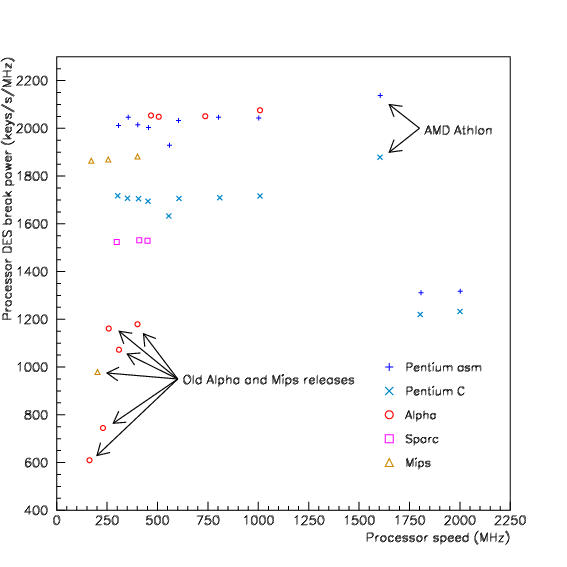
In the second figure we can see in more detail what we would call intrinsic
DES break power of the processor. I get this value simply dividing the break
speed by the processor speed, that is, we get the number of DES keys tried per
second and per MHz. This is a measure of the performance of the processor type
independently of its speed. The results show that the best processor for this
task is the AMD Athlon, then comes the Alpha and very close after it is the
Intel Pentium (except for the higher speed ones which perform very poor due to
the saturation effect). Next is the Mips processor and in the last place is the
Sparc. Some Alpha and Mips processors are located at bottom of scale because
they are early releases not including enhancements of late versions. Note that I
included the performance of x86 processors for C and assembler code as there is
a big difference. It seems that gcc is not a good generator of optimized machine
code, but of course we don't know whether a manual optimization of assembler
code for the other processors (Alpha, Mips, Sparc) would boost their results
compared to the native C compilers (I did not use gcc for these other platforms)
as it happens with the x86 processor.
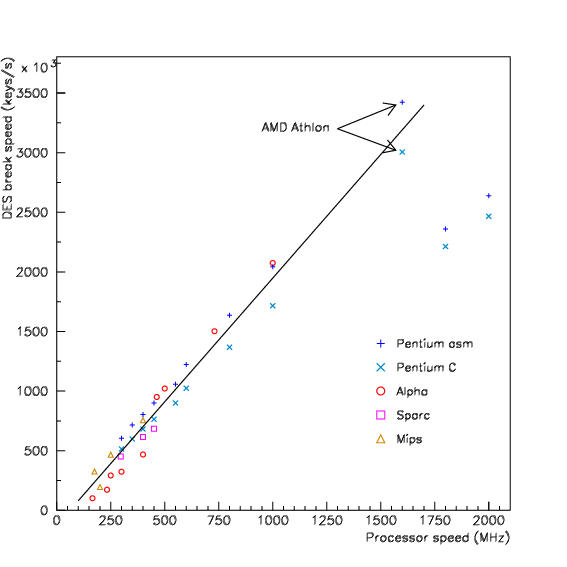
The top mark I got running my program was approximately 3 423 922
keys/second using the AMD processor. So, how much time would need the AMD to
break the VISA PIN? It would simply be the ratio between the size of the key
space and the key trying rate, that is, 2^56 keys/3 423 922 keys/second ~ 2.1 *
10^10 seconds ~ 244 thousand days ~ 667 years. This is the time for the program
to finish, but on average the true secret key will be found by half that time.
Using commercial cryptographic cards (like the IBM PCI Cryptographic
Coprocessor or the XL-Crypt
Encryption Accelerator) does not help very much, they are, at most, 2 times
faster than my top mark, i.e. it would take more than a hundred years to find
the key, at best. Some more speed might be achieved (double, at most) by using a
dedicated gigabit VPN box or similar hardware in a way surely not foreseen by
the manufacturer ;-)
Even if you manage to get a hundred newest AMD or Pentium processors working
in parallel it would still take more than 3 years to find the key (if they are
provided with crypto-cards the time might be reduced to less than two years or
to less than one year in case of a hundred gigabit VPN boxes). It is clear that
only expensive dedicated hardware (affordable only by big institutions) or a
massive Internet cooperative attack would success in a reasonable time (both things were already made).
These are the good news. The bad news is that I have deliberately lied a little
bit (you may already noticed it): VISA PVV algorithm allows for the use of
triple DES (3-DES) encryption using a 128 bit (only 112 effective) encrypting
key. If 3-DES is indeed in use by the PVV system you can still use the same
attack but you would need four additional TSP-PVV pairs (no problem with that)
and it would take more than 3 * 2^56 times more to find the double length key.
Forget it.
PVV algorithm with triple DES consists in the encryption of the TSP with the
left half of the encrypting key, then it decrypts the result with the right half
of the key and encrypts the result again with the left half of the key. Note
that if you use a symmetric 128 bit key, that is, the left half equals the right
half, you get a single DES encryption with a single 64 bit key. In this case the
algorithm degenerates into the one I explained above. That's why I did this
work, because PVV system is old and maybe when it was implanted 3-DES was not
viable (due to hardware limitations) or it seemed excessive (by that time) to
the people responsible of the implementation, so that it might be possible some
banks are using the PVV algorithm with single DES encryption.
Finally we can conclude that the VISA PVV algorithm as in its general form
using 3-DES is rather secure. It may only be broken using specially designed
hardware (implying an enormous inversion and thus not worth, see Wayner
and Wiener)
which would exceed the encryption rate of the newest processors by many orders
of magnitude. However the apparently endless exponential growing of the computer
capacities as well as that of the Internet community makes to think that PVV
system might be in real danger within a few years. Of course those banks using
PVV with single DES (if any) are already under true risk of an Internet
cooperative attack. You might believe that is something very hard to coordinate,
I mean convincing people, but think about trojan and virus programs and you will
see it is not so difficult to carry on.
padilla@gae.ucm.es
(17-Jun-2003) My PGP public
key.This link:
http://www.gae.ucm.es/~padilla/extrawork/visapvv.html

 Go to the parent
page: Magnetic stripe reader/writer.
Go to the parent
page: Magnetic stripe reader/writer.