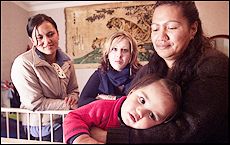
By GEOFF CUMMING
Working with young offenders from some of our poorest suburbs
leaves Joanne Henare acutely aware of the consequences of low
incomes and substandard housing.
The single mother with a BA in psychology and education earns
$44,000 as service co-ordinator for the Waipareira Trust's
wrap-around programme, while raising her two teenagers and
one-year-old, and looking after a whanau member who stays with them.
Her income means she doesn't qualify for an accommodation
supplement to help meet private sector housing costs. Nor can she
get a childcare subsidy. And with 7000 Aucklanders on the waiting
list, she wouldn't get near a state house of her own.
But after paying the rent, childcare costs and student loan
repayments, Henare has less to come and go on than even her
worst-off clients - $60 a week for food, clothing and bills.
"I look at how much I earn and think I should be well off, but
I'm on the poverty line.
"I sometimes feel I'd be better off being unemployed. I really
want to be an independent working person supporting my family but
the benefits aren't there - and the housing market is so expensive."
Henare is one of thousands of New Zealanders dubbed the "working
poor" by housing activist Alan Johnson, a lecturer in social policy
at Unitec. His report for the Child Poverty Action Group, Room for
Improvement, claims at least 400,000 New Zealanders are mired in a
poverty trap; 200,000 of them children, their health and education
scarred by overcrowding and high mobility.
In July, the Weekend Herald highlighted the impact of soaring
house prices on first-home buyers, with couples needing household
incomes of $100,000 to afford traditional three-bedroom bungalows in
Auckland City. First-home buyers planning families were being forced
to the outer suburbs, with nearly half the homes in central suburbs
rented out by investor owners.
Johnson's report shows that for low- to moderate-income earners,
rentals are just as unaffordable. He says the restoration of
income-related rents for 53,000 state tenants three years ago
ignored the needs of 166,000 private sector households who qualify
for accommodation supplements.
"The poorest New Zealand households are now not state tenants but
private sector tenants dependent on inadequate subsidies for their
housing."
The report says state house building lags woefully behind what's
needed while the accommodation supplement has failed to keep pace
with rising rents and house prices, despite now costing taxpayers
$741 million a year.
Thousands of others, like Henare, are ineligible for the
supplement because thresholds are so low. She says it's time the
supplement, and other subsidies, were re-evaluated.
"I class myself as an average income earner but we struggle from
one pay to the next. It gives no incentive for people to study or
get into full employment."
It affects her health. She avoids going to the doctor and treats
children's coughs and colds with lemon drinks and store-bought
remedies.
"It's a struggle to give them sufficient clothing - my son's feet
grow so fast he needs new shoes every six months. We just prioritise
and go to second-hand shops."
In July, she shifted the family from a cheap, one-bedroom unit on
Waiheke Island to Papatoetoe, to be closer to work and reduce
commuting costs.
"I tried looking for places for around $220 a week but they were
snakepits. All I wanted was a clean and tidy place.
"I had to really stretch myself to paying $260 a week to get
something decent."
Her 14-year-old son, Hemi, missed most of the third term at
college because the school wouldn't admit him without a uniform and
she could afford to buy only one item at a time.
"It's a big problem for a lot of low-income families in South
Auckland. They can't afford the uniform so they don't go to school."
Dr Nikki Turner, at the Waipareira health clinic in Henderson,
sees the effects of people living in overcrowded, often damp houses.
Meningitis, respiratory conditions and skin infections are all
related to housing conditions and result in unnecessary hospital
admissions, says Turner. Cellulitis, a sometimes fatal skin
infection related to poverty and poor housing, is the third most
common cause of admission to Auckland's two children's hospitals.
"Their asthma doesn't get better so there are lots of colds and
chestiness. Bugs spread easily because they are exposed to a lot of
people coming and going. They often don't have quiet places to go
and sleep so they get quite stressed and their immune systems aren't
good."
The impacts of unaffordable housing are not confined to Auckland.
Florence Tumai, 35, blames her inflammatory skin condition, lupus,
on black soot from a coal range falling into food in her run-down
house in Huntly. The mother of three says practically all her
benefit was going in rent.
"At the end of the day I was living off $15. So I bought food
instead of paying the rent and ended up leaving the house."
Her next place was in even worse condition, with no guttering and
faulty water pipes.
With help from the Salvation Army and other agencies, she's now
in a three-bedroom house in Manurewa with faulty aluminium windows.
"I get crook when the wind blows."
Housing costs are only one reason many low-income earners end up
in such conditions. Gerry Walker, formerly with Winz and now with
the Salvation Army, says many people don't know what they are
entitled to. "A number of people receiving the supplement are not
aware that a special benefit can be paid on top of that."
There are no hard and fast income limits for a state house, a
Housing NZ official says. Much depends on the family makeup and
circumstances.
"We do have a low turnover and it's becoming hard for us to find
suitable properties.
"A couple with one child may be borderline, but get a family with
four or five children on $35,000 and our objective is to find
something not only affordable for them but close to transport, work
and schools - so it's sustainable in the long term."
Nikki Turner says patients with housing-related health problems
often have "multiple issues - but affordability is the core
problem".
"My feeling is affordability is getting worse for these families.
There are more families moving more often because they just can't
afford their housing.
"So they don't complete their immunisation course or asthma
treatment. You are just getting a handle on their health issues and
they vanish."
It's the same in schools, where high mobility has a major impact
on learning, says Manurewa Principals Association convenor Shirley
Maihi. Turnover in the rolls of Manurewa schools is as high as 80
per cent, she says, with many children changing schools three or
four times a year.
"It's a horrific situation for them. It's compounding poor
literacy and numeracy skills.
"There are big gaps in their learning. By the time they move to
another school and mum gets them enrolled somewhere it can be four
to six weeks."
Maihi says 5- to 8-year-olds are worst affected, missing big
chunks of schooling at the prime learning age. "A lot will never
recover. They are going to be bottom-of-the-heap children all the
way through and it's going to turn them off secondary school."
Most Manurewa parents are part-time workers or beneficiaries
living on the borderline, she says. "They move because they can't
afford the rent. So they move in with family or with a group and
things turn to custard because there's so many people.
"It's a vicious circle. A lot of pupils move to the country and
reappear in six months. They move back with nana or mum until they
get enough money to rent somewhere else or get the power
reconnected.
"The students can be quite disruptive because they don't have any
length of time to consolidate and take ownership in their schools.
"It makes it difficult to try and catch them up. You get them on
a programme and then they're off again. "
Johnson, a former Manukau city councillor who grew up, and still
lives, in Manurewa, says 90 per cent of tenanted households
receiving the accommodation supplement are beneficiaries; the
majority are households with children. The lecturer in social
policy, community development and economics who is involved with
several housing and welfare agencies blasts the Government's housing
policy as "minimal state involvement couched in the rhetoric of
state support" and a "policy of neglect".
Those receiving accommodation supplements were as badly off as
state tenants when income-related rents were reintroduced, he says.
The proof is that average accommodation supplement payments didn't
drop when state tenants were taken out of the equation, indicating
that private sector tenants had as great a need. "They were earning
the same incomes and paying the same in rent."
While state tenants now receive an average $121 a week rental
subsidy, the average accommodation supplement is $59. His report
compares two families, couples with two children, one renting
privately and the other state tenants. Both receive basic
benefit-level incomes of $300 a week. After paying rents of $180 a
week, the state tenant has $46.50 more to spend. Not until incomes
reach $440 a week is the private rental household better off than
the state tenant.
Johnson estimates the cost of bringing private sector tenants up
to the same level of subsidy as state tenants at $500 million a
year. It would be folly to do so, he says, as any increase in the
supplement would generate further rent increases. For the same
money, the Government could build 2500 houses each year, 1500 of
them in Auckland - but this would only meet demand for state houses.
The Council of Christian Social Services says up to two-thirds of
people approaching food banks are private renters. Nearly
three-quarters pay more than 30 per cent of their income in housing
costs and nearly half pay over 50 per cent. Many of the worst
affected have children. In Manukau, a quarter of the Salvation
Army's food bank clients have jobs.
For Jessica, 25, and her 16-year-old brother, home is a spartan
concrete-block unit in Glendene. Jessica, who did not wish her
surname published, has the only bedroom in the ground-level flat,
beneath another in a block of four. Junior sleeps in the fibrolite
garage, hastily converted into a bedroom. Their stove, a mini-oven
with two elements, sits on a wooden box.
Basic as it is, it's a big step up from their last accommodation
- Jessica's car. For three months in the early winter, the pair
lived in her two-door Nissan Pulsar.
Family problems led to homelessness which ended Junior's
schooling. But the housing shortage is so acute that neither Housing
NZ nor emergency housing agencies could assist. And without an
address, the pair couldn't obtain benefits from Winz, says Jessica.
"We were sleeping at these netball courts and in secluded places
that people wouldn't go to after hours.
"Winz thought it was a joke. The case worker at Housing New
Zealand said 'I'll get back to you'. There was absolutely nothing
available."
Her asthma deteriorated and did not respond to medication. "I
ended up getting sinusitis really badly and getting chest
infections. I got really, really sick and was prescribed
anti-depressants.
"We only found a house because my brother stole a Herald. We felt
bad but we had no money and it was really cold."
They moved into a granny flat in Avondale after Winz granted them
benefits and a loan. It cost $1600 to move in. Last month, they
moved to Glendene, with furniture begged and borrowed from friends.
After a $60 accommodation supplement, they pay $240 a week in rent -
nearly half their combined income.
It's clear that the accommodation supplement acts as a landlord
subsidy and has inflated rents, says Johnson. It has become locked
into policy setting - axing it would not lead to a corresponding
drop in rents - and is projected to cost $1.1 billion in tenant
subsidies alone by 2021.
"Unless there is a brutal policy shift, the experiment with rent
subsidies has left the state with high, long-term housing costs."
Housing Minister Steve Maharey says the Government shares the
report's aspirations of access to affordable housing. It plans to
build or "acquire" 3200 houses over the next four years and is
trialling a new mortgage insurance scheme. It is also spending $172
million upgrading existing houses.
Johnson says these measures are short of what's needed. "It's
ironic that a Government which campaigned on the need to reintroduce
income-related rents for state tenants has remained so indifferent
to the continuing relative poverty of the three times as many
families who continue to rent from private sector landlords."
He advocates a mix of "supply and demand" approaches, including
low-interest loans to community housing providers, home purchase
grants, payment of initial rental costs and mortgage relief schemes.
"This is a problem that's been 12 years in the making. It's going
to be 12 years in the solution.
"We need to turn things around and try and assist home
ownership."